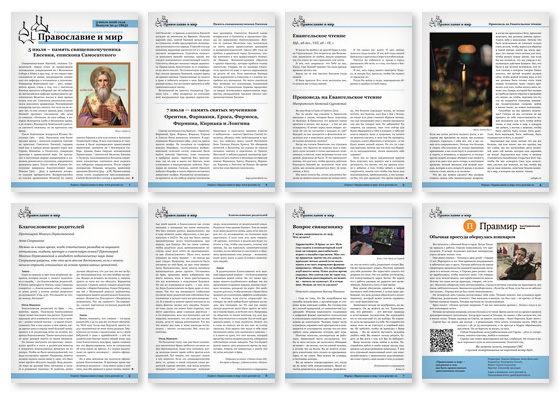
I remember last year in the Church of St. Eusebius in the Zavodskoy district of Minsk they talked about his martyrdom. How good it is that the wall newspaper remembered this saint!
I heard that in the village of Scânteia, near Bucharest, there is a church dedicated to Saint Eusebius, but I did not know that he was also a bishop. How is it celebrated today in such small communities?
In subsequent years, the issue of publishing the martyrdom of the Bishop of Samosati was a part of the case, and now I see such a name indicating his name that the Chkeri church on the Telavi side also celebrates him. I know the church of the Zavodsky district of Minsk, but the church of our name will use the name that was told to us by the ancient scholars.
Yes, the church in Scânteia is dedicated to Saint Eusebius, but he is not the bishop of Samosata - he is an old saint, not a bishop. At Vama Veche, we did a simple service in January, with only a few people from the church. Do you know if in Scânteia they have an annual service or just an iconography in the church?
His carved icon is displayed in Chkeri church, as it is known on the Telavi side. And I did not know about the martyrdom of this bishop of Samosati, as you saw his name in the publication.
Yes, in Scânteia the service is held annually on January 23, but only with a few, like you in Vama Veche. It's not a big service, just a few prayers in the church.
Lela, it is interesting that in the Telavi area, the church named Chkeri is associated with the name of Eusebius. I didn't know anything about the church in the Zavodsky district of Minsk, but ancient scholars in our area really gave us the name that corresponds to the bishop of Samosati. How do you think these names are related to each other?
Indeed, his balcony is depicted in the Chkeri church, they are well known on the Telavi side. And I read the story of his martyrdom in this issue for the first time, it was quite hard to read. How did you find out about his story, Anna?
Yes, I also went to Scânteia once on January 23, it's really a small service, only with the parishioners from the village. In our church, the iconography is clear, but I understood that it is another Eusebius, a martyr from ancient times. You at Vama Veche, what do you usually sing in the choir at such a simple service?
Indeed, I remember his icon well in Chkeri church, I stopped in Telavi once to see it. And I read the story of his martyrdom the year before, in the history book of Samosati, and then I learned how cruelly they were treated. Anna, how did you find out his name in connection with Chkeri church?
Indeed, I remember the balcony in Telavi well, I saw it when I was a child. I also read the story of martyrdom in this issue and it was really hard, especially the place where bricks were thrown. Natia, what do you miss the most in its history?
Thea, that's an interesting observation. The fact that the name of Eusebius is associated with the Church of Chkeri in the Telavi area, if it was given to us by ancient scholars, it was new to me as well. But how directly it is related to the Church of the Zavodsky District of Minsk, if you want to know more precisely, it would be good to compare sources - do you have any specific book or article on this?
Yes, at Scânteia the service is really very simple, almost like a family vespers. Here at Vama Veche, in the choir, we usually sing "Holy God" on voice 6 and the martyr's tropes on voice 1, nothing complicated. Did you notice any difference in the iconography between the two Eusebius?
Yes, the service at Scânteia is really like a family vespers, quiet and without fuss. I didn't notice much difference in the iconography, but the trope on voice 1 at Vama Veche sounds very appropriate for a martyr. Have you ever sung the troparion of St. Eusebius of Samosata on voice 8, as it is in some older parishes?
Levan, you are right, the connection with Minsk Zavodskaya Church is more indirect. I just pointed out that it bears the name of Eusebius there as well, as it says in the given article. I have a specific source, the Moscow edition of "Жития святых", but to share your information about Telavi, please tell us where this version came from among ancient scholars.