Life of the Hieromartyr Sergius Konstantinovtranslated
On November 27, the memory of the minister of the Tver diocese, Hieromartyr Sergius Konstantinov, is celebrated. In 2026 we remember the 85th anniversary of his repose and the 25th anniversary of his canonization. The message Life of the Hieromartyr Sergius Konstantinov appeared first on Tver Diocese.
Origin and education
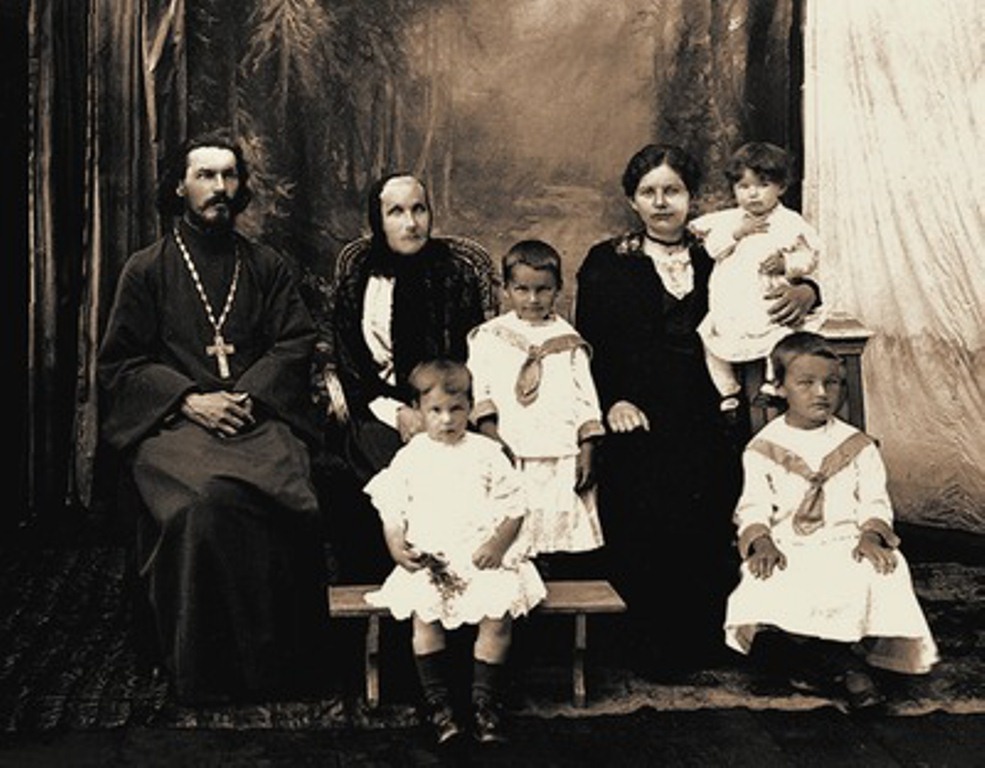
Hieromartyr Sergius (Sergei Vyacheslavovich Konstantinov) was born on August 15, 1877 in the village of Rogachevo, Dmitrov district, Moscow province, into the family of Archpriest Vyacheslav Konstantinov and his wife Elena. He received his initial education at a theological school, where his father was a teacher, then graduated from the Bethany Theological Seminary (1900). In 1900 he worked as a teacher at a factory school in the city of Yakhroma, Moscow province.
Family
In 1906, Sergei Vyacheslavovich married Antonina Vasilievna Smirnova, daughter of Deacon Vasily Smirnov. In 1904, Antonina Vasilievna graduated with honors from the Moscow Diocesan Filaretov Women's School, receiving a certificate for the title of home teacher with the right to teach Russian and Church Slavonic languages, literature, arithmetic, geometry, geography, history, physics, didactics and French. The marriage produced ten children, three of whom died in infancy.
Priestly ministry
In 1906, Sergei Vyacheslavovich was ordained a priest. He began his ministry in the Church of the Resurrection of Christ in the village of Voskresensky, Moscow province (the church was built in 1898, the bell tower was erected in 1908). He also worked as the director of the parochial school at the church and as a teacher of law until the school closed in 1918.
In 1911, Father Sergius was transferred to the Trinity Church in the city of Yakhroma, where he later became rector and was elevated to the rank of archpriest. The church was built at the paper spinning and weaving factory of the Pokrovskaya Manufactory Partnership at the expense of its owner, the former Moscow mayor I. A. Lyamin. Under Father Sergius, a bell tower was built. In Yakhroma, until the persecution began, Father Sergius was the director of the school and taught the Law of God. According to the recollections of everyone who knew him, he was strict but fair.
Years of persecution
With the beginning of the persecution of the Russian Orthodox Church, the priest began to be persecuted. The first thing they did was take the house away, which was a serious test for a large family. Father Sergius rented a room in a neighboring village, then, borrowing money, bought a house in the village of Leonovo. To pay off his debt, he, without leaving his ministry in the church, began working as an accountant at a brick factory; however, when the authorities found out that he served in the church and did not want to leave him, the priest was fired. They lived poorly: Antonina Vasilyevna, in order to dress her children, sewed dresses for her daughters from scarves that were given by parishioners; boys teased the priest's daughters on the street that their dresses were made from scarves.
At the end of the 1920s, during dispossession, government officials often began to come to the priest to seize the “surplus.” Sometimes these “surpluses” consisted of five kilograms of cereal - and this was all the family’s food for the near future. There was almost no property left: they put out cots at night, and since there weren’t enough of them, they slept in twos. Sometimes the authorities summoned Father Sergius for night interrogations. His wife sent his daughter Yulia with him, who sat on a wooden sofa in the district office of the NKVD and waited for her father to be released, while her mother prayed at home.
In 1930, Trinity Church was closed. The closure was preceded by the removal of the bells. For the priest this was a great shock.
Ministry in Kimry
On February 9, 1930, Archbishop Thaddeus (Uspensky) of Tver appointed Archpriest Sergius rector of the Intercession Cathedral and Trinity Church in Kimry. Later the cathedral was destroyed and a drama theater was built in its place. After the closure of the church, Father Sergius served in the Ascension Church in the city of Kimry - and remained there until his arrest.
Arrest and investigation
On November 13, 1937, authorities arrested the priest. During the arrest, a thorough search was carried out, but nothing was found, about which a report was drawn up. The next day, an interrogation took place, after which Father Sergius was taken to prison in the city of Kashin.
The investigator demanded a confession:
- The investigation requires truthful testimony from you that you, being hostile against the existing system, carried out anti-Soviet agitation among the population... Do you plead guilty to this? “I was not involved in anti-Soviet agitation and I do not admit my guilt in this,” answered the priest.
Since he refused to admit guilt, “duty witnesses” were called in and signed the false statements required by the investigation. On November 22, the investigation was completed, and on December 2, 1937, the NKVD Troika sentenced Archpriest Sergius to ten years in a forced labor camp.
Camp years
For the first time after the verdict, Father Sergius was kept in prison in Kashin, then he was sent to the Smutikha correctional labor colony (near the Kesova Gora station in the Tver region). On October 9, 1938, he wrote to his wife:
“My dear Tonya, children and granddaughters! I’m still healthy, are you healthy, especially Tonya? After all, you were probably terribly cold, since on the day of your trip to me, October 6, it was windy and cold... For the broadcast, I really, really thank everyone who took part in it...”
Soon Father Sergius was sent to prison in Bezhetsk, from there to Zubtsov, then to a colony near the Lykoshino station. On June 20, 1940 he wrote:
“...I am so poor that during the entire time of my imprisonment I have not experienced such poverty... I have not had a single piece of sugar for a long time... If possible, send a parcel, or even better, come with it yourself, if possible.”
In mid-July 1940, Father Sergius became seriously ill. On July 20, he wrote to his wife, lamenting that he had caused her concern, and asked: “If it is possible to get it, then please send some white bread, the same crackers or little lamb... and if this is not possible, then so be it - people live, and we will live.”
Attempt to review the case
On August 1, 1940, Father Sergius wrote a letter addressed to Beria:
“I have never interfered in politics, I was completely apolitical... I do not plead guilty to the charges brought against me, and therefore I consider the verdict to be incorrect and essentially based on the slanderous, deeply slanderous slander of evil people against an innocent person... I ask you, in my case, to order an investigation into all the circumstances of my case in Kimry, where I served, through a wide survey of the population...”
On August 30, 1940, the district office of the NKVD in Kimry received orders to further investigate the case. One of the false witnesses was interrogated, who confirmed the previous testimony; the other had himself been arrested by that time. Three additional witnesses testified that they knew Father Sergius as the rector of the Church of the Ascension, but they knew nothing about his anti-Soviet activities. In September 1940, the investigation was completed: “In essence, the newly interrogated witnesses did not give anything significant in the case, they only confirmed that S.V. Konstantinov belonged to the clergy.” The verdict was upheld.
Last months and death
Soon after receiving the answer, Father Sergius was sent to a camp in the Nilova Hermitage on Seliger Island, and on September 6, 1941, he was transferred to a forced labor colony on the outskirts of the city of Kovrov, Vladimir Region.
Archpriest Sergius Konstantinov died on November 26, 1941. The cause of death was overwork and hunger. On the same day, he was buried in the camp cemetery on the outskirts of the forest not far from the village of Sergeytsevo, Kovrovsky district, in grave No. 226.
Canonization
On July 17, 2001, by determination of the Holy Synod of the Russian Orthodox Church, Archpriest Sergius Konstantinov was canonized as new martyrs and confessors of Russia.
Memory
Hieromartyr Sergius raised six children. Their fates turned out differently. The memories of the grandson of Sergei Nikolaevich Sorokin, Sergei Nikolaevich, have been preserved:
“... A lot of materials were provided by my Aunt Julia. It was based on her archival data that an article about Father Sergius was written in a book about the holy martyrs. We read where he was buried and went to Kovrov. After a long search and questioning of local residents, we found a common burial, but, alas, it was not possible to determine where exactly our grandfather’s grave was located - they were buried there without records or sequence. It was forbidden to write names on the graves of prisoners; at best, only a number. A local resident told us that they buried people in this cemetery haphazardly, and they could have dug a grave at the site of the previous burial. This created enormous difficulties for the search. We realized that we would not be able to determine where exactly our grandfather’s grave was located. And since then we did this only for our family and for our family archive, we installed a cross at the site of the common burial. The name of the holy martyr Sergius Konstantinov was written on the tablet...”
Sources:
Kimry archive, f. 16 op. 1 day 21
Compiled by Deacon Nikolai Rychkov.