The restoration of the facades of the Epiphany Cathedral in Elokhov, Moscow has been completedtranslated
A full-fledged scientific restoration of the facades of the Yelokhovsky Cathedral was carried out for the first time. It took about two years. Previous work carried out in the 1980s was of a renovation nature.
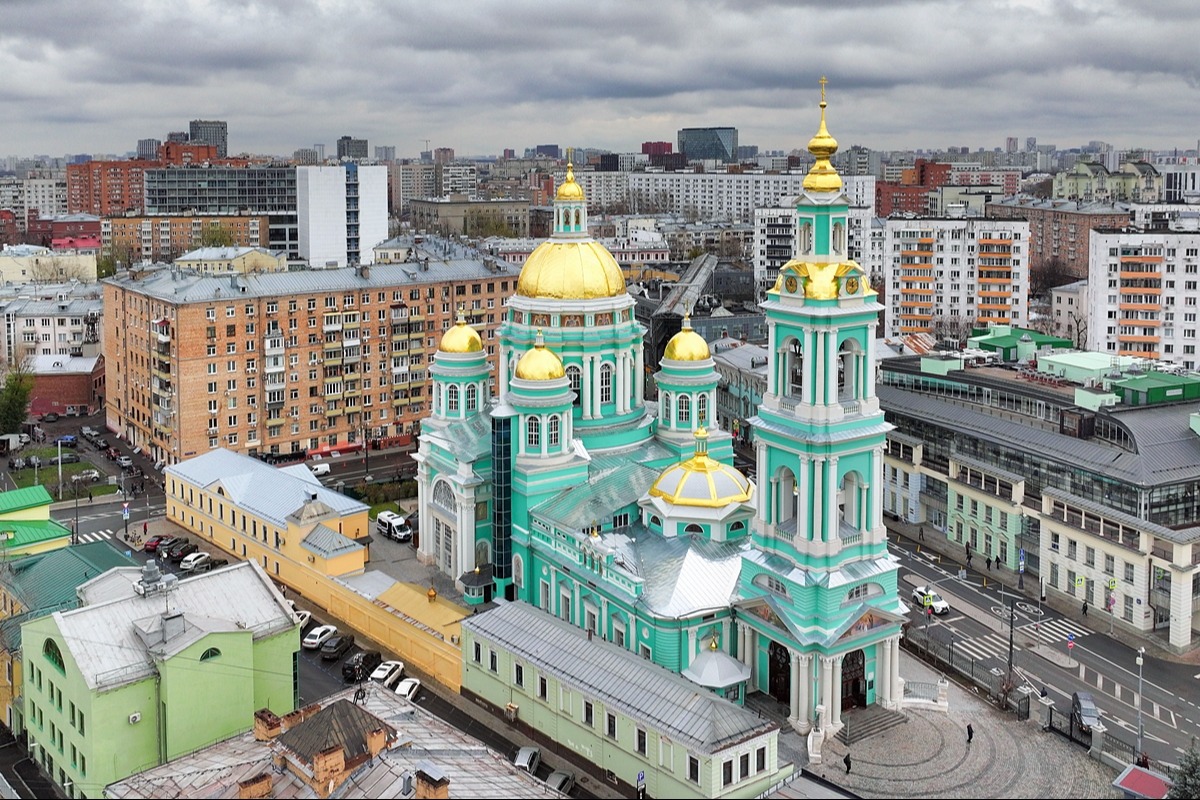
The restoration of the facades of the Epiphany Cathedral in Elokhov, Moscow, has been completed. On November 20, 2026, the mayor of the capital, Sergei Sobyanin, got acquainted with the results of the restoration work.
“Today marks the 80th anniversary of our Patriarch. He is the Patriarch not only of all Rus', but also of Moscow, this is his main church. At the same time, we completed the renovation of the Cathedral of Christ the Savior, the main church of our country. Thus, this is a kind of gift to our Patriarch. May God grant him longevity and an active life for the benefit of our country and Moscow,” said Sergei Sobyanin.
An object of cultural heritage of federal significance, the Cathedral of the Epiphany in Yelokhov, built in 1845 according to the design of the architect Evgraf Tyurin, is one of the oldest and largest operating churches in Moscow. In Soviet times, it became the Patriarchal Cathedral of the Russian Orthodox Church. Since 1991, the church has the status of a Moscow cathedral.
A full-fledged scientific restoration of the facades of the Yelokhovsky Cathedral was carried out for the first time. It took about two years. Previous work carried out in the 1980s was of a repair nature, Sergei Sobyanin said in his channel in the Max messenger.
“All the domes of the cathedral have been restored to their historical appearance. Before the restoration, only the central one was made of copper and gilded, the rest were covered with a material imitating gilding. Now experts have applied the technology of cladding with checkers (small square elements) of copper sheets, followed by gilding with gold leaf,” noted the mayor of Moscow.
The total gilding area was about 850 square meters. Specialists updated the wooden frame on the domes of the snare drums.
In 2025-2026, specialists plastered the facades of the church with a total area of about seven thousand square meters: they removed long-term layers of dust, soot and mold, and also restored damaged brickwork and restored lost fragments.
Elokhovsky Cathedral is richly decorated with architectural details made of white stone. Specialists cleared all the elements from the late plaster coating, which in some places reached two centimeters in thickness, and then restored the massive white stone columns, plinth, cornices, platbands and gypsum stucco decoration: medallions, capitals, panels, brackets.
Another famous decoration of the facades of the Yelokhovsky Cathedral are mosaic panels depicting archangels and saints. The central place in them is occupied by the images of the Mother of God, Saints Alexy and Nicholas the Wonderworker. No less noticeable are the pictorial compositions on biblical subjects. Restorers carefully cleaned them of many years of contamination and preserved them.
Wooden doors with stained glass windows were restored in the workshops. The stained glass windows were put in order, the wooden elements were cleaned of old coatings, tinted with paint and varnished. The window frames and grilles were also painted.
Restorers put in order the main decoration of the bell tower - a gilded clock oriented to the four cardinal directions.
The roof of the church was covered with sheet steel, the rafter system was strengthened and the sheathing was replaced. The roof area affected by the work was about 1.6 thousand square meters. The granite steps and platforms, white stone pillars and their bases at the entrance to the church were put in order.
“We are deeply grateful to you for your assistance to the Epiphany Cathedral. Thank God, all the work that was planned has been completed today at the highest quality, at a high level,” said Archbishop Thomas of Odintsovo and Krasnogorsk, head of the Administrative Secretariat of the Moscow Patriarchate, rector of the Epiphany Cathedral.
One of the oldest churches in Moscow
The history of Elokhovsky Cathedral goes back 450 years. The wooden church in the village of Elokhov in Basmannaya Sloboda appeared at the end of the 16th century and was first mentioned in written sources in 1694. Elohovo is called the birthplace of the wonderworker St. Basil the Blessed, revered in Rus'. The construction of a stone building on the territory of a dilapidated church began by decree of Peter I in the 1720s and was completed a decade later at the expense of Grand Duchess Praskovya Ioannovna, Peter’s niece.
“We are carrying out large, serious restoration work together with the Patriarchate. In recent years, 130 churches have been saved and restored, and this work continues. Today we have completed the restoration of the main church of Moscow - the Cathedral of the Epiphany in Elokhov, where Alexander Sergeevich Pushkin was once baptized. This is truly one of the most famous cathedrals in Moscow. Over the last century, scientific restoration has never been carried out here. A huge amount of work has been done to save this cultural monument, this place of worship,” said Sergei Sobyanin.
The church was located near the German Settlement, where non-Christians initially settled, but in a short time the number of Orthodox parishioners grew significantly, which required the expansion of the existing areas.
At the end of the 18th century, large construction work began here, a spacious refectory with two chapels appeared: Epiphany and St. Nicholas the Wonderworker, as well as a bell tower in the style of Moscow classicism. In June 1799, the great Russian poet Alexander Pushkin, whose parents lived in Nemetskaya Sloboda, was baptized in the church. A memorial plaque installed on the facade of the building reminds of this event. On the centennial anniversary of the poet’s death, a prayer service was held in the church, which was attended by the Governor General of Moscow, Grand Duke Sergei Alexandrovich and Grand Duchess Elizaveta Feodorovna.
By the middle of the 19th century, the cathedral and bell tower were again rebuilt according to the design of the architect Evgraf Tyurin “in a vast scale and the best architecture.” The low single-domed church was replaced by a grandiose five-domed cathedral with a dome reminiscent of the dome of St. Peter's Basilica in Rome. The height of the church and bell tower was 56 meters, which secured its position as the architectural dominant of the Basmanny part of Moscow.
During the years of the anti-religious campaign, the Soviet authorities repeatedly tried to close the church. Despite the difficult times, in the 1920s thousands of believers gathered for the services of His Holiness Patriarch Tikhon. In the early 1930s, icons and utensils from closed nearby Moscow churches were transferred to the Church of the Epiphany, and the number of parishioners increased to 25 thousand people. Plans to demolish the building in connection with the construction of the metro, as well as to open a cinema in it, did not materialize.
In 1935, after the closure of the Kazan Cathedral on Red Square, the revered copy of the Kazan Icon of the Mother of God was transported to the Elokhovsky Cathedral. During the Great Patriotic War, the Patriarchal Locum Tenens Metropolitan Sergius, the future Patriarch, prayed in front of this image, asking for the granting of victory.
During the Great Patriotic War, the Yelokhovsky Cathedral united thousands of believers: prayers were held here for the victory of the Russian army. During the defense of the capital, the bell tower housed an air defense post that protected Moscow from bombing. In case the capital surrendered, the church was mined as a strategic object. Priests and parishioners collected funds for defense needs. Over four years, they contributed 835,200 rubles to the defense fund and sent 535,100 rubles as gifts to the soldiers of the Red Army. After the victory, the cathedral received the status of Patriarchal. The enthronements of His Holiness Patriarch Sergius, His Holiness Patriarch Alexy I, His Holiness Patriarch Pimen and His Holiness Patriarch Alexy II took place here. After his death in 1944, Patriarch Sergius was buried in the cathedral.
In 1947, the relics of St. Alexy, Metropolitan of Moscow, kept in the Kremlin since 1930, were handed over to the faithful. The relics and relics were taken to the Elokhov Cathedral, and since then they have been located at the royal doors of the main iconostasis. In 2008, Patriarch Alexy II was buried in the Yelokhovsky Cathedral - next to the relics of his heavenly patron.
Today the cathedral is a cathedral. Festive services there are often led by His Holiness Patriarch Kirill of Moscow and All Rus'. The church conducts spiritual and educational activities, has a Sunday and choir school, a youth club, organizes pilgrimage trips, and conducts catechesis courses for those wishing to study the fundamentals of the Orthodox faith.
Moscow is the cathedral city of the Patriarch of Moscow and All Rus' and one of the largest cities in the world with a predominantly Orthodox population.
Within the borders of pre-revolutionary Moscow on January 1, 1915, there were 563 separate churches, including 102 churches in 25 monasteries and convents. Despite the repeated expansion of the city's territory, during the reign of state atheism their number decreased by 10 times.
Since 1988, when the country celebrated the 1000th anniversary of the Baptism of Rus', most of the surviving churches have been returned to the Russian Orthodox Church. However, most of these churches are located in the historical center of Moscow. At the same time, in many residential areas outside the Third Transport Ring there were no functioning churches.
In this regard, since 2010, the Russian Orthodox Church, with the support of the Moscow Government, has been implementing a program for the construction of new churches in the capital. It also involves individuals, public organizations, entrepreneurs and philanthropists who make donations to the Moscow Church Construction Support Fund. The capital provides land plots for free use to religious organizations for the placement of buildings and structures for religious or charitable purposes.
The Moscow government provides assistance to the Russian Orthodox Church in preparing the necessary urban planning documentation, connecting the built church complexes to city communications, landscaping the area around new churches and other technical issues.
Over the 17 years of implementation of the program, 157 churches were built and opened. Now another 122 are being built: 41 churches are already under construction, 10 are undergoing preparatory work, and specialists are developing documentation for 71.
For the construction of church complexes, the city transferred 279 land plots to the Russian Orthodox Church, including 69 in the territory of the Trinity and Novomoskovsk administrative districts.
There are over 1.2 thousand churches and chapels of the Russian Orthodox Church in Moscow. Among them are 582 objects - free-standing churches and temporary church-chapels in which regular services are held, and 15 monasteries.
Restoration of religious monuments
The Moscow Government pays special attention to the preservation of religious monuments. Since 2011, 137 churches have been restored under city programs, including subsidies to religious organizations.
“In 2026, work will be carried out in 30 churches. Plans for 2027 include work on 12 sites of the Russian Orthodox Church,” Sergei Sobyanin specified in his channel in the Max messenger.
Among the iconic objects that have been updated are the Church of the Prophet Elijah in the Novgorod Metochion, the Church of the Assumption of the Blessed Virgin Mary in Veshnyaki, the Church of the Resurrection of the Slovous on Uspensky Vrazhek, the Church of Peter and Paul in Novaya Basmannaya Sloboda, the Spaso-Preobrazhensky Cathedral of the ensemble of the Novospassky Stavropegic Monastery, the Church of St. Nicholas the Wonderworker on Trekh Gorah, the Church of the Resurrection of the Word at the Vagankovskoye cemetery, the Church of the Life-Giving Trinity in Khoroshevo, the Church of the Assumption of the Blessed Virgin Mary in Sviblovo and the Church of the Ascension in Kolomenskoye.
In 2026, work will be carried out on 30 cultural heritage sites of religious significance. Among them are the Church of the Life-Giving Trinity in Khoroshevo, the bell tower of the Church of St. Nicholas the Wonderworker in Podkopayi, the Church of All Saints in Kulishki and others.
In 2027, it is planned to carry out work on 12 sites of the Russian Orthodox Church, including the Church of the Great Martyr Irene (Trinity of the Life-Giving) in Pokrovskoye, the Sergius refectory ensemble of the Vysoko-Petrovsky Stavropegial Monastery, the Church of John the Baptist near Bor, the Church of the Intercession of the Blessed Virgin Mary in Rubtsovo, the Church of the Resurrection of Christ in Sokolniki. In the latter, specialists will take care of the roof, basement, interiors and landscape the area. In the Church of the Apostles Peter and Paul in Novaya Basmannaya Sloboda, it is planned to recreate the iconostasis of the lower church, in the almshouse and the Church of All Saints of the Alekseevsky Stavropegial Convent - to complete production work, in the Church of the Great Martyr George the Victorious in Gruziny - to put the facades and roof in order.
Repair and restoration work in the Cathedral of Christ the Savior
In 2026, large-scale repair and restoration work was completed in the Cathedral of Christ the Savior, the main and largest Orthodox church in Russia.
For three years, more than 500 specialists worked here: masons, roofers, carpenters, bronze and gilding restorers, artists, high-altitude climbers, climbers, designers and many others. Students from College of Architecture, Design and Reengineering No. 26 worked together with experienced craftsmen.
As a result, it was possible to completely update the appearance of the church. The most extensive work took place on the facades. Specialists checked each of the almost 64 thousand marble panels: they repaired cracks, eliminated chips and carefully restored damaged areas; several lost elements were replaced with new ones made to order.
The facades were also checked for the presence of hidden voids behind the facing slabs. Where they were found, they used injection technology: they drilled more than 29 thousand holes and filled them under pressure with special compounds, guaranteeing the reliability of the walls for many years.
The interiors of all belfries were re-plastered and painted white, matching the historical shade. Metal fences, stairs and ceiling structures were cleaned of dirt and rust, treated with protective agents and painted black.
Particular attention was paid to the domes of the belfries. Specialists repaired the metal sheathing of the domes, replaced damaged parts and treated the structure with special hydrophobic and anti-corrosion compounds. The domes were then covered with stainless steel coated with titanium nitride, which gives a beautiful golden color. Thanks to this technology, the domes will not fade over time. New pommels were also made for them.
All four observation platforms of the cathedral, which are visited annually by thousands of Muscovites and tourists, were put in order. For the safety and comfort of guests, a new strong screed was made here, waterproofing was carried out and modern insulation was installed, after which the paving was restored.
The gate bell tower required special attention. The famous high reliefs - “Savior Not Made by Hands”, “Hieromartyr Alexander”, “His Holiness Patriarch Tikhon” and “Great Martyr Elizabeth”, as well as the bronze high reliefs above the entrance with the face of the Savior and the scene of the Transfiguration of the Lord were cleaned and polished. Instead of the old coating of the dome of the gate bell tower, a new one was applied - made of stainless steel coated with titanium nitride. They also replaced the pommel, after which they carried out the finest work of gilding the bell tower cross with gold leaf.
The roof and roof of the cathedral were completely renewed. For this purpose, a temporary roofing workshop was set up on the stylobate of the church. There, the metal was manually cut into the desired shape - about 14 thousand unique components.
The most difficult and critical area of work was the main dome with a diameter of almost 30 meters and a height of about 27 meters. Reinforced scaffolding of 35 tiers was built on it. The design not only withstood heavy decorative elements, but also made it possible to carry out work in any weather conditions. The restorers removed the old coating in small fragments, and here, in the workshop, they made a replacement section and adjusted it to the required size on the spot. Stainless steel with titanium nitride was also used for the main dome - the total weight of the updated coating was about 15 tons.
Landscaping and other work on the territory of churches
Between 2014 and 2026, the Moscow Government carried out work on the territory of 363 churches and other objects of the Russian Orthodox Church.
Specialists landscaped the grounds of 86 churches. The total area of work was more than 90 hectares. 157 new churches were connected to utilities. For this purpose, 27.5 kilometers of cable lines were laid (24.2 megawatts of electrical power were connected), more than 13 kilometers of heating networks (more than 50 gigacalories per hour of heat load were connected) and 15.2 kilometers of water supply and sewerage networks (water supply in the amount of 65.5 cubic meters of water per hour was provided).
51 churches were decorated with architectural and artistic lighting. Additional lighting appeared on the territory of 69 churches: a total of 568 supports and 835 lamps.
Joint projects of the Russian Orthodox Church and the Moscow Government
In 2026, the Russian Orthodox Church, together with the Moscow Government, held several events. On January 25-29, the International Christmas educational readings were held on the topic “Enlightenment and Morality: Personality Formation and Challenges of the Time.” About 70,000 people took part in them. On March 15, a festival of Moscow Sunday school choirs took place. On May 14 and October 14, charity concerts of the Moscow Synodal Choir were organized.
On May 24, events were held dedicated to the Day of Slavic Literature and Culture. In the Hall of Church Councils of the Cathedral of Christ the Savior, a concert was held with the participation of masters of art, as well as a flower-laying ceremony at the monument to Equal-to-the-Apostles Cyril and Methodius on Slavyanskaya Square.
On July 28, we organized events dedicated to the Day of the Baptism of Rus' in Moscow. They included a religious procession with a particle of relics and an icon of Equal-to-the-Apostles Prince Vladimir to the monument to Prince Vladimir - the Baptist of Russia at the end of the Divine Liturgy in the Patriarchal Assumption Cathedral of the Moscow Kremlin and a prayer service on Borovitskaya Square, which was led by His Holiness Patriarch Kirill of Moscow and All Russia.
On August 2, Ilyin’s Day took place on Ilyinka Street, timed to coincide with the celebration of the day of memory of the Prophet Elijah and the Day of the Airborne Forces of the Russian Federation.
The city assists the Russian Orthodox Church in organizing photo exhibitions “The Life and Social Activities of New Orthodox Parishes” dedicated to the program for the construction of Orthodox churches in the capital, supports the Foundation for Prizes in Memory of Metropolitan Macarius of Moscow and Kolomna (awarding prizes for new scientific works, holding scientific conferences) and the activities of the Church Scientific Center “Orthodox Encyclopedia” (purchasing volumes of the encyclopedia for city schools and libraries), and also helps in the preparation and holding of the church-public exhibition-forum “Orthodox Russia - for the Day of National Unity.”
Every spring in Moscow, with the blessing of Patriarch Kirill of Moscow and All Russia, the “Easter Gift” is held - one of the most beloved street festivals among Muscovites, which is dedicated to charity.
Mass events of the Russian Orthodox Church in 2026
Every year, relevant departments of the Moscow Government and city services provide assistance in ensuring safety measures during the holidays of Christmas, Epiphany and Easter. From August 27 to September 4, 2026, the necessary safety measures, medical and sanitary support were provided during the bringing of the Tikhvin Icon of the Mother of God to the Cathedral of Christ the Savior.
On September 6, the necessary assistance was provided in the preparation and conduct of the All-Moscow religious procession from the Cathedral of Christ the Savior to the Novodevichy Stauropegic Convent. Security and public order measures, sanitary, hygienic and medical support, blocking of sections of the road network, information coverage of the event, and comprehensive arrangement of sites near the Cathedral of Christ the Savior and the Novodevichy Convent for organizing a video broadcast were provided. Sergei Sobyanin supported the initiative of His Holiness Patriarch Kirill to hold an annual All-Moscow religious procession.
On September 15-20, the capital's executive authorities provided support in organizing mass access for citizens to the relics of the blessed Prince Demetrius Donskoy and the right hand of St. Spyridon of Trimythous in the Cathedral of Christ the Savior.
Website of the Mayor of Moscow/Patriarchia.ru