Why Do We Need Asceticism if There is Psychology?translated
Dmitry Semenik Answers Skeptics Orthodoxy is about freedom, self-revelation, joy, and love. Depression and apathy, on the other hand, are the fruits of passions.
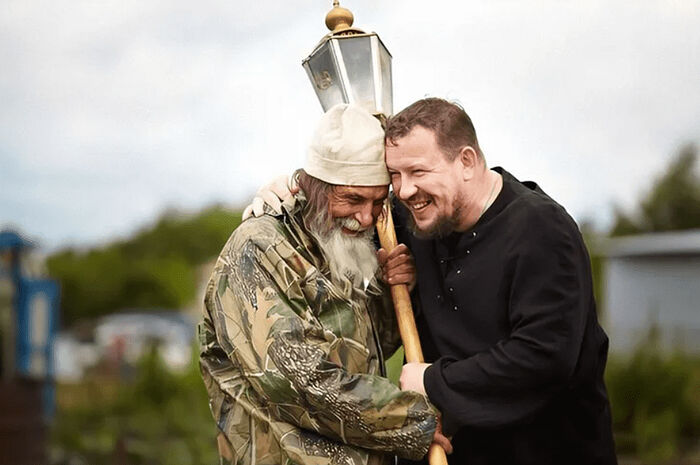
Dmitry Semenik Answers Skeptics
Not long ago, skepticism towards psychology prevailed in the Church. However, as psychology has spread, a counter-skepticism towards ascetic practices has emerged, which can arise in people who have felt the beneficial influence of psychotherapy. If one feels lighter, their relationship with their spouse has improved, and overall relationships with people have become more pleasant, does that mean spiritual practices are not needed?
To answer these and similar questions from skeptics, we asked Dmitry Semenik, a Orthodox psychologist known in the Orthodox community for compiling "The Spiritual Physician" - a systematic collection of patristic quotations.
- Dmitry, what is the point of Confession if there is psychotherapy?
- Let's first distinguish between Confession and the sometimes accompanying conversation. If we talk about the conversation, I do not see any significant advantages of this conversation over a consultation with a Orthodox psychologist, especially considering the inevitable brevity of this conversation.
It is true that the question "Should I divorce?" in a sacramental marriage is better discussed with a priest. But this should not be done during Confession. It is too serious a matter that requires detailed discussion and time.
As for the sacrament of Confession itself, there is nothing in psychology that could replace it. The value of Confession for the state of one's soul cannot be overstated!
A woman came for her first consultation with a request to "not go crazy." Before the consultation, my clients fill out a detailed online questionnaire, and among other things, it includes questions about suicide attempts and occult experiences. I have been dealing with these issues for about 20 years and see that these sins are the main cause of severe psychological damage.
I explain this by saying that every sin increases the power of the demons over a person, and these two sins, as the most god-defying, strengthen the power of the demons radically. The power of the demons is exercised by imposing false, painful thoughts, which can simply ruin one's mood, or even drive one to madness and lead to irreparable consequences.
And it turned out that this woman had attempted suicide and had two occult experiences. In my assessment, this condition was at least half due to these sins (there were also purely psychological preconditions).
What can psychology do about this?
Psychology has no tools against demons
Absolutely nothing! Psychology has no tools against demons.
Further, it turns out interesting: the woman was on the verge of being received into the Church, and just a few days earlier, she had a general Confession - she confessed for seven days in a row. And for the first time in her life, she received the Eucharist. But she did not mention these sins! She simply did not consider them important.
Of course, I helped her to realize this and directed her to Confession. I am confident that she will rush there.
- What would an atheist psychologist do in this situation?
- Most likely, they would put her on long-term therapy. The psychological component of the problem, if the psychologist is qualified and the client has the financial means, can be alleviated in a year or two. But the spiritual component, which determines the severity of the condition by 50-80%, would remain.
- Is there an equivalent of the Eucharist in psychology?
- In the traditions of the Russian Church, Confession and the Eucharist are almost inseparably linked. The sacrament of the Eucharist cannot be replaced by anything in psychology!
Let me be forgiven by all who think grandly, but the spiritual benefit of the Eucharist is practical as well. I consider it quite pious to note this and not to close one's eyes to it. The spiritual benefit of the Eucharist is multifaceted, but I will mention two of its aspects based on my observations.
The first benefit is the strengthening of one's strength. In general, the situation when a client lacks strength is one of the most hopeless in psychological practice. To change oneself, to work on oneself, requires strength. Psychotherapy is also daily work on oneself: it is not necessary to think that it is just a rest on the couch. What can a psychologist do if a client has no strength at all? Only refer them to a psychiatrist for a prescription for medication. A Orthodox psychologist working with a Orthodox client can advise them to receive Communion more often, preferably weekly, at every liturgy. This will also give the client strength, and it will be a strength to change for the better.
The second benefit of the Eucharist is some clarification of the mind. This is especially relevant in a crisis situation. At this time, a person is suffering from the intrusive demonic thoughts that torment them and present the picture of reality in a distorted light. After all, Satan is the father of lies: he distorts the picture of reality to bring a person to despair.
Satan is the father of lies: he distorts the picture of reality to bring a person to despair
The divine light of the Eucharist can dispel this dark mirage, at least partially.
- Why do we need Confession if feelings of guilt are toxic and need to be eliminated?
- This is a very fashionable topic. Many psychologists write texts generated by neural networks, and they often throw in this idea. The truth is, they usually do not refer to the sacrament of Confession itself, but to a more general and abstract form of repentance. Recently, on one of the social networks, I came across a video of a psychologist who calls themselves a "former Church servant." Former Church servants are generally terrible, and this idea, in my opinion, is completely demonic. Literally "Down with shame!" as during the revolution.
So, there is indeed a harmful thing - a false sense of guilt. It torments a person, brings no benefit, distorts the picture of reality, leading to the degradation of marital relationships and the distortion of spiritual life. Indeed, people prone to a false sense of guilt easily find confirmation for their sense of guilt in church texts.
In fact, psychology can help here. Because a false sense of guilt does not come from sins, it is instilled in a child by their parents. A false sense of guilt is the product of an imperfect family environment. Psychology knows how to deal with this.
But repentance is not involved here! A false sense of guilt is intensified not by a deep knowledge of Orthodoxy, but the opposite - by an incomplete, superficial acquaintance with Orthodoxy. A person can take up quotations like "Whoever does not hate his own life…" and cling to them, thinking that their constant gloom is repentance.
A more profound and systematic knowledge serves as a remedy against such misconceptions. A diligent researcher of Orthodoxy cannot overlook the apostle Paul's command: "Rejoice always!" (1 Thess. 5:16). From this brief command, when one tries to apply it, many correct understandings arise.
And repentance itself is described by the saints clearly and unambiguously. It is impossible to confuse repentance with a false sense of guilt. My favorite quotation on repentance is by St. John of the Ladder:
"Fallen, he is crushed, and though he is without boldness, he nevertheless stands boldly before prayer, leaning on the staff of hope and driving away the dog of despair with it."
This "leaning on the staff of hope and driving away the dog of despair" is the principled difference between repentance and a false sense of guilt.
A false sense of guilt is "I am bad," while repentance is about a specific sin. When we confess this sin (during Confession or in prayer), relief comes. Therefore, a repentant person is a bright and joyful person, not a bent by guilt.
A repentant person is a bright and joyful person, not a bent by guilt
- Why do we need the Church if the problem can be solved in a psychologist's office?
- First of all, without the Church, you see the problem differently, and you won't understand why you are depressed after your wife's infidelity, and an atheist psychologist won't explain this to you. You won't turn to a Orthodox psychologist, who is not received into the Church. There are many such moments. But to avoid trying to grasp the ungraspable, I will stop here and only address one of these moments. And that is the scale of the "request."
A client comes to a psychologist to solve a specific problem. The problem is solved (in one consultation or over two years) - the work is finished.
In the Church, people initially come for various reasons, but soon they realize their main request - to become holy (to live a worthy life until the end and then be with God in heaven). This is a completely different scale of tasks, and this task is for life.
Such a lifelong task gives a person three enormous advantages: the healthiest life goal, the stability of the life goal, and the continuity of efforts.
Why is it important to have a life goal, and a correct one? Because a life goal determines the course, quality, and result of life. After all, all the big and small decisions in life are made under the influence of a life goal. The quality of the goal determines the quality of the decisions. For example, an egoistic and hedonistic goal. Naturally, an egoistic goal will inevitably lead to decisions that will destroy your marriage. A goal to become holy will contribute to happiness and the strength of your marriage.
Therefore, in cases where the problem of my client is clearly linked to the absence of a life goal, and the client is a "non-Church believer," I advise them to be received into the Church. Church life itself corrects all worldviews, strengthens faith, and directs the entire life of a person in a beneficial direction for their soul.
Second, stability of the goal. It is difficult to find a healthy life goal, and it is even more difficult to maintain it. And a person can wander through life, like a lost soul in the three oaks. Church life daily returns us to our correct goal.
Third, the continuity of efforts. The saints say that the soul cannot remain in an unchanging state: it either climbs the steps upwards, or slides down the slope downwards. The entire system of Church life ensures constant control of where we are, whether we are moving upwards towards our goal, or downwards, and quickly correcting the situation.
None of the first, second, or third can be given to a person by psychology.
- Modern science knows more about man than the saints. Why read them?
- More does not mean "better," "more reliable."
A very naive person might think that any of the millions of psychology books is the truth. Yes, in many of them, there are crumbs of practical experience, valuable observations, but all of this is dissolved in a mass of false hypotheses, the totality of which can confuse anyone.
In general, the concept of science is stretchable. For example, I have two higher educations - technical and psychological. In my first education, I studied exact sciences. Mathematics, physics, chemistry, mechanics. Exact sciences - these are sciences in the true sense of the word. The foundation of exact sciences is axioms (unprovable, but obvious statements). On the basis of axioms, theorems - proven statements - are built. The entire building of exact science is whole, non-contradictory, beautiful, harmonious.
Against this beauty of exact sciences, the humanities look like a big dump, smoking. This is just a collection of hypotheses - from more or less realistic to completely absurd. No unified foundation. No integrity and systematicity. People wander through this dump, covered in smoke. These are university theoreticians, founders of directions.
More or less like this, in my eyes, psychology looks.
The collection of works of the saints is more like an exact science. Its foundation is the understanding of what a person is, what he was created for, what he consists of. This is the foundation. The building of this science is a more detailed description of the laws of the life of the soul, the connection of its state with the behavior of a person and the actions of spiritual entities - demons and angels. All is whole, non-contradictory, beautiful.
When a person studies in school, they first learn letters and numbers, then arithmetic, mathematics, and then in university, they can study programming or finance. But without knowledge of mathematics and languages, nothing good will come of it.
So it is here: if you want to be happy in earthly life and/or saved in eternity, you need to first study the basics, patristic teaching. A psychologically healthy person will be enough with this.
If there are psychological problems, you can cautiously take up psychology. But this is the second stage.
There is another path - to immediately turn to Orthodox psychology. Orthodox psychology is a building whose foundation is patristic teaching. But the problem is that this building is far from complete, it is built no more than 10%. And these 10% are not always easy to find: not everything that is presented as Orthodox psychology is. But it is better to try to study these 10% than to wander through the dump in the smoke.
- According to psychology, suppressing emotions leads to neurosis. Then why fight with passions?
- Passions, in the language of psychology, are not emotions, but addictions. And psychology, of course, does not defend addictions, but helps to overcome them.
So the fight with passions is fully in line with psychological work. The main differences between patristic knowledge about the fight with passions and atheistic psychology are in the definition of passions, understanding of the mechanism of each passion, and the interdependence of passions. The saints know all this, atheistic psychologists do not.
As for negative emotions (which are derivatives of passions), suppressing them is indeed harmful. But there is also a third path - managing emotions.
An example of emotion management based on patristic knowledge. The saints say that it is impossible for a person to be angry at another person if they do not exalt themselves over them. From this, the recipe: as soon as you notice that anger is approaching, immediately recall your own weaknesses and strengths in this person. Exaltation disappears, along with the anger. And you do not need to suppress anything in yourself.
- Why confess if psychological therapy can work on emotional wounds and "frozen emotions"?
- These are not different means of solving one problem, but different means of solving different problems.
With a psychologist, we solve problems in which we are not guilty. After all, most psychological distortions are the product of our family of origin, not our free will.
But repentance heals the wounds we inflict on ourselves.
- Psychology teaches healthy self-esteem. Why then fight with sins?
- I cannot speak for all psychologists. There are as many psychologies as there are psychologists. We have heard about psychologists who can, in certain situations, advise engaging in fornication.
But there are certain general patterns. One of them is that after sin, a person suffers. And the goal of psychology is to reduce suffering. Therefore, an experienced and conscientious psychologist, even if they are an atheist and have no concept of sin in their system of values, will not advise anything that is a sin. An Orthodox psychologist, however, has a clearer understanding of this pattern, knows what sin is, and understands why it needs to be fought.
Regarding self-acceptance, it has nothing to do with indulging in one's sins
Increasing self-acceptance is the central theme of my work. And I have long been convinced that when a person's self-acceptance increases, they become more demanding of their spiritual life, more ascetic. Because they begin to value their soul more and are more intolerant of what harms it.
Moreover, with increased self-acceptance, many passions weaken. Low self-acceptance is the main psychological source of pride. Not accepting oneself - therefore not accepting the circumstances of one's life (pride). Accepting oneself - accepting life events, trusting God more (humility). The more one accepts oneself, the more one accepts others, and one has more peaceful relations, both with strangers and in the family. With the weakening of passions, naturally, one sins less.
- Why call depression and irritability sins if they are symptoms that doctors treat?
- Doctors-pysiatrists treat symptoms. In contrast to them, the first cause of the illness is treated by psychologists.
Depression and irritability are emotions or states. These states are symptoms of sin passions (addictions). Passions and addictions are treated in the Church and in psychology.
- Psychology teaches healthy self-esteem. Why then humility?
- Is humility teaching unhealthy self-esteem? It is strange to think that the Church could teach something unhealthy. After all, mental health and Christian perfection, if not identical, are very close. And mental health involves a clear perception of reality. The more a person is healthy (perfect), the more clearly they perceive everything, and, above all, themselves.
Why did the saints become more strict with themselves as they approached sanctity? Not because their perception of reality was distorted and they lost healthy self-esteem, but because they approached God, and with this, their standards for themselves increased. That is, they better understood how far they are from the Divine perfection.
Many Orthodox confuse humility with self-abasement. And after reading some saints, one can identify these concepts. But in my understanding, they meant something else. In essence, self-abasement is merely one of the tools for approaching humility. And humility is more about trusting God than about considering oneself nothing. Trusting God, we accept all events of life with peace. The distinguishing feature of humility is constant peace.
Healthy self-esteem is seeing oneself clearly. And this does not prevent one from trusting God
- Why renounce oneself if psychologists teach to love oneself?
- Christ and the saints meant by "renouncing oneself" the liberation from passions. The love for oneself, as I have already said, contributes to this.
- Why humility if, as some say, it makes a person apathetic and suppresses personality?
- Those who say this have no idea about humility. To humble oneself is to accept everything from God with peace. To accept any pressure from a person, humility requires not always. If there is no way out - it is from God, and one must accept it. But if you have led yourself into these circumstances and can get out of them, you have the right to do so. Or, remaining in these circumstances, resist the pressure.
In general, Orthodoxy is about freedom, self-revelation, joy, and love. Depression and apathy, on the other hand, are the fruits of passions.
- Obedience to a spiritual father is very similar to codependency.
- Indeed, sometimes codependency occurs in single women. But this is not a property of spiritual fatherhood in and of itself, but the result of their psychological immaturity. The source of codependency is low self-acceptance.
We are not talking about the imperfection of Orthodox practice here, but about the imperfection of people who resort to this practice. The healthier a person comes to the Church, the fewer distortions there are in their practice.
The healthier a person comes to the Church, the fewer distortions there are in their practice
- Fasting and asceticism can harm the psyche of some people. Then why do they exist?
- Spiritual means of Orthodoxy are powerful. They can really help. But, as in medicine, powerful means can be harmful if misused. That is why they should be used correctly, timely, individually, and with individual intensity.
Reading the saints is precisely that "medical education" that will allow us to use these means with maximum efficiency and without harm.