Southwestern destinies of the Russian landtranslated
History of pre-Christian and Christian Europe Archpriest Vladislav Tsypin The daughter of Yaroslav Osmomysl, Efrosinya, was married to Prince Igor of Novgorod-Seversky, whose campaign against the Polovtsians is dedicated to “The Tale of Igor’s Campaign.”
History of pre-Christian and Christian Europe
The website “Pravoslavie.Ru” continues to publish fragments of the book “History of Pre-Christian and Christian Europe” by church historian and canonist Archpriest Vladislav Tsypin.
In 1054, before his death, Yaroslav the Wise placed his sixth son Igor on the princely table in the main city of Volyn, Vladimir. Due to the relative distance of Vladimir-Volynsky from Kyiv, in comparison with Pereyaslav, Chernigov and Turov, Yaroslav, apparently, did not attach any importance to it.
In the north, the Volyn inheritance bordered on the Principality of Turov and the land of the Baltic-speaking Yatvingians, in the east - on the Principality of Kyiv, in the south - on the steppe inhabited by nomads, in the southwest - on Hungary and in the west - on Poland. The border with Hungary ran along the Carpathians, shifting into the depths of the Russian land or towards Transcarpathia, depending on the vicissitudes of the armed confrontation. During the period of existence of the separate Galician principality, it, and not Volyn, bordered the Polovtsian steppe and Hungary.
“During the 11th and 12th centuries,” according to the English Slavist John Fennell, “both regions suffered from the greedy claims of their non-Russian neighbors, especially the Poles and Hungarians”[1].
The right tributaries of the Pripyat in its upper reaches, the Western Bug, which flowed into the Vistula and served as a water artery for access to the Baltic, flowed through the territory of the Volyn principality, and in the Galician inheritance, separated from Volyn, there were the channels of the Prut and the Southern Bug at their sources, as well as the Dniester basin in its upper and middle reaches.
“River routes allowed merchants to access the Black and Baltic Seas, and land routes connected Galician land with Hungary through the Carpathians. In addition, the two main routes connecting Kyiv with Krakow and Prague passed through Vladimir in the Volyn land in the north and through Terebovl in the Galician land in the south.”[2].
The land of Volyn is covered with broad-leaved forests, and in the north, especially in the Pripyat basin, it is swampy. But on this land with a temperate and mild climate, previously inhabited by the Slavs of other regions of Rus', there are many extensive plowed fields with fertile soil, and Galicia is located in a forest-steppe zone that is especially favorable for agriculture. In the west of the Russian land there was a dense network of cities. In addition to the political center of the fief (Vladimir-Volynsky), these were in Volyn Drogichin, Berestye, Kholm, Cherven, Chertorysk, Lutsk, and in Galicia, in addition to Galich, which gave its name to the land, Przemysl, Terebovl, Zvenigorod, Buzhsk, Vasylev and a number of other cities. Not one of them numbered ten thousand inhabitants together with the settlements, like other Russian cities at that time, with the exception of Kyiv and Novgorod.
Volyn, as can be seen from its name, was inhabited by the Volynians, and also by the Buzhans, if they are separated from the Volynians, but there is another version of the interpretation of this ethnonym, according to which the Buzhanians are an earlier name of the tribal union of the same Volynians. The Dregovichi also lived in the north of the principality, the vast majority of whom inhabited the neighboring Turov inheritance. In the north-west of Volyn there were settlements of the West Slavic tribe of the Mazovshans and the Baltic-speaking Yatvingians. The population of Galicia consisted of white Croats, Tiverts and, possibly, also those who fled from the Black Sea region captured by the nomads. In the south of the principality there was a Romance-speaking element - the ancestors of modern Moldovans. In the cities of Volyn and Galicia there were colonies in which merchants of Roman (from Taurida), Armenian, Khazar and Sephardic origin, and artisans from Germany lived.
In 1057, the first prince of the Volyn inheritance, Igor Yaroslavich, was moved to the Smolensk table, and Volyn was transferred to the eldest grandson of Yaroslav the Wise, the outcast Rostislav Vladimirovich, who fled to Tmutarakan in 1067, after which Volyn temporarily came under the direct rule of the Kyiv prince Izyaslav, who two years later put Vladimir-Volyn table of his eldest son Yaropolk. In the last third of the 11th century, on this table, replacing each other, sat Oleg Svyatoslavich, nicknamed Gorislavich, again Yaropolk, then the son of the first appanage prince of Volyn Igor David, and again Yaropolk, and again David, then the son of Svyatopolk Mstislav. In 1100, the great-grandson of Yaroslav the Wise, Yaroslav Svyatopolchich, became the Prince of Volyn, retaining Volyn for an exceptionally long period in the era of specific fragmentation - until 1118, when he was replaced by the son of Vladimir Monomakh Roman.
Since then, Volyn was ruled by the descendants of Monomakh: after Roman, from 1125 to 1134, his brother Andrei, then it passed to the grandson of Vladimir Monomakh, Izyaslav Mstislavich. Izyaslav himself twice sat on the princely table in Vladimir-Volynsky: from 1135 to 1141 and a second time from 1149 to 1151. From 1157 to 1170 his son Mstislav reigned, and from 1170 - Roman Mstislavich. At this time, in Volyn, under the supreme authority of the prince, who sat in Vladimir-Volynsky, there were small volosts with centers in Lutsk, Cherven, Belz, Brest, Peresopnitsa, Dorogobuzh and Shumsk. This exceptionally energetic, warlike and talented commander and statesman united under his rule two neighboring fiefs - Volyn and Galician, after which two principalities located at opposite ends of the Russian land (Galician-Volynian and Vladimir-Suzdal) began to compete for supremacy, the symbol of which was the possession of the mother of Russian cities, Kiev, which was in decline.
The Galician land began to be called that no earlier than the 12th century, when Galich was first mentioned in the chronicles. Until then, the most famous and obviously the largest cities there were Terebovl and Zvenigorod. According to the city of Cherven, located not in Galicia, but in Volyn, now in the Lublin Voivodeship of Poland, it was also called Chervonna, or Red Russia. In the chronicle record of the dying order of Yaroslav the Wise, these cities are not mentioned. Probably, they, together with the rest of the southwestern outskirts of the Russian land, were annexed to the Volyn inheritance, on which Igor was planted then, in 1054. According to another hypothetical version, Yaroslav bequeathed the future Galicia to his grandson Rostislav, who became an outcast because his father Vladimir died during the life of Yaroslav the Wise. In any case, the three sons of Rostislav - Rurik, Volodar and Vasilko - ruled in Przemysl, Terebovlya and Zvenigorod. The most warlike of them, Vasilko, fought with his squad against the Pechenegs, saving the Roman empire from being captured by these nomads, and made successful campaigns against Poland and Hungary.
Rurik died in 1092. At the princely congress in Lyubech in 1097, it was decided that Przemysl was the patrimony of Volodar, and Terebovl was Vasilka’s. After the death of Prince Volodar and the blinded Vasilko, who left no sons, in 1124, power in the Galician land until the end of the 12th century belonged to the descendants of Prince Volodar.
In 1153, 23-year-old Yaroslav Osmomysl, so nicknamed for his extraordinary mind that amazed his contemporaries, sat on the Galician table
In 1153, Volodar’s 23-year-old grandson Yaroslav Vladimirovich Osmomysl, which means “who has eight minds,” so nicknamed for his extraordinary mind that amazed his contemporaries, sat on the Galician table. His mother was the daughter of the Hungarian king Kalman the Book, Sophia. And at the age of 19 he himself married Yuri Dolgoruky’s daughter Olga. This marriage was concluded to consolidate the alliance of the Suzdal Prince Yuri with his father Vladimir Volodarich, directed against the Kyiv Prince Izyaslav, the nephew of Yuri Dolgoruky. Having become a prince, Yaroslav continued the war with Izyaslav of Kyiv over disputed cities in eastern Volhynia. In the decisive battle near Terebovl, he was defeated; many Galicians were then captured, and most of them were then killed. Yaroslav was forced to recognize the supremacy of Prince Izyaslav of Kyiv. After the death of his patron Yuri Dolgoruky, Yaroslav Osmomysl sided with the new Kyiv prince Izyaslav Davidovich, sending him part of his squad to help him keep Turov, but Izyaslav did not keep Turov in his power with the help of the Galicians.
In 1158, Yaroslav Osmomysl came into conflict with Izyaslav, who kept with him Yaroslav’s cousin Ivan Rostislavich Berladnik, who had been brought from the Zvenigorod table by his father Vladimir, so nicknamed because at one time he, having been defeated in an attempt to take Galich from Yaroslav, fled to the Moldavian city of Berlad, where other fugitive Russian princes who suffered failures in fratricidal civil strife. Not having his own volost, Ivan Berladnik, having recruited a squad of brave warriors and returning with them to Rus', served the princes who hired him, becoming a kind of condottiere and at the same time the prototype of the Russian service princes of the era of Ivan III and Vasily III, who, having lost their inheritance, were forced to enter the service of the Moscow sovereign.
The difference, however, was that in the 12th century it was possible to choose which of the numerous appanage princes to serve, and when Moscow became the Third Rome, the choice was between serving the Orthodox Russian autocrat and treason, which was already punishable by death under Ivan the Terrible. In numerical terms, this can be represented as follows: one Berladnik per dozens of princes’ employers, and more than three centuries later, many dozens of princes deprived of their inheritance - per one Moscow sovereign. Having refused to hand over Berladnik to Yaroslav Osmomysl, Izyaslav moved his army against him, the lion’s share of which were Torci, Berendeys and Polovtsians brought by Berladnik from the steppe. But due to the betrayal of the Berendeys, Izyaslav soon lost the battle with Yaroslav’s ally Mstislav of Volyn and lost the Kyiv throne. Having lost his patron, Ivan Berladnik fled to the Roman Empire and died in Thessalonica in 1162, believed to be the result of poisoning.
In the 1160s, Yaroslav Osmomysl became one of the most powerful and influential rulers of the Russian land. His voice carried considerable weight in the disputes and feuds of the princes fighting for the Kyiv table. In Galich, under him in 1164, his cousin Andronik, who fled from the Roman empire during the reign of Manuel, found refuge, and later briefly took possession of the imperial throne. After the reconciliation of Emperor Manuel with Andronik, Yaroslav concluded an alliance with Manuel directed against the Kingdom of Hungary. Galician squads took part in campaigns against the Polovtsians in 1159, 1167 and 1184. The power of the Galician prince was sung by the creator of “The Tale of Igor’s Campaign”:
“Galichki Osmomysle Yaroslav! Sitting high on his gold-plated table, he propped up the Ugric mountains with his iron shelves, interceding the queen’s path, closing the gates of the Danube, swords of burden through the clouds, rowing the courts to the Danube. Your thunderstorms flow across the lands; You open the gates of Kiev, you shoot from the gold of the Saltani table for the lands.”
Despite successful wars and successful diplomacy, Yaroslav faced opposition from the Galician boyars
“Many princely marriages were then concluded for political reasons between children of five to eight years of age. When the young prince grew up and the marriage took place, he received not the relatives that he could choose for himself, based on his interests, but those that met the interests of his parents decades ago. The boyars had to take advantage of these contradictions, and for the princes there was only one way out - to transfer the throne to a rootless side son”[3].
The famous historian exaggerates the inevitability of the transfer of the throne to an illegitimate son, but what is indisputable: dynastic marriages, both in the Middle Ages and in modern times, were always concluded almost for dynastic reasons - exceptions, like the marriage of Saints Peter and Fevronia or at the end of the 19th century, the holy royal passion-bearers Nicholas and Alexandra, were rare. Taking advantage of the princess's resentment, the Galician boyars staged a rebellion, seized Nastasya, accusing her of witchcraft, and, following the example of an enviable Western European practice, burned her at the stake, her son was expelled from Galich, and Prince Yaroslav was forced to swear that from now on he would live in harmony with his legal wife. The princess returned to her husband, and then soon left him again with her son, this time moving to her brother Vsevolod the Big Nest.
Some time later, Yaroslav made peace with his legitimate son Vladimir, but in 1172 he left Galich again, this time to the Volyn city of Lutsk to Prince Yaroslav Izyaslavich, an ally of the Smolensk Rostislavichs. A war began, during which two Volyn cities were burned by the army of Yaroslav Osmomysl. His son was transported from Lutsk to Torchesk, from there they were going to send him to Suzdal, but along the way he stayed in Chernigov and finally returned to his father in Galich.
The daughter of Yaroslav Osmomysl, Efrosinya, was married to Prince Igor, whose campaign against the Polovtsians is dedicated to “The Tale of Igor’s Campaign”
Yaroslav Osmomysl died in 1187 and was buried in the Assumption Cathedral of Galich. His daughter Euphrosyne was married to Prince Novgorod-Seversky Igor Svyatoslavich, whose campaign against the Polovtsians is dedicated to “The Tale of Igor’s Campaign,” one of the most poetic passages of which is the famous “Lament of Yaroslavna,” reproduced in Borodin’s opera. In his will, Yaroslav Osmomysl left the capital of the principality to the bastard Oleg, contemptuously nicknamed Nastasich by the boyars, and Przemysl to Vladimir Yaroslavich. Soon after the death of his father, Oleg fell victim to poisoning, and his half-brother, the legitimate Vladimir, settled in Galich.
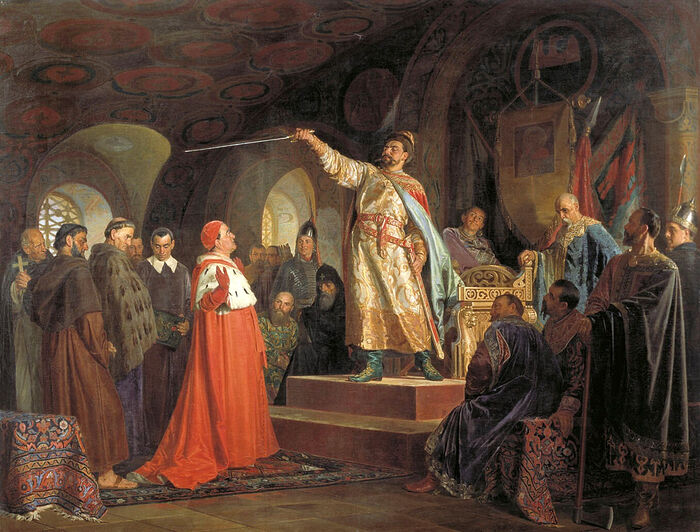
The struggle for the inheritance of Yaroslav Osmomysl did not stop there; it involved the princes of various volosts of the Russian land and foreign sovereigns: Emperor Frederick Barbarossa, the Hungarian king Bela III. Vladimir Yaroslavich was supported by his uncle Vsevolod the Big Nest. And the unrest in Galich began with a conspiracy of local boyars, who this time used the second marriage of Prince Vladimir as a pretext for the rebellion - he was first married to the daughter of the Kyiv prince Svyatoslav Vsevolodovich Boleslav. Vladimir Yaroslavich “been liking a lot of drinking and not liking thoughts with your husbands and taking a wife from the priest and getting yourself a wife”[4]. He took his wife, unknown by name, from a local priest and married her. The boyars declared that they did not want to “bow to the priest” [5] and tried to kill her. They expelled Vladimir and his new wife from the city and invited the Volyn prince Roman Mstislavich to their place in Galich.
Vladimir, with his second wife and two children, fled to Hungary to King Bela III, and he, taking advantage of the unrest in the neighboring state, showed the hapless Vladimir a kind of hospitality, imprisoning him and his family, after which he invaded the Principality of Galicia with an army and placed his son Andras on the throne of Galich. Vladimir, his “priest” wife and children managed to escape from prison to Emperor Frederick Barbarossa and enlist the support of Poland.
In 1189, Vladimir returned to his father’s table, however, having pledged to pay the Polish king an annual tribute of two thousand hryvnia (about 20 kilograms - not much, but significant for the treasury of the principality). With a request for protection, Vladimir then turned to the most powerful of the Russian princes - his maternal uncle Vsevolod the Big Nest: “Father Lord, keep Galich under me, and the language of God and yours are with all Galich, and I am always in your will.”[6]. Vsevolod heeded his nephew’s request and “ordered” all the princes and ... queens in Lyakhy [7] not to attack the Galician land, and no one, including the Polish king, dared to disobey him. From then on, Vladimir reigned relatively calmly until his death in 1199. His children from the “priest” were not recognized as the legal successors of the dynasty, although there are references to their stay in Hungary in 1218. Thus the dynasty of the Galician Rostislavichs died out.
1199 is considered to be the time of the founding of the united Galician-Volyn principality
The Galician inheritance went to Prince Roman Mstislavich of Volyn, whose daughter Vladimir Yaroslavich's eldest son Vasilko was married to. Called by the rebellious Galician boyars for the first time ten years earlier, Roman did not then retain the Galician table during the outbreak of civil strife, so the year 1199 is generally considered to be the time of the founding of the united Galician-Volyn principality, which, after more than half a century, in 1254, under Roman’s son Daniel, would receive the title of kingdom as a gift from the pope as a pledge of the never-taken-off conversion of the king and his subjects to Catholicism
Roman was born around 1150, when his father Mstislav of Volyn also bore the title of Grand Duke of Kyiv. His mother was Agnieszka, daughter of the Polish prince Boleslaw Wrymouth. Roman spent his childhood and early youth, from 5 to 17 years old, in Poland, returning to his homeland in 1167. The following year he was seated on the Novgorod table, honorary, but not associated with the political power of the prince. He reigned there for two years, during which time he made his first campaign: he fought against the allies of Grand Duke Andrei Bogolyubsky, the Polotsk, and then the Smolensk princes. In 1170, the Novgorodians, through the intercession of the Mother of God, revealed through her icon “The Sign,” won a victory over the Suzdalians under his command. But in the same year, after Novgorod made peace with Prince Andrei Bogolyubsky of Suzdal, Roman left Novgorod and took the Vladimir-Volyn table, where he remained for the rest of his life, minus a short break in 1188, when the Galician boyars called him to their place. While he was in Galich, his younger brother Vsevolod ruled the Volyn fief.
Driven out of Galich, he returned to Vladimir-Volynsky.
In 1194, when Roman’s father-in-law Rurik Rostislavich sat on the Kiev table, he transferred to his son-in-law Roman the cities located on Kyiv land: Torchesk, Trepol, Korsun, Boguslav and Kanev. The growth of the power of the Volyn prince worried Vsevolod the Big Nest, and he demanded that these cities be handed over to him. Roman obeyed, after which one of them, Torchesk, Vsevolod handed over to Rurik, returning him to the Kyiv inheritance. Roman, having quarreled with his father-in-law (the Kyiv prince), divorced his daughter Predslava Rurikovna, declared war on Rurik and entered into an alliance with the Chernigov prince Yaroslav Vsevolodovich, who laid claim to the reign of Kiev.
In the mid-1190s, Roman intervened in the turmoil that erupted in Poland, fighting on the side of the young sons of Prince Casimir the Just against their uncle Mieszko the Old. In a bloody battle on the banks of the Mozgawa on September 13, 1195, both Roman Mstislavich and his opponent Mieszko were wounded. The battle ended in a draw, but Roman's intervention helped the Kazimirovichs retain Krakow and avoid defeat. Returning to Volyn, Roman reconciled, and again quarreled, and fought with his former father-in-law Rurik. In the winter of 1196-1197, Roman made a trip to the land of the Yatvingians, who more than once invaded his principality for predatory purposes.
Having united the Galician and Volyn principalities, Roman became the most powerful Russian prince after Vsevolod the Big Nest
Having united the Galician and Volyn principalities in 1199, he became the most powerful Russian prince after Vsevolod the Big Nest. Twice, in 1201 and 1204, Roman bore the title of Grand Duke of Kyiv. In domestic politics, Roman considered his main task to be the suppression of the boyar front. For this purpose, he subjected those boyars whom he suspected of being inclined to conspiracies and weaving intrigues against the power of the prince to arrests, torture, executions, confiscation of land holdings and transferring them to loyal servants.
“If you don’t kill the bees, you can’t eat honey,” he said; and so the best boyars died from him, as they say, in terrible agony”[8].
Many of the boyars then fled to other Russian principalities or beyond the Russian land, most often to Hungary and Poland, and to more distant Western countries.
“Roman was known as a formidable scourge of the surrounding peoples - Polovtsians, Lithuanians, Yatvingians, a good ascetic for the Russian land, a worthy heir to his great-grandfather Monomakh”[9].
In 1201, Rurik Rostislavich, having entered into an agreement with the Olgovichs, was preparing for a campaign against the Galician-Volyn principality, but, having learned about the threat, Roman led his regiments to Kyiv. Rurik was not ready for resistance and fled from Kyiv, where Roman placed his cousin Ingvar Yaroslavich. In the winter of 1201-1202, Roman with his Galician and Volynian regiments made a long campaign against the Polovtsians, displacing them from Thrace, thereby providing invaluable assistance to the Roman emperor Alexei III Angel. The warriors returned to Rus' with rich booty and fellow tribesmen freed from captivity. In January 1203, Rurik, in alliance not only with the Olgovichs, but also with the Polovtsians, expelled Roman Ingvar’s protege from Kyiv and subjected the mother of Russian cities to plunder. Roman again moved his army to the Kiev region and besieged Rurik, who had locked himself in Ovruch.
But through the messengers of Vsevolod the Big Nest, peace was concluded with Rurik: Kyiv was left to him, obliging him to break off alliances with the Polovtsians and the Olgovichi, to recognize Vsevolod the Big Nest as the senior Russian prince so that his heirs would retain primacy in the family of Russian princes.