The latest issue of the journal "Church and Time" has been publishedtranslated
Along with the traditional thematic sections "Dogmatics" and "Church History," a special section dedicated to the 80th anniversary of the Most Holy Patriarch of Moscow and All Rus' Kirill occupies a prominent place in the new issue.
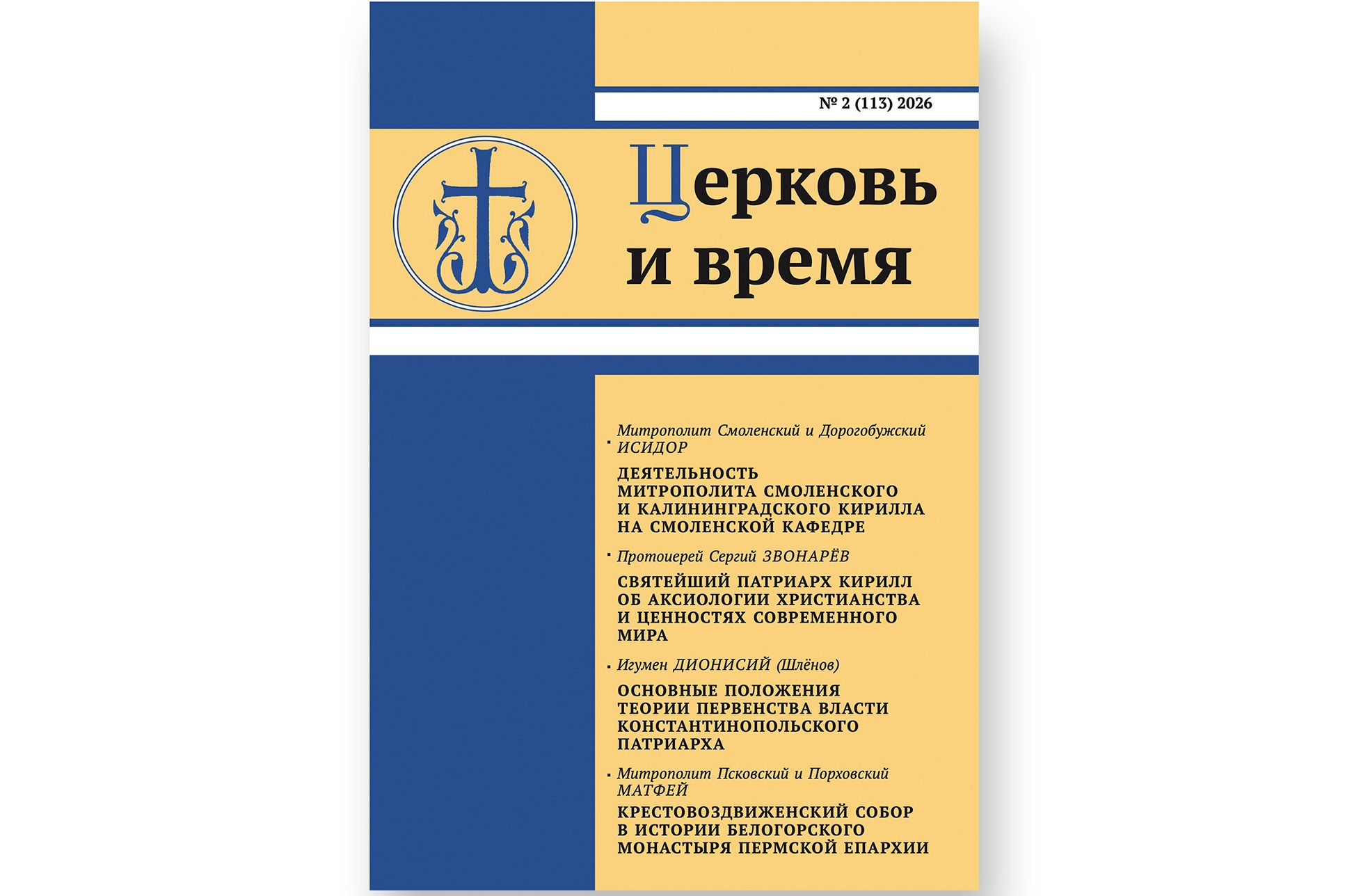
The latest issue of the scientific-theological and church-social journal "Church and Time" (No. 2 (113), 2026) is published by the All-Church Postgraduate and Doctoral Studies named after the Equal-to-the-Apostles Cyril and Methodius in collaboration with the Department for External Church Relations of the Moscow Patriarchate. In addition to the traditional thematic sections "Dogmatics" and "Church History," a special section dedicated to the 80th anniversary of the Most Holy Patriarch of Moscow and All Rus' Kirill occupies a prominent place in the new issue.
The materials in this section, prepared based on the presentations given by the authors at the Interdisciplinary Conference of OCAAD "Sin and Virtue in Religious and Secular Understanding" on April 1-2, 2026, examine the multifaceted archpastoral and First Hierarch service of the Primate of the Russian Orthodox Church. His activities as a Metropolitan on the Smolensk Diocese, which began in December 1984, are discussed in an article by Metropolitan of Smolensk and Dorogobuzh Isidore. The research covers three main vectors of service of the Primate in Smolensk: cultural, socio-political, and moral. The process of restoring the eparchial infrastructure in the post-Soviet period and laying the groundwork for a fundamentally new model of interaction between the Church and the state are described. Special attention is paid to the analysis of the role of the People's Council of the Smolensk Region as a unique platform for dialogue between power and society, as well as the implementation of specific social, educational, and cultural projects. All these initiatives not only gained public recognition but also helped to form an effective model of synodal work and cooperation between secular and religious institutions in new historical conditions.
The Deputy Secretary for Affairs of the Far East of the Department for External Church Relations, Professor of OCAAD, Archpriest Sergius Zvonarev, in his article "Most Holy Patriarch Kirill on the Axiology of Christianity and the Values of the Modern World," systematizes the apologetic reflections of the Primate of the Russian Church on the relationship between Christian theocentrism and the anthropocentrism of the New Age, as well as the ontological contradictions between the traditional Christian way of life and the secularism born from liberal ideology - a topic he began to address even in his capacity as the head of the Department for External Church Relations of the Moscow Patriarchate. The article also discusses the critique of the destructive idea of transhumanism as a logical continuation of anthropocentrism and the understanding of the modern concept of human rights through the lens of the Church's teaching on the dignity of the person and its moral responsibility before God. The author concludes that Most Holy Patriarch Kirill made a significant contribution to the formation of the Church's view and assessment of modern ideologies, which not only reject religious heritage but are also aggressively hostile to Christianity.
Associate Professor of OCAAD, OVDTS communications service referent, V.A. Kuznetsov, in his article "Defending the Sacred Gift of Life in the Activities of the Most Holy Patriarch of Moscow and All Rus' Kirill," writes about the factors that prompted His Holiness to take an active and consistent position in defending life. Based on programmatic texts, the author reveals the grounds for his consistent criticism of abortion and euthanasia, and considers the specific impact of the Patriarch's activities on changes in Russian legislation in the areas of family support and protection of the sacred gift of life.
In the section dedicated to dogmatics, a speech by the First Deputy Chairman of the Publishing Council, Professor of OCAAD, Bishop Serafim of Istra, delivered on October 3, 2026, at the celebratory event at OCAAD, is published. The speech is focused on the "imperative of contemporary Church service." According to the author, in the digital age, the rapid development of artificial intelligence systems, biotechnology, robotics, and genetic engineering poses serious existential and metaphysical questions to the pastor. The author emphasizes that without a comprehensive ethical and spiritual-moral expertise, technological possibilities can turn into an instrument of civilizational and spiritual catastrophe. Therefore, the modern Church specialist must not only orient himself in the dogmatic field but also master the methodology of scientific research, engage in interdisciplinary dialogue, and give a Christian assessment of the challenges of the time. The triad "strong faith, fundamental knowledge, and constant research" is named by the author as the main imperative of contemporary Church service - both in the scientific-educational and pastoral areas.
Also included in the section is an article by the abbot of the Andreievsky stavropegial men's monastery in Moscow, director of the Synodal Library named after the Most Holy Patriarch Alexius II, deputy chairman of the Educational Committee, and professor of the Moscow Theological Academy, Archimandrite Dionysius (Shlenov) "Basic Principles of the Theory of the Primacy of the Power of the Ecumenical Patriarch." The author notes that, since the Ecumenical Patriarchate claims exclusive judicial power in Orthodoxy, as well as exclusive rights to grant autocephaly and manage the entire Orthodox diaspora, this leads to the disruption of harmonious and equal relations between the Autocephalous Churches, causing serious harm to ecclesial unity. However, such claims, which speak of the transformation of the primacy of honor of the Ecumenical Patriarch into the primacy of power, have never been accepted by the Church and cannot be accepted. The article concludes with the principles of Orthodox synodical ecclesiology as the true foundation for the preservation of ecclesial unity.
The section on Church history opens with an article by Metropolitan of Pskov and Pskovsk, Matthew, dedicated to one of the largest churches in the Ural - the Cathedral of the Ascension of the Cross of the Nikolaevsky Missionary Monastery of the Perm Diocese. Based on archival materials, the author reconstructs the stages of the construction of the church from the blessing given by the holy Righteous John of Kronstadt in 1902 to its consecration in 1917. The article highlights the active participation of all social strata of the Russian Empire, including the Emperor Nicholas II, in this matter, as well as the dramatic fate of the cathedral and the entire monastery during the Civil War and the "red terror" until its final closure by the Bolshevik authorities in 1923.
The issue concludes with an article by a doctoral student of the Moscow Theological Academy, Archpriest Maxim Maslakov, "Brotherhood of Metropolitan Peter in Moscow in the Context of the Development of Orthodox Brotherhoods." In it, the author writes about the activities of this brotherhood as a key phenomenon of church-social life in the second half of the 19th century, reflecting the search for a balance between Orthodox tradition and new societal challenges of that time. Special attention is paid to the relationship between ecclesiastical and social factors that influenced the formation of the brotherhood movement, as well as the spiritual and moral tasks set by its participants.
The latest issue of the journal "Church and Time" continues the academic reflection on Church life, offering readers a substantive analysis of both historical experience and the acute contemporary challenges facing the Russian Orthodox Church.
Press Service of OCAAD / Patriarchia.ru