“You have forgotten about Christ!” How Dr. Haass defended even those considered criminalstranslated
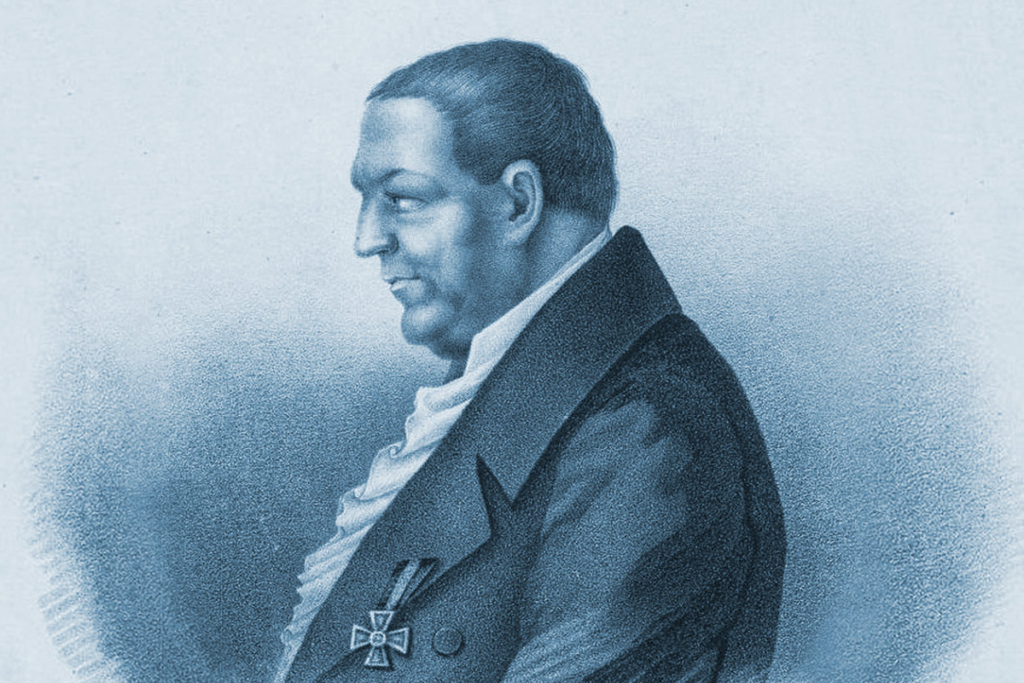
He could have become a rich and respected doctor, but he devoted his life to those whom society preferred to turn away from. Fyodor Gaaz sought to mitigate the fate of the prisoners, experienced lighter shackles, helped not to separate children from their parents, and donated his own money to help the prisoners. Why was he called the “holy doctor” during his lifetime?
Friedrich Joseph Laurentius Haas was born in 1780 in a small town near Cologne. His father, Peter Haase, was a pharmacist, his grandfather a doctor of medicine. Two of the six sons in the family became doctors.
True, Friedrich was initially interested in mathematics and philosophy, but gradually showed interest in theoretical medicine and surgery, anatomy, and then eye diseases, which later became one of his main specialties. After studying in Jena, Göttingen and Vienna, he received a medical diploma.
In 1806, one of his Viennese patients was the Russian princess Varvara, the wife of Prince Nikolai Grigorievich Repnin-Volkonsky. She suffered from an eye disease, and this disease was considered incurable, but he cured it. The delighted prince persuaded Haase to go to Russia.
In Moscow, he quickly turned from Haase into Haase, from Friedrich Joseph into Fyodor Petrovich. There was a catastrophic shortage of doctors in the country, and the young doctor quickly acquired famous and wealthy patients. The long and very well-fed life of a private doctor stretched out before him.

However, getting acquainted with Moscow hospitals and almshouses, he ended up in the Ekaterininsky and Preobrazhensky charity houses and found there completely abandoned people suffering from eye diseases. The city did not have the funds to treat them. Haaz began to come here and treat the most helpless for free. The rumor about this spread throughout Moscow, and with it came recognition: at the suggestion of the Dowager Empress Maria Feodorovna, Haaz was accepted into the public service and in 1807, at the age of 27, was appointed chief physician of the Pavlovsk Hospital, one of the largest in Moscow.
Haaz opens balneology in Russia
In 1809-1810, Haaz traveled to the North Caucasus, where mineral springs were just beginning to be studied. It was customary to travel to Europe on water from Russia.
Haaz explored the springs of Kislovodsk, Zheleznovodsk, Essentuki and Pyatigorsk, described their composition and medicinal properties, and developed rules for treatment using the waters. In fact, he was the first to describe and scientifically substantiate the value of Caucasian mineral waters, thus laying the foundation for his own Russian balneology.
For his Caucasian research and successful hospital service, Haaz received the Order of St. Vladimir, 4th degree, and the rank of court councilor.
Haaz is at war with diseases and the system
When the Patriotic War of 1812 began, Haaz went to the active Russian army as a military surgeon - and reached Paris with her. Before he could return back, he had to start a new war - a war against epidemics.
In 1813-1818, croup was rampant in Russia, claiming thousands of children's lives. Haass became the first in Russia and one of the first in Europe to clearly describe the differences between true diphtheria croup and its false forms. Later, for decades he had to fight epidemics of typhoid, dysentery, trachoma and cholera.
Despite his growing authority, he regularly had to fight with the Russian bureaucracy. Having headed the Pavlovsk hospital, Haaz began to eradicate theft so successfully that denunciations rained down on him. The most absurd was the dispute over 1,502 rubles spent on repairing a government pharmacy: the doctor announced in advance in writing that he was ready to return the money from his own pocket if the expenses were not approved, but the proceedings still dragged on many years after the doctor left the Pavlovsk hospital.
Haaz reforms prisons in Russia
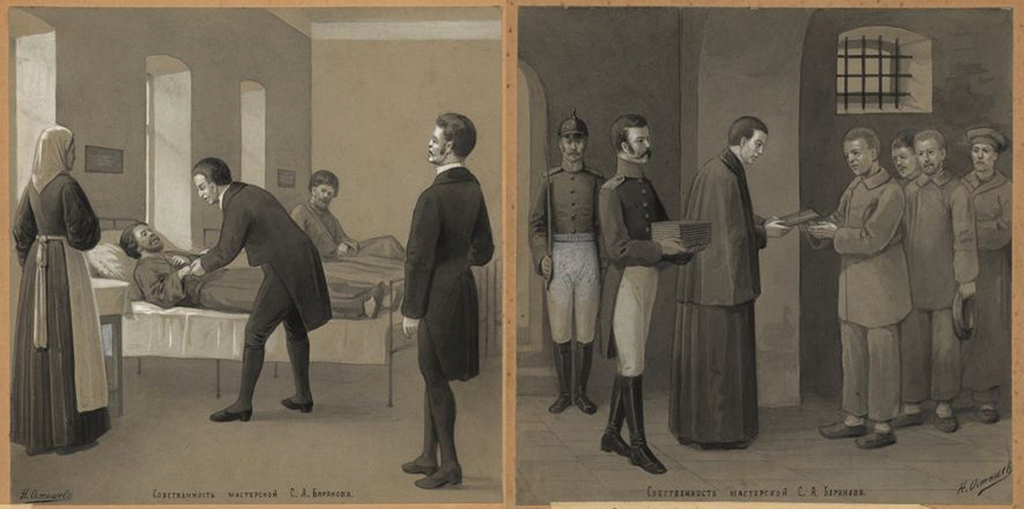
In 1825, the Moscow Governor-General asked Haase to deal with the typhus that was rampant in the Butyrka prison. Haaz got down to business with his usual energy: he established hygiene, exterminated rats and mice, recruited full-time cats, organized the work of pharmacies, and set up an isolation ward for infectious patients. He stopped the epidemic, but could not cope with the embezzlement of public funds - denunciations began to pour in again, and a year later he was removed from his post.
However, during this short time, he managed to see what life was like for its most powerless citizens - prisoners - in Russia, and he could no longer be just a successful private doctor.
In 1828, Golitsyn recruited him to work on the Moscow Committee of the Society for the Guardianship of Prisons, established by a special decree of the emperor. So the life of a successful doctor ended. The life of the “holy doctor” began.
Dirt, dampness, cold, overcrowded cells, lack of bunks and simple beds, meager food, lack of medicine, lack of rights and cruelty, cruelty and lack of rights - this is what the penitentiary system of the Russian Empire looked like. The sick lay next to the healthy, families were separated, human life was worth nothing.
Haaz saw this and could not stay away. From that moment on, he participated in the fate of each batch of transit prisoners: he did not allow the prisoners to be sent from Moscow until he examined everyone, delved into the circumstances, and tried to help. Everything he achieved was obtained through endless petitions and tireless conversations with his superiors.
But his efforts were rewarded. Gradually, he achieved the release of old people and the sick from shackles, developed lightweight shackles, almost three times lighter than usual, covered with leather or cloth, so as not to injure their legs and arms. They were called that way - “Gaazovskys”. He himself walked many miles in them in his own office to make sure that they were safer for humans.
He achieved the abolition of the rod - an iron rod to which 8-10 people were chained the entire way to Siberia, so that often those who were still on their feet had to drag the exhausted ones behind them.
He got the majority of transit migrants to stop shaving half their heads. He introduced bunks with straw mattresses and pillows stuffed with Baltic seaweed into prison use, and replaced wooden bunks with armored beds. He insisted on separating repeat offenders from those convicted for the first time, and ensured that the period of preparation of convict parties for the stage was extended from two or three days to a week.
He himself constantly invested his own money, time and effort to supply the convicts with medicines, food, linen, and sometimes money on the road, helped write and forward letters to their relatives, and supplied the prisoners with books. In 1842, he achieved the establishment of the position of investigator and intercessor in prison cases, who professionally helped prisoners write complaints and petitions and lead them through the authorities.
From 1830 to 1853, at the request of Haas, 74 prisoners were ransomed and about 200 children were released. He filed more than 300 petitions asking not to separate the children of those arrested from their parents. Once he took care of two convicted sisters and got them to be left together in a prison hospital, explaining that “God gave them one strength for two.”
They recounted the doctor’s conversation with Metropolitan Philaret of Moscow. “You keep talking about innocently convicted people, Fyodor Petrovich, but there are no such people, they don’t exist. If the court imposes punishment, it means that the defendant was at fault.” Haaz thought and answered: “And Christ?..”
Haaz rich, poor, holy fool
He became so focused on caring for the prisoners that he became more and more like a holy fool. Once, at a reception with the mayor, who scolded him for his desire to expand and expand the prison hospital (the doctor settled those who could not fit there in his apartment), Haaz fell to his knees in tears.
Another story that was told about him. It was as if robbers had attacked him in an alley at night and demanded that he take off his fur coat - it was old, but you couldn’t see it in the dark. And Haaz told them: “Then come to me at the Police Hospital, ask Haaz, they will give you a fur coat.” The thieves felt ashamed and did not rob.
In 1832, at his request, the Committee of the Prison Guardianship Society financed the equipment of a department of the prison hospital with 120 beds. 10 years later, with his participation, a hospital for exiled convicts on Vorobyovy Gory, a prison church, a school and a shelter for the children of prisoners were built. At his insistence, hospitals introduced positions of nurses in men's wards.
Finally, in 1844, the Police Hospital for the homeless opened on Maly Kazenny Lane - it accepted those who had no shelter, no money, no relatives. Haaz also lived with her.
A doctor who once came to Russia to earn money, and for the first twenty years made really good money, became practically bankrupt in his old age.
Until the 1830s, Haass did not experience financial difficulties: wealthy patients supported his practice. Almost everything he managed to save gradually went to charity. He purchased his own house on Kuznetsky Most, but in 1831 he had to sell it. He bought the Tishkovo estate near Moscow with a cloth factory, but there was no time to work on it; the doctor’s time belonged to the sick and prisoners. As a result, he was declared bankrupt, and the estate was sold at public auction. Since then, Haaz lived at hospitals - modestly, as a caretaker, and not as an eminent doctor.
He also refused the money that he was entitled to by imperial decree for the fight against cholera in 1847.
He never started a family, but he had an adopted son, Leib (baptized Nikolai) Norshin, a homeless orphan whose life he once saved.
Haaz lived his last years at the Police Hospital - in two small rooms with a table, an iron bed, a crucifix and a copy of Raphael's Madonna on the wall. At night I looked at the stars through a telescope.
"Holy Doctor"
He was given the nickname “holy doctor” during his lifetime. In the Nerchinsk fort, an icon of St. Theodore Tyrone was dedicated to him. New exiles arriving in Siberia were always asked if Dr. Haass was still alive.
He worked almost until the end - he received patients, participated in the affairs of the committee, and made rounds. In August 1853, he developed painful abscesses on his back and sides, accompanied by fever and chills. On August 16, the doctor, exhausted by pain, fell asleep during the day so as not to wake up.
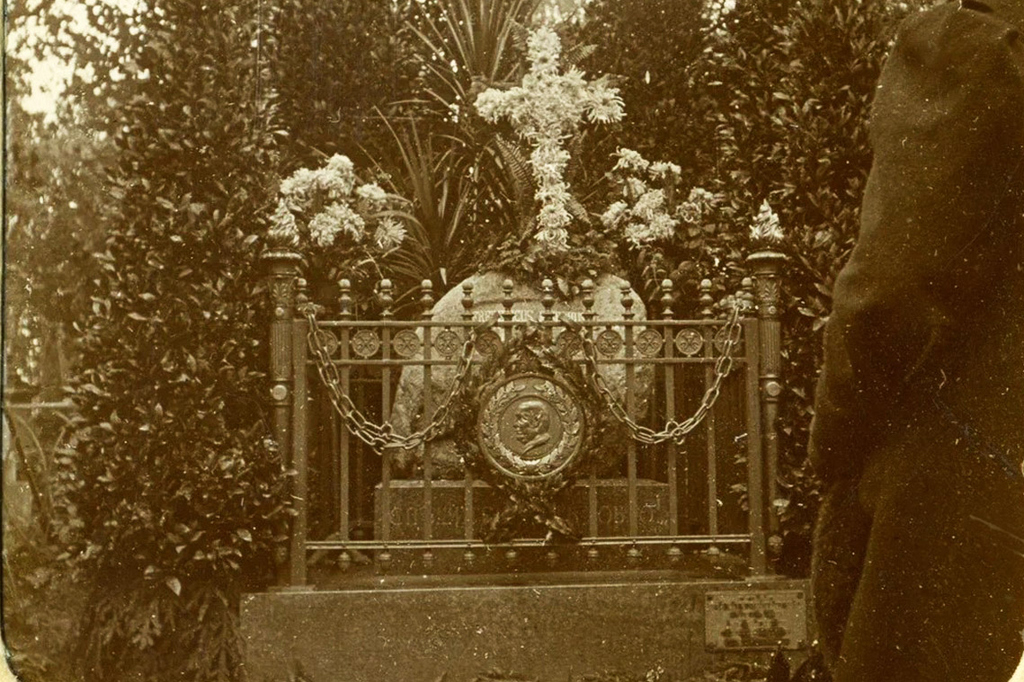
There was no money for the funeral; they were buried at public expense. But they say about 20,000 people came to bid him farewell. Over time, former prisoners entwined the fence of his grave at the Vvedensky “German” cemetery with “Haaz” shackles.
Victoria Belyaeva, editor Egor Otroshchenko, Mercy.RU