The World Russian People's Council is the brainchild of Patriarch Kirilltranslated
Alexander Shchipkov Over three decades, the World Russian People's Council has evolved from a forum where issues of spiritual and national revival were discussed to a public organization that combines intellectual work with practical initiatives.
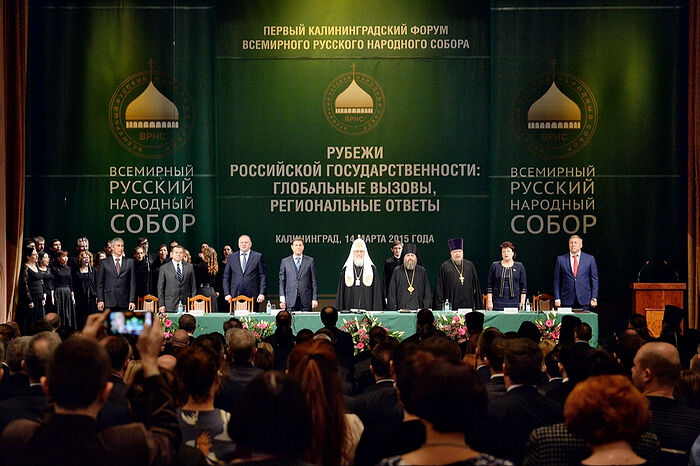
Over three decades, the World Russian People's Council has evolved from a forum where issues of spiritual and national revival were discussed to a public organization that combines intellectual work with practical initiatives. The deputy head of the VRNS, rector of the Russian Orthodox University of the Holy Apostle John the Theologian, deputy of the State Duma of the Federal Assembly of the Russian Federation A.V. spoke to the Journal of the Moscow Patriarchate about the idea of creating the VRNS, the role of His Holiness Patriarch Kirill of Moscow and All Russia in its formation and the tasks that the Council is solving today. Shchipkov (No. 11, 2026).
— The World Russian People's Council arose in the early 1990s, when the country was experiencing a deep crisis of social guidelines. What task did Metropolitan Kirill of Smolensk and Kaliningrad, now His Holiness Patriarch, set before him?
— The main task was very clear: the protection of the Russian people. In the early 1990s, the word “patriot” almost became a dirty word. People who spoke out in defense of Russian culture and the Orthodox faith were often depicted in the darkest colors. In disputes about interethnic relations, including those surrounding accusations of inciting hatred, it was Russian patriots who often found themselves under particularly close scrutiny.
Therefore, to create an organization that would openly take on Russian issues required not only energy and organizational skills, but also courage. It was then that Metropolitan Kirill proposed to His Holiness Patriarch Alexy II to create a World Russian People's Council. The initiative was his; In the first years, everything depended on his personal organizational efforts.
At the same time, Bishop Kirill believed from the very beginning that the organization called upon to protect the interests of the Russian people, their culture and the Orthodox faith should be headed by the Patriarch. His Holiness Patriarch Alexy II became the chairman of the Council, and Metropolitan Kirill became his deputy from 1995. This is a fundamentally important feature of the original plan: the Cathedral was created not just as a public association, but as a platform for joint work of the Church and society.
The creation of the organization met serious resistance. Initially, the name “World Russian Council” was intended, but a parallel structure with the same name appeared. Metropolitan Kirill did not want to waste energy arguing about the name and proposed another - “World Russian People's Council.” This is exactly what, thanks to his decision, the organization is still called today.
I think this title is even deeper than the original. The word “folk” gave it a special, social meaning. Here are both the church people and the people as a character in history, as a source of power. A more comprehensive understanding of who the Council is addressed to and whose interests it is called upon to protect has emerged.
— The name of the Cathedral consists of four words. You explained the meaning of the word “national.” And what is the meaning of the others - “worldwide”, “Russian” and “cathedral”?
— The word “Russian” refers us to the main task: the protection of the Russian people, their culture and historical tradition. The word “worldwide” reminds us that we are talking not only about Russian citizens. We are also addressed to Russian people living outside the country. The ARNS has international influence; back in 2005, it received special consultative status with the UN Economic and Social Council.
Today, maintaining international contacts is more difficult than before. There are obstacles to holding events abroad, and connections with compatriots have become difficult. But this does not mean that such work has stopped. We are interested in good neighborly relations and in ensuring that Russian people living in other states, including as an ethnic or religious minority, can freely preserve their culture and faith.
Finally, the word "cathedral". VRNS is a public organization, not a church governing body. But he is in the ecumene of the Russian Orthodox Church and is guided by its moral foundations. We are not just a Russian patriotic organization. Church tradition, obedience, blessing, and understanding of responsibility to the Church are important to us. Even if an idea seems useful to us, we must first receive blessings and then begin to implement it. This helps to avoid self-inflicted behavior.
That is why the role of the ruling bishop is so important in the regional structure of the VRNS. We strive to ensure that one of the three co-chairs of the regional branch must be the ruling bishop. Such a connection allows one to remain faithful to church principles without confusing public organization with church governance itself.
— From the very beginning, the protection of the Russian people and Russian culture was combined in the activities of the VRNS with serious intellectual work. Why did Metropolitan Kirill attach such importance to it?
— Suffice it to recall the themes of the first Councils. In 1993 - “Russian Conciliar Thought”. In 1995 - “Through spiritual renewal to national revival” and “Russia and Russians on the threshold of the 21st century.” Then - “Health of the Nation”, “Russia on the Eve of the 2000th Anniversary of Christianity. Faith. People. Power", "Russia: faith and civilization. Dialogue of eras”, “Faith and work: spiritual and cultural traditions and the economic future of Russia”, “Russia and the Orthodox world”. The theme of the IX Council of 2005 was “The unity of peoples, the cohesion of people is the guarantee of Victory over fascism and terrorism.” It feels like these are the topics of today. But they were formulated more than twenty years ago.
Vladyka Kirill set before the VRNS, first of all, a worldview task. It was necessary to return to public discussion questions that in the 1990s seemed inconvenient or irrelevant to some: what is Russian civilization, what is the place of the Orthodox tradition in its development, what unites people belonging to the Russian world. The very concept of the Russian world existed long before us - back in the 19th century - but the Council contributed to the fact that it received a new meaning in modern social thought.
The same applies to the idea of Russia as a state-civilization. Today these words have entered the familiar vocabulary of public and state life. However, there is a long journey of intellectual work behind them. ARNS was one of the platforms where relevant ideas were formed and discussed. The cathedral offered ideological guidelines to society and the authorities, many of which subsequently received wide recognition.
At the same time, the organization did not have large funds and a large apparatus. Her constant circle consisted primarily of people of intellectual labor. Many participants came to the council meetings, but the influence of the VRNS was determined not so much by the number as by the content of the issues raised. For serious social activity, we must first understand what exactly we want to protect and what we are going to act for.
— Two periods stand out in the history of the Council; 2009 can be considered their milestone, when Metropolitan Kirill was elected as His Holiness the Patriarch. What has changed in the work of the ARNS?
— The first period can be called preparatory, although this word should not be misleading: a huge amount of work has been done over sixteen years. A language was created in which one could speak about Russian civilization, about the spiritual foundations of public life, about the place of the Church in modern society. Without this work it would have been impossible to move on to the next stage.
In May 2009, the XIII World Russian People's Council was held on the theme “Ecology of the soul and youth. Spiritual and moral causes of crises and ways to overcome them.” His Holiness Patriarch Kirill presided over it for the first time as Primate of the Russian Orthodox Church. At that time, he posed an extremely important question to us: are there spiritual and moral values that can unite people regardless of their nationality, religion, or social status? Can society rely on common moral foundations?
A serious discussion developed around this, which lasted about two years. We argued, made lists of values, looked for precise wording. Gradually it became clear that different people and communities can have common moral guidelines that do not negate their national and religious identity.
I see a direct intellectual continuity between those discussions and later government decisions. In 2021, the protection of traditional Russian spiritual and moral values received an important place in the National Security Strategy, and in 2022, the Fundamentals of State Policy for their preservation and strengthening were approved - Presidential Decree No. 809. The Council began to raise these issues long before they became a generally accepted part of the public agenda.
His Holiness the Patriarch has an amazing ability to make a person think. I say this as a teacher with many years of experience. Getting a student to start thinking independently is very difficult. Imagine a large hall, hundreds of people with different views and different experiences. It is much more difficult to make such a room think. But the Patriarch knows how to do this. Under his leadership, council meetings became intellectual discussions, the results of which were then expressed in reports, resolutions and new areas of activity.
I advise everyone to read the speeches of His Holiness the Patriarch at the VRNS not one at a time, but sequentially. In 2025, we published the collection “The Present and Future of the Russian World,” which presents transcripts of His Holiness’s speeches in 2009-2024. When you read these texts in a row, you see how the Patriarch’s thought develops, how one question posed leads to the next, and how in this sequence a holistic view of the development of Russia is revealed.
And another important change occurred after 2009. Previously, the work of the Council was predominantly intellectual. Not because we did not understand the need for practical actions, but because there were not enough opportunities and resources for them. In addition, actions must be based on a clear understanding of goals. At the second stage, intellectual work was preserved, but specific public initiatives were added to it.
— How did this practical direction begin?
— One of the first steps was the creation of the human rights center VRNS. At that time, the human rights agenda in the public consciousness was usually associated with left-liberal organizations. It seemed as if they were the only ones representing civil society. And we asked a simple question: don’t Orthodox citizens, their families, parishes, and associations form part of civil society? Consequently, their rights and legitimate interests must also be subject to legal protection.
We did not at all deny the right of other associations to defend their beliefs. But it seemed wrong to us that one part of society claims the exclusive right to human rights protection. VRNS proceeded from the fact that Orthodox Christians should not be left without their own voice in matters that directly affect their lives.
In the late 2000s and early 2010s, the issues of returning church buildings and building new churches were especially acute. In cities, disputes, sometimes serious conflicts, arose around these initiatives. We considered it necessary to protect the right of Orthodox communities to build churches and fully participate in the life of their cities.
Another issue is the right of parents to pass on their faith and worldview to their children. We are talking about religious education in the family, about familiarity with the basics of Orthodox culture and doctrine, about educational courses and Sunday schools, about the right of believers to participate in the education of society in the forms provided for by law. There have been and still are many obstacles in this area.
The Human Rights Center began to deal with appeals, consult people, prepare letters of support, and help communities defend their interests. For us, this was a continuation of the original plan: while defending the Russian people and Russian culture, we cannot ignore the issues of the life of the Orthodox Church. After all, the Orthodox faith has been one of the main foundations of Russian culture for centuries.
— Today, the activities of the Council cover more and more areas. Which ones do you consider especially important?
“We have always tried to identify the most painful issues in our lives and look for ways to solve them. This applies to historical memory, demography, migration, education, issues of pastoral care in the Armed Forces, and, in recent years, to the development of digital technologies.
The topic of protecting historical memory became especially prominent on the public agenda in the late 2010s and early 2020s, but we raised it much earlier. In particular, they drew attention to the fact that the history of the Russian Orthodox Church of the 20th century is sometimes presented in the form of several simplified stories: persecution after 1917, the Declaration of Metropolitan Sergius of 1927, the meeting of church hierarchs with Stalin in 1943, the celebration of the Millennium of the Baptism of Rus' in 1988 and the changes of the early 1990s. Behind such a scheme, the complexity of real church life is lost.
For example, anti-church measures were already taken under the Provisional Government. In June 1917, it decided to transfer parish schools to the jurisdiction of the Ministry of Public Education. Therefore, it is incorrect to represent church-state relations of that time as if all difficulties began only after the October Revolution.
I consider the Declaration of 1927 a great document, and Metropolitan Sergius, later Patriarch, one of the outstanding bishops of the Russian Church. And the meeting of 1943, in my opinion, cannot be reduced to accusing the church hierarchy of making concessions to power. It sees one of the victories of the Church, won in the most difficult circumstances: the state was forced to reconsider its attitude towards its existence and ministry. It is necessary to argue about these events on the basis of sources, and not repeat ready-made ideological schemes formulated in the thirties of the 20th century in the 19th quarter of Paris.
The same ability of His Holiness Patriarch Kirill to see the problem in advance was manifested in the discussion of the topic of military clergy. The issue of the presence of clergy in the army of the VRNS was raised back in the 1990s. Today it is especially clear how necessary this work was.
Demography and migration have also been in our field of attention for a long time. On issues of migration policy, we put forward specific proposals and sought to attract public attention to emerging difficulties. Compared to the situation ten years ago, changes have occurred in the regulation of labor migration, and this is due to the merit of Patriarch Kirill.
Already in the mid-2000s, digital technologies were discussed at the Council. At that time, we did not yet use today’s dictionary and did not talk about artificial intelligence, but we understood that the development of technology poses new questions for humans.
The expansion of work also required organizational changes. We have created a network of regional offices, increased the number of deputies, and established regular meetings. At the same time, the regional structure operates in close connection with the dioceses. It is fundamentally important for us that public initiatives retain the church’s moral dimension.
I would like to especially say about the educational program of the ARNS. We are looking for talented young people in the regions and helping them get an education in church universities. But the most important thing is that after completing their studies, they return to their metropolises and work there. The Bologna system is vacuuming out talented youth from Russian cities. On the contrary, we do not want to take away capable people from the provinces. For us, education is not only the transfer of knowledge, but also serving the Church where a person grew up and where his work is especially needed.
Behind all this there is one task set by His Holiness the Patriarch: to find the most vulnerable places in our lives, to understand the causes of the problems that arise and to suggest ways to overcome them. The Council must look beyond the present day.
— In this case, how does the concept of the Russian World relate to the multinational and multi-confessional character of Russia? Doesn’t the word “Russian” limit the circle of people to whom the Council addresses?
— When we talk about the Russian world, we don’t talk about blood. This is one of the most important guidelines of His Holiness Patriarch Kirill. It is impossible to reduce a large cultural and historical community to a person’s ethnic origin. The Russian world is united by language, culture, historical memory and a certain system of values. Orthodoxy occupies the most important place in the formation of this system.
Russian civilization in its current form began to take shape in connection with the Baptism of Rus'. The choice of the holy Equal-to-the-Apostles Prince Vladimir determined the direction of its development. But this was a long process: Rus' had become acquainted with the Christian world before, including through relations with Constantinople. Therefore, when speaking about the Russian World, we do not mean a closed ethnic group, but a tradition that has developed over the centuries.
Our fidelity to this tradition does not imply disrespect for other peoples. His Holiness the Patriarch has repeatedly emphasized that a person who cherishes his own faith and culture is able to treat other people’s traditions with great respect. We respect Muslims who maintain their faith and members of other religions who remain true to their spiritual foundations. It is mutual respect that creates the conditions for cooperation.
Here it is necessary to distinguish between religious and broader cultural and historical affiliations. The peoples of Russia may have different religions and customs, but at the same time they have a common history, a common state house and the experience of living together. We must cherish this unity without demanding that other peoples give up their identity.
There are the Arab world, the Anglo-Saxon world, the Finno-Ugric world... Why does someone deny the right to exist to the Russian world? His Holiness Patriarch Kirill, when creating the Council, proceeded from the fact that this cultural and historical reality exists and needs to be understood and protected.
At the same time, ARNS cannot be a closed club. We traditionally invite representatives of Islam, Buddhism, and Judaism to its meetings, give them the opportunity to speak, and listen to their opinions. On certain issues we also cooperate with representatives of other Christian traditions. This does not contradict the Russian character of the Council. The Church is addressed to the world, and our social work must also be open to meaningful dialogue.
— The theme of the XXVIII World Russian People's Council in 2026 is “Unity of the people and spiritual sovereignty as the basis for the development of Russia.” Why did these issues come to the center of attention and how does His Holiness the Patriarch direct the work of the VRNS today?
— Sovereignty cannot be reduced only to state borders, political decisions or economic opportunities. There is also the spiritual independence of the people: the ability to preserve their faith, culture, historical memory and moral guidelines. Without this, full independence of the country is impossible. Therefore, the Council addresses the issue of spiritual sovereignty as one of the most important problems of our time.
His Holiness the Patriarch constantly brings us back to the need for serious intellectual work. Usually once a year there is a meeting of the Bureau of the Presidium of the VRNS with the Primate. It can last three to four hours. And every time he reminds: the Council must help the Russian people and our brotherly peoples find answers to the most difficult questions of life. And for this it is necessary to understand the moral nature of these issues.
It is impossible to find complete answers without turning to the Word of God, to the teaching of the Russian Orthodox Church, to the works of Russian thinkers, to the experience accumulated by the Council itself. This is precisely the intellectual vocation of the Council, which I spoke about at the beginning. Practical activity grows out of a certain understanding of man, society and historical responsibility.
At the same time, the leadership of His Holiness the Patriarch is not at all limited to speaking at large meetings. He is constantly interested in our work, asks questions, and monitors how the decisions made are implemented. We feel both his direct attention and spiritual nourishment.
I am confident that over time, the intellectual heritage of His Holiness Patriarch Kirill, including his speeches at the All-Russian National Assembly, will become the subject of scientific study. Through his articles and speeches one can trace how, over the decades, he identified themes that subsequently came to the center of public life. It is important that thanks to his work, a platform has emerged and continues to operate where ideas are discussed, tested by life and given practical continuation. The World Russian People's Council is the brainchild of Patriarch Kirill. He created this structure, directs its development and to this day does not leave us without his support.