The Moscow Theological Academy hosted a conference “Orthodox theology: traditions and modernity”translated
On November 23, the VII All-Russian Scientific and Practical Conference “Orthodox Theology: Traditions and Modernity” took place in the Elizabeth Hall of the Moscow Theological Academy.
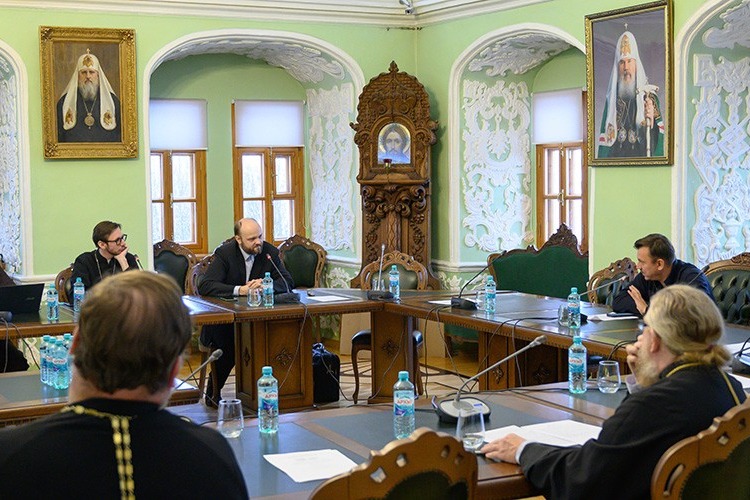
On November 23, 2026, the VII All-Russian Scientific and Practical Conference “Orthodox Theology: Traditions and Modernity” was held in the Elizabeth Hall of the Moscow Theological Academy. The conference is dedicated to two memorable dates - the 50th anniversary of the death of Martin Heidegger and the 730th anniversary of the birth of St. Gregory Palamas.
The conference was opened by Associate Professor of the Department of Theology A.M. Gaginsky. He based his reading of Heidegger's philosophy on the question of God's mode of being. The vice-rector for scientific and theological work of the Moscow Academy of Arts, Archpriest Alexander Zadornov, turned to the history of philosophical and theological thought at the Moscow Theological Academy, considering, in particular, the question of how academic philosophers perceived Heidegger’s ideas at the turn of the 20th and 21st centuries.
Associate Professor A.A. Solonchenko talked about how the ideas of the German philosopher were reflected in the ontology of the Orthodox theologian David Bentley Hart. Priest Stefan Domusci compared the understanding of guilt in Heidegger and in Christian theology. Priest Nikita Sorokoletov dedicated his speech to the influence of Heidegger on the “weak theology” of John Caputo. Senior lecturer of MDA A.A. Parpara examined how Heidegger’s philosophy relates the experience of loneliness and “togetherness”-a person’s being with other people. The first part of the conference concluded with a report by priest Alexander Sukharev on the work of Romano Guardini and his theological reading of poetry.
The second meeting was opened by the head of the Department of Biblical Studies of the Moscow Academy of Sciences, Archpriest Oleg Mumrikov. He turned to the image of the eighth day by St. Gregory Palamas and its significance for modern biblical apologetics. The head of the department of theology at the MDA, Abbot Adrian (Pashin), examined one of the central issues of Palamite theology - how the distinction between essence and energies in God is consistent with the doctrine of Divine simplicity.
Associate Professor of the Orthodox St. Tikhon's Humanitarian University S.A. Chursanov devoted his report to the doctrine of deification in modern Orthodox anthropology. Turning to the legacy of St. Gregory, he raised the question of how to express the fullness of man’s communion with God and at the same time preserve the idea of the uniqueness of the human person.
In the report of Hierodeacon Mark (Elimanov), the Palamite disputes were presented by the opponent of St. Gregory - Barlaam of Calabria. The subject of the study was the theological and philosophical origins of Varlaam’s teaching on the vision of God. Deacon Sergius Kozhukhov examined how Sevier of Antioch interpreted the terminology of Dionysius the Areopagite; The material for the report was the Christological florilegium Doctrina patrum de incarnatione Verbi. The second part of the conference concluded with a report by Deacon Sergius Panteleev on the names of God in the debate about the Trisagion Song.
In conclusion, A.M. Gaginsky thanked the speakers for interesting and relevant topics and noted the need to continue research in the thematic areas of the conference.
Press service of MDA/Patriarchia.ru