Be able to thank the Patriarchtranslated
Alexander Shchipkov Article by the Deputy Head of the World Russian People's Council, Rector of the Russian Orthodox University of St. John the Theologian, Deputy of the State Duma of the Federal Assembly of the Russian Federation A.V. Shchipkova is timed to coincide with the 80th anniversary of His Holiness Patriarch Kirill of Moscow and All Russia.
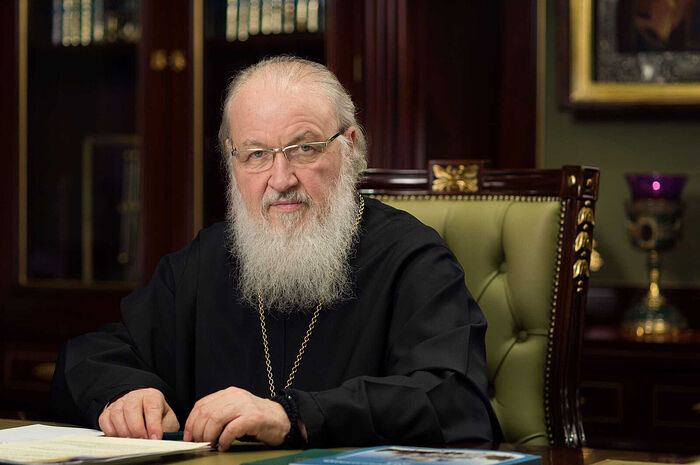
Article by the Deputy Head of the World Russian People's Council, Rector of the Russian Orthodox University of St. John the Theologian, Deputy of the State Duma of the Federal Assembly of the Russian Federation A.V. Shchipkova is timed to coincide with the 80th anniversary of His Holiness Patriarch Kirill of Moscow and All Russia.
Every day in the churches of the Russian Orthodox Church, with the blessing of His Holiness Patriarch Kirill of Moscow and All Rus', whose 80th birthday we are celebrating these days, a prayer sounds for our Fatherland, for the granting of victory: “Lord God of hosts, God of our salvation, look in mercy on Thy humble servants, hear and have mercy on us: behold, for those who want to fight have taken up arms against Holy Rus', hoping to divide and destroy its united people. Arise, O God, to help Your people and grant us victory through Your power.”
At every Liturgy, His Holiness the Patriarch, on behalf of all our people, pronounces these words, giving thanks to God. The Patriarch thanks the Lord for not leaving us. And we internally join him, even if we are outside the church. After all, the Liturgy does not end with the walls of the church: it continues in the consciousness and conscience of the entire Russian society.
The phenomenon of prayer of thanks is familiar to every believer. In the structure of the service, prayers of petition and thanksgiving stand side by side. This is not an accident: gratitude to God is as necessary a part of spiritual life as asking for help. The prayer of thanksgiving is the key moment of the Liturgy, when the fullness of the Divine Gifts meets the congregational prayer of the people.
The outstanding Russian thinker Saint Ignatius (Brianchaninov) argued: “Faith leads to thanksgiving to God, and thanksgiving deepens faith.”
In a society where gratitude becomes the norm, relationships between people, between society and government, between the people and those who take responsibility for the common cause are built completely differently. Restoring the culture of thanksgiving is not only a church task, but also a civil one. Patriarch Kirill constantly reminds us of this in his speeches and books.
First of all, the Patriarch is a clergyman. His main concern is saving people. He serves a lot, prays a lot. This service reveals a special spiritual vertical-the vertical of the connection between society and the highest, sacred principle. The ministry of the Patriarch extends far beyond the altar. His work is both prayerful work and spiritual-intellectual work, visibly influencing social development.
In the early 1990s, Metropolitan Kirill raised the question of Russianness: Russian dignity, Russian leadership, Russian sovereignty. Moreover, he did this while being in the very center of the liberal inferno. It was he who returned and introduced the concept of “Russian World” into official and everyday use. This is a modern analogue of such ancient Russian concepts as “Holy Rus'” and “Russian Land”, known to us from chronicles. The Russian world strives for moral ideals and the gathering of the triune Russian people. At that time, his words sounded to the then masters of life as sedition and unheard-of insolence, but this did not bother him. The defenders of the Russian world survived those difficult times. It was Patriarch Kirill who created in 1993 an analogue of zemstvo councils - the World Russian People's Council. It is no coincidence that today Western liberal professors react so nervously to the concept of the Russian World, trying in vain to “abolish” Russian culture, Russian civilization, which unites and cements all the fraternal peoples who have lived side by side for centuries and together defend our common Fatherland.
I would call the most important of the acts of His Holiness Patriarch Kirill his historic speech in the fall of 2009 at the World Russian People's Council, when he called for compiling a list of traditional values that unite all citizens of Russia, regardless of nationality and religion, such as faith, life, family, patriotism, solidarity, and so on. It was Patriarch Kirill who initiated the return of all these ideas to public discourse. Now these guidelines are enshrined in the public life of Russia by presidential decree and other basic documents.
This historical turn is the fruit of the tireless efforts of Patriarch Kirill. Largely thanks to these efforts, our society is not split and has a common value foundation.
Another important result of the Patriarch’s spiritual and intellectual work was the development and adoption in 2000 of the “Fundamentals of the Social Concept of the Russian Orthodox Church.” This document sets out the official position of the Church on interaction with the state and society. Thanks to Patriarch Kirill, the Church, and after it all the traditional religions of Russia, regained the right to vote that was taken away from it in the twentieth century. And today the Patriarch consistently defends the sovereignty of the Church - from transnational centers of influence and comprador elites, while relying on the principles of the church-state symphony.
Everything I have listed is not some separate effort, but a single fabric of Patriarchal service, where prayer is inseparable from spiritual and intellectual work, and this work itself is inseparable from socio-political action. Based on this basic spiritual and intellectual work, Russian politicians today are successfully formulating a national ideology. It is national, based on its own tradition, on its own people's collective experience, and not on imported ideological constructs growing from the teachings of Rousseau, Kant, Marx, Jung, Nietzsche and others like them. Without a national ideology, neither social construction nor a constructive political process is possible.
We know well that, according to the Constitution, the source of power is the people. In other words, the state directly relies on the people, on their will and energy.
But where does the will of the people themselves, their ideals and principles come from? After all, they are not made of thin air. They come from the depths of tradition and collective cathedral experience.
And the keeper of the national tradition is the Church. The Church is responsible for its preservation and reproduction. Therefore, it is the Primate of the Church who is the main connecting person here. His efforts, his service create this foundation, the basis of national unity - the unity of society, state and Church. Therefore, all social meanings, theses, narratives can only be built on such a foundation.
That is why we have every reason to feel gratitude to His Holiness Patriarch Kirill.
This gratitude is not just etiquette. This is the ability to see and appreciate work that connects the spiritual and the human, the personal and the social, prayer and intellectual work. The culture of high (and not everyday, mundane) thanksgiving is being revived in our society today. We see and appreciate the scale of service of those who connect our past and future, and do not allow the thread of tradition to break again.
Thanksgiving is also a service. To give thanks means to serve with a neighbor to whom you are grateful. This is also a conciliar work.
The Patriarch thanks God for us, and our return gratitude to him is not a formality, but a restoration of the true order of things. We honor those who serve for others.
Therefore, on behalf of the State Duma deputy corps, I dare to thank His Holiness Patriarch Kirill for his service, for his prayerful work, for his spiritual and intellectual work. For helping us carry out our common mission entrusted to us by God.