The Entrance of the Theotokos into the Temple
By His Eminence Metropolitan Cleopas of Sweden The Entrance of the Theotokos into the Temple is one of the most solemn and theologically profound feasts of our Church, i.e. the entrance of Mary, the Child of God, into the Temple-“the entrance of the human race into the Kingdom…
By His Eminence Metropolitan Cleopas of Sweden
The Entrance of the Theotokos into the Temple is one of the most solemn and theologically profound feasts of our Church, i.e. the entrance of Mary, the Child of God, into the Temple-“the entrance of the human race into the Kingdom of God,” according to Metropolitan Elder Meliton of Chalcedon, of blessed memory.
From the very beginning, the Church, through the divinely inspired language of her hymnography, offers us the key to entering the meaning of today’s feast: “Today is the prelude of the good will of God.”
The word “today” is the liturgical today of salvation. The Church does not invite us merely to recall an event belonging to the past, but to become contemporaries of the mystery, to participate in it, and to allow its grace to transform our own present.
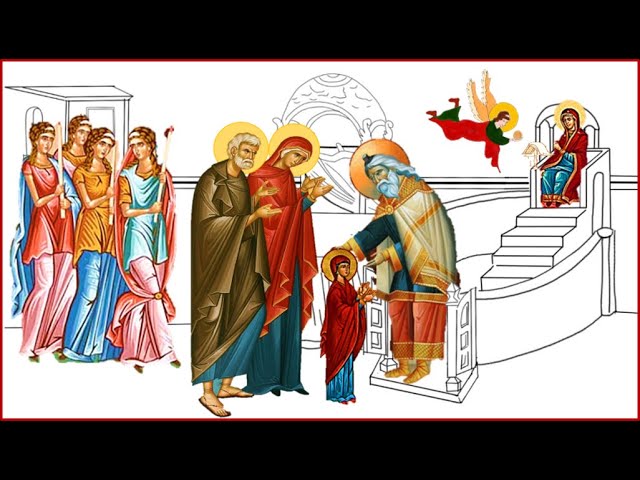
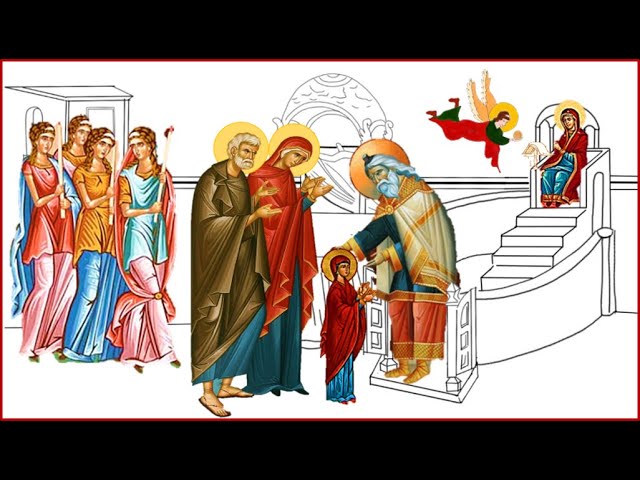
The righteous Joachim and Anna, fulfilling their promise to God, lead their three-year-old daughter into the Temple in Jerusalem. Maidens carrying lamps go before her, and the priest Zacharias receives her and leads her into the Holy of Holies, where only the high priest entered once a year.
A little child ascends the steps of the Temple, and with her begins the ascent of all humanity from alienation to communion. The wondrous paradox of the feast is that Mary enters a temple built by human hands, while she herself is destined to become the living Temple of God not made by hands. For this reason, the hymnographer calls her “the purest temple of the Savior.”
The Holy of Holies receives her who will become holier than all the saints. The Ark of the Old Covenant held the tablets of the Law, the jar of manna, and Aaron’s rod; the Virgin will bear within herself not symbols and foreshadowings, but the Lawgiver Himself, the true Bread of Life, and the High Priest of the good things to come.
The Epistle reading appointed for the feast, from the Epistle to the Hebrews, describes the Tabernacle and the inner veil. The Old Covenant is not abolished; it reveals its full meaning in Christ, and the Theotokos stands precisely at the point of this sacred encounter. She is a daughter of Israel and, at the same time, the Mother of the Messiah; she is the fruit of the promises and the beginning of their fulfillment; she is the ladder by which God descends and humanity ascends.
God does not save humanity without human participation. From her earliest childhood, the Virgin is prepared to offer later, at the Annunciation, her conscious and free assent: “Behold the handmaid of the Lord; let it be to me according to your word.”
This “let it be to me” does not appear suddenly. It is the mature fruit of a whole life of prayer, purity, trust, and willingness to belong entirely to God. For this reason, the Feast of the Entrance is inseparably linked to the Incarnation.
The Theotokos offers the beginningless Word flesh from her flesh and blood from her blood. Through her humble assent, the Son of God becomes truly the Son of Man, so that we human beings may become children of God by grace.
The Theotokos does not simply enter the Temple; she becomes a Temple. Herein lies the personal summons of the feast to each of us. The Feast of the Entrance asks us: Is there room within us for Christ and for our brothers and sisters?
Yet the image of three-year-old Mary entering the Temple calls us today to stand before another ecclesiastical and pastoral duty, the formation of our young people.
For the young Mary, the Temple becomes a place of nurture, prayer, and maturation. The entire scene is an image of a community accompanying her toward the source of life.
This is the first message for us; no child grows up alone. Character is formed through relationships, examples, wounds, and blessings. The family, the Church, the school, and society write each day upon the sensitive hearts of the young.
The Church is not a greenhouse that shelters young people from every question, nor a mechanism that produces uniform personalities. She is the Body of Christ, a workshop of freedom and communion, and a place of healing and truth.
In the Church, young people must be able to ask questions without being humiliated, to doubt without being rejected, to confess their pain without being exposed, to discover their gifts without being exploited, and to learn that truth is not imposed by force but is revealed within relationship and offered with love.
His All-Holiness Ecumenical Patriarch Bartholomew has repeatedly emphasized that pastoral care for youth is a fundamental dimension of the Church’s witness. You have called upon the Church not to speak to young people with the gloom of a pessimistic religion, as though their world were nothing but threat and decline.
Young people do not need us to be nostalgic for an idealized past. They need the eternal Gospel expressed with truth, sensitivity, and courage amid the real questions of their own present.
With fatherly clarity, His All-Holiness has said that the Church wants her young people to be “dynamic, creative, committed to service, and open to the world and to their fellow human beings.” This statement rules out every passive conception of youth.
In the same spirit, His All-Holiness reminded us, citing the Message of the Holy and Great Council, that “young people are not simply the future of the Church, but her dynamic and creative present.” This is a foundational truth.
When we speak of young people exclusively in the future tense, we risk postponing their participation indefinitely. The Church, however, is the communion of all generations today.
If we preach love yet live harshly, if we speak of humility yet claim privileges, and if we demand honesty yet tolerate our own hypocrisy, young people are not rejecting Christ, but our own untrustworthy portrayal of Christ.
The best catechesis children can receive is a family that prays and seeks reconciliation, a clergyman who serves without authoritarianism, a parish that opens its arms to the stranger, and a community that tolerates no form of violence, insult, or exclusion.
The Church must educate without manipulating, present the faith without crushing, and guide without creating dependencies. Faith imposed from without remains fragile; faith born of an encounter with Christ becomes a source of freedom.
The young people of our time inhabit both a physical and a digital world at once. They are continually exposed to information, images, comparisons, and invitations. Technology offers great possibilities for knowledge and communication, but by itself it cannot answer the question of meaning.
Artificial intelligence can process data; it cannot love, repent, forgive, pray, or assume moral responsibility. For this reason, the Patriarchal exhortation to cultivate “spiritual intelligence” is especially timely. Young people need discernment, an inner life, and sound judgment, so that technology may serve the human person, and the human person may not become enslaved to technology.
Within this environment, the Temple can become for the young person not a place of escape, but a place of true presence. Especially in the societies of Northern Europe, where people of different languages, cultures, and spiritual journeys encounter one another every day, young people seek an identity without exclusion and roots without hostility toward the other.
The parish cannot be a museum of ethnic memories or a club of like-minded people. It is the Eucharistic assembly in which “there is neither Jew nor Greek,” for all are called to become one in Christ.
Language, customs, and cultural heritage are precious gifts when they open paths to communion; they betray their purpose, however, when they become walls of self-sufficiency or contempt.
We also need a genuine encounter between the generations. Older people are not a burden, but bearers of memory and time-tested patience. Young people are not a threat, but bearers of questions, courage, and creative renewal.
When the generations are isolated from one another, tradition becomes either stagnation or oblivion. Yet when they meet in Christ, experience becomes wisdom and enthusiasm becomes ministry. The Tradition of the Church is a flame that we hand on, and that flame remains alive only when it lights new candles.
Entrance into the Temple becomes an exodus into service. Prayer gives birth to responsibility. Contemplation leads to action, and true ecclesial formation shapes people who can stand within society as bearers of peace, justice, reconciliation, and respect for creation.
This responsibility for the younger generation is also a privileged field of encounter and cooperation among Christians. We do not ignore the theological differences that remain, nor do we seek an easy uniformity. Yet we know that in the face of loneliness, violence, war, racism, the instrumentalization of the human person, and the destruction of creation, our common Christian witness to love, peace, and the sacredness of the human person is imperative.
Sincere dialogue does not weaken our identity; when grounded in truth and mutual respect, it helps us to know both the other and our own tradition.
Let us beseech Our Lady the Theotokos, the “vessel of the unapproachable and divine Light,” to lead us also into the true Holy of Holies. Amen!
Search
Popular Posts
While at the seat of the Ecumenical Patriarchate in Constantinople, His Eminence Metropolitan Cleopas of Sweden and All Scandinavia, who accompanied His Eminence Archbishop Martin Modéus of the Lutheran Church of Sweden during his official visit to the Phanar from November 20 to 23, 2026, was received in audience by His All-Holiness Ecumenical Patriarch Bartholomew.…
By His Eminence Metropolitan Cleopas of Sweden The Entrance of the Theotokos into the Temple is one of the most solemn and theologically profound feasts of our Church, i.e. the entrance of Mary, the Child of God, into the Temple-“the entrance of the human race into the Kingdom of God,” according to Metropolitan Elder Meliton…
Dearly Beloved Brothers and Sisters in Christ, In today’s Gospel, a lawyer asks our Lord, “Teacher, what shall I do to inherit eternal life?” The Lord points him to the commandments; to love God with all our heart, soul, strength, and mind, and to love our neighbor as ourselves. But the lawyer then asks, “And…