Next to pure soulstranslated
About Ray Bradbury's story "The Outlandish Wonder" Anna Berseneva-Shankevich For Bradbury, a mirage is a symbol. Beauty that reveals itself to pure souls.
About Ray Bradbury's story "The Outlandish Wonder"
Recently, on the train, I saw a man who looked like a doctor who participated in my operation and did his job flawlessly. I didn’t dare come up to say hello: perhaps it seemed to me that the person was a stranger. The next day I wondered: was it really a doctor, or did my consciousness, in a state of emotional instability (which I now have to live through), throw up an image that carried symbols of reliability, support, knowledge and help? Thinking about this, I remembered Ray Bradbury's story about mirages. And I wanted to write about him.
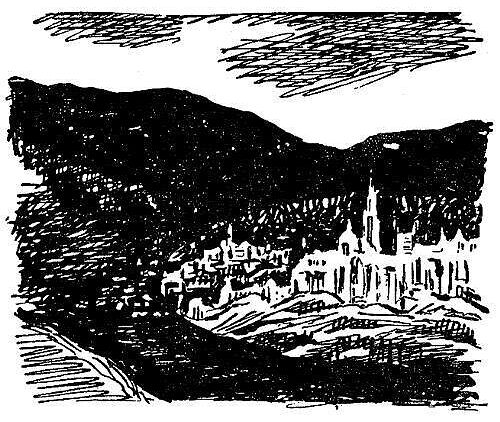
Bob and Will are two tramps who have been traveling around America in search of easy money for thirty years. And all these years they have been pursued by Ned Hopper, who knows how to take away what they find from two simpletons. During the next pursuit, Bob and Will manage to break away from their “black man”: turning off the road in time, they find themselves in a place in the desert from where a beautiful, unprecedented mirage can be seen.
The tramps realize that they can claim rights to a plot of land and sell tickets to the spectacle to passing cars. They manage to earn a good amount in a day. It would seem that this is a gold mine. But by evening the thirst for profit is replaced by another feeling.
“In my opinion,” said Bob, “we’ll keep just enough for ourselves to buy gas for the week, and put the rest of the money in the first church mug.” This mirage is like a pure transparent spring to which thirsty people fall. A smart person will scoop up a glass, take a refreshing sip and move on. And if we stay and start building dams, we’ll plan to appropriate everything...”
Taking money for something that brings people comfort carries a wormhole that puts lives at risk more than an empty pocket
On the one hand, two poor people need funds. On the other hand, both understand: what is created by the Lord belongs to the Lord. Taking money for something that brings people comfort carries a wormhole that puts lives at risk more than an empty pocket.
And in the evening of the same day, Ned Hopper proves the correctness of this guess. He appears suddenly and says that he has guessed the plans of the tramps and has already claimed the land. And now he himself will take money from passing cars. Bob and Will leave, but not far - to the nearest hill. From there they see Ned Hopper's failure: everyone who came to look at the mirage makes a scandal and demands their money back - they see nothing. Ned leaves in a rage.
Returning to their original place, Bob and Will also see nothing. The mirage disappeared. And Ned Hopper is to blame for this.
“He never saw what we saw. Didn't see what anyone else saw. I didn't believe it even for a moment. But disbelief is contagious. It sticks to others too.”
In spiritual practice, a vision, a mirage, has a rather negative connotation and in most cases borders on delusion. But for Bradbury, a mirage is a symbol. Beauty that reveals itself to pure souls. It is no coincidence that in the story, everyone who looks at the mirage sees something of their own: what touches the soul most strongly, touches the heart. The most beautiful and joyful thing for everyone.
For Bradbury, a mirage is a symbol. Beauty that reveals itself to pure souls
Even if Ned and Will are two lazy people, and in general they cannot be called righteous, but they have what the Lord said about “be like children.” Ingenuousness. Openness. Two people in whom there is no guile.
“Is this true? That we are pure souls?
- Of course, not as pure as the children who visited here today and saw everything they wanted, and not like those adult simple people who were born among the golden fields and by the grace of God wander around the world, remaining children at heart. No, Willie, you and I are neither one nor the other, neither small nor adult children. But we also have dignity: we enjoy life. We know what a clear morning is like on a deserted road, we know how stars are born and extinguished in the sky. And old Ned, he stopped being happy a long time ago.”
Consciously or not, Bradbury artistically illustrated the lines from the Psalter:
“You will be reverent with the venerable, and with the innocent man you will be innocent, and with the chosen you will be chosen, and with the obstinate you will be corrupt” (Ps. 17:27).
This is precisely where the outlandish wonder lies (“Outlandish Wonder” is the title of the story): the ability of one human soul to influence another, to transfer its properties to it. This is not a mirage in the desert.
After Ned's devastation, it seems that the miracle can't be brought back. Therefore, William begins to explain to a family with two children who have arrived that because of the twilight the mirage is no longer visible, but Robert stops him. He already knows what will happen now.
Children are the first to see the mirage.
“Oh,” whispered the daughter, “is this really true?
The father nodded, illuminated by a vision that was on the verge of the visible and beyond the comprehensible. And he said as if he was standing alone in a huge reserved church:
- Yes. And I swear… it’s beautiful.”
And the two tramps, coming closer to the children, also begin to see on the border of faith and disbelief. It's vague at first. But Robert recalls a quote from the poem he heard from a daytime visitor:
“Truly... An outlandish wonder - Cave ice and the play of the sun.
Perhaps this is my favorite moral, not only in the above story, but in general in everything that catches my eye.
The Lord created the world beautiful, and the ability to rejoice helps to see the beauty of God’s world even where it would seem difficult to find
Firstly, the ability to rejoice can and should be trained.
Secondly, the Lord created the world beautiful, and the ability to rejoice helps to see the beauty of God’s world even where it would seem difficult to find.
Thirdly, this skill can be shared. And this is precisely the case when the divided becomes not less, but more. Deeper, stronger, brighter.
During times of emotional instability, knowing this is comforting. Gives hope. “And the light shines in the darkness, and the darkness did not overcome it” (John 1:5).