The magazine of the interwar press: The Romania Nouă newspaper raises a question: If we have a Metropolis, why don't we also have a metropolitan?translated
100 years ago, the newspaper "Romania Nouă" raised a very natural question: If we have a Metropolis, why don't we also have a metropolitan? Through the organization law of the Romanian Orthodox Church, adopted after the Great Union, five metropolitans and 13 bishoprics had been established. The fifth was the Metropolis of Bessarabia, based in Chisinau and subordinated to the Bishopric of Cetății-Albe - Ismail.
However, in 1926, although the Metropolis had been established by law, a titular metropolitan had not yet been appointed.
Priest Vasile Vasilescu, head of the Chisinau Cathedral, publicly asked why this appointment was delayed, especially since the city already had a Faculty of Theology.
And he even proposed a candidate: Archbishop Gurie, the one who was already leading the diocese of Chisinau.
The author believed that Gurie deserved to become the first metropolitan of Bessarabia, for his church activity and for his contribution to the Romanian life of the province. Two years after the publication of the article, Gurie Grosu would become the first metropolitan of Bessarabia in 1928.
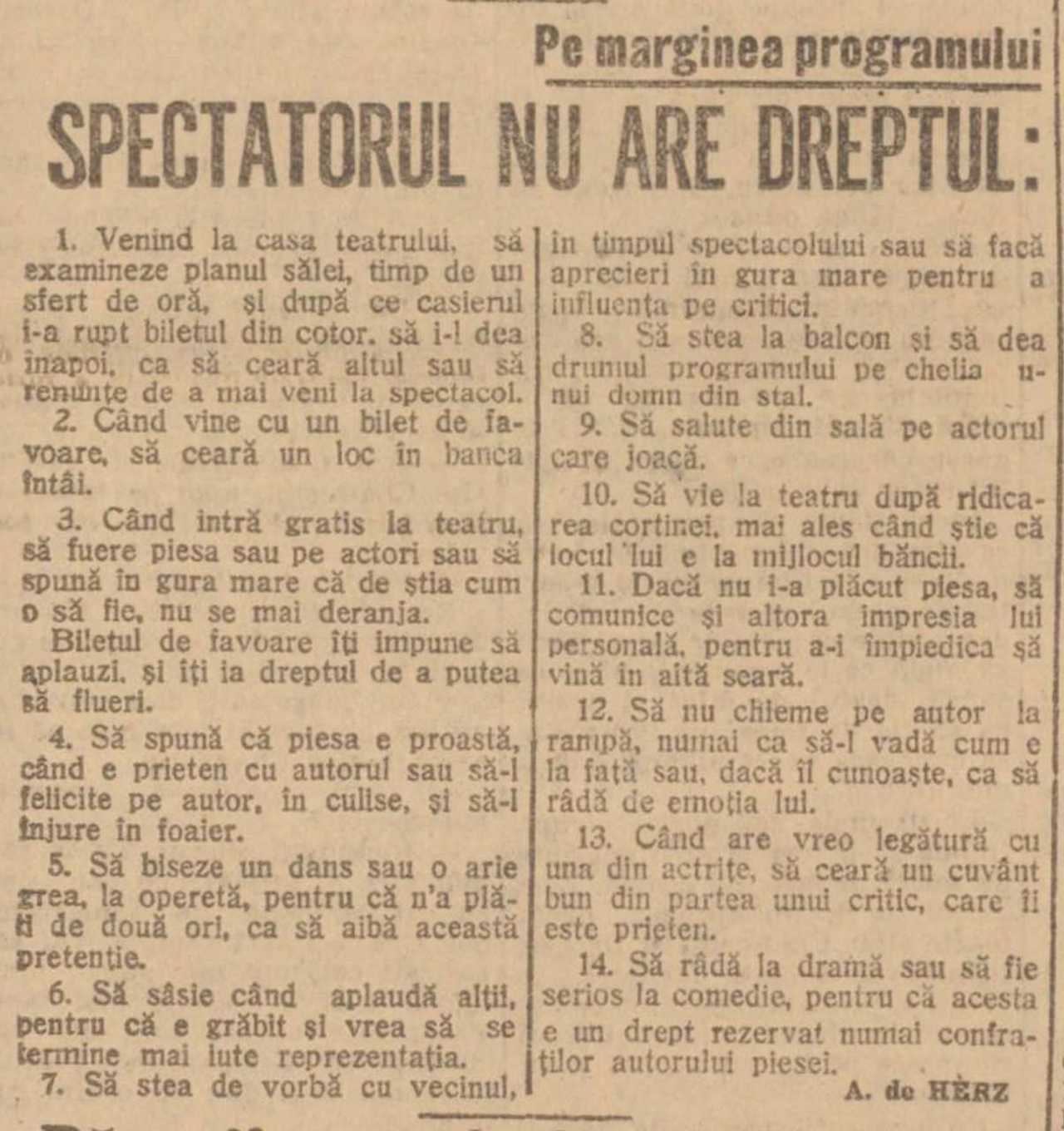
100 years ago, in the newspaper "Dimineata" appeared a tasty article, signed by the playwright A. de Herz, with the title "The spectator has no right!". The author lists 14 things that audiences should do at ironic theater.
To buy a ticket to the gallery and claim a seat in the front row.
To enter for free and whistle the actors, as if the favor ticket gave him this right.
Say the play is bad, then congratulate the author backstage
To snicker at those who are cheering, because he is hurrying home.
Chatting with the neighbor during the performance or commenting loudly to influence the critics.
To throw the program from the balcony at the head of a spectator in the stable.
To greet from the hall an actor who is just playing on stage.
To come after the curtain rises, especially if he has a seat in the middle of the row.
To tell someone else that he did not like the play, only to prevent him from coming to the theater.
To ask a critic to praise an actress with whom he has a personal connection.
And finally, to laugh at the drama and be serious at the comedy, just to contradict the author! These are some of the 14 ironic rules of the playwright A. de Herz, published in 1926.
*Today he would have written 15 rules, and I sense it: "ring the phone as loudly as possible during the show!"
100 years ago, on November 20, 1926, the "Circle of Housewives from Orhei", led by Eugenia Demetrescu, organized a big concert-ball, with the participation of the orchestra and the choir of the Ateneului Popular. The aim was to promote the Romanian national port and traditional crafts: carpets, fabrics and pottery. And the ladies from the committee came dressed in popular costumes, followed by many participants from the public. The concert began with a Schubert march, performed by the Ateneului orchestra, conducted by lawyer N. Antonescu.
Works by Beethoven were also played, and the choir performed popular songs such as "Go to the Dry Valley", "Devil's Lily" and "Lullaby". the same choir from Orhei also sang in Iasi, where it represented Bessarabia during a cultural visit.
The program also included poetry, dances and artistic moments, and the large hall of the club had become, according to the newspaper, too large.
Romania Nouă newspaper also announced a surprising news: the short story "An Easter Torch", by Ion Luca Caragiale, had appeared in Chinese! The translation belonged to the university professor Kenn Wu, from Peking, the current Beijing, who had visited Romania a few years before and had personally met people from the Romanian cultural environment. The article also mentioned another promoter of Romanian literature in Asia: doctor Fujisava, from Tokyo, Japan. The two were presented as enthusiastic supporters of Romanian culture.
In 1926, Caragiale had already reached Chinese readers!
In 1926, the "Dimineata" newspaper announced a spectacular invention: the "phonofilm", that is, the talking film. According to the newspaper, two Danish engineers had managed to combine the cinematographic image and sound, and the launch of the invention was expected in the coming days.
The sounds were transformed into light variations, recorded directly on the film, then reproduced in the projection, in synchronization with the images. But the talking movie wasn't exactly a world premiere. As early as 1923, the Americans had presented their own system, called "Phonofilm". And the two Danish engineers had developed another system for recording sound on film.
So, 100 years ago, silent cinema still dominated the screens, but the sound revolution had already begun. In 1927, the famous American film "The Jazz Singer" would appear, which decisively contributed to the popularization of talking cinema.