The Chairman of the Synodal Department for Prison Ministry took part in a seminar of the Interdiocesan Department for Prison Ministry of the Moscow Metropolistranslated
On November 24, as part of the XXIV Moscow Regional Christmas Educational Readings, a seminar of the Interdiocesan Department on Prison Ministry of the Moscow Metropolis was held in the assembly hall of the Kolomna Theological Seminary on the topic “Prison ministry of the Russian Orthodox Church: experience,…
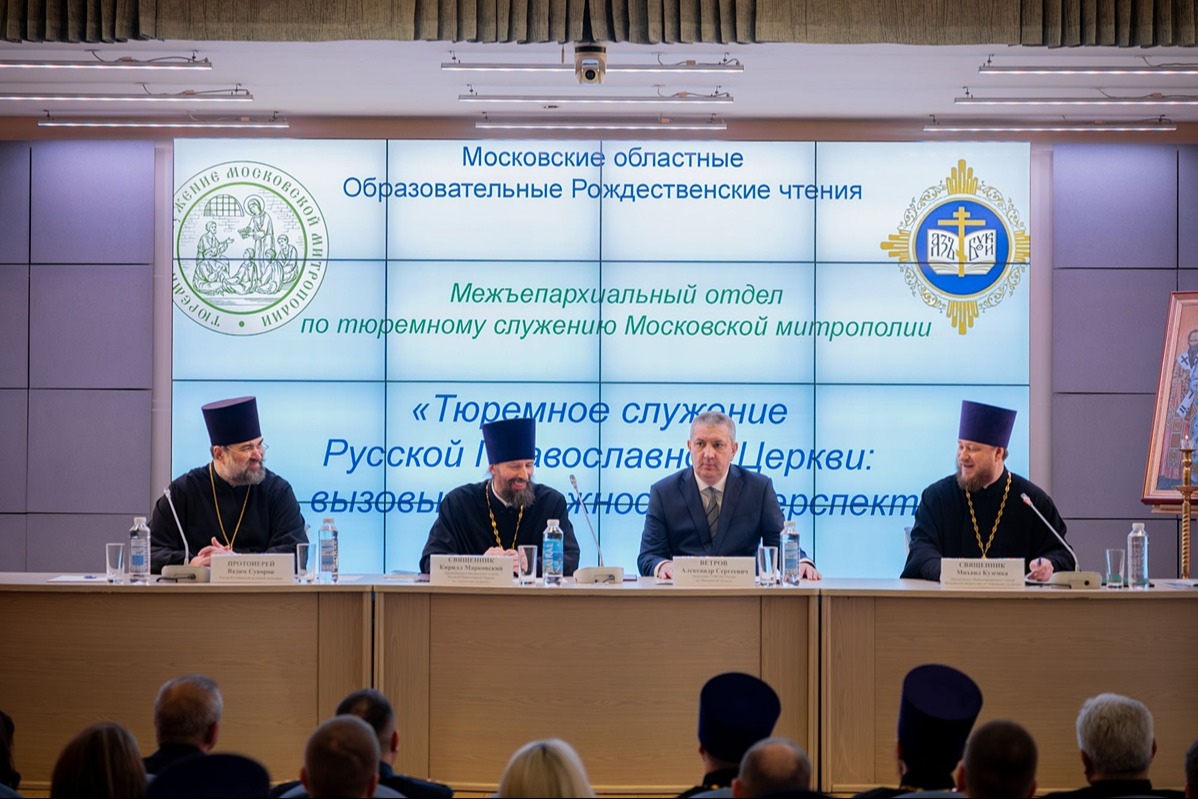
On November 24, 2026, as part of the XXIV Moscow Regional Christmas Educational Readings, a seminar of the Interdiocesan Department on Prison Ministry of the Moscow Metropolis was held in the assembly hall of the Kolomna Theological Seminary on the topic “Prison ministry of the Russian Orthodox Church: experience, challenges, opportunities and prospects.” The seminar was dedicated to the fifth anniversary of the formation of the Moscow Metropolis.
The event was attended by the Chairman of the Synodal Department for Prison Ministry, Priest Kirill Markovsky, Head of the GUFSIN of Russia for the Moscow Region Alexander Vetrov, Assistant to the Head of the GUFSIN of Russia for the Moscow Region for organizing work with believers, Head of the Interdiocesan Department for Prison Ministry of the Moscow Metropolis, Priest Mikhail Kuzemka, Rector of the Kolomna Theological Seminary, Archpriest Vadim Suvorov, Deputy Chairman of the Public Chamber of the Moscow Region, Chairman of the Public Council under the Main Directorate of the Federal Penitentiary Service of Russia for the Moscow Region Sergei Leonov, heads of institutions of the penal system, heads of prison departments of the dioceses of the Moscow Metropolis, pastors carrying out prison ministry.
The head of the Federal Penitentiary Service of Russia for the Moscow Region, Alexander Vetrov, addressed the audience with a welcoming speech. He emphasized that the mission of prison chaplains in places of deprivation of liberty is invaluable, since they are the ones who help the imprisoned person to come to repentance and gain the spiritual core that is necessary to return to normal life in society.
“Practice shows that where there is regular pastoral care, where there is an opportunity for confession, conversation, participation in worship, the very atmosphere in the institution changes, the level of tension changes, the number of conflicts decreases,” the head of the regional GUFSIN expressed confidence.
He also noted that very strong and good relations have developed between the penitentiary system of the Moscow region and the Russian Orthodox Church. The leadership of the GUFSIN is always ready to support the Church’s initiatives for the spiritual care and moral correction of convicts. Alexander Vetrov thanked the prison clergy for their hard work, patience and mercy towards people who had stumbled.
Priest Kirill Markovsky said that the interaction between the Church, the Russian Ministry of Justice and the Federal Penitentiary Service of Russia is at a very high level. At the initiative of the Minister of Justice of the Russian Federation, Konstantin Chuychenko, a meeting was held at which problematic issues related to the activities of religious organizations in places of detention were discussed. Based on the results of the meeting, one of the upcoming initiatives will be the introduction of positions of assistant chiefs for work with believers in women's colonies, as well as in universities of the Federal Penitentiary Service of Russia.
The Chairman of the Synodal Department paid great attention to the issue of the participation of clergy in the probation system, including post-penitentiary. He complained that currently the potential of religious organizations in the post-penitentiary probation system is practically not used. Meanwhile, it is a good and wise shepherd who can help a person released from prison avoid re-involvement in a criminal environment, as well as maintain contact with the Church if he was a member of the Orthodox community in a correctional institution. Father Kirill also noted that those who most need resocialization and social adaptation - people who are criminally oriented, have been repeatedly convicted, and suffer from addictions - do not want to enter probation, because they either simply do not want to change their lives, or they see in it only a restriction of their freedom and additional responsibilities before the penal inspection.
Father Kirill urged pastors to take initiative in their activities: not only to perform the sacraments in churches on the territory of the colonies, but also to visit the industrial zone, residential units, conduct conversations with convicts, and speak at service training classes for employees who also need nourishment and spiritual support. The priest raised the most important issue of the participation of convicts in services in the prison church on weekdays and called on the leadership of the GUFSIN and subordinate institutions to work out the issue of combining their work schedule with participation in church services.
The next most important topic identified by the pastor was the activities of full-time clergy in large pre-trial detention centers with a capacity limit of more than 1,000 people. He explained that one clergyman is simply not able to fulfill his pastoral duties fully, and even with a high staff shortage. Meanwhile, only a full-time priest can freely communicate with suspects and accused. Caring clergy, who carry out their activities on the basis of the Cooperation Agreement, do not have such a right and can communicate with prisoners only with the permission of the person or body in charge of the criminal case. The only solution to this problem seems to be the granting of powers to communicate with prisoners to clergy who have the right to perform divine services and sacraments of the Church by the Agreement on interaction between the dioceses of the Russian Orthodox Church and the territorial bodies of the Federal Penitentiary Service of Russia.
Much attention was paid to the development of a project for convicts to receive free distance primary theological education on the basis of the Sophia educational platform, implemented by the Synodal Department for Prison Ministry. The priest called on the heads of the institutions of the Main Directorate of the Federal Penitentiary Service of Russia in the Moscow region to join such an important project that helps convicts deepen their knowledge of the Orthodox faith.
The chairman of the interdiocesan department for prison ministry of the Moscow Metropolis, assistant to the head of the Main Directorate of the Federal Penitentiary Service of Russia for the Moscow region, Priest Mikhail Kuzemka, told those present about what a prison shepherd should be, about his qualities and virtues. He shared his personal story of choosing a life path dedicated to prison ministry, gave examples of the ministry of prison pastors in the pre-revolutionary period and today, and recalled the wonderful books written by pastors and dedicated to prison ministry.
The head of the department of the Ryazan diocese for interaction with the Federal Penitentiary Service, assistant to the head of the Federal Penitentiary Service of Russia in the Ryazan region for organizing work with believers, Abbot Joasaph (Sorokin), made a report “His word: spiritual and moral readings as a form of prison shepherding,” in which he spoke about events and actions of a spiritual and moral orientation implemented in the penal system institutions of the region.
Assistant to the head of IK-6 of the GUFSIN of Russia for the Moscow region for work with believers, chairman of the department for prison ministry of the Kolomna diocese, Priest Alexander Derzhavich, shared his practice of caring for prisoners and employees of the penal system at the institution.
The assistant to the head of the Mozhaisk educational colony for work with believers, Priest Sergiy Andriyanov, spoke about his personal experience of spiritual care for the inmates of the colony. The uniqueness of the institution lies in the fact that there are only two colonies for convicted girls in Russia, one of them is located in Mozhaisk near Moscow. The pastor, in his active ministry, pays great attention to introducing teenage girls to the Orthodox faith, regularly celebrates the Liturgy in the colony’s church, and organizes a large number of events, including trips to holy places in the Moscow region. For many girls who have faced the most difficult trials in life at such an early age, a good and wise shepherd becomes both a father and a friend. On the day of the long-awaited liberation, some pupils come to the Church of the Archangel Michael in Mozhaisk, where Father Sergius serves as rector. There they organize a real holiday for the girls, so that they feel that they are not alone in this harsh world, that there is a place where they will always be welcome, that they are sincerely loved here and are always welcome.
“In the church we meet the girls, treat them to ice cream, and give them memorable gifts. We also already have this practice: we take them to St. Nicholas Cathedral in Mozhaisk and the Spaso-Borodinsky Convent, where we ring the bells,” says Father Sergius. “And this bell, which is essentially Easter, remains in their hearts as some kind of good emotion, which, it seems to me, helps them not to return to the life that caused them to end up in the colony.”
The role of clergy in the work of the Public Monitoring Commission was reported in his speech by the Deputy Chairman of the Public Chamber of the Moscow Region, Chairman of the Public Council under the Main Directorate of the Federal Penitentiary Service of Russia for the Moscow Region, Sergei Leonov.
The seminar was attended by the Patriarchal Vicar of the Moscow Metropolis, Metropolitan Pavel of Krutitsky and Kolomna. After listening to a number of speeches by prison pastors caring for penitentiary institutions in the Moscow region, the bishop emphasized the importance of such service and gave a bishop’s blessing to all workers in places of deprivation of liberty.
Moscow regional educational readings have already become a good tradition, making it possible to build a constructive dialogue between the Church, the Moscow region GUFSIN and civil society institutions, discuss problematic issues, share positive practices, and develop further directions for the development of the prison mission of the Church both in places of isolation and in the post-penitentiary probation system.
Synodal Department for Prison Ministry/Patriarchia.ru