Under the omophorion of Patriarch Tikhontranslated
Today, on the day of remembrance of St. Tikhon, the patron saint of the Orthodox St. Tikhon State University, teachers, graduates, students and staff are talking about their Alma Mater.
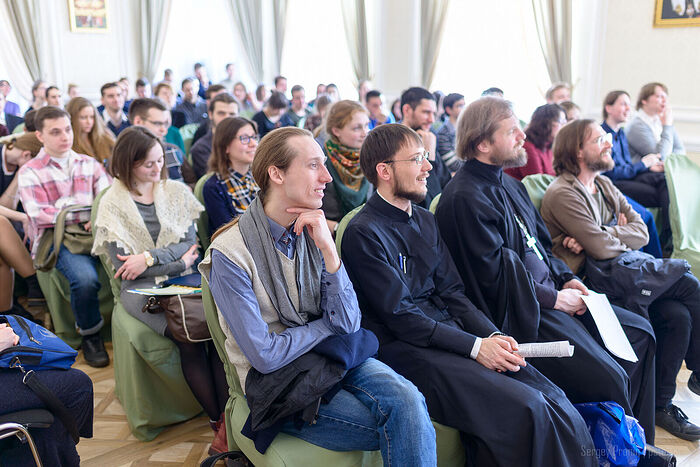
PSTGU through the eyes of teachers and students
Today, on the day of remembrance of St. Tikhon, the patron saint of the Orthodox St. Tikhon State University, teachers, graduates, students and staff are talking about their Alma Mater.
Andrey Ivanov, content manager of the Historical, Cultural and Educational Center “Cathedral Chamber”:
“It so happened that after forty I had to ask myself what to do in life now, what I would like to do in life. Everything that happened before was out of necessity, out of inertia. And it turned out that it is not so easy to find the answer to this question. It was difficult to even find the answer, but to ask the question itself. The question is not only for yourself, but also for God. And at some point I was able to mumble it out of muteness. And then I realized that I would like to do something related to the New Martyrs. Because for me they became the answer to many questions, the hope of finding an answer. About patriotism, about vocation, about immortality, about what can truly unite people. Death and lies: are they surmountable at all?..
A month or two later they called me and asked if I would like to take part in a grant project, to work at the Museum of the New Martyrs. It turns out that the Lord Himself answered me!!! It was a real shock!
I come for an interview with the project managers. And somehow it didn’t work out right away. I’m trying to say something about the exhibition, but I get questions about “relevant experience”, about how I’m going to “achieve the indicators stated in the project.” And I wilted. There is no experience. And there is no character corresponding to the tasks either. I understand this myself as a former manager. How so? So it seemed to me? Doesn't the Lord accept me?..
Managers are also perplexed. “Let’s,” they say, “let’s try to make an appointment with Father Vladimir.” And suddenly: “Father Vladimir will receive you, right now.” Let's go in and take the blessing. Father Vladimir looks at me for a long time, and then starts talking - but not at all about what was discussed with the project leaders. And every word of his falls on the soul, fills... It was a very short conversation. We stood up, Father Vladimir gave his blessing. And it was like after confession, for the first time in many years. "The Father's Embrace..."
It seems to me very important that our university bears the name of St. Patriarch Tikhon. Now it’s hard to imagine, but at the time when the university was created, there were completely different names around. Everything was named after the revolutionary leaders - and at the same time everything was impersonal. And then the name of Patriarch Tikhon became like a beacon. As in the times of revolutionary turmoil and civil war, when the name of Patriarch Tikhon united those for whom it was important to remain with Christ, with His Church. And now this name gave hope that another life was possible, that disunity, discord, disappointment, and burdened with sins could be overcome. All this can be overcome - with love. And after all, many responded to this call - not only those who secretly or openly during the Soviet years were able to remain involved in church life, but also those who, “having gone through half of their earthly life,” were exhausted from the surrounding untruth, and did not know where to go next and where to look for the truth. And Patriarch Tikhon, as it were, gathered under his omophorion the sheep that had been lost during the Soviet years.
Focus on the feat of the “Tikhonovites”
Polina Vladimirovna Simonova, graduate and teacher of the Faculty of Church Singing:
— First of all, the University for me is a place of formation, a place of my professional and personal formation. Having first entered the music school, and then the faculty of church singing, I studied here for 8 whole years, and all the discoveries of my inspired youth took place within the walls of the university. At PSTGU my first musical revelations happened, and when I began studying at the faculty, I had revelations about the beauty of the art of church singing.
Of course, the university for me is a place of meeting with wonderful teachers who love their work with all their hearts, who were able to ignite this love in us, their students, including me. A meeting place with my dear friends, many of whom I still keep in touch with very warmly. Well, PSTGU also seems to me to be some kind of big, big common cause for the benefit of the Church. This is a matter of such a scale that you seem to be a small cog in it, but I want to believe that I can make my contribution as much as I can!
One of our faculty rehearsals for services on November 17th and 18th comes to mind. At the evening service there are wonderful stichera, which list all the saints, participants in the Local Council, who subsequently suffered martyrdom. I remember how at this rehearsal the head of the department of regency Tatyana Ivanovna Koroleva, explaining the text of the stichera, briefly told us the life of each saint. And after this very fiery story, she said: “Know them!” And indeed, the “Tikhonovites” are not those who put on the University badge after graduation. These are the same associates of St. Tikhon who endured hardships and persecution for taking upon themselves his name. We can only focus on their feat and, indeed, as Tatyana Ivanovna said, know as much as possible about their life and death!
Elizaveta Ushkevich, 1st year master's student at the Faculty of Theology:
— At PSTGU, people are connected not only by education and science, but also by a common liturgical life, which connects us with some invisible threads stretching since the founding of the University, turning us into one big family. It is a special value to feel at home at the university and together be guardians of the church tradition, while participating in the modern mission of our University.
I really love our faculty services, especially the everyday early liturgies that are celebrated every day. This common prayer is very dear to me, when every day, every couple, every event begins and ends with prayer. This evokes a very special feeling of belonging to something very important. Even at the university, they are especially sensitive to the memory of the new martyrs. Indeed, when they look at you from icons and photographs, talk to you through their letters and sermons, they become very close and dear, and you also feel a reverent responsibility for preserving their memory. I feel this especially acutely every time at the all-night vigil on the faculty holiday of October 9, when the entire cathedral chamber sings the troparion to St. Tikhon.
Lately, for some reason, I have been remembering with warmth the days of passing state exams and defending my diploma. As usual, I was terribly worried then, but a few minutes before the defense, the scientific adviser said with a smile: “As the French say, “bon courage.” Everything then went somehow very calmly and kindly: not only friends supported me, but also teachers, for which I feel especially grateful. And this phrase seems to very well reflect my personal relationship with the University. Every time he opens another new door, he seems to push him towards it and says with a smile: “Bon courage!” And with God’s help, something works out in the end.
“Here you feel like you are part of one big happy family”
Varvara Artamkina, 1st year student of the Faculty of Church Arts of PSTGU:
— I have known about St. Tikhon’s University since childhood. His parents talked a lot about him, about his history. I entered the Faculty of Church Arts this year, studied for only a short time, but the university has already become a home for me! This is a very beloved and dear university. I'm happy to be studying here.
At our department we are engaged in the restoration of icons made in tempera and oil techniques. We start with tempera painting. Already in the first semester, in mid-autumn, we were given our first icons. It was very interesting and joyful to finally start real work, try my hand and gradually begin to learn new skills. It is especially pleasant that at the department we study together with senior students. If we have any questions or something doesn’t work out, we can always turn to them. They will advise, help and share their experience. Thanks to this, you feel like you are part of one big friendly family, in which everyone helps each other. I am glad that already from my first year I can get involved in the real work of serving the Church.
Churchliness, professionalism and humanity
Deacon Nikolay Antonov, head of the department for strategic development, associate professor of the department of systematic theology and patrolology of PSTGU:
— It seems to me that the distinctive feature of PSTGU is that we have three vectors that, it would seem, may contradict each other. At a basic level they are indeed somewhat contradictory. This often happens in life, on an ideological level. But the fact that we manage to combine them shows that in reality they do not contradict each other.
This is churchliness, professionalism and humanity.
Within the walls of the university, these three vectors are not opposed to each other. Sometimes the emphasis may shift in one direction or another, but it is still important that they can coexist.
What is humanity? It's not just about being polite to others and being humane. It is also an opportunity to live a holistic life. This is the understanding that before us is a whole person, and not just a church person, not just a professional or someone else. The fact that families are created at our university, that people live a family life here and participate in the life of the university, is one of the aspects of humanity. This also includes interest and the feeling that the university is the work of our whole life.
This does not reduce professionalism. On the contrary, such a structure of life contributes to the development of the general level of culture and professionalism.
And all this does not contradict churchliness. It would seem that our church life could interfere with this, limit or reduce the importance of other aspects of life. But with us everything is different!