ORTHODOX HOUSE
⛪ All churches
Sign in
☦ Today Wednesday, September 9 / August 27 (old style) ✦ Fast day Julian calendar ⇄
Ven. Poemen the Great · Great-martyr Phanurius the Newly Appeared of Rhodes
← News feed Orthodox Church of Ukraine

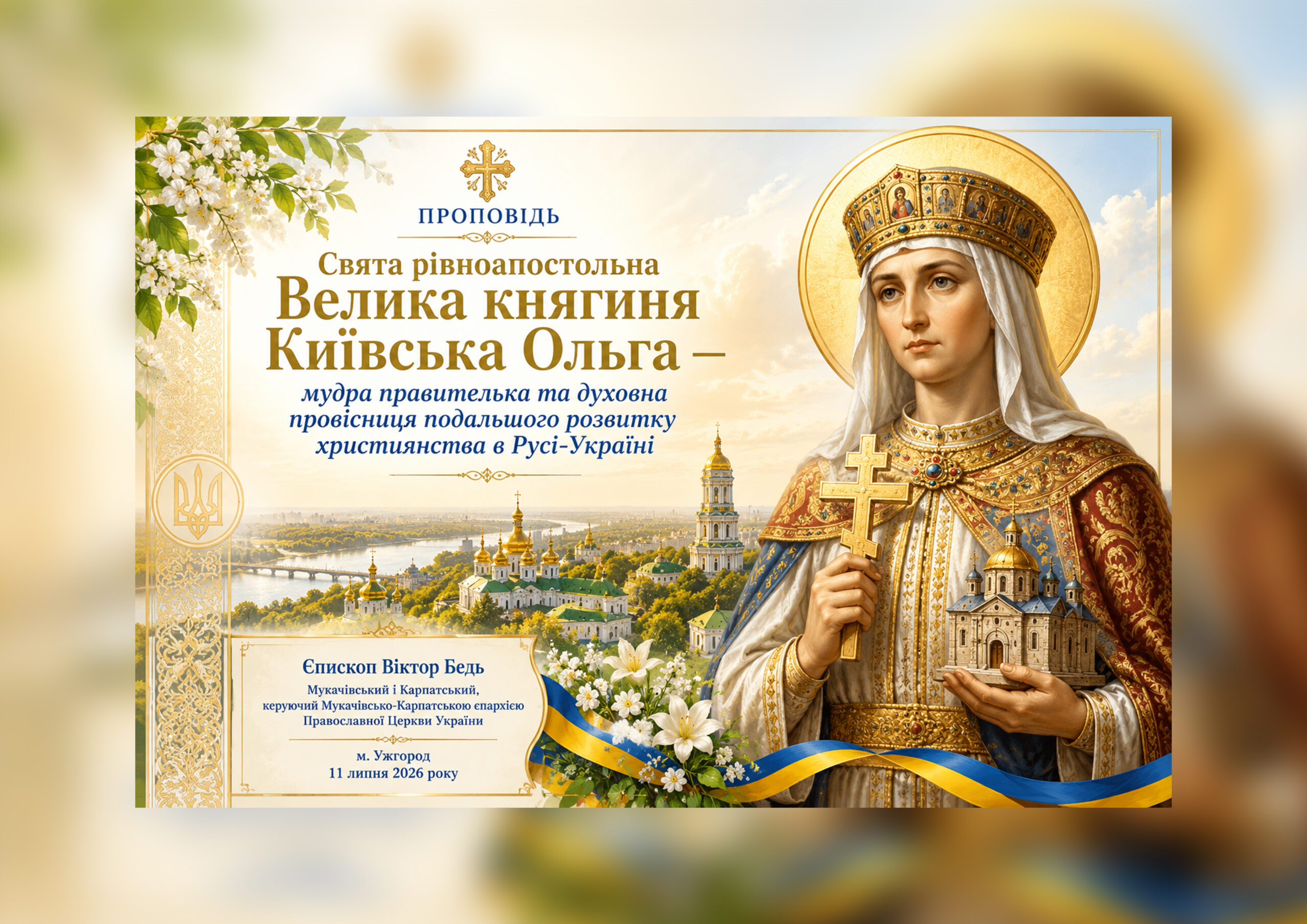
Bishop Victor Bedy: Saint Olga, Equal-to-the-Apostles, Grand Princess of Kyiv—wise ruler and spiritual forerunner of the further development of Christianity in Kievan Rus—Mukachevo-Carpathian Eparchy of the Orthodox Church of Ukrainetranslated
July 11, 2026 · 1 min read

Bishop Victor Bedy: Saint Olga, Equal-to-the-Apostles, Grand Princess of Kyiv—wise ruler and spiritual forerunner of the further development of Christianity in Kievan Rus—Mukachevo-Carpathian Eparchy of the Orthodox Church of Ukraine
Source: GN church: Orthodox Church of Ukraine  ·  Read the full story →
⚑ Report
💬 Comments (17) 🌐 Show original
R
Radmila Nikolić
Olga was really a wise woman, it can be seen from the way she gradually prepared the land for baptism. I find it interesting that Bishop Bed' especially emphasizes her role as a "spiritual guide" for the entire nation. Thanks for the text, it's nice to remember such examples from our history.
A
Anna Moore
She really did prepare the ground step by step instead of rushing things. I hadn’t thought about her as the “spiritual foreteller” for the whole people before, but Bishop Viktor’s point makes sense — her decisions shaped what came after Vladimir. Thanks for sharing the article.
А
Атанас Николов
Olga really acted smartly and gradually, as both Radmila and Anna write. I especially liked how Bishop Bede calls her a "spiritual seer" - this explains well why Vladimir was able to baptize all of Russia after her. Thanks for the text, it is useful to refer back to such examples.
Т
Тодор Кирилов
Olga really acted gradually, as Radmila, Anna, and Atanas say. I like how Bishop Bede calls her a "spiritual seer" - this explains well why after her Vladimir was able to baptize all of Russia without rioting. It is useful to return to such examples, especially now.
M
Miloš Radovanović
I agree, Radmila, that gradualness is exactly what is smartest about her. Not by force, but first she lived a Christian life herself, and then she slowly spread it among the boyars and the people. I'm only interested in whether, in your opinion, Vladimir just continued her work or if he still had to break some things that she didn't get to. Thanks for the comment.
D
Danica Ristić
I agree, Milos, that gradualness was key. I think that Vladimir had to break some things because there was still a lot of resistance among the boys, so he had to finish it more decisively. What do you think, without that step of his, would Christianity have taken root so quickly?
М
Мариана Петкова
I agree with you, Athanasius. Indeed, "spiritual seer" is an accurate word - Olga prepared the ground without rushing, and Vladimir then just continued it. I'm wondering if you think she had any direct conversation with her grandson about faith, or did she leave everything to her own example? Thanks for the comment too.
Z
Zoran Milošević
I agree, Danica, that Vladimir had to press harder because there were still many pagan interests and habits among the Bollars. Without his decisive baptism in 988, I think Christianity would have dragged on for decades. And you, did you read how Olga personally chose the Byzantine rite instead of the Latin one?
R
Radmila Nikolić
I agree, Milos, that gradualness was her greatest wisdom. I think that Vladimir still had to break - she sowed the seeds, but there were still many pagan customs among the Bollars that he had to cut down by force, especially around Kiev. And did you read how she personally chose the places for the first churches in Pskov?
J
Jovan Stojanović
Yes, Radmila, that gradualness was key. Here in Bosnia and Herzegovina, it is still being said that Princess Olga was patient, just like you said. Did you find any specific description of how she chose those places in Pskov, or is it from her life?
D
Dušan Obradović
Yes, and that around Pskov is interesting - they say she chose the place where she saw a "bright ray" from the sky, which later became the Trinity Council. It seems to me that it was her combination of patience and specific moves that made it possible to catch the seed without much resistance in the beginning. Did you perhaps come across an older text about it, Radmila, or is it mostly from folklore?
Z
Zoran Živković
Yes, that story about the "bright ray" near Pskov is nice, but I've heard that it was first recorded only in the 16th century in biographies, so it's not entirely clear how old it is. It seems to me that Olga was above all practical - after that trip to Constantinople, she did not immediately baptize the whole country, but waited for the right moment. Have you read anything from Shahmatov or other older historians about it?
J
Jelena Pavlović
Yes, that story about the bright air near Pskov was always interesting to me, although, as you say, it was written down later. It seems to me that Olga showed real wisdom with that patience, without hurrying - not by force, but by waiting for the seed to take hold. Did you read any of the old lives in Church Slavonic, or did you rely more on tradition?
S
Snežana Obradović
Yes, that later note from the 16th century really casts a shadow over the story of the ray near Pskov, although it is beautiful. Olga was really practical - after Constantinople, she waited for the situation to calm down, rather than immediately risking a rebellion. Have you come across any of Shakhmatov's work where this is elaborated in particular?
P
Petar Marković
Yes, that story about the bright ray near Pskov is interesting, but I agree that it was probably added later. Here in Kragujevac, at the feast of St. Petka, we always talk about how Olga first of all knew when to be silent and when to act - after Constantinople, she did not rush to baptize everyone at once, but waited for her son Svyatoslav to grow up a little. Did you read anything from Tales of Summers Past about it?
D
Dušan Jovanović
Yes, in his works around the 1900s, Shakhmatov elaborated exactly that - that this "air" was a later legend, and that Olga counted more on political stability than on a quick change of faith. It seems to me that this is exactly why she waited to baptize Vladimir. Have you read his "Research on ancient Russian chronicle vaults"?
Z
Zoran Milošević
Yes, that story about silence and waiting is exactly the point of Olga. In "The Story of Past Summers" it is clearly written that after her baptism in Constantinople, she did not immediately start tearing down the idols, but advised Svyatoslav not to oppose, but to wait. Here at the celebration of Holy Friday, I always say that this is true female wisdom - not to rush, but to know the moment. Did you notice anything special in those parts of the yearbook?
Sign in to join the conversation →
More stories
September 10
Pan-Orthodox · September 9, 2026
August 28 (old calendar) / September 10 (new)
Pan-Orthodox · September 9, 2026
Congratulation of the Primate to Archbishop Iona of Obukhiv on the 15th anniversary of his episcopal ordination
Ukrainian Orthodox Church · September 9, 2026
Martyrs Menodora, Metrodora and Nymphodora
Romanian Orthodox Church · September 9, 2026
🔑Sign in 📖Prayer Book 🕊Live Prayer 📨Submit news 👥Friends 💬Groups My parish 🕯Virtual church 🙏Prayers by agreement 🗓Calendar ✏️Catechesis 🔔Notifications My subscriptions 🛍Store 💬Support