On conciliarity, catholicity and democracytranslated
Alexander Shchipkov The portal “International Affairs” published an article by the rector of the Russian Orthodox University of the Holy Apostle John the Theologian, deputy of the State Duma of the Federal Assembly of the Russian Federation A.V. Shchipkova.
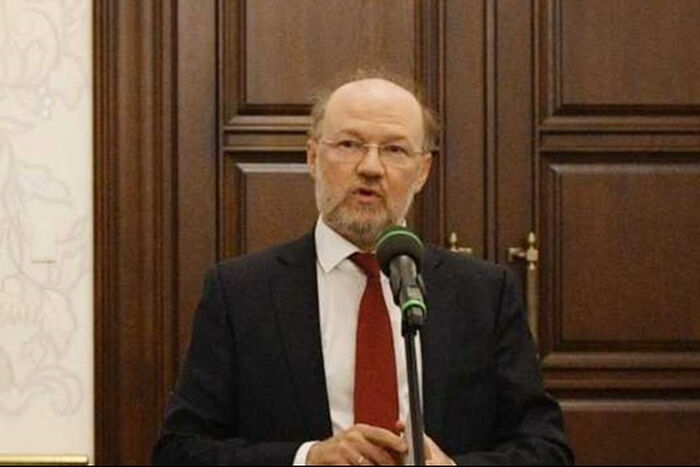
The portal “International Affairs” published an article by the rector of the Russian Orthodox University of the Holy Apostle John the Theologian, deputy of the State Duma of the Federal Assembly of the Russian Federation A.V. Shchipkova.
In our time, we often see the replacement of theological concepts with others that do not have such a definite status in church practice. One such case is associated with the words “catholicity,” “conciliarity,” and “democracy.” Their use often gives rise to a feeling of superficial clarity, which obscures their real meaning, and as a result, the phenomena denoted by these words appear in the wrong light.
Let's start with the obvious. The concept of “catholicity” was enshrined by the Council of Nicaea (325 AD) and characterizes one of the four main properties of the Church mentioned in the Creed. In the Church Slavonic tradition, the Greek word “καθολικὴ” (universal, universal), as a result of the translation of the Creed made by Equal-to-the-Apostles Cyril and Methodius, received an analogue “conciliar” (sobornaya). From this moment, conciliarity becomes an analogue of “catholicity,” therefore, in the Russian version, the corresponding place in the Creed reads like this: “I believe in the One, Holy, Catholic and Apostolic Church.” However, the word “catholicity” is widely used in church theological practice.
We are talking about catholicity (conciliarity) as the most important law of church structure. Catholicity means completeness in the true faith. This is what unites the “circle of the faithful,” that is, the Church.
Scripture says: “Where two or three are gathered in My name, there am I in the midst of them” (Matthew 18:20). In other words, Christ himself, the head of the Church, is present in the Catholic community. Therefore, a simple community of pious people is not yet a Church, but becomes one - that is, it acquires catholicity only if it has a mystical connection with Christ.
As you know, every individual person is the image and likeness of God. But the Church, being a catholic community of people, is also His likeness. And this similarity manifests itself in two aspects.
Firstly, according to the words of the Apostle Paul, “The Church is the body of Christ” (Eph. 1:23), therefore it reflects the unity of the two natures of Christ and has two natures, earthly and heavenly, just as Christ has two parts, divine and human. Also, Paul’s definition emphasizes the indispensability of all members of the Church, as if parts of one body, as well as its universality, according to which before God “there is neither Greek nor Jew, circumcision nor uncircumcision, barbarian, Scythian, slave, free, but Christ is all and in all” (Colossians 3:11).
The Apostle Peter in one of his letters compares the community of the faithful to a church built of “living stones”: “You yourselves, like living stones, are being built into a spiritual house, a holy priesthood, to offer spiritual sacrifices acceptable to God through Jesus Christ. For the Scripture says: “Behold, I lay in Zion a cornerstone, chosen and precious; and he who believes in Him will not be put to shame" (1 Peter 2:6). It is difficult not to notice the beauty and theological depth of this statement.
In addition to direct definitions, to understand the essence of catholicity, it is necessary to take into account the difference between its Orthodox understanding and the Catholic interpretation.
Since the Great Schism of 1054, the Western Church has interpreted catholicity as universality - an external, territorial community within the “orbis terrarum” (circle of the earth, or globe); hence the self-name - “Catholics”, “Catholicism”. The Orthodox criterion of catholicity is not the external (territorial), but the internal fullness of the Church, a community of spiritual and mystical order. Saint Philaret of Moscow wrote that in Orthodoxy “the Church is called conciliar or universal because it is not limited to any place, time, or people, but contains and gathers within itself the true believers of all places, times and peoples.”1
It is quite correct to conclude that the Roman Catholic Church, based on its own interpretation of catholicity, violates genuine Christian catholicity. Among other things, its Catholic understanding shows that the globalism of the Western worldview was established already at the dawn of the Christian era, when catholicity was replaced by the “universal” jurisdiction of the Holy See. This precedent creates the preconditions for a number of other historical substitutions, in particular, for rethinking in European culture the catechesis of peoples as their colonization.
However, as events in Ukraine have shown, in some cases the Orthodox world can violate the Catholic principle. The Patriarchate of Constantinople committed a gross violation of it, exceeding its powers and issuing the infamous tomos to the schismatic pseudo-church structure - the OCU.
Despite the identity of the terms “catholicity” and “conciliarity,” debates renew from time to time about how successful the translation of the Greek word turned out to be. The arguments of the parties come down to a dilemma: what is more important, formal accuracy or the immersion of the concept in the conceptual sphere of the addressee’s language? By the way, translators of fiction and philosophical literature often find themselves and still find themselves in a similar dilemma.
In our case, the situation is as follows. A simple tracing from the Greek word “catholicity” is quite sufficient for a linguist and biblical scholar; it refers them to the Greek original source. But to a simple parishioner such a tracing will tell nothing and will not help him in any way in comprehending the essence of the Church. “Conciliarity” gives a visible, bright and convex image of the nature of churchliness as such. In any case, something has to be sacrificed: either accuracy, or imagery and accessibility, while both options are applicable and interchangeable, provided that terminological identity and a strict ecclesiological understanding of conciliarity are maintained.
In order to fully understand the role of the concept of conciliarity in Russian culture as a whole, and not just in the church sphere, we have, whether we like it or not, to take into account the ambiguity of this concept.
Conciliarity, also known as catholicity, mentioned in the Creed, represents to us the most important meaning available, but it is not the only one. Taken in a broad sense, “conciliarity” (as “assembly”, the result of a certain “assembly”) only indicates the principle of universality, in connection with which the adjective “conciliar” also has a second - secular, generalized-universal meaning. It means everything that is adopted by the meeting, consensus, general opinion, consent, for example, documents of the World Russian People's Council, conclusions of a state commission or medical consultation.
Finally, the third meaning of the word “conciliarity” is, as it were, on the border of the first and second meanings: this is how conciliarity was understood by Slavophiles in the 19th century. One of the main representatives of this movement, Alexei Stepanovich Khomyakov, attributed the property of “conciliarity” to both the church community and the peasant community (for example, in the essay “Semiramis”), and in a letter to the editor of “L’Union chrétienne” regarding the speech of the Jesuit Father Gagarin, he even contrasted the word “conciliar” with the word “catholic”, which he perceived in the Catholic interpretation (as “universality”). and thus de facto left true catholicity to Russian conciliarity.
A.S. Khomyakov sought to “expand” the concept, since the patriarchal nature of peasant life and the national way of life were dear to him. Thus, he hoped to help bring together two communities - church and non-church - on the basis of catholic conciliarity, as if to church one at the expense of the other. But this intention, good in plan, ultimately led to the opposite result, namely: to the secularization of the concept of “conciliarity” in the consciousness of a certain part of Russian inhabitants and the Russian intelligentsia, to a distorted interpretation and confusion.
True, Vladimir Lossky wrote the following on this topic: “Since the Slavic root “cathedral” means “assembly” and, in particular, “cathedral”, “synod”, the derivatives “conciliar”, “conciliarity” for the Russian ear acquired a new nuance, which does not mean that they have lost their direct meaning “catholic”, “catholicity”2. But today, looking back at almost two centuries, we can already state that the erosion of the concept of “conciliarity” in the conditions of its specific use in secular contexts has nevertheless occurred. That is why the third (“Slavophile”) version of meaning in Russian cultural consciousness still does not have clearly defined boundaries and seems to drift, vacillating between the ecclesiastical and the secular.
A commonplace of Slavophil thought has become the conviction that, unlike the Catholic and Protestant West, Russian society is conciliar in its original foundations. It strives to unite people “in the moral law of mutual love”3, since the spirit of authentic Christianity is still alive in Russia. But the authorities do not understand this and, since Peter’s reforms, have been striving to impose on the people the Western ideal of an autonomous, egoistic “private individual” who enters into a contract (“social contract”) with other autonomists, as if from a blank slate.
Some aspects of the Slavophil understanding of conciliarity were developed in later philosophical thought, both religious and secular - in particular, N.O. Lossky, N.A. Berdyaev, L.P. Karsavin, V.I. Vernadsky, N.F. Fedorov (the latter in his philosophy of “common cause”).
Unfortunately, the community, whose apology was launched by the Slavophiles and which the bureaucracy fought both before and after 1917, did not have time to “church” and came to a premature extinction in unfavorable historical conditions. The prerequisite for this situation was that A.S. Khomyakov in his reasoning went beyond the boundaries of church ecclesiology, which, however, does not negate his philosophical merits and deep understanding of the potential of the Russian community. It was this potential in the 20th century that helped our people endure great construction projects and the war against Nazism, but by the end of the 20th century it was practically exhausted, which was rightly lamented by country writers.
Alas, the polysemy of the word “conciliarity” opened up wide scope for speculation in the theological sphere. First of all, this concerns liberal-modernist theology, which pushes co-religionists to judge conciliarity according to its Western, Protestant models, which merge with secular republicanism. Thus, through substitution, the Presbyterian principle is imposed, which presupposes elective elders.
This model was founded by a follower of John Calvin, John Knox, who led the Reformation in Scotland in 1560.
Representatives of this school of thought juggle with different meanings of the concept of “conciliarity,” passing one off as another, and instead of catholic conciliarity, they actually promote a version of liberal democracy for the Church.
In this case, the church structure itself is interpreted in the spirit of the principle of “horizontal hierarchies of the earthly city.” Of course, this approach is based on a gross substitution of concepts and leads to the secularization of the Church. Democratic “conciliarity” has nothing in common with genuine, catholic conciliarity. Its source is actually the ancient pagan polis, and not at all the early apostolic community, which sought to survive and preserve itself in a pagan environment. The phenomenon of non-catholicity is also known to the early church in connection with the activities of the so-called “robber councils,” or false councils, for example, the famous council at Oak, which condemned St. John Chrysostom (this decision was later cancelled). Today, the distortion of the nature of conciliarity often occurs precisely as a result of the loss by certain groups of believers of the catholic spirit of the authentic Christian community and is a dangerous seduction.
The liberal approach in the spirit of non-catholic conciliarity is often used to fight the episcopate and patriarchy (through the demand for the election of the episcopate or the “universal priesthood”), that is, to fight the hierarchical principle in the Church. But hierarchy is another important principle that supports catholic conciliarity and without which the Church is impossible. These two principles are related like two sides of the same coin.
The key to preserving the Church from secularization and schism is today the comprehensive strengthening of the unity of these two principles - catholicity and hierarchy.
1 St. Philaret of Moscow. About the ninth member of the Creed // Long Christian Catechism of the Orthodox Catholic Eastern Church. St. Petersburg: Synodal Printing House, 1823.
2 Lossky V. On the third property of the Church // Journal of the Moscow Patriarchate. 1968 No. 8. P. 72.
3 Khomyakov A.S. About old and new // Articles and essays. M.: Sovremennik, 1988. P. 200.