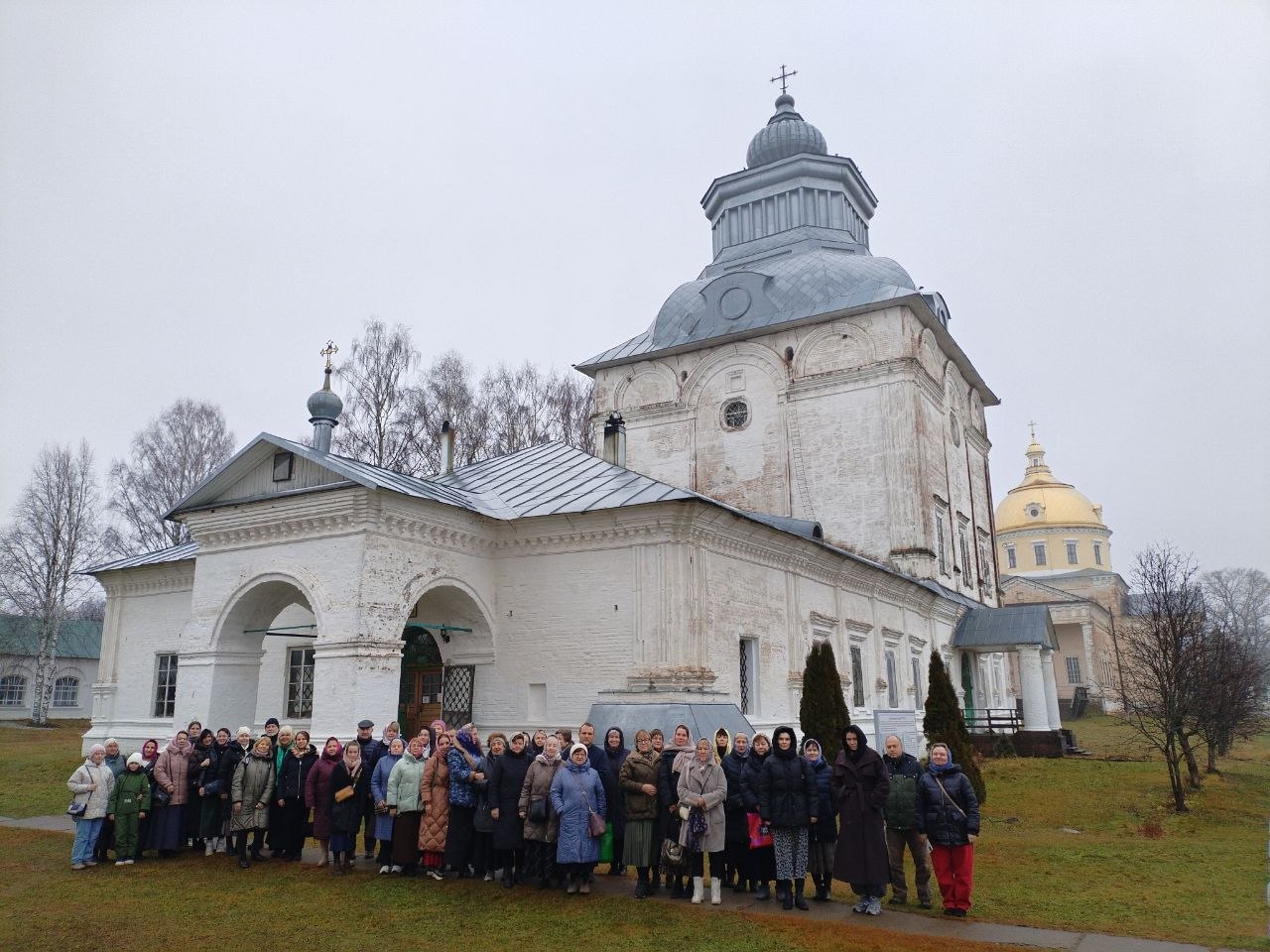
About the trip to the Vyatka diocesetranslated
Khlynov, Vyatka, Kirov - names given in different historical eras to the same city, located 896 km from Moscow. The trip to the Vyatka diocese, which took place on November 20-23, 2026, was made possible thanks to the support of Russian Railways OJSC as part of the social...
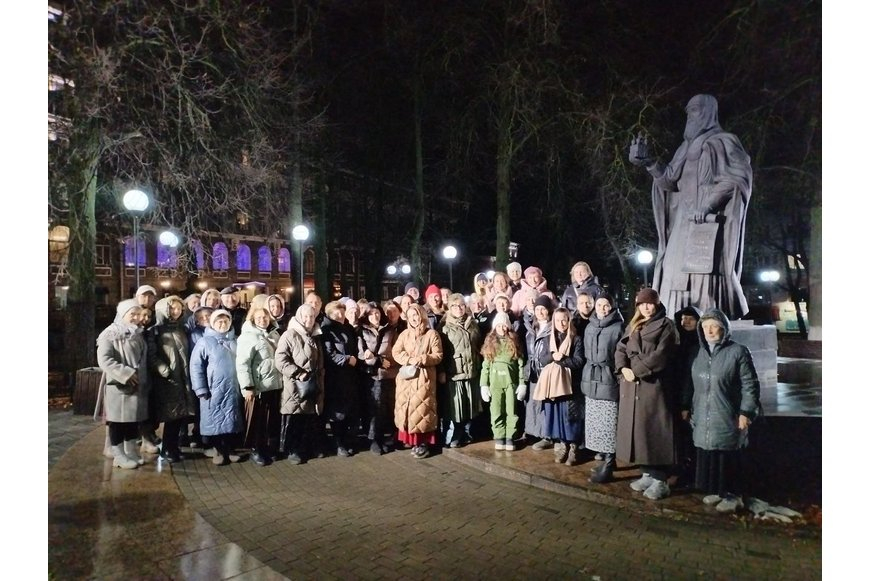
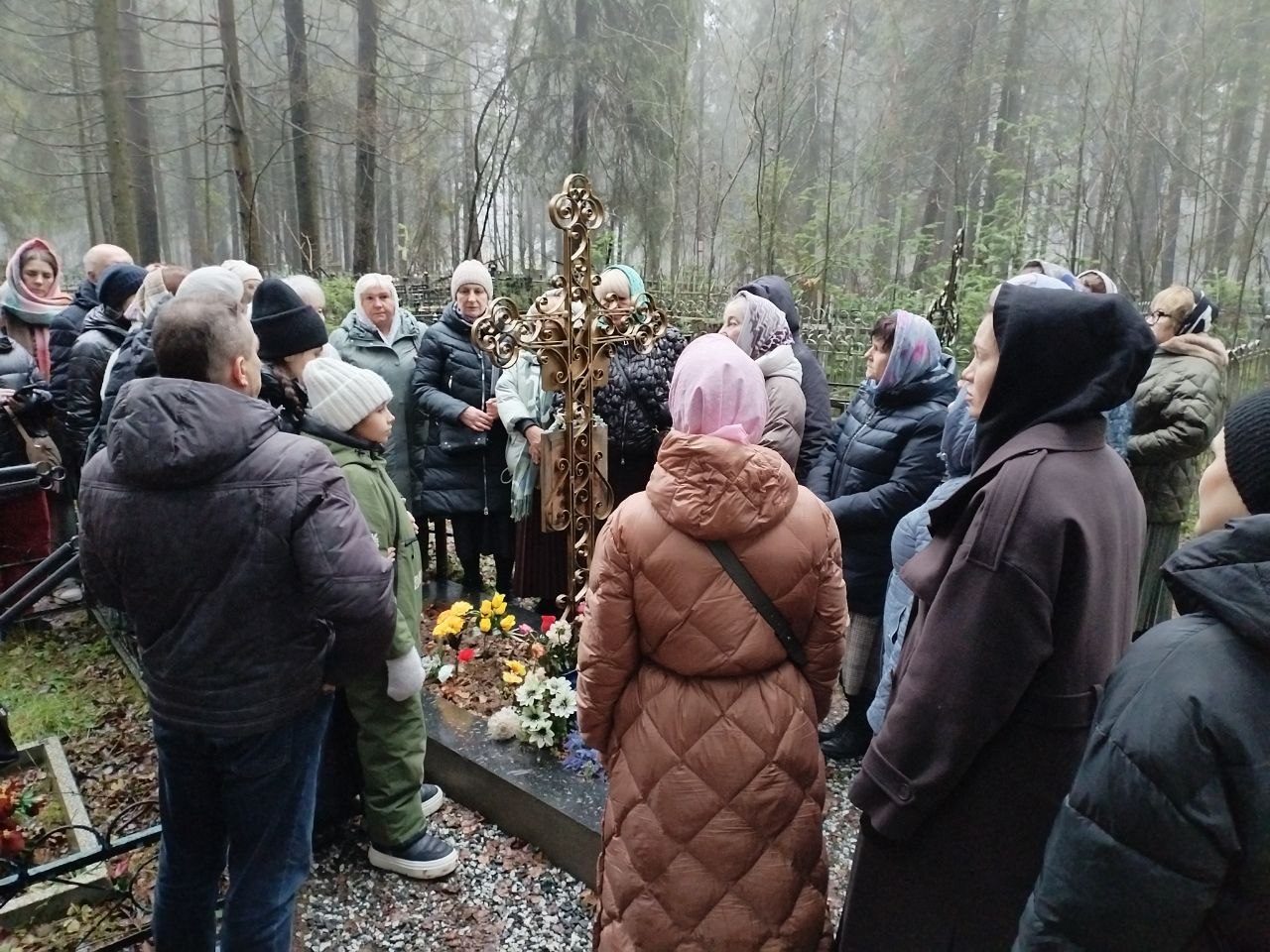
The pilgrimage began with a visit to the Philean cemetery, where, among many hundreds of graves, there is the burial place of the locally revered saint - St. Stephen of Phileia.
Information: Simeon Kurteev was born on July 17, 1830 in a peasant family in the village of Fileyki near Vyatka. He spent his childhood in the house of pious parents. From a young age, he had an ardent desire to serve God, knew many prayers by heart, read sacred books, and often visited church.
After graduating from high school, Simeon’s parents sent him to study in Kazan and then to St. Petersburg, but worldly life did not attract him. In 1850, the book “Letters of the Holy Mountainer about the Holy Mount Athos” was published, after reading which the young man had a great desire to devote his life to serving God. He dropped out of school and decided to leave the world. He lived in the Solovetsky Monastery, then traveled a lot, visited Sarov, the Glinsk Hermitage, the Crimea, the Holy Land, and visited Athos twice. During his wanderings, Simeon led an ascetic life, endured hunger and cold, and prayed incessantly. Returning, he lived in his native village of Fileyki. Not far from the village, in the forest, he dug a cave, where he labored in solitude, prayer and reading spiritual literature. Over the years of wandering, he learned smart heartfelt prayer.
The villagers, not understanding the high aspirations of the ascetic, considered him mentally ill, despised him, and mocked him. Simeon had to endure many sorrows and humiliations. Meanwhile, the Lord performed miracles through his prayers. Over time, people began to revere Simeon for his righteous life, kindness and kindness. When zemstvo schools began to open, the villagers begged Simeon to teach their children to read and write. Simeon agreed, but began to teach not from worldly textbooks, but from sacred books. Being an educated man, righteous Simeon finally decided to write his own works. His works on ascetic and moral topics were highly appreciated by the Vyatka Bishop Apollos, who persuaded the ascetic to take monastic vows and holy orders.
Fileyskoye Cemetery. At the grave of St. Stefan Fileisky

In 1877, on February 23, Simeon was tonsured a monk with the name Stephen in honor of St. Stephen of Great Perm, the enlightener of the Vyatichi people. On the third day after his tonsure, he became hieromonk Stephen of the Holy Cross Monastery in the city of Slobodskoye, but soon returned to his hermitage near the village of Fileyki. With his labors, Father Stefan erected a church and founded a monastery. The brethren began to gather to the elder. After some time, the monastery was transformed into the men's dormitory Alexander Nevsky Hermitage, and on March 10, 1890, the construction of the Alexander Nevsky Monastery was allowed. By this time, the elder’s strength had weakened greatly, but the foundation of the monastery was carried out under his leadership. Soon after this, the blessed death of the elder followed: on August 6, Father Stefan was tonsured into the schema, and on August 15, he peacefully departed to the Lord.
Hieroschemamonk Stefan was buried in the monastery he founded, next to the Assumption Church. Immediately after his death, people began to constantly come to his grave, they served memorial services, turned to the elder with requests and always received what they asked for. In Soviet times, the honorable remains of Father Stefan were transferred to the Fileyskoe cemetery in Vyatka, and his hermitage was devastated. The godless authorities made every effort to erase the memory of the ascetic from people’s hearts, but they failed. In 1998, the cell icon of Father Stephen was miraculously found - the miraculous image of the holy great martyr and healer Panteleimon with a particle of his relics.
On October 29, 2001, Patriarch of Moscow and All Rus' Alexy II blessed, based on the facts of the ongoing popular veneration of the ascetic and miracles through his prayers, to glorify St. Stephen among the locally revered saints of the Vyatka diocese. On July 14, 2002, this glorification was performed, a life was compiled and an icon of the saint was painted.
Having sung the glory of St. Stephen at the place of his burial and bowed to his relics lying in the ground, we headed to Orlov, where in the Church of the Nativity of the Blessed Virgin Mary we were met by its rector, Hieromonk Nikodim (Polushkin). Father Superior, co-served by the head of the Pilgrimage Section of the IOPS, Hegumen Seraphim (Kravchenko), performed a prayer service in front of the shrine with the relics of the Hieromartyr Michael, Presbyter Orlovsky, who became the first new martyr of the Vyatka diocese.
Orlov. In the Church of the Nativity of the Blessed Virgin Mary
Information: Mikhail Petrovich Tikhonitsky was born in 1846 into the family of a psalm-reader. Having completed the full course at the Vyatka Theological Seminary, in 1868 he was ordained to the priesthood. He began his pastoral ministry in the Ilyinsky Edinoverie Church of the Izhevsk plant, then in the villages of Podrelie and Bystritsa, and in 1880 in the city of Orlov. Father Mikhail was an honest and sympathetic man, he loved his parishioners, and they repaid him with unfeigned love. In Orlov, Father Mikhail taught the Law of God at the local gymnasium. He instilled in his students a sincere sense of reverence for God, love for the Church and respect for people.
In 1917, Russia was swept by a wave of revolution and red terror. Grieving over the grief that befell the Russian people, Patriarch Tikhon issued a message in which he cursed the persecutors of the Church and called on all people to peace and harmony. On February 15, 1918, Father Mikhail read a message from His Holiness Patriarch Tikhon during the Divine Liturgy in the Kazan Cathedral in the city of Orlov. He was soon arrested and put on trial. The parishioners stood up for their beloved priest and were able to persuade the persecutors to postpone the arrest. But, six months later, when the country was swept by a new wave of Red Terror, Father Mikhail was captured again. The Extraordinary Commission at the Tribunal, having carried out an investigation, decided: “For disseminating counter-revolutionary appeals, priest Mikhail Tikhonitsky should be shot.” The sentence was carried out on September 20, 1918.
Three sons of Father Michael linked their fate with the Russian Orthodox Church: Vyacheslav accepted monasticism early and then, already in exile, became Exarch of Western Europe (Metropolitan Vladimir); Veniamin served as a priest in Vyatka for many years, and in 1942 he became a monk and, in the rank of Archbishop of Kirov and Slobodsky, worked hard on the revival of the Vyatka diocese; Elpidifor, a talented teacher and deeply religious Christian, died in Stalin’s camps. The daughters of Father Mikhail worked for a long time in the teaching field in Orlov and humbly looked after their father’s grave.
By the determination of the Holy Synod of the Russian Orthodox Church, Father Michael is now canonized as the new martyrs and confessors of Russia. His glorification took place in 2003. On September 8, 2008, his holy relics were found at the Orlov cemetery, which now rest in the parish Church of the Nativity of the Blessed Virgin Mary.
In the afternoon there was a trip to the Velikoretsk courtyard of the Holy Dormition Trifonov Monastery, where the image of St. Nicholas the Wonderworker was revealed on the river bank. The Velikoretsk religious procession is held annually at the site of the icon’s appearance, in which tens of thousands of people take part.
Reference: The first information about the Velikoretsk Icon appears in the Nikon Chronicle (second half of the 16th century). Initially, the religious procession took place along the Vyatka and Velikaya rivers on boats and rafts on the first Sunday after the feast of the transfer of the holy relics of St. Nicholas to Bargrad (May 22). Since 1668, with the blessing of Bishop Alexander of Vyatka, a new date for the celebration was established - June 6. Later, in 1778, a new route was developed - an overland route, which is still in use today.
In the first years of Soviet power, the tradition of the religious procession was steadily preserved. In 1935, after the demolition of the cathedral in Vyatka, where the Velikoretsk Icon of St. Nicholas was kept, religious processions stopped due to the loss of the icon. But despite the unofficial ban on the move, it turned into a pilgrimage of small groups of believers to the banks of the Velikaya River to the place where the miraculous icon was found. In 1959, an official ban on pilgrimages to the Velikaya River was published for the first time. Nevertheless, the pilgrimage was never interrupted.
The revival of the religious procession began in 1989, when the ban on pilgrimage was lifted. From 1989 to 1993, the religious procession was allowed only from the nearest village of Chudinova (10 km away). Since 1993, the religious procession began to take place along the historical route. In 2000, by the decision of the Patriarch of Moscow and All Rus' Alexy II, the Velikoretsky religious procession received the status of an all-Russian one.
In the Church of the Transfiguration of the Savior of the Velikoretsk Metochion, Abbot Seraphim (Kravchenko) served a prayer service to St. Nicholas. Pilgrims had the opportunity to venerate the revered image of the Pleasant of God and venerate the particle of his relics kept in the ark.
The pilgrims visited the supposed site of the appearance of the Velikoretsk icon, drank water from the holy spring, and some also plunged into the font.
In the evening we prayed in the St. Seraphim Church, which in Soviet times had the status of a cathedral. The all-night vigil with the blessing of the church clergyman, Archpriest Sergius Sizikhin, was led by Abbot Seraphim (Kravchenko), who was co-celebrated by Deacon Dionysius Bulychev.
Vyatka. All-night vigil in St. Seraphim Church
On Sunday, pilgrims who arrived from the capital prayed in the Assumption Cathedral, the main church of the Trifonov Monastery. The Divine Liturgy was led by the abbot of the monastery, Archimandrite Job (Muravyov), co-served by Abbot Seraphim (Kravchenko) and Hierodeacon Dionysius.
Information: The Assumption Monastery became one of the first in the Vyatka region. It was founded by a native of Arkhangelsk peasants, the Monk Tryphon of Vyatka. At his suggestion, residents of five Vyatka cities wrote a petition to Tsar Ivan Vasilyevich asking for the creation of a monastery. In June 1580, the tsar gave the monk a charter for the construction of the monastery and allocated land for it from the old city cemetery with two dilapidated churches. The tsar also granted the Vyatka monastery “freely and without debt” with villages and hamlets with people, arable land, meadows and lakes. His son, the blessed Tsar Theodore Ioannovich, as a sign of special favor, sent twelve carts with icons, books, vestments and various church utensils as a gift to the Vyatka monastery. He also granted the monastery rich land holdings, in particular, the Voblovitskaya volost and uninhabited lands in the Kazan district, where the village of Polyanka (Vyatskie Polyany) was subsequently founded. The monastery settled the empty lands with peasants from the Voblovitskaya volost, contributing to the development of the vast, sparsely populated region.
Rich donations and income from the lands allowed St. Tryphon to build 4 churches in the monastery. The first church in honor of the Annunciation of the Blessed Virgin Mary was floated down the Vyatka River from the city of Slobodskoye. After some time, a second, more spacious, Assumption Cathedral was built. This was followed by St. John the Baptist and Gateway St. Nicholas churches. By the beginning of the 17th century, 14 cells for monks, a bell tower, and outbuildings - cellars, granaries, a cookhouse with bread and a kvass brewery - were also built. The monastery was surrounded by a wooden fence, which had two entrances on the north side, one of which was called the Holy Gate. On the eastern side of the Assumption Cathedral there was a wooden chapel over the spring. Behind the monastery walls there were stables and cattle yards.
The Monk Tryphon introduced a strict communal rule, according to which all monks had a common meal and property, drinking wine was prohibited, and no one could visit or invite guests. Services were held daily in the monastery. Such severity was not to the liking of the elder brethren, and the saint was expelled from the monastery - only in 1612, at the end of his life, was he able to return and rest in the monastery he founded.
Cancer with the relics of St. Tryphon Vyatsky
Since 1600, the abbots of the monastery have held the rank of archimandrites. In the 17th century, the importance of the first monastery of the Vyatka land grew. In addition to the economic development of the region, the monastery conducted missionary and educational activities. Churches and chapels were built on patrimonial lands, and the monks of the Tryphon Monastery founded new monasteries in the area. The monastery also became the cultural and book center of the Vyatka land - here novices and monks learned to read and write, copied and compiled new works, and already at the beginning of the century there was a rich library with more than 140 books.
Vyatka. Holy spring in Tryphon Monastery
Significant funds allowed the monastery to quickly restore buildings after fires and begin expensive stone construction. In 1684-1689, a stone Assumption Cathedral was erected on the site of the wooden one. The main work on the construction of the stone ensemble took place at the beginning of the 18th century - the Holy Gate with the gateway St. Nicholas Church was built in stone in 1692-1695; in 1711-1717 the Church of the Three Saints; in 1714 the bell tower; in 1717-1725 the Fraternal Corps; in 1719 the Superior Corps; in 1728 the Church of the Annunciation; During the same period, fences with towers were erected.
In the monastery rest the relics of St. Tryphon of Vyatka (in a shrine under the canopy) and the relics of Blessed Procopius of Vyatka (under a hidden cover). In the gate church, where the image of St. Nicholas, revered and used in the Velikoretsk religious procession, is located, abbot Seraphim (Kravchenko), having asked for a blessing from the father of the governor, served a prayer service, after which we went to the holy spring, located on the slope behind the Assumption Cathedral.
In the St. Nicholas Church near the Velikoretsky Icon of St. Nicholas
After the meal, the IOPS pilgrim group visited the Transfiguration Convent, where we had the opportunity to venerate the relics of St. Victor the Confessor, Bishop of Glazov. Our meeting with Abbess Thaddea (Sivtsova) turned out to be accidental, but useful for the mind and heart. Mother briefly but succinctly told the Moscow pilgrims about the purpose of Christian life. Before leaving the monastery, we still managed to visit the monastery museum, which also displays the original things of St. Victor.
Vyatka. Conversation between Abbess Thaddea and pilgrims
The next stop on our way was the city of Slobodskoy. At St. Catherine’s Cathedral, our pilgrim group was met by the rector of the church, priest Sergius Pentin, who spoke about miraculous events that took place in the lives of parishioners through their faith and prayers. Pilgrims venerated the icon of the Holy Great Martyr Catherine with a particle of her relics and the image of the Mother of God “Quick to Hear” from Athos.
Slobodskaya. In the Catherine's Church
Outside the program, we also managed to visit the Slobodskaya Convent of the Nativity of Christ, the main shrine of which is the icon of the Mother of God “Consolation in Sorrows and Sorrows.” We also visited Cathedral Square: next to it stands the wooden church of the Archangel Michael, erected in 1610-1614.
Slobodskaya. Church of St. arch. Mikhail
Returning to Vyatka in the late afternoon, we visited the Spassky Cathedral, which is undergoing large-scale restoration. The rector of the church, Archpriest Sergiy Endaltsev, not only spoke about the history of the restoration of the destroyed shrine, but also showed the guests the upper church, into which a multi-span cast-iron staircase leads.
A bright and memorable end to the trip was dinner, during which traditional Vyatka cuisine was served.
Head of the Pilgrimage Section of the IOPS Hegumen Seraphim (Kravchenko)