SAINT CATERINEtranslated
FOREWORD The hymn writer calls her "all-glorious nymph of Christ" Saint Catherine and very rightly because... The article SAINT AKATERINE appeared first on HOLY DIOCESE OF MONEMVASIAS AND SPARTIS - HOLY DIOCESE OF MONEMVASIAS AND SPARTIS.
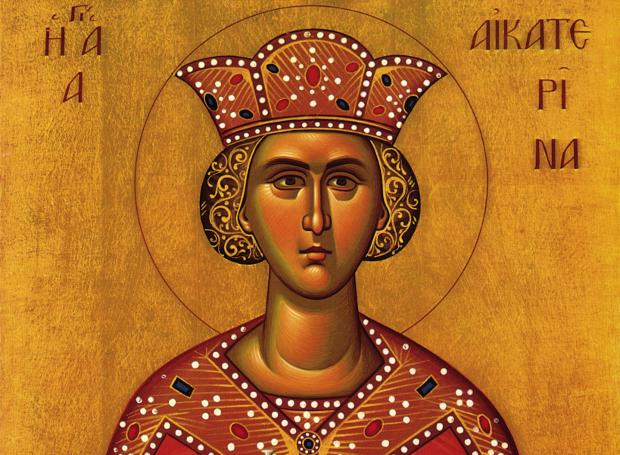
The hymn writer calls her "all-glorious nymph of Christ" Saint Catherine and quite rightly because the Saint, as the only bride of her soul, had made Christ. Her truly multi-sport life amazed everyone. Wisdom and knowledge, all the science of her time had become her property. But he despised everything for the love of the unique Bridegroom, Christ.
And yet the wisdom of this world did not mislead her, nor did earthly philosophy. He placed it at the service of true philosophy, in order to attract the philosophers and orators of that time to the faith of Christ.
She endured many tortures and imprisonments and the Lord miraculously freed her from all of this. Finally, she surrendered her holy soul by a martyr's death by the sword, so that from then on she would be an ambassador for all who invoke her protection. She is particularly honored on Mount Sinai by the monks of Sinai Monastery, because her body was miraculously transported to this mountain.
We think that the dear reader will receive great benefit from reading the life of Saint Catherine, which is why we are publishing this booklet with the wish that the Great Martyr "begs for great mercy."
Saint Catherine was born in Alexandria and was martyred during the time of the impious kings Maximian, Maxentius and Maximinus (305-313). She was the daughter of the ruler of Alexandria, Consta (or Kesto), famous for her beauty and wisdom, because she had been educated in the lessons of Greek education and knew Homer, Virgil, Aristotle, Plato and other ancient authors.
Many wealthy lords of the senate asked her in marriage from her mother, who was a secret Christian because of the persecution initiated by Maximian. Her relatives and her mother advised her to marry so that her father's kingdom would not fall to a foreign man, but Catherine loved virginity and avoided proposals. Tradition mentions the following incident: When they began to bother her systematically, she said to them:
Find a young man who resembles me in the four gifts you confess, that I surpass other young women, and then make him my husband, for I do not accept to take my inferior. Inquire if there is anyone like me in nobility, wealth, wisdom, and beauty. If he lacks any of these, he is not worthy of me.
They all knew that it was impossible to find such a person, and they told her that the son of the king of Rome and others were nobler and richer than she, but inferior in wisdom and beauty. But the daughter did not accept to be "illiterate", as she said.
Her mother had spiritual a holy man outside the city. So he took Catherine and they went to consult him. The ascetic heard her wise words and thought to attract her to the faith of Christ. So he said to her: I know a wonderful man, who surpasses you in all gifts and in innumerable others. His beauty outshines the sun in brightness, his wisdom rules over all beings, his wealth is shared throughout the world and never diminishes, his kindness is inconceivable and invincible.
The daughter thought it was an earthly lord and asked if these gifts were real. So he asked: Whose son is he?
He has no father on earth, but was born supernaturally of a Most Holy Virgin, who was claimed for her holiness to remain immortal in soul and body.
Is it possible for me to see this news, of which you speak so wonderfully?
If you do as I say, you will deserve to see his face.
I see you as a knowledgeable and respectable person, I believe you are not lying to me. I'm ready to do whatever you tell me.
Then the ascetic gave her an image of the Virgin Mary holding the divine Infant and said to her: This is His eternal Mother. Take her and after you close the door of your room let's pray all night and beg her, whose name is Mary, to show you her Son. I hope that if you pray in faith, he will hear you.
Catherine took the icon and all night locked in her chamber she prayed, as the old man told her. He fell asleep from the trouble and sees in a vision the Virgin Mary with the divine Infant. But he had his face turned towards his Mother, so the daughter could see his back, desiring to go from the front to the other place, but Christ was turning his face again. This happened three times. Then he heard the Virgin Mary say:
Embrace, my child, your servant Catherine, how beautiful and good she is. The infant responded:
It is dark and ugly, so much so that I cannot see it at all.
Is she not wise above all orators, rich and noble?
My mother, he is ignorant and very low in his condition, so he should not look at me in the face.
Please, my child, do not despise your creature, but instruct and lead it so that it may enjoy your glory and see your face, which even the Angels desire to see.
Let her go to the old man who gave her the image and do what he advises and then she will see me.
The next day he started in the morning with a few women and arrived at the old man's cell. With tears she told him the vision and asked his advice. The saint narrated all the Mysteries of true faith, beginning with the creation of man.
After the catechism, the Saint, putting down the old man and wearing the garment of a divine cloth, returned to the palace. She spent the whole night praying until she fell asleep and saw in apparition the Virgin with the child, who was looking at Catherine, with great hilarity. To Theomitor's question if the daughter was now liked, Despotis replied:
Now the ugly and dark became glorious, the poor and ignorant became rich and all-wise, the despised and unworthy became noble and glorious. She is adorned with such gifts that I wish to betroth her to my bride unfailingly.
I am not worthy, Most Glorious Despot, to see your kingdom, but deserve me to be numbered with your servants.
The Virgin then took the daughter's right hand and said to her:
Give her, my child, a betrothal ring, that she may claim your kingdom. Then the Lord gave her a beautiful ring saying:
Today I take you as my eternal and incorruptible bride. Keep this deal. Take no other bride on earth. From that moment on, Catherine was attracted by the Heavenly Bridegroom and her heart was captured by the divine love of Christ.
Before the king Maxentius
At that time the king issued the following order: "I, the king, command all those under my authority to gather in the palace to honor the great gods, showing our gratitude with sacrifices for all the favors they have done us. Whoever disregards this order and dares to worship another god will be severely punished."
After these decrees a multitude of people assembled to offer sacrifice, whatever each could. The king sacrificed one hundred and thirty bulls, while the other lords and rulers sacrificed fewer.
Catherine was distressed, seeing the disrespect of people, who betrayed their souls out of fear. Motivated by divine zeal, he took a few slaves and went to the pagan temple, where they sacrificed. He stood at the door attracting everyone's attention. He then informed the king that he had something important to tell him about a case. The king commanded him to approach. Catherine bowed and said impudently:
You, king, should have first known the error you have in worshiping idols as gods. It is a shame and great folly to worship perishable and insensible creatures. You do not at least believe the wise Diodorus, who says, that these gods were men with passions and faults, but because they sometimes showed prowess, they were called immortal. Later people thinking that they are indeed gods worshiped and honored them. Even Plutarch blames and scorns those who revere such statues. You must, O king, obey these teachers and not become the cause of so many souls being lost. One is God, Eternal and Immortal, who became man for our salvation. This Almighty God has no need of such sacrifices, but only commands that we observe his commandments.
The king was angry on hearing Catherine's wise words, but unable to oppose, he replied:
Let us finish the sacrifice and then we will listen to your words.
When he had finished the foolish feast and ceremony, he ordered the Saint to be brought to the palace and said to her:
Tell us who you are and what do the words you used to say mean?
I am the daughter of the ruler Konstas. My name is Ekaterini and I have studied Rhetoric, Philosophy, Geometry and the other sciences. But I despised all this and came to be the bride of the Despot Christ, who says through the mouth of the prophet: "I will destroy the wisdom of the wise and the prudence of the prudent I will violate."
The king admired the wisdom, wit and beauty of the virgin and thought that she was not born on earth of mortals, but that she was one of those gods whom he himself respected and adored. Because the king expressed this opinion of his, Catherine said to him:
Of course, you have truly said this, king, because you call the demons gods, who show you various ghosts and incite you to indolence and other unreasonable desires. I am from the earth and God created me in such a form and honored me with the image and likeness" and that is why the wisdom of the Craftsman should be admired, because he managed to give so much beauty from humble matter.
Do not speak ill of the gods, whose glory is immortal, said the king teasingly.
If you want to shake off the darkness of deception you will know the insignificance of your gods and understand the true God. And only the name of God or even his Cross printed in the air destroys your gods, and if you want I can prove it to you.
The king was afraid lest she should defeat him with proofs and be ashamed, and said to her:
It is improper for the king to converse with women. I will gather my wise orators and then you will understand the weakness of your words and believe what I say.
Conversation with the orators. Martyrdom of the orators
After this conversation the king by letters summoned all the wise men and orators. The content of the letters was something like this:
"I the king greet all the sages and orators of the Greeks, and I beseech you to come hither quickly, to slay a wise woman, with the help of the wise god Hermes. This woman mocks our gods, calls their deeds fables and chatter. If you defeat her, you will deserve many honors.''
A hundred and fifty sages gathered, sharp in mind and skilled in speech. So the king said to them.
Prepare diligently to fight well, and do not neglect, thinking that your task is easy, because you have a woman to contend with. But prepare yourself as if you were to rival the wisest orator. Show your wisdom, which I think exceeds the wisdom even of this Plato.
To these words one of the distinguished orators answered:
Even if she is the wisest woman and the wisest she will not be able to reason with us. So bid her come.
Filled with joy, the king, hoping that he will win full grace philosophy, orders the daughter to be brought to the theater, where a crowd of people had gathered. Before the envoys arrived at Agia, the Archangel Gabriel came and said to her:
Don't worry, daughter. The Lord will add wisdom to your wisdom, so that you will overcome the rhetoricians and not only they, but also many others will believe and you will all be worthy to receive the crown of martyrdom.
When the virgin appeared before the sages, the proud orator, who had assured the king of victory, said to her:
Art thou she, who blasphemes our gods so shamelessly?
It's me. But I do not blaspheme shamelessly, as you said, but speak softly and truthfully about your false gods.
While the great poets call them lofty, you, who have known their wisdom, dare to speak so insolently?
My phobia is a gift from God, who is Wisdom and Life. He who respects and observes the divine commandments is indeed a philosopher. The works of your gods and the stories about them are full of deceit. Tell me which of the great poets called them gods!… First Homer and Orpheus and all the others. Do not be deceived, then, you wise one, to worship the Crucified One, whom no poet has called God.
But Homer himself says of Zeus that he is a deceiver, cunning and liar and that Hera, Poseidon and Athena wanted to bind him if he did not hide himself. And the others report such insults about the Gods. You said that the Crucified One is not mentioned by any ancient sage, and therefore let us not deal with him, who is the true God, Creator of all creation and of the entire human race. Remember what the Sibyl and Apollo say about his flesh and his saving Crucifixion. This God became man, walked the earth, taught, worked miracles. Then he also accepted death to solve the first condemnation and open the gates of Paradise. After His martyrdom He died and rose again. When he ascended to Heaven, he sent the Disciples into the world, enlightened by the Holy Spirit, to redeem souls from the error of unbelief. You must also believe these things and know the true God and become His slave, if you want your interest.
Christ himself says, calling everyone: "Come to me, all you who labor and are heavy laden, and I will give you rest"...
With such words full of wisdom the all-wise woman amazed the philosopher, who was left speechless. The king, seeing the defeat of the wise man, ordered the others to discuss with the Christian woman. But they said:
We cannot resist the truth, especially now that we see that the best orator has been defeated.
Then the king got angry and ordered them to be burned in the middle of the city. They fell at the Saint's feet, begging God to forgive them for what they had done out of ignorance, because now they believe in the true faith and wish to be baptized and receive the free gift of the Holy Spirit. So the Saint said to them:
You are now happy and fortunate, because you left the darkness and followed the light of truth. The fire, which the impious king threatens you, will become for you a Baptism, which will cleanse you from all impurity of soul and body.
So he motivated them all and sealed them with the sign of the Cross sending them to martyrdom.
The soldiers threw them into the fire on November 17. In the evening of the same day, some pious people went to collect the relics and found them all safe and sound and undamaged by the fire.
Tortures and prisons of Agia
The king, for his part, had concentrated all his care on the Saint. As he could not win her over by reasonings of philosophy, he tried to achieve his purpose by flattery and artifices, saying:
Obey me, who advise you like a loving father to worship the great gods and especially Hermes, who adorned you with the gifts of philosophy and I will give you half of my power and you will dwell with me in the palace.
Take off the mask, king, and do not pretend, replied the Saint. I am a Christian and I will become the bride of Christ, who is my unique Bridegroom and counsellor, adornment of my virginity and I desire martyrdom more than any royal garment and crown.
Do not force me to curse your worth without wanting to, said the king again.
Do what you will, because with this temporary dishonor you will become an occasion for me to be glorified with immortal glory and for a multitude of people to believe in my Christ even through your palace.
The king got angry after this answer and ordered to beat her with the sinews of oxen. So, they beat the Martyr for two hours hard on the stomach and back, until they tore off her virginal body. The Saint stood with such courage and bravery that those who saw her admired her. In the evening an order was given to imprison her and not give her food and water for twelve days, until a decision was made as to how she would be killed.
Return to the faith of the queen and Porphyrio
Faustina, the king's wife, had a desire to meet the Saint, who had loved her by listening to her virtues and deeds. So she found the opportunity when her husband was away from the city. He called the centurion Porphyrion, a worthy and trustworthy person, and said to him:
Last night I saw in a vision Catherine sitting among many virgins. When she saw me she sat me down near her and put a golden crown on my head saying: "The Despot Christ sends you this crown." Please, then, Porphyrion, find a way for me to meet this daughter tonight.
I will fulfill your wish, mistress, replied Porphyrion.
So when night fell he took two hundred soldiers and they went to the prison with the queen. They gave money to the jailer and he opened the prison door for them. Augusta fell with tears at the feet of Martyros saying:
Now I am fortunate and happy, said the queen, because I have met you. I longed to see your royal face and thirsted to hear your melodious words. Now even if I lose my life and my kingdom I will not be sorry at all. You are jealous, for clinging to such a Despot, who gives you so many gifts and gifts.
And you are happy, my queen, because I see the crown that the Holy Angels put on your head. After three days you will receive it, after you have endured torture. Then you will go to the True King, to reign forever.
I am afraid of torture and my husband, because he is very cruel and inhuman.
Have courage. In your heart will be Christ, who will strengthen you in the difficult hour of martyrdom. Very little shall your body suffer here, that it may rest there eternally.
While the two women were saying this, Porphyrion asked the Saint:
What does Christ give to those who believe? I also want to meet him and become his fan.
Have you never read any Christian scriptures? Haven't you heard anything about them either?
I have been in wars since I was a child, and I am only concerned with them. I haven't taken care of other things.
The tongue cannot tell the goods, which God prepares for those who love Him and keep His commandments.
Then grace filled Porphyrion's heart. He believed with all his heart in Christ together with his two hundred soldiers and after they all got strength from the Martyr they left.
Food from God. New torture
The philanthropist Christ did not leave the Saint alone. Like a loving father, he sent food with a dove and strengthened her by saying: "Do not be afraid, daughter, because I am with you. You will remain untouched by the martyrdoms and with your patience you will return many to the right faith and you will be worthy of many imperishable honors".
The next day the king ordered the Martyr to be brought before him. As soon as he saw her he was surprised, because while he expected to see her emaciated and depressed, he saw her shining with beauty and grace. She thought that maybe a guard was secretly feeding her and was planning to punish the guards. However, in order not to punish irresponsible people, the Saint confessed the truth:
No man, king, gave me food, but I was nourished by the Despot Christ, who cares for his servants.
The king tried for the last time to persuade her with flattery:
To you, sunny daughter, the kingdom is worthy, to you, who surpass even this Aphrodite in beauty. Come, then, sacrifice to the gods and be my queen. Please don't want such beauty to be wasted by torture.
I am earth and clay and all beauty withers like a flower and like a dream is lost either by illness or by old age or by death. Well, never mind my beauty.
While the Saint was conversing with the king, a prefect named Khursasaden, wanting to show the king love and favor, said:
I, king, know a machine, with which you will defeat the daughter or she will be killed in pain. He ordered four wooden wheels to be made. Around them to nail razors and other sharp irons. The two turn left and the other two turn right. In their midst they will put her tied and thus turning the wheels will seize her flesh.