SAINT ANDREAS THE PROTOCLITEtranslated
Apostle Andrew came from Bethsaida in Galilee and was the son of Jonah and... The article SAINT ANDREAS THE PROTOCLIST appeared first on HOLY DIOCESE OF MONEMVASIAS AND SPARTIS - HOLY DIOCESE OF MONEMVASIAS AND SPARTIS.
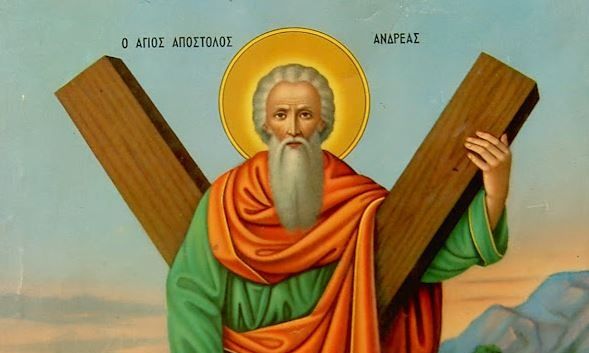
The Apostle Andrew came from Bethsaida in Galilee and was the son of Jonah and the brother of the first Apostle Peter. His profession was a fisherman.
However, he was one of those noble souls who studied the prophets and eagerly awaited the fulfillment of God's promises for the salvation of the world.
Andrew, together with John the Evangelist, were in the beginning disciples of John the Forerunner. One day in fact, when they were on the banks of the Jordan and the Forerunner showed them Jesus and said to them "behold the Lamb of God who takes away the sin of the world", those two simple fishermen were so moved that without any hesitation or reservation they immediately left their teacher and they followed Jesus. They followed him with eagerness and zeal and stayed with him that day. What did they see and hear in all those unforgettable hours? Without another word, holy and sacred words. Verbs of eternal life. Words that captivated their souls and made them believe that in truth Jesus was the One they were waiting for.
The Messiah. The Savior and Redeemer of mankind.
We see their enthusiasm and satisfaction from their communication and contact with the Lord from the action of Andreas. As soon as they were separated from Jesus, he ran to meet his older brother Peter and tell him with joy: "We have found the Messiah (who is the reinterpreted Christ) and brought him to Jesus." How kind. What kindness of soul! How much love! He did not keep his joy to himself. He hurried to share it with his brother. And he was right! He who has tasted the honey of the Gospel cannot eat it alone. Real grace, when it enlightens the soul, puts an end to the spiritual monopoly, says a great missionary of the last century.
This case is an excellent example of fraternal solidarity and spirituality. Our siblings, our parents, our relatives, our families must be dear to us. People, with whom we are ready to share every moment, both our joy and our sadness. We will say the good word to them. We will give the Christian edition. We will invite them to a Christian gathering. We will tell them in one visit: "We have found the Messiah". Our brothers! Come to Christ. This is the joy. This is the life and the light. This is the peace of the world. Don't be alarmed by some of the perversions you see around you. Do not be scandalized by the life of some who call themselves Christians and want to show the way to others. You only look at Christ. He and he alone gives joy and peace to this world. The life of all simple, true Christians testifies to this. This is confirmed by the life and example of our great apostle.
After the incident that we mentioned, both Andreas, as well as Peter and John returned to their ships and resumed their work. The blessed time had not yet come for the Lord to begin his work. This happened a few days later. There, in the lake of Gennesaret, the two brothers were going down to throw their nets into the sea, when Jesus found them again and called them to follow him. "Look behind me", he said to them, "and I will make you fishers of men". And these "directly sent the networks followed him". "Right away", without any delay, without any delay, they followed him. On this occasion, they resembled the wise and prudent merchant of the evangelical passage, who sought to find and buy pearls. And when he once found a great and "precious daisy", he hurried to sell everything he had and buy it. This is what the two brothers did.
Andreas followed the Lord faithfully and willingly until the end. During this period of his discipleship, two of the many episodes demonstrate the special position he had among the other disciples and close to Jesus. The first happened in the desert. The multitudes, who had been informed that the Lord was there, gathered from all the surrounding places, to ask for his favors and to listen to his teaching. The sun was about to set and no one was saying to leave. At some point, Jesus called Philip to him and asked him: "From where and with what money are we going to buy bread, so that all these people can eat?" The Lord naturally knew what he would do. However, he said this to test Philip and the other students. And he, on behalf of the other students, full of confusion, answered: "Two hundred dinars of bread are not enough for each of them to handle." Two hundred dinars worth of bread is not enough, not to fill them up, but for everyone to take a bite.
At that moment, Andreas jumped up and said. "Lord, here is a child who has five barley loaves and two small fish" (John v. 9). Of course, five barley loaves and two fish are nothing for so many people. But you, Lord, can bless them even then, oh, yes! Then all the people can eat and have leftovers. This episode presents us Andreas as a person with impudence and a latent faith in Christ.
The second episode presents him as a person with a broad and big heart. At the same time, however, he is also a man of courage, who does not hesitate to take a big decision and to take on his responsibilities at the same time. The reason for this episode was given by some of our Greek compatriots. It was the days of Easter, the last Easter of our Lord. They were among the crowds that gathered in Jerusalem from different parts of the world. Surely they were people who had converted to Judaism. The spiritual religion of Israel had drawn deep into their hearts the desire to know him. So they approached Philip - perhaps his Greek name gave them courage - and asked him to lead them to Christ. Philip, however, hastened to ask the opinion of Andreas. Why Andreas? Because he was his compatriot and knew his foolishness.
But also because Andreas was known as the man with the big heart and he would have faced the matter not with the narrow Jewish understanding, that Christ came and belonged only to the Jews, but also to other people. And indeed his attitude justified his reputation.
Andrew, as if he learned the incident from Philip, without wasting time, took the Greeks and brought them with him to Christ (John 12:20-22). What does this episode show? His big, broad heart, but also his intimacy with Christ. Happy are all those who imitate Protokletos and help other souls to approach and know the Lord.
The life of Protocletos during the three years of his apprenticeship is the same as the life of the other students. He, along with the other apostles, was hungry and drank from the mouth of the divine Teacher the "verbs of eternal life". With him he toured the Holy Land and saw his blessings and miracles. Deep was his emotion for the reception, which the wealthy people reserved for our Lord "six days before Easter". Deeper his sorrow for the arrest of his Master and for what followed it. However, the visit of the Lord on that day of His Resurrection and while it was already evening and the doors of the house were closed "for fear of the Jews" brought joy and hope back to his soul. Andreas attended the Ascension and took part in the election of Matthias.
After the outpouring of the Holy Spirit on the day of Pentecost, our Apostle, as the holy hymn writer also sings, after "spreading the web of the Spirit, like a calm wave moving with the spirit, all enriched the earth with divine preaching". Andreas was the supreme Apostle of the Greeks. Scythia, i.e. today's southern Russia, Greek Bithynia, Pontus, Thrace, Macedonia, Epirus and Achaia were richly watered with the honest sweat of Protocletos. But also the Church of Byzantium, which was and is the center of Orthodoxy, was founded by our Apostle. Here Andrew installed the first bishop, Apostle Stachy, and his successor is the Ecumenical Patriarch. In one of his tours, tradition mentions that our Saint also came to our island.
The ship that carried him to Antioch from Joppa, shortly before they passed the well-known cape of Apostle Andrew and the islands known as the Keys, was forced to stop there in a small port, because the wind died down. During these quiet days, they also lacked water. One morning, when the captain went out to the island and was looking for water, he took the Apostle with him. Unfortunately, no water anywhere. At some point, when they reached the middle of the two churches that exist today, the old one and the new one, which is built a little higher, the Saint knelt down in front of a dry rock and prayed that God would send water. He desired the miracle, so that those who were there would believe in Christ. Later he got up, sealed the rock with the sign of the Cross and the miracle happened. From the root of the rock immediately came a lot of water, which runs to this day in a pit of the old church and from there it proceeds and comes out of a fountain near the sea.
It is the well-known sacrament. The blessed water, which quenched the thirst of so many, but also so many others, whole myriads, who took it with faith cooled and comforted. And first - first of all the captain's blind child.
This was also one of the faces of the ship that the father was carrying. He was born blind and grew up in constant darkness. It never saw the light of day. Trees, plants, animals, he struggled to get to know them by rummaging. That day, when the sailors came back with the boats full of water and explained how they found it on the island, a light of sweet hope lit up in the heart of the unfortunate child. Could this water, he thought, which came out of the dry rock after the prayer of that strange fellow passenger, be able to give him the light he longed for? Since he came out in a miraculous way, he could also offer miracles. With this faith and deep hope, the child also asked for some water. He was thirsty. He was burning with thirst. The Apostle, who was there, hastened and gave the child a container full of cool water. However, the child preferred, instead of cooling his lips with water, to wash his face first. Oh my goodness!
As soon as the cool water touched the child's eyeballs, the chronic darkness began to dissolve. And a light, a cheerful light, began to bathe the surrounding things...
- Father, father, the child began to call, sometimes rummaging and sometimes running to find the father. And the captain, who was frightened by the child's voices, also runs to the place where the voice was heard. At the sight of the child he stopped, bent down and opened his embrace.
- My child, what is the matter with you? asked the father in horror.
- I see! Father, I see! Look at me, I see the sea, the people, the billowing sails of our ship. Father, the blessed water that grandfather gave me to drink and wash, he gave me because we were longing. My light, father...
Except for a short break that passed in tears and unrepentant gratitude, the captain stood up and said:
- My child, let's go find the grandfather you say, to thank him for what he gave us!
- Not me, said the Apostle who approached. Let us all thank Christ. He gave us the water. He also healed the child. This is the true God, who became a man and came to the world to save us!
And the Apostle, whom they all looked at with admiration, began to speak to them and to teach them the new religion. The end of the speech very fruitful. Those who heard him believed and were baptized. The beginning was made by the captain with his child, who was also named Andreas. And then all the other passengers and some fishermen who were there. They all believed in the Christ that our Apostle preached to them and were baptized. Naturally, the miracle of the healing of the blind child was followed by others, and others. Meanwhile, the wind started to blow and the ship prepared to continue its journey. The Apostle, after calling to him all those who believed in Christ and were baptized, gave them his last advice and said goodbye. Thus on the blessed island another group was organized, a church of believers in the one true God.
Later, after years, the Great Monastery of the Apostle Andrew was built in the place where the Protokletos disciple walked and sanctified with his prayer, miracles and sweat, which over time had become a Cypriot place of pilgrimage. Every year thousands of pilgrims from all parts of Cyprus, orthodox and heterodox and even non-religious, gathered at the monastery to worship the miraculous icon of the Apostle, to baptize their newborn children there and to offer their rich gifts in money or in kind. Namely, to express their thanks and gratitude to the holy Apostle. Pool of Siloam was his church for the sick. Many miracles were performed there for those who went there with true faith and brokenness of soul.
In all the churches of our martyred island we will find his holy icon and his name is the most common among the inhabitants (Andreas or Adriane - Androula) and the most widespread. For reasons that only the Lord knows, here and for a few years - since 1974 - the holy monastery along with all of Karpasia, Mesaoria and Northern Cyprus has come under the rule of the most barbaric invader, the Turk. The blessed churches located in these places normally remain inactive. And the bells stopped ringing and calling the faithful to mental alertness from then on. However, the holy one that came out of the earth after the prayer of the great Apostle Andrew remains and continues its purring.
It continues its purring and waits for the holy hour, when the faithful of the island, washed and cleansed in the tears of sincere repentance, will deserve to be free and visit the beautiful monastery again to sing thanks to the Lord for their deliverance from the sufferings of the bitter trial and to drink and cool the lips from the sweet water. May God grant, with the help of the embassies of the Holy Apostle Andrew, but also of the other Saints of our Cyprus, that this day may come as soon as possible.
The end of the Apostle was proportional to his history. He was martyred in Patras, where he had arrived, in order to spread the message of redemption here as well and to spread the light of Christ. His visit from this side brought many fruits. In a few days his preaching together with his many miracles literally shook the foundations of idolatry in Achaia. Among the first to believe, he himself was the ruler. This is what the Roman lords who ruled one of the provinces of the state were called during Roman times. Of the city, the Lesbios as it was called, who had suddenly fallen seriously ill and had been healed by our Apostle. The example of the leader was followed by other idolaters. But the thing became known in Rome. The emperor Nero was enraged by his evil and gave an order to immediately replace Lesbius with a certain Aegeat, a very fanatical idolater and very cruel.
Having Lesbius as his companion, Protokletos continues his sermons and miraculous cures every day. Crowds of people from all over Achaia are watching them with interest and many are increasing the ranks of the faithful every day. Among them are now added the wife of Aegeates, Maximilla, his brother Stratocles, a wise mathematician, and many others of his relatives and his entourage.
The governor Aegeates, even though he saw his wife Maximilla saved from certain death by the intervention of Protocletus, even though he saw his brother Stratocles, who esteemed him so much, join the new faith, yet he himself remained unmoved. Something more. He was stubborn with his wife and demanded from her to deny Christ. However, Maximilla did not agree to listen.
- I prefer, he said, to be separated from you than from my Christ.
And he, blinded by his passion, orders Protokletos to be arrested and thrown into prison. In order to further blackmail the woman devoted to Christ, he threatens her that if she does not return to the religion of her fathers, idolatry, he will terribly torture the old Apostle and in the end he will crucify him. Worried, Maximilla runs to the prison to convey her husband's threats to the Apostle. The good woman trembles, lest any harm should come to her benefactor and savior.
- Do not be afraid, my daughter, for my life, Protokletos told her. Keep your faith firm. It will be God's honor and favor for me to deserve to leave this world in the same way that our Redeemer left. He does, because Aegeatis wants. Burn me in the fire. Burn me with the knives. Nail me to the Cross. "The sufferings of the present time are not worthy of the future glory revealed to us". Stratoklis, who was there, burst into tears.
1 - Do not cry, the Apostle told him. One day we will leave this world. "We don't have a city where they lived." Pay attention only to the seed of the Gospel, which I sowed in your heart. Hold him carefully and sow him and you below.
The words of the Apostle boosted the courage of Maximilla and Stratoklis and steeled their will to fight to the end. Aegeatis called his wife again and tried with sweet and flattering words to convince her of the faith of Christ.
- I am ready to do everything for your love, he told her. If you are convinced to leave Christ, I will have you as queen in my house. Otherwise, I will nail the old man who took your mind to a cross, and I will kill you too.
Maximilla's response was truly heroic.
- I prefer death a thousand times over life with an idolater like you.
The words of the Christian heroine ignited the anger of her husband, who gave the order to severely torture the Saint and in the end to raise him on a cross, which had the shape of the letter X and which had been set up on the "edge of the sea sand". On this Cross, which was made of olive wood, they tied the hands and feet of the Apostle, without nailing him. And this happened, because Antipatos wanted to keep the Saint alive for a long time, in order to torture him.
From a sea, the beautiful Sea of Galilee, the Lord called the great Fisherman to follow him to become his disciple and fish for people. From another nearby sea, the sea of the historic city of Patras, Christ again called the disciple and Apostle of Andrew, after a hard work of sowing his word, to jump to our heavenly homeland, to receive the indestructible crown of justice. The apostle left this world at the age of about 80 years.
The Christians of Achaia deeply mourned his death. Their pain became even greater when the governor Aegeatis refused to hand over his holy relic to them to bury. But God saved things. On the same day that the Saint died, Aegeatis went mad and committed suicide. "Death to wicked sinners." The Christians then with their bishop Stratoklis, first Bishop of Patras, received the sept relic and buried it with great honors. Later, when Constantius, who was the son of M. Constantine, ascended the throne of Byzantium, part of the holy relic was transferred from the city of Patrons to Constantinople and deposited in the church of the Holy Apostles "inside the Holy Table". St. Cara of Protocletos seems to have remained in Patras.
However, when the Turks were about to occupy the city in 1460, then Thomas Paleologos, brother of the last emperor Constantine the Paleologos and last Despot of Morea, took the precious heirloom and transported it to Italy. There it was deposited in the church of Saint Peter in Rome, where it remained until 1964. On the 26th of September († Anakomidi Timias Karas) of that year, a representative of Pope Paul took the precious treasure from Rome and handed it over to the rightful owner, the Church of the Fathers. St. Cara of Protocletos, after the actions of the Archdiocese, was also transferred to Cyprus in 1967 for a few days and exposed to a reverent pilgrimage. Thousands of Cypriots at that time, young and old, men and women, started from the four points of our island and went and worshiped the holy Cara of Protocletos and before her they deposited their deep respect and reverent gratitude for what his grace offered and offers to our island.