THE ENTRIES OF THE THEOTOKOUtranslated
TODAY THE HOLY VIRGIN IS PREACHED TO THE CHURCH Dedication to the Feast of the Entry of the Virgin Mary, To... The article THE ENTRIES OF THE MOTHER OF GOD appeared first on HOLY DIOCESE OF MONEMVASIAS AND SPARTIS.
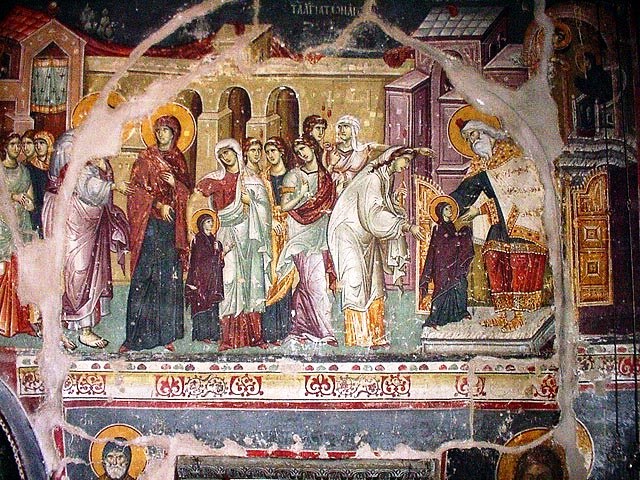
TODAY THE MOST VIRGIN IS PREACHED TO MY CHURCH
Dedication to the Feast of the Entry of the Virgin Mary,
By Lambros K. Skontzos, Theologian - Professor.
The feast of the Assumption of the Virgin Mary is an important feast of the Mother of God, which is celebrated with respect and splendor by Orthodox believers all over the world. It was established around the 6th century in Jerusalem based on the ancient tradition of our Church. Saint Sophronius of Jerusalem (634-638) speaks in his writings about this holiday. It was established in Constantinople around the end of the 7th or the beginning of the 8th century. According to her, the event of the entry of Our Lady into the Temple of Solomon, when she was three years old, is celebrated.
Of course, there is no biblical evidence for this fact. We derive information from the tradition of our Church, which saved many events, which are not recorded in the Holy Gospels. On this occasion, we would like to emphasize once again that the Gospels are not historical texts in the strict sense of the term, but are primarily missionary texts, which were written to serve specific missionary and pastoral needs of the ancient Church. Thus, most of the Lord's presence on earth and the lives of other holy persons, related to the work of salvation, were left out of the Gospel narratives. Instead, some of this information was saved by Sacred Tradition, which is, as we know, equal to the Holy Bible.
So, according to Holy Tradition, the Virgin's parents, Joachim and Anna, were pious and righteous people. They belonged to that small portion of the faithful and pious Jews, who anxiously awaited the coming of the Messiah. These pious people struggled to have children, hoping that the Messiah would be born from their offspring.
The Virgin's parents lived with the expectation of having children, but unfortunately, they were childless. For twenty whole years they tried to have children without success. The shame of childlessness and the state of loneliness created unbearable bitterness in their souls. But they did not lose their faith in God even for a moment. They had the belief that God is the sponsor of all goods and especially of procreation. Their lives revolved around prayer, fasting and intense expectation that God would hear their pleas and have mercy on them in the end.
Indeed, God heard their prayers. The Angel of the Lord appeared to Saint Anna and announced to her the happy fact that she will become a mother. The old couple finally got a widow. The pious old Anna gave birth to a cute girl, whom they named Maria (Hebrew Mariam), which means Lady. They expressed their unexpected joy with praises and thanks to God. They considered the new-born infant as His own gift and therefore, from the first moment, they dedicated it wholeheartedly to Him
Little Mary from infancy was adorned with graces and qualities logically inexplicable. It appeared from then on that she was set apart by God to serve the plan of the salvation of the world. Her prudence, meekness, humility and obedience amazed Her parents and their social circle.
When Mary turned three years old, her pious parents decided to fulfill their promise to God, to offer Him their beloved daughter as a gift. After all, as tradition says, they were both so advanced in age that they could no longer take care of little Maria. So they went to the Church of the Lord in Jerusalem. There they met their relative priest Zacharias, father of John the Forerunner, who was also childless until then. He served the sanctuary with fear of God and prayed incessantly that God would have mercy on him and that he too would have a child with his beloved wife Elizabeth.
Their arrival at the surrounded Church filled their souls with rapture and reverence. They were treading the sacred space, where the presence of the Lord was felt. The Jews believed that the Church was the residence of God and his throne the Holy of Holies, so that apartment was considered a place of awe and terror. No one entered there, except the high priest of the year once a year, on the day of Atonement, to burn incense, barefoot, uncovered, and in a simple tunic.
The priest Zacharias received them at one of the great gates of the great court. The people were not allowed to enter the Church. Only the high priest, the priests and the Levites entered the pronaos and the Holy of Holies, to offer the sacrifices established by Moses and to perform the rituals. The people stood in the spacious court and in the innumerable adjoining galleries, where they watched the sacrifices, the prayers, and the other various ceremonies of the priests.
With surprise and admiration they observed that little Mary not only did not show any resistance, as was natural, to part with her parents, but gladly followed the venerable Zacharias to the Church of the Lord. God's grace had covered every natural reaction of hers, had already made her a precious vessel of election. The ancient Christian tradition states that the old man Zacharias, by divine inspiration, led Mary to the Holy of Holies. There, in the most sacred, god-dark and inaccessible compartment of the Church, she entered to spend her childhood years untainted by human sin, as a precious treasure in a safe vault!
The living conditions in that place were very unfavorable for a common mortal. As we have said, it was pitch dark and the entry of anyone was strictly forbidden, for the provision of food. But little Maria was no ordinary mortal. She had been called by Her mother's womb to become the mother of God. The inhospitable space of the sanctuary of the Church was transformed for Her sake into a heavenly environment. Heavenly uncreated light, which only She could see, illuminated the space abundantly and blindingly. Angels of God were constantly near Her and kept her company. Other angels carried her secret heavenly food and others ministered to her.
This lasted for twelve full years, until She was fifteen years old. Then Zacharias together with other respected and reverent priests of the Church decided to take Mary out of the Holy of Holies and lead her into the world. For protection, they betrothed her to the pious and middle-aged Joseph, who, according to tradition, was a widower and had custody of his children from his first wife. They settled in the beautiful and peaceful town of Nazareth, where her holy Annunciation took place some time later.
The great and universal Mother of God feast of the Introductions is brilliantly celebrated by our Church. Holy services have a solemn character. Great hymn writers, such as George Nicomedias, Leo the Magister, Joseph the Hymnographer, Sergius the Agiopolis and Basil the Pigorite composed hymns of great poetic and theological value. "Heaven and earth rejoice, the sky, the wise walker, who sees in the divine house, is brought up decently" says a hymn. The faithful flood the churches and honor Aeipartheno, Who became the cause of our salvation and covers us under Her eternal prayers to Her Son and our Savior Jesus Christ.
THEOLOGICAL SIGNIFICANCE OF THE FESTIVAL OF THE ENTRIES OF THE MOTHER OF GOD
The Mother of God is the holiest human being, Who was chosen by God among millions of other girls, to play a leading role in the process of saving the human race and all of creation. The divine omniscience imparted to Her most holy person the extreme purity and holiness, which was necessary to become the mother of the absolutely holy God.
The Feast of the Entrances aims to teach us very high concepts about the personality of the Virgin Mary. To introduce us to the unimaginably deep theology surrounding Her unique contribution to the realization of the divine plan of the salvation of the world.
The historical core of the event of the Introductions is of little concern to the Church, as much as its theological significance. Some argue that, because the first written testimony of the event is referred to in the apocryphal "Protoevangelium of James", it should not be considered reliable. For our Orthodox theology, however, this historical event in itself has little importance in relation to its theological and moral significance.
The Temple of Jerusalem is an icon of Theotokos. The belief in the sanctity of the Church by the Jews is known. They believed that God dwells in him, that is why they climbed the hill of Zion, which was built with respect and fear, as if they were approaching God Himself. The Ark of the Covenant was considered God's throne and His visible presence on earth. No one dared to approach the compartment of the Church, which was called the Holy of Holies, except the high priest of the year, once a year, on the mourning day of Atonement. He would enter that terrible place without hindrance, dressed in a linen tunic, to burn incense. Since then no one dared to go near there.
The common people were not allowed to enter any part of the Church, but only the priesthood in the pronaos and the Holy of Holies. Lay pilgrims stood in the huge courtyard and the various adjacent galleries, from where they prayed and watched the rituals of the priests.
Our Lady is the imaginary church of God. The most sacred imaginable mosque, in which the eternal and infinite God agreed to dwell. The holy hymn writer of the feast, wanting to emphasize this amazing simile, wrote that the Virgin Mary is, "The most pure church of the Savior, the precious past and virgin, the holy treasure of the glory of God". If the Temple of Jerusalem, in which God was supposed to dwell, according to the belief of the Jews, was considered holy, let us think how much more holy and holy could be considered the Theotokos, Who truly kept in Her most pure womb the Word made flesh and nourished it with Her honest blood! The Temple of Jerusalem was destroyed and destroyed by the Roman conquerors. On the contrary, the imaginary church of God, the Virgin Mary, remains throughout the ages and enjoys the highest honors from the myriad believers of all times.
The entry of the Virgin into the Temple of Jerusalem wants to reveal the incomprehensible height of Her purity and holiness. In the inaccessible Holy of Holies, her purity was preserved and her holiness cultivated. Only within such a sacred space could Her required purity be preserved from the unimaginable sinfulness of the world. Only association with the holy angels could cultivate Her holiness. Human iniquity had such power and momentum that if the Virgin Mary had been in the world we do not know if she could have maintained the height of holiness needed to receive the all-holy God into Her womb.
In the person of the Mother of God, we have overcome the peptocy of human nature and restoration of the previous propototic. She was certainly born with a fallen nature, as an heir to the sin of our first ancestors. But divine grace gradually exalted her from her infancy until her Annunciation, whereupon, with the overshadowing of the Holy Spirit, she was completely cleansed of original sin and took on the uncorrupted prophetic nature. Only in this way, freed from the burden of the fallen nature and the corruption of sinfulness, could she fulfill her supreme mission. The pious narratives about Her miraculous stay in the Church express exactly this belief in Her progressive purification.
The blessed entry of the Virgin Mary into the Church is the beginning of the realization of the eternal will of the Triune God for the salvation of the world. In the hymnology of the great holiday we sing that "Today is the prelude of God's prosperity and the proclamation of people's salvation". It is the dawn of the redemption of the human race from the slavery of sin. That is why our Church brilliantly celebrates the event. As conscious believers of Christ, we are warm and constant honorers of the holy person of Theotokos, because Her contribution to the work of our salvation was decisive. With unbridled enthusiasm we praise the great feast and lift up the Mother of God, singing "with one voice" together with the holy hymn writer of the day "Hail, the fulfillment of the economy of the Creator"