Art as Witness: A Living Christian Traditiontranslated
About the exhibition “Christian Art. Our days" Oksana Golovko The exhibition's exposition is large-scale - both in terms of the genres and types of art represented, and in terms of stylistic diversity - but at the same time it is very integral.
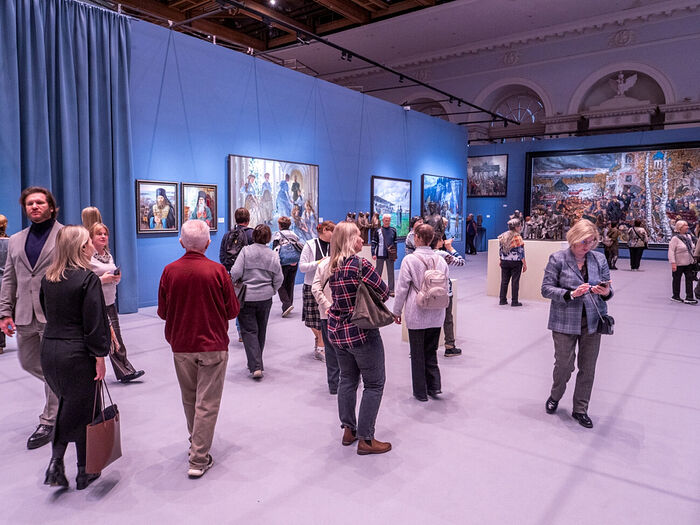
About the exhibition “Christian Art. Our days"
The exhibition turned out to be large-scale: despite the name, it covers not only the present, but also touches on the past. Our current reality is understood here in inextricable connection with history. In the single space of the Manege exhibition hall, medieval shrines - monuments of art - coexist with what was created more recently. And this proximity speaks more eloquently than any words about a living tradition and true continuity.
The exhibition reveals the structure of our life in its deepest understanding: it semantically leads from the main thing - Biblical history - to the history of Russia, and from there - to the present. It is through the prism of the main section of the exhibition – “God and Man” – that everything else is comprehended, because without this foundation this “everything” loses its meaning and simply becomes impossible.
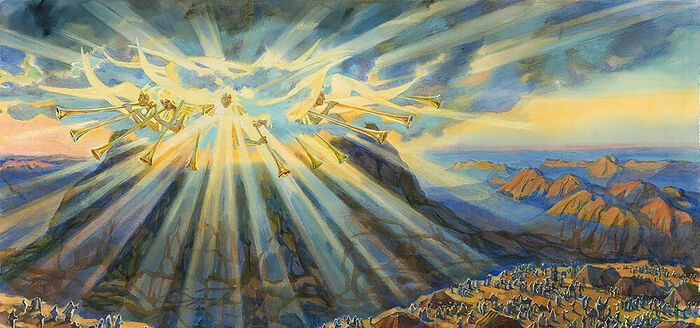
It is in the main section that the exhibition reveals the stated theme through various works dedicated to the dialogue between the Creator and creation. Among them are illustrations of the Biblical story by Aliya Nurakshieva, almost all of them are filled with light. It is clear that the artist here relies on “Biblical Sketches” by Alexander Ivanov, trying to convey through visible images the Divine light that illuminates (and sanctifies) our earthly reality.
In the triptych “And the Word became flesh” (2025), Tatyana Chuvasheva deeply reveals the theme of the diminishment of the Lord, Who became incarnate for the salvation of people: Almighty God became a defenseless Baby - fragile and vulnerable by His human nature, like all other children...
In the triptych “The Gatekeeper,” Tatyana Chuvasheva turns to the story of Peter’s abdication and to each of us. She shows that the rooster - a symbol of betrayal - can crow for anyone. But even after a fall, there is an opportunity to rise and go in the right direction.

All four Gospels speak sparingly about Peter's betrayal, only mentioning that he, realizing what he had done, “wept bitterly” (Luke 22:62). Andrei Drozdov in his work “The Lamentation of St. Peter” (2017) reveals the full depth of despair and the power of the apostle’s repentance, sprawling him on the ground. It seems that Peter is physically crushed by the weight of his own betrayal: there he is, the rooster, in the foreground, crowing for the third time. Following the iconography established in ancient art (remember the Sinai encaustic icon of the 6th century), the artist depicts the apostle with short gray hair and an equally thick beard. But this painting speaks not only about Peter...
The landscape of the Eternal City, in which events took place that changed the course of human history, is unfolded before the viewer by Dmitry Belyukin in the paintings of the triptych “Jerusalem. Dawn" (2017).
The works of Zurab Tsereteli from the series “Biblical Stories” (2002–2003) seem to be beautiful miniatures from medieval books. Only they were made not on paper, but using the 3D enamel technique, and their size is not miniature, but monumental, which enhances the emotional response of the viewer and makes them memorable.
The very beginning of the exhibition is a section telling about the history of Russia, which is perceived in close inextricable connection with the history of the Church, including church art.
The miracle of the appearance of an iconographic image is touched upon by Svetlana Ivleva in her work “Reverend Andrei (Rublev) Iconographer” (2026).
The continuation of the tradition of Byzantine art, its living development – in the monumental projects of Mikhail Leontyev and Daria Shabalina, in the creation of the Museum and Church Complex “New Chersonesos”, which is described in the exhibition...
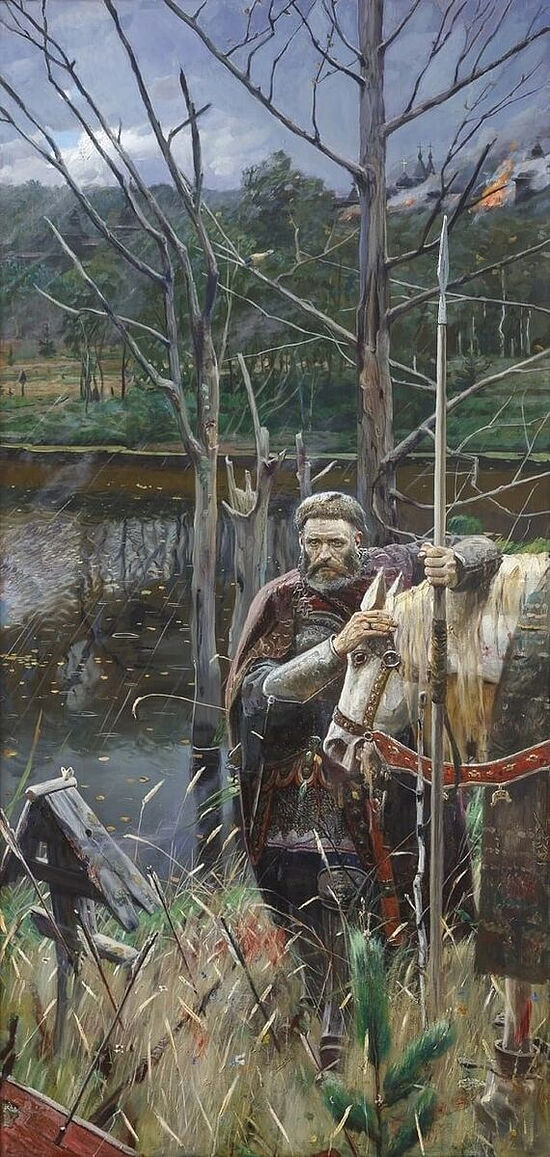
The history of Russia appears here in volume, from different sides, and not always from ceremonial ones (such as, for example, the work of Alexander Shchemelinsky “Potemkin presents the Black Sea Fleet to Catherine II” (2016)) or solemn victorious ones, like the painting “Victory. Berlin 1945" by Dmitry Shmarin (2005). Thus, Pavel Ryzhenko in a triptych dedicated to Alexander Nevsky (2010) shows the image of the holy prince as majestic and powerful, but at the same time humane, experiencing pain, grief from the loss of his comrades, truly suffering for his native land.
The exhibition contains many historical references. For example, the named work by Shchemelinsky and the diptych by Yulia Smirnova “Pushkin and Pugachev” (2008). The first part of the diptych also refers to the reign of Catherine II. Pugachev is depicted sitting almost directly opposite the viewer, and Pushkin, writing about Pugachev, is in profile. The artist shows how a frozen historical fact is transformed by the power of art into a living process. Smirnova uses the language of parsuna (and refers the viewer to Pugachev’s Simbirsk portraits and copies written from them - for example, to a work of the first half of the 19th century from the collection of the State Historical Museum). Thanks to this technique, what is depicted acquires monumentality, breaking away from a specific era and becoming transtemporal. Each part contains many hidden symbols that immerse the viewer even deeper into the general cultural context.
What is depicted acquires monumentality, breaking away from a specific era and becoming transtemporal
The same historical heroic episode - the Crimean War - is told by Aliya Nurakshieva in her work “Archbishop Innocent (Borisov) during the defense of Sevastopol in 1855” (2025) and Evgeny Emelyanov, who presented the painting “Veteran of the Sevastopol Defense at the Fraternal Cemetery” (2024). Archbishop Innocent prayed for those who held the defense, and where military operations were taking place. And the veteran, now standing alone and remembering those who fought next to him, at that time defended the shores of the Russian Empire. In both works, the background is the sea, which is true, of course, from a topographical point of view, but in this case it also becomes a kind of special symbol.
The theme of the spiritual feat of Russian saints is touched upon in the works “The Moscow Wonderworker Blessed Basil” by Vitaly Grafov (2025), “Tsar Ivan and Blessed Basil” (2018) by Mikhail Shankov, “Healing. (St. Seraphim Vyritsky heals a child)” (2019) by Anastasia Korableva; in the sculpture “Xenia of Petersburg” by Olga Legkova (2019), sculptures by Vitaly Shanov, including “Pechora Elders” and “St. Luke with Children”, sculpture by Anastasia and Nikolai Klykov “St. Tikhon, Patriarch of Moscow and All Rus'. To the centenary of the blessed death" (2026) and many others.
The juxtaposition of icons and works of secular art in the exhibition halls makes the exhibition more voluminous. The conversation with the viewer here is conducted in two languages at once - church and secular fine art, thanks to which the events of the same historical period can be revealed through the realities of both the local world and the world above.
Here, for example, is the icon of the holy martyr Elijah Gromoglasov, painted by Roman Loboruk. Gromoglasov was a theologian, a member of the Local Council of 1917–1918, he took holy orders in 1922 and died as a martyr in 1937... And here is Ilya Glazunov’s painting “The Communists Passed By” (2001), where against the backdrop of a dark sky there is a ruined church with the remains of domes, lopsided crosses and icons lying on the ground. About the same thing, but in a different way.
The same line of understanding the tragedy of the first half of the 20th century is continued by the portrait of General A.P. Kutepov, made by Dmitry Trofimov in 2007 in the series “Gallery of Portraits of Participants in the White Movement.” The red background seems to move and glow, giving the work expression and drama.
Vasily Nesterenko, creating the monumental-sized painting “Heavenly Intercessor” (2017), relied on the iconography of the August Icon of the Mother of God, painted in memory of the appearance of the Mother of God in 1914, during the First World War. But the author, while depicting a specific historical event, simultaneously creates a generalized image of Her intercession, regardless of the specific era.
The theme of heavenly intercession, raised in Nesterenko’s painting, is continued by other works in the exhibition. Therefore, the work “Virgin Mother of God, Rejoice...” by Yuri Andreev (2006), which shows not just an episode from the Great Patriotic War, but the moment of meeting with the Heavenly, the work “Prayer” by Vasily Kuraksa (2023) and many other works look very appropriate here.
If paintings tell about a miracle, about the manifestations of Heaven in earthly realities, then icons should lead directly from the image to the Prototype, setting the believer up for prayer. The works of Alexander Sokolov are just like that. The exhibition includes his works “Our Lady of Lyubiatov” (2013), “Spas” (2014). “Spas” is Sokolov’s last icon; he didn’t even have time to write the inscriptions; they were written by the icon painter’s relatives...
The combination of skill, without which a real icon is simply impossible, theological precision, and depth allows artists to create real, beautiful works. It is simply impossible to do otherwise, because Beauty is one of the names of God; He initially created the world beautiful. It is precisely such works that become a window into the Mountain World. In addition to the works already mentioned, the exhibition presents icons created at the icon-painting department of the Moscow Theological Academy, at the faculty of church arts at the Orthodox St. Tikhon's Humanitarian University, and at the icon-painting workshop of the Co-action Institute.
The icons of Irina Zaron are immediately recognizable - soulful, restrained in color scheme, seemingly striving for monochrome, but at the same time not losing their picturesqueness.
An interesting iconographic solution was presented by Dmitry Trofimov in the icon “St. Princes Demetrius and Euphrosyne of Moscow with selected saints" (2025).
The life of a Christian does not end behind the church fence, but even in the most everyday, everyday phenomena, he is able to discern that very real beauty that is present in our world and is a reflection, an echo of the Divine beauty.
This beauty is also in the images of children (works by Maria Pereyaslavets “Time Out” (2023), Dmitry Rodzin “Sophia” (2009), Albert Soltanov “Easter. Kolya” (2024), Elena Stepura “Grandfather’s Attic” (2018)). Reality (here is the work of people, not God) can turn to children with an unkind, scary side. But life and joy still take their toll, no matter what. This is the work of Alexey Kryukov “In a Minute of Silence” (2016), in which a girl draws on the asphalt with crayons, and spent cartridges lie nearby.
Beauty is revealed both in the images of motherhood (“Dreams” by Yulia Bobrova (2021), “Introduction to the Church” by Anna Boganis (2011)), and in the desire to show the family, its significance, the present that connects all its members (“Me and You” by Yana Patokina, “Spring Sun” by Elmira Petrova (2009), “In the Silence of the Rooms of the Petrovskoye Estate” (2020–2025) Yuri Orlov).
Family is what gives strength for life, opens up the vastness of knowledge of the world, leads to understanding and comprehension of the main foundations of existence. Nikolai Gorsky-Chernyshev reflects on this connection between generations in his profound work “Roads of Childhood” (2009). The artist depicted himself as a child, together with his grandparents - Nikolai Mikhailovich Chernyshev, a student of Konstantin Korovin and Valentin Serov, and his wife Antonina Alexandrovna. Thus, the painting also speaks of creative continuity.
The topic of connections between generations is addressed by Tatyana Necheukhina in her work “VK” (2026). It has beauty, tragedy, good humor - everything that is present in our lives. Necheukhina depicted an old woman in a headscarf, enthusiastically looking at the phone, and a young girl in a festive dress, with a samovar. The telephone and sneakers on the young heroine are the realities of modernity, but the whole surroundings: a round table, portraits in golden frames on the wall - take the viewer into the space of historical time. A reproduction of a painting by Viktor Popkov from his northern cycle, also placed on the wall, is needed not only for a bright spot of color. She brings into the calm mood of the work a reminder of how much pain, difficulties and tragedies there were in the life of a Russian woman throughout history...
Through the landscape you can also show continuity, the inextricable connection of generations, and even touch upon historical memory. In the works of Maria Vishnyak “The Age of the Tree” (2014) and Anton Stekolshchikov “The Nameless Star” (2015), the image of a tree becomes an important compositional and semantic component.
In Maria Vishnyak's work, almost the entire pictorial space is occupied by an old tree that suddenly blossomed vigorously. Perhaps it is blooming for the last time, but still it is a hymn to life, that life that does not disappear anywhere, it is also embodied in the figures of children standing under an old apple tree. Anton Stekolshchikov unfolds the composition of his work from bottom to top. At the very edge of the pictorial space is an obelisk placed at the burial site of those who gave their lives during the Great Patriotic War for the world that the artist shows: with flowering herbs, linen swaying in the wind, wooden houses near the horizon. But the artist builds the composition in such a way that the landscape begins to sound large-scale, global. From the obelisk, the gaze moves upward to a huge birch tree rustling against the backdrop of the endless sky. And this is also a symbol of peace and peace, if we recall pre-revolutionary spelling.
Nature reflects the beauty of God’s world, which is why Orthodox churches fit so harmoniously into it (“Yaroslavl” by Sergei Andriyaka (2007), “Geese-Swans” by Tatyana Yushmanova (2010), “Autumn in the Pskov-Pechersky Monastery” by Igor Mashkov (2025)).
Even in a metropolis, with its rhythm and tension, if you look carefully, you can suddenly see angels in the sky, as Alexey Sukhovetsky did in his work “Borodinsky Bridge” (2021).
An echo of Divine beauty is also present in creativity, and therefore at the exhibition you can see paintings and sculptural portraits of people who contributed to Russian art, including “Portrait of V. I. Belov” by Olga Mertyn (2012), “Portrait of G. N. Rozhdestvensky” by Oksana Velichko (2010); “Portrait of the Composer Artemyev” by Maxim Leontyev (2024).
Repentance is an important part of the life of a Christian. Dmitry Petrov’s work from 2014 is called “Repentance”, and Oleg Ivashchenko in the film “Returned” (2023) refers the viewer to the parable of the prodigal son...
Nikolai Tretyakov in his work “The Cross” (2024) showed a worship cross, so often found on the roads of Russia, as a reminder of the constant presence of God in our lives. It is no coincidence that the artist places it on the side, in front of him is a road without beginning or end, and in the background the space of the Russian land unfolds.
It is worth noting that there are many portraits in the exhibition. This speaks of attention to the person, and Christianity is always addressed specifically to the individual, and not to the masses of the people - to everyone who makes up these masses. God loves and sees everyone, and He went to the cross for everyone...
The exhibition's exposition is large-scale - both in terms of the genres and types of art represented, and in terms of stylistic diversity - but at the same time it is very integral. It presents high-quality, inherently creative art (and it can only be like that if it is based on the Christian tradition, even when it concerns tragic themes).
Works of secular art are shown here as part of the context of Christian life
Works of secular art - paintings and sculptures on completely different themes - are shown here as part of the global context of Christian life. This life, of course, is connected with the church and worship, but it continues beyond the church fence. In this life, monuments of the past are preserved, new significant cultural and historical objects are built and opened. The exhibition also talks about all this.
The article can only briefly talk about secular works and church paintings presented at the exhibition: the exhibition is too large-scale, there is enough material for a whole book. And I’m not talking about decorative and applied arts here – sewing and jewelry – but I can say that they are all genuine works of high quality.
So the best option is to come and see in person. Moreover, entry is free.
The exhibition runs until December 8 at the Manege Central Exhibition Hall, Moscow, Manezhnaya Square, 1. Daily 10:00 - 20:00 Entrance to the exhibition until 19:00.