It’s time to forget the decree on the separation of Church and statetranslated
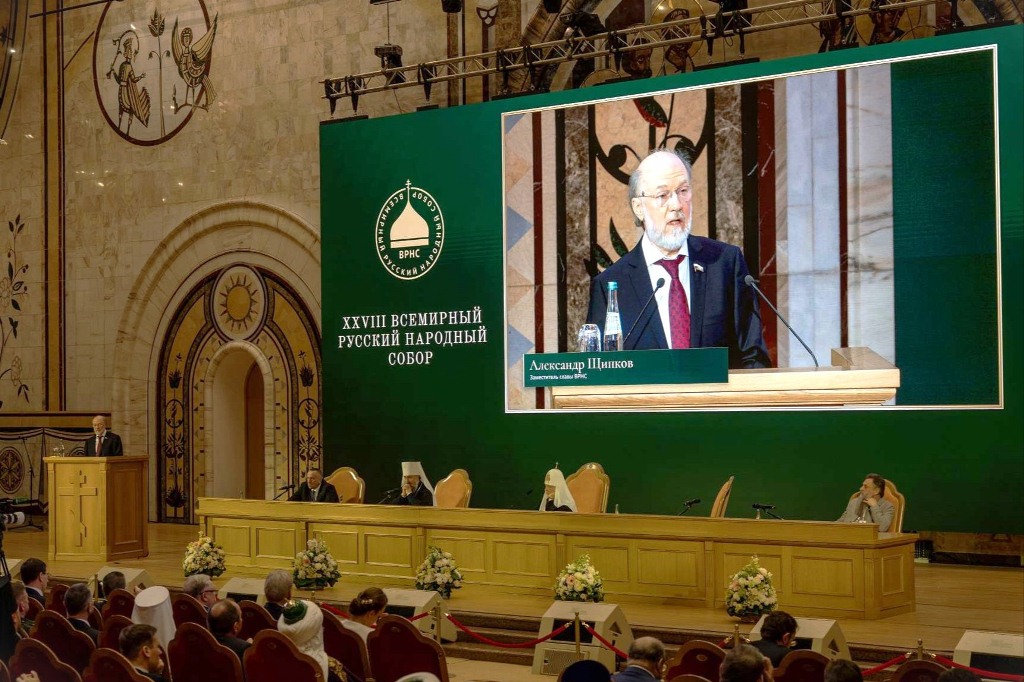
On November 26, 2026, in the Hall of Church Councils of the Cathedral of Christ the Savior in Moscow, a plenary meeting of the XXVIII World Russian People's Council was held, which was chaired by the head of the Council, His Holiness Patriarch Kirill of Moscow and All Rus'. The speech made at the meeting by the deputy head of the VRNS, deputy of the State Duma of the Federal Assembly of the Russian Federation A.V. Shchipkov formed the basis for the published article.
On November 23, 2026, speaking at a gala reception on the occasion of his 80th birthday, His Holiness Patriarch Kirill said, addressing the political, cultural and business elite of our country:
“I don’t quite understand what the separation of Church and state is. Not a single philosopher or lawyer has yet been able to explain to me what this means. How can one separate the Church from the state, headed by an Orthodox president? Where is the line between Church and State? “Separation of Church and State” is a cliche that came from the era of liberalism. This principle was not characteristic of our national culture and our history, but was enshrined in laws. However, the Church does not grieve over this, because no political schemes can shake the most important thing - the faith of the people.”
Today, the real position of the Russian Orthodox Church and its formal social status indeed remain inconsistent. The main reason for this situation is the Soviet and post-Soviet stereotype associated with the 1918 decree “On the separation of church from state and school from church,” which actually continues to be in effect. Formally, during “separation,” religion is considered a private matter of citizens, but believers turn out to be outcasts, and society lives in a regime of secular propaganda.
Church-state relations are the most important issue for any nation, and different nations solve it differently, choosing different models of relations, from symphony to separation. The separation model was firmly established at the end of the 18th century during the French Revolution. According to the "Civil Constitution of the Clergy", adopted by the French Constituent Assembly on July 12, 1790, church hierarchs began to be appointed by universal vote of citizens, including non-believers.
In Russia the Church has gone through a more difficult path. Until the end of the 17th century, its relations with the state were partnerships: the priests reconciled the princes, softened the royal anger and grieved for the people before the sovereign. During the Time of Troubles, not only citizen Kuzma Minin and Prince Dmitry Pozharsky, but also Patriarch Hermogenes showed themselves. It was symphony time.
In the 18th century, the symphony was lost. In 1700, Peter I, instead of the Patriarch, appointed Metropolitan Stefan (Yavorsky) of Ryazan as “exarch, guardian and administrator of the Patriarchal Table,” and decided to entrust the direct management of the Church to a collegial body: thus the Holy Governing Synod, the governing body of the Church, was born. Peter I essentially destroyed the structure of the Church; No wonder he will be called “the first Bolshevik” in the 20th century.
During the two revolutions of 1917, the Petrine system revealed its entire underside. The secular captivity of the Church resulted in persecution and destruction of the priesthood. In March 1917, Chief Prosecutor of the Provisional Government Vladimir Lvov forcibly dissolved the former Synod and demanded a personnel revolution within the episcopate. The “freedom of the Church” is hypocritically proclaimed. The Provisional Government begins arrests and detention of metropolitans, among whom the most prominent names were Metropolitan Pitirim (Oknov) of Petrograd and Metropolitan Macarius (Nevsky) of Moscow. By the decision of the new liberal-revolutionary government, parochial schools are separated from the Church and transferred to the secular ministry. Liberal-bourgeois Russia, like revolutionary France, is moving along the path of radical secularization.
For a long time it was believed that the Bolsheviks began the persecution of the Church. But in fact, the Bolsheviks only continued the course taken by the Provisional Government towards a church revolution, which was understood as part of the social revolution.
On March 13, 1917, Anton Kartashev, who replaced Vladimir Lvov as Chief Prosecutor a few months later, sent a letter to the Provisional Government about the “distance” of the Church. There was no talk of “separation” yet, but the process had already begun. By the way, later, already in exile, Kartashev actively supported Hitler and the Nazi military campaign against his former homeland, noting in one of his letters that Hitler “went to liberate Holy Rus'.” Later, in 1948, he preemptively welcomed the American atomic bombing of Soviet cities, predicting that “crushing technology will crush the Kremlin with lightning speed,” and Soviet leaders “will be tried and hanged, including Patriarch Alexei.”
On June 20, 1917, the Provisional Government, anticipating Lenin's decree, transferred parochial schools to the Ministry of Public Education. The church is being removed from the educational process. And only six months after these events, on February 2, 1918, the famous Bolshevik decree “On the separation of church from state and school from church” was issued, which in the light of previous events should be called not Lenin’s, but Keren-Lenin’s. The main goal is to separate the religious feeling from the civil feeling in the Russian person.
The Bolshevik Party actually claimed the place of the Church and sought to retain it through repression and propaganda. The persecution of the priesthood and the laity was on the rise. In the 1930s, the Church almost lost the entire composition of its episcopate. Only during the Great Patriotic War did the Soviet state temporarily ease the pressure on the Church and was forced to allow the restoration of the Patriarchate. This was an unconditional victory for the Church and Metropolitan Sergius (Stragorodsky).
Today we live in a historical paradox. Epochs and political systems have changed, Kerensky and Lenin have long been dead, but their decree continues to apply. By inertia, we continue to consider it the norm and are afraid to look at things with different eyes. We are still called to separate the citizen from the Christian, to be one person at work and another at home.
It turns out that the decree continues to work as it did a hundred years ago. We feel the unnaturalness of this situation, but we continue to think in the Keren-Leninist paradigm, forgetting that this order is imposed on us from the outside, and not invented by us ourselves. We continue to live a strange double life.
But is it possible to split a person from the inside, is it useful? Public experience suggests the opposite. It is impossible to separate the civil and religious in consciousness and historical memory. It’s time to honestly admit that the separation of civil and religious imposed on us by the ideas of the Enlightenment is disgusting to the Russian mentality. The unity of two principles, faith and citizenship, has always lived secretly in Russian self-consciousness under the yoke of social models set by Robespierre and Kerensky. The unity of these two principles is the most important element of the national cultural code, which is often talked about and which constantly makes itself felt. The indivisibility of religious conscience is absolutely traditional for Russia.
We are not yet accustomed to this thought, it scares us, but this fear is illusory. Indeed, in difficult life situations we are always aware of the connection between citizenship and faith. Our whole life is subject to the law of unity of conscience - civil and religious. "The Immortal Regiment" is filled with religious content. The grandiose honoring of Admiral Fyodor Ushakov on the main square of Saransk is the giving of military honors to the great commander and at the same time a prayer appeal to the holy righteous warrior Fyodor, whose relics rest in Mordovia, in the Sanaksarsky monastery.
The law of unity of conscience should be openly recognized and Russian historical experience should be used. We must admit out loud that the Western Enlightenment model is working today against Russian national institutions, limiting the creativity of the people. This divisive model binds us very tightly, convincing us that faith is supposedly a private matter. This is wrong. Faith, on the contrary, is our common cause. And we, of course, must add it to the list of values of Decree 809.
Fortunately, the described situation is gradually being overcome. The President of Russia and many who also make government decisions do not hide their religiosity, and it directly influences their decisions.
In fact, the order of things in which we live today is completely different. And you just need to call a spade a spade, stop pretending to be atheists and positivists. It's time to openly admit that Kerensky's idea, embodied by Lenin, is no longer valid in Russia.
But how are the symphonic, co-operative relations between the Church and the authorities, the Church and the state really organized in modern Russia? Where is the government and where is the Church?
We know well that, according to the Constitution, the source of power is the people. In other words, the state directly relies on the people. The President directly relies on the people, on their will and energy.
And what do the people themselves rely on? After all, he doesn’t hang in airless space. Where does the will of the people themselves, their ideals, their principles come from?
There can be only one answer: they come from the depths of tradition and collective cathedral experience. The people rely on tradition and centuries-old collective experience, which we pass on from generation to generation. This Russian collective experience is our main social capital, which ensures the stability of Russian society and Russian statehood.
Where is the Church, you ask? The Church is the custodian of the national tradition, the custodian of this collective experience. The Church is responsible for its preservation and reproduction. The Patriarch, as the Primate of the Church, is the main connecting person in this structure. His efforts, his ministry direct the Church to strengthen the foundation of national unity - the unity of society, state and Church. Therefore, all social meanings, theses, narratives can only be built on this foundation.
I repeat once again: the President relies on the people. The people rely on tradition and centuries-old collective experience. The Church and the Patriarch are the guardians of this experience.