To sing with “one mouth”translated
Regents on church choral singing Orthodoxy is not sorrow and sadness, but still joy and love. And the direction of a Christian’s feelings should still be joyful.
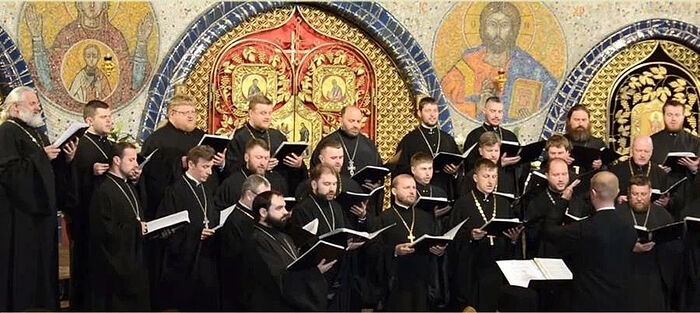
Regents about church choral singing
Church choral singing. This is an integral part of worship. And a unique element, different from any other music as such, capable of directing the whole person into the heavenly, spiritual world.
Nowadays we have the opportunity to attend services in many churches and monasteries and hear a wide variety of singing - both powerful festive choirs, and modest parish groups that quietly, without any special frills, praise God on weekdays of the year, and the ascetic, strict chants of monks, striving to renounce the sounds of the vain world. Moreover, many spiritual chants performed by singers of churches, where we will most likely never go in our lives, are recorded and heard on the Internet: choose and listen to what your heart desires!
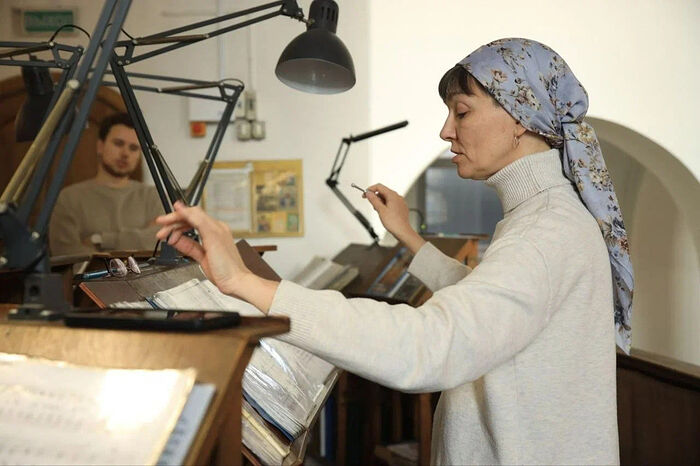
But what does she want... and what is useful? What kind of singing is appropriate for worship and will help to pray? And will he not lead one away from prayer “to a distant country” with his sensuality? What should a parish choir be like? I had the opportunity to talk about this with the directors of church choirs and find out what they, professionals in their field, think about liturgical singing.
Some of the conversations left an unforgettable mark on the memory, were remembered for deep thoughts, and impressed with the nuances of spiritual meanings and the prayer experience of people who create in the church a kind of sound space for prayer - congregational and personal.
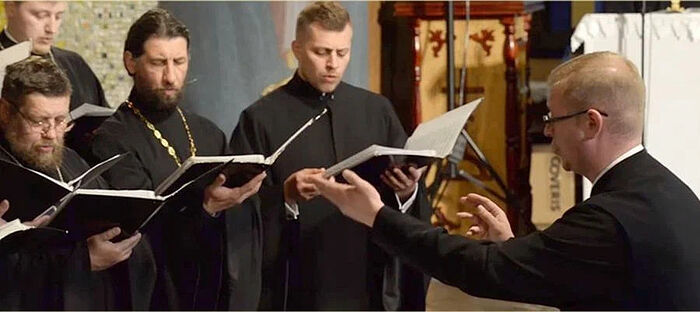
Several significant fragments of these interviews are collected in this material. They were recorded with participants in the International Festival of Sacred Music “Sovereign Voice”, held in Minsk in 2010–2020. At such festivals and at concerts of choral groups, as a well-known expert on the history and theory of Orthodox church singing, Archpriest Michael Fortunato († 2022), put it, “church choirs want to show society outside the walls of the church some glimpse of the inner church life.” And they succeed quite well.
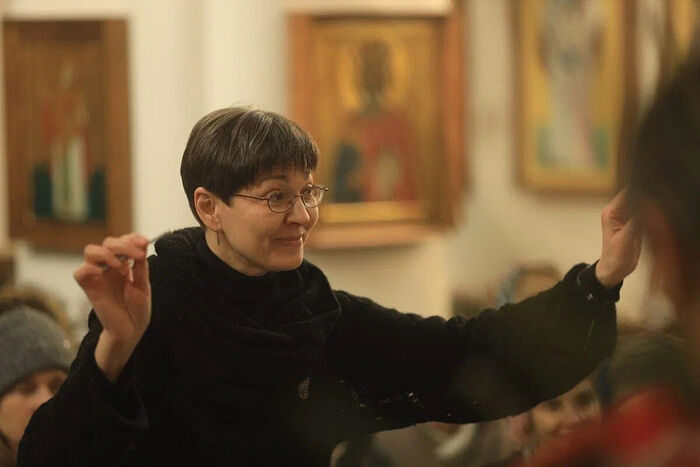
The voice is the most perfect instrument
Lyudmila Kutselai has been singing and presiding at church services for about 20 years. She began her professional education at the choir department of a music college. Then I studied at the Minsk Conservatory, also majoring in choral conducting. After the first year, I entered and simultaneously studied at the Minsk Theological School in the regency department.
Lyudmila Yaroslavovna has experience leading not only a mixed parish choir, but also a children's and youth group, and a men's church choir in the St. Peter and Paul Cathedral in Minsk. Currently, he is the regent of the festive choir of the capital’s Church of the Resurrection of Christ.
– Lyudmila, what is your attitude towards choral concerts and festivals, primarily those that bring together church choirs?
– You know, when a choir constantly sings at services, sometimes it starts singing out of habit. It seems that you are experiencing the same sensations... And the singers in the church are either not visible - they are upstairs somewhere or in a corner. And when the choir goes on stage, stands in front of the audience, then, of course, the singers try, prepare and show a very high professional level.
It turns out that concerts are a useful thing. Very useful! But I’m not saying that the competition is useful, no. It seems to me that this is a completely useless thing, because everyone has their own feeling - both spiritual and musical - and experience of a particular work. And you can’t compete here – absolutely. But festivals and concerts are also good for regents. After the concerts, they communicate, exchange materials, can hear some new piece and take it into their repertoire. I think this is very useful.
– As a professional musician, as a church choir director and simply as a believer, what can you say about the parish choir? What is the main thing in its sound?
- Word. And if the choir does not convey the word, then such a choir is not needed. No, of course, everyone likes it when they sing purely and harmoniously. This is understandable. It’s better to sing in one voice, but get the word across.
– By the way, this is how Orthodox worship is radically different from Catholic: we only have the word that is sung, but there is also music, the same organ plays.
- Absolutely right. The voice is the most perfect instrument created by God. Why anything else?
– But the sound of an organ has such a powerful effect on the soul! Do you think the human voice is something more meaningful and better? Why?
– The fact is that the sound of an organ has certain, characteristic frequencies, overtones. We understand that this is the sound of an organ. And it’s the same with other instruments: we understand that this sounds like a piano, and this sounds like a clarinet or flute. And people... How many people - so many voices. Each voice is unique, absolutely inimitable. Just like fingerprints...
How many people - so many voices. Each voice is unique, absolutely inimitable. Just like fingerprints
And it is very difficult to collect these unique voices so that they combine with each other and sound like one.
- How does this happen? By what miracle?
– First of all, at the request of those people who come to sing, because each choir member understands that the more he listens to his neighbor, the more his voice will blend with him. When I came to the conservatory, I practically couldn’t sing. I understand this now. And thanks to the girl with whom I sat next to in the choir for four years, I learned to do this. And in the last year of study, our voices matched in vibration.
In order for a choir to become established as a collective, time must simply pass. It is not even the number of rehearsals and services that is important, although this is also very necessary - what is more important is the passage of time. People then begin to more or less feel each other and join together in a party.
And so in any choir - children's, women's, no matter what. The same people need to sing. The more turnover in the team, the worse the sound, the worse the ensemble.
– About your special experience of working with a male choir: what is the most significant thing you would like to tell? It’s rare when a male team is led by a female regent...
– In general, I really love the sound of the male choir, because it is perceived completely differently in the church. And I understand why for so many centuries singing in the Church was only for men.
- It makes you pray. The lower the frequency of performance, the more calming it is. The higher the voice, the more annoying it is.
– So, male voices sound soothing?
- Certainly. And they make you think. What is a high female voice associated with? With mom, with sensuality. And the male voice is the rigor, order, orderliness that should be in life.
– When you listen to how a secular choir and a church choir perform liturgical chants, you always feel the difference in this “how”... Do you agree? If yes, then tell me what it is, in your opinion?
– Yes, there is a difference, but I don’t know how to put it into words... Awareness is different. No matter how much you explain to a secular person the content of a spiritual work, if he does not go to church, if he does not read anything spiritual, if he does not live by these thoughts, he will still have a superficial performance. There will be no deep penetration into the word. But when the singer is a believer, the penetration is completely different, the presentation is different.
Sometimes during a rehearsal we cannot go through all the pieces that will be performed at the service. We take the text and substitute a vocal chant. And an amazing thing: people, seeing a certain verbal expression, for example, “nailed with nails,” pass this thought through themselves and perform it in a completely different way, although I may not show them anything. Here is a meaningful pronunciation of the text, a meaningful singing. Not just higher and lower, quieter and louder, but everything – through the heart.
– It turns out that each person is not only unique, but also, like some kind of instrument, passing music and words through himself, he adds something there? I don’t even know what to call it: life, the breath of the soul, spirituality...
– Yes, spirituality, which is still from above...
–...A piece of the Divine that is in each of us, because God Himself breathed the breath of life into man.
Protodeacon Dmitry Shepelev studied at the Republican College of Music and graduated from the Belarusian State Academy of Music in choral conducting. In 2015, he completed his studies at the Minsk Theological Seminary. Since 2013, he has been the regent of the choir of clergy of the Grodno diocese, and also directs the Pokrovsky men's ensemble. Cleric of the Holy Intercession Cathedral in Grodno.
– What tasks are set for the clergy choir of the Grodno diocese, in contrast to traditional church choirs? They are? The choir is still special...
– The purpose of the existence of the choir of clergy is concerts that will attract people. Maybe even those who don’t go to church will come. And those who go will receive a charge of light mood at the concert, otherwise at the service they only reflect on their sins before Confession... And then they will feel that Orthodoxy is not sorrow and sadness, but still joy and love. And the direction of a Christian’s feelings should still be joyful.
Although, of course, this is another problem in selecting the repertoire. Because the most heartfelt hymns are written on Lenten texts. But there are not enough joyful and cheerful works, they are very difficult to find, and, of course, you cannot base an entire concert on them.
After all, there is an unspoken canon - what to sing in church and what to sing at concerts. We have the same opinion: it is inappropriate to perform a piece at a concert that is intended specifically for sacred rites. Cherubimskaya, “Mercy of the World” - specifically for prayer, for worship, and not for a concert.
The clergy choir is a sermon. Sermon in sound
In the Church there is divine service, there is social service, and there is missionary service. As I understand it (and maybe someone will disagree with me), the clergy choir is a sermon. Sermon in sound. Singing, music in general, has attracted human attention from time immemorial. The Holy Fathers have the idea that music is the honey on the edge of the cup with the teachings of the Church, this is the delight that makes it easier to accept the bitterness of realizing some truths associated with this teaching.
If we move somewhat away from Orthodoxy and consider the phenomenon of music itself, then it always awakens feelings in people. And often these are positive, creative, sublime feelings. Music encourages a person to think about something and feel something more deeply.
When the choir of clergy enters the stage - all in robes, some with crosses - this immediately prepares the listener for a more attentive perception, for the fact that the truth will now sound. The moment of distrust or criticism goes away.
Anyone can perform Orthodox chants, right? These can be any choirs - student, amateur, secular, municipal. I think that the choir of clergy a priori sets the listener in the mood that he will be given the right message, that people who serve God, constantly perform the Divine Liturgy, cannot present church music incorrectly, or feel it incorrectly. One thing is our vocal, professional capabilities, and another thing is what our singing is filled with, that is, the inner feeling of the singers during performance. And it is like a tuning fork for understanding the essence of the texts of spiritual chants.
I call choirs that sing an absolutely precise part, but without filling it with their feelings, without a soul, “organ choir” or “harpsichord choir,” or any other instrument where you press a key and the sound comes out. You can make it louder, quieter, you can sing legato or abruptly, but vocal music cannot exist without internal, sensory content. The choir is not an instrument.
– This is a very good question! Almost always, in 99% of cases, not counting vocalizations or closed-mouth singing, vocal music is related to the text. This is probably the most key, most important difference between it and instrumental music. A word cannot have some kind of neutral color, it cannot but carry some kind of semantic load. A purely musical phrase can only evoke certain abstract sensations. But a vocal phrase, a sung word, in addition to this coloring, also carries a semantic load. And so, the interweaving of music and words, their symbiosis, in fact, creates the distinctive property of choral music.
On the one hand, this is a kind of musical sensation, color, on the other, the meaning that is conveyed by words. And their combination gives a very large number of different “cocktails” from these concepts, various aftertastes.
Choral art, music in general, is a temporary art, it was performed once, and in the same way you will not repeat it again. Only if it's recorded, but it loses something, unlike live performance. Only here and now what is heard in front of the listener in the hall becomes a work of art. And the task of any choir director is to correctly understand the composer’s intention, implement it and convey it to the listener so that he immediately understands it. If this happens, it means that this is a successful work of the team leader and the composer, their co-creation.
– It turns out that this is the next stage of creativity, which does not end with the score being completed and closed?
- Certainly. This is a very old debate: where is the music - in the notes or between them? In fact, she is both there and there at the same time. The composer's creativity continues through the conductor's skill of interpretation.
The composer’s creativity continues through the conductor’s skill of interpretation
- Yes. It is important how skillfully the conductor was able to explain and infect the performers with his understanding of the work. And during the concert there is a continuous process of creativity - after all, works are not learned in some frozen form, only this way and no other way. Often during a concert a new interpretation is born. Or during rehearsal you may suddenly realize that you need to perform it differently here.
It is very pleasant to realize that you have been understood when you are trying to convey your inner mood, what you are feeling now, with a conductor’s gesture and gaze. And through the performers it already goes to the listener.
And each listener thinks about something different, hears in his own way. For some, what they hear will be beneficial, but for others it will be meaningless. Everyone will apply it differently. And so creativity continues - like some kind of endless chain from composer to listener.
There should be no falsehood in the Church
Olga Sholkova began her professional education at the music lyceum at the Belarusian State Academy of Music (now the Republican College of Music), then graduated from the Academy itself in violin class.
She studied the features of the specialty “church choir director” at the Minsk Theological School. After the ordination of her husband Kirill (now deceased, † 2023) to the priesthood, she carried out choir obedience for many years in the Church of the Icon of the Mother of God “Vsetsaritsa”, where he was appointed rector.
Olga Mikhailovna has been singing and regenting in churches in Minsk and the capital’s suburbs for more than 20 years. Currently, he is a teacher in the regency and singing department of the Minsk Theological School, regent of the choir of the St. Nicholas parish in the village of Gorodishche (Shchomyslitsky village council, Minsk region).
“I see my service in the choir as not only glorifying the Lord, but also teaching my singers church singing, correct, statutory.
– What do you mean when you say “correct church singing”?
– It seems to me that singers in a church choir should be taught not just to sing notes, but to understand the texts they sing, and also learn to pray while singing and reading. And it is desirable, first of all, to give them the basis of the church singing practice of the Russian Orthodox Church. Not some original chants, but our original Russian tradition of singing...
The style of chants, the architecture of the church - everything should complement each other, be organic. It’s not very true to sing concert scores in some small wooden church with a low ceiling. This is an imbalance, there is no harmony in this. How many regency congresses have there already been, where they say (and the saints also said so) that in church you need to sing simply. But at the same time you need to sing very well, with dignity, with an understanding of what is being sung and for whom.
– What do you think, since you are both a regent and a teacher with extensive experience, what chants should there be more in the church? What kind of singing will help make the service a service, a divine service? Or could there be different options?
“The Lord has a lot of everything, and all this diversity is wonderful. And the fact that choirs sing in different traditions and in different ways is good. Now the emphasis is on traditional church singing. Minimum concert performance. But church classics are very diverse and rich. On the one hand, original chants may be inappropriate to perform in a church. But there are also such magnificent compositions, as well as harmonizations of primordially church chants, made by composers, which are quite conducive to prayer. This is a matter of the taste of the regent, his capabilities, his internal state. As a matter of fact, the tandem of the rector and the regent determines what will be sounded. Some priests do not like partes, while others do not like simple or monophonic singing. And it is more correct for the regent to obey, because with the help of the choir he must create an atmosphere of prayer in which the priest can perform divine services.
Everyone should be in agreement, and not so that the choir sings to itself, the altar prays separately, and the people are left to their own devices
There must be love between us. Everyone should be in harmony, like one family, and not so that the choir sings to itself, the altar prays separately, and the people are left to their own devices. There must be a kind of dialogue between the clergy and the choir - without pauses, without strain, without fuss. General service.
The choir can help you pray in church, or it can hinder you. We should not sing in such a way that the congregation will pay attention to us. When they start whispering or looking around at the choir, this is already a sign that people are not praying, but listening to singing, what kind of voice a singer has, or a new beautiful chant... This means that the choir has, in fact, violated its purpose.
But if there is a twelfth or patronal feast day in the church, then you can choose from a number of church hymns what will correspond to the moment. This is why church education is necessary, so that the regent can be oriented, know and understand what to sing and under what conditions. This is especially important when you have a small choir or trio. You cannot sing something complex or big, because when performed by such a composition, this chant will sound ridiculous or inappropriate.
– In some parishes there are services where the believers themselves sing. Could the people sing it all themselves? Isn't that how it was in ancient times?
– The Charter of the Church states that special people have always been elected to the choir. Even in ancient times. There are unchangeable chants that people sing during services. But there are chants (stichera, troparia, irmos) in which the texts change every day. People won't be able to sing it. People simply do not have enough knowledge and skills. With our singers, we analyze Church Slavonic texts, translate incomprehensible words and semantic phrases into modern Russian, and get acquainted with the Charter. That is, the regent must also know church history...
– Does so much depend on the regent?
– In musical circles it is customary to make comments to each other. They discuss the musicians and the conductor - whether he is good or bad. It is inappropriate to do this in a church environment. Because in the choir the regent is the main one, he is responsible for everything - for the choice of the work, for how it will be performed, what the nature of the service will be.
He is fully responsible before God for how he conducts the service and how the choristers sing
In general, the choir is a special service. If a singer in the choir places purity of intonation and quality of performance higher than the interaction of the entire group, than singing “with one mouth,” this is bad. In my opinion, peace in a team is more important than professionalism. Relationships in the choir are special; here you need to give in, tone down your ego and pride a little. Without peace there will be no prayer, without real Christian relationships it is impossible to sing in the choir. It will be a substitution, a falsehood. And there should be no falsehood in the Church!
Recorded by Elena Nasledysheva Photo from the archives of the regents, Ministry of Education and Science