Artefacts linked to St Constantine the Great’s ancient Danube bridge discovered in Romania
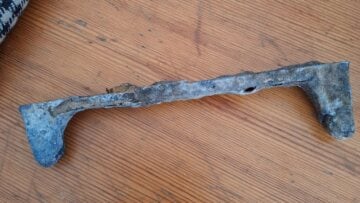
Underwater archaeologist Iulian Rusu recently discovered lead objects believed to have been used to secure the piers of St. Constantine the Great’s bridge on the Danube and handed them over to the Corabia Museum.
Mirela Trandafir, a museum curator and coordinator of the Cultural Service at Corabia City Hall, announced the discovery on social media.
She told Agerpres that “the archaeologist brought to light a lead clamp and an unidentified three-legged object, also made of lead, probably likewise used to secure the piers, as well as the neck of an amphora”.
The objects, discovered this week in the waters of the Danube, were taken to the Corabia Museum and will be placed on public display.
The museum curator believes that the lead objects recovered from the Danube date from the 4th century, during the reign of St Constantine the Great, who inaugurated the bridge in the summer of 328. It is considered one of antiquity’s longest bridges.
The fall in the Danube’s water level in recent months has made it easier to observe the piers of the bridge across the river, built more than 1,600 years ago.
Photo credit: Facebook / Mirela Trandafir