Apostle Philiptranslated
Maria Tobolova When the Jewish High Priest and his companions began to blaspheme the Lord and attacked the Apostle Philip, they suddenly became blind. Through the prayer of the apostle, everyone received their sight, and, seeing this miracle, many believed in Christ.
Their messages went out into all the earth, and their words went out to the ends of the world.
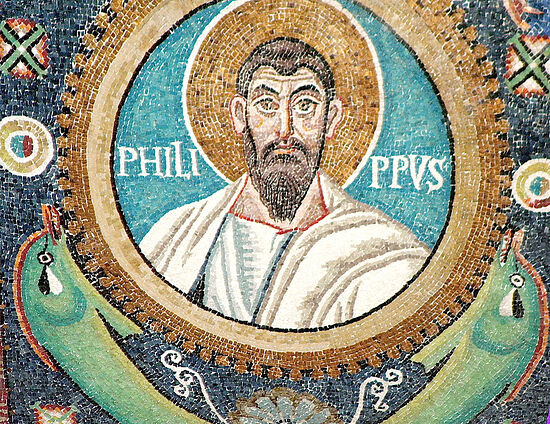
The Apostle of the Lord Philip is one of the twelve closest disciples of the Lord Jesus Christ. In the Synoptic Gospels (cf. Matt. 10:3; Mark 3:18; Luke 6:14) he is simply included in the list of the twelve apostles. But in the Gospel of John his role is revealed in more detail.
Philip was born in the city of Bethsaida, located on the shores of Lake Galilee, near the city of Capernaum, in the same area as the apostles Peter and Andrew. From his youth, he was sent by his parents to study as scribes. Apparently, the parents wanted to see their son as an interpreter of the Torah in the future. Philip truly became an expert on the Pentateuch. Diligently reading and studying it, as well as the prophecies about the Messiah, he fell in love with Him and looked forward to His coming. According to Clement of Alexandria and Eusebius of Caesarea, Philip was married, had daughters and a sister, Mariamne, who would later become his assistant in spreading Christianity among the pagans.
Christ, having come to Galilee, called Philip to serve, saying to him: “Follow Me.”
(John 1:43), and Philip immediately followed Christ. Having met his friend Nathanael (Bartholomew), he joyfully told him: “We have found the One about whom Moses in the law and the prophets wrote - Jesus, the son of Joseph, from Nazareth” (John 1, 43-46). So he brought the future apostle Nathanael to Christ. Subsequently, Philip followed Jesus everywhere and served Him faithfully.
Philip followed Jesus everywhere and served Him faithfully
At first, Saint Philip saw in the Teacher only high human perfections, but did not yet recognize His Divine essence in Him. One day the Lord, walking surrounded by a crowd of thousands, decided to test Philip and said to him: “Where can we buy bread to feed them?” (John 6:5-6). Philip answered: “Two hundred denarii will not be enough bread for them, so that each of them gets at least a little” (John 6:7). Immediately he became convinced of the omnipotence of God, who fed 5 thousand people with five loaves of bread and two fish. He was ashamed of his lack of faith and, together with others, glorified Jesus and the power of God.
It was Philip who, during the festival in Jerusalem, led the pagan Greeks who wanted to see Him to Christ (cf. John 12:21-22).
During the Last Supper, Philip dared to ask the Lord Christ about God the Father: “Lord! show us the Father, and that is enough for us!” (John 14:8) The Lord responded to this with a slight reproach:
“I have been with you for so long, and you do not know Me, Philip! He who has seen Me has seen the Father; How do you say: “Show us the Father?” Don’t you believe that I am in the Father and the Father in Me” (John 14:8-11).
The Lord’s answer taught the holy Apostle Philip, and with him the whole Church, to believe in the equality of the Son with the Father
This answer of the Lord taught the holy Apostle Philip, and with him the whole Church, to believe in the equality of the Son with the Father.
Before the Ascension, the Lord gave the apostles the command: “Go therefore and teach all nations, baptizing them in the name of the Father and the Son and the Holy Spirit” (Matthew 28:19). The places where the Apostle Philip preached are known to us only from apocryphal sources. According to legend, after the Ascension of Christ and the descent of the Holy Spirit on the Apostles, Philip preached the Word of God in his homeland - in Galilee; his preaching was accompanied by miracles. For example, one day he met a woman carrying her dead baby in her arms and sobbing inconsolably. The Apostle of Christ took pity on her and in the name of Christ raised the baby. Then the woman, unconscious of joy, fell at the feet of the apostle and asked to baptize her and her child.
From Galilee he went to Greece and preached among the Jews who had resettled there. Philip's preaching about the risen Christ was heard by many. Some of them reported this to Jerusalem, and then scribes, led by the High Priest, arrived from there to arrange a trial of the apostle. The Apostle Philip exposed the lies of the High Priest. When the Jewish High Priest and his companions began to blaspheme the Lord and attacked the Apostle Philip, they suddenly became blind. Through the prayer of the apostle, everyone received their sight, and, seeing this miracle, many believed in Christ. The Apostle Paul appointed them a bishop named Narcissus (from among the 70 apostles).
Then the Apostle Philip brought the Good News to Parthia, and then arrived by sea to the city of Azot, where he healed Charitina, the daughter of a local resident Nikoclides, from an eye disease, who accepted him into his home and then was baptized with the whole family. The Apostle also preached in Hierapolis in Syria, where he resurrected a dead youth and healed the withered hand of the mayor Aristarchus.
The apostle also preached in Hierapolis in Syria, where he resurrected a dead youth and healed the withered hand of the mayor Aristarchus
Incited by the Pharisees, the Jews in the first days of his appearance in the city wanted to kill him, but, seeing the miracles he performed, they repented, after which many accepted Holy Baptism. Having installed Ira as bishop of Hierapolis, the apostle traveled through Syria, Asia Minor, Lydia, and Mysia, everywhere preaching the Gospel and enduring persecution. He and his sister Mariamne were stoned, imprisoned, and expelled from villages. Together with Mariamne and the Apostle Bartholomew, he walked through all of Lydia and Mysia. More than once the saints suffered beatings and imprisonment from the pagans, but they endured everything for the sake of the Lord.
In this city, Saint Philip, through prayer, defeated the church viper (snake), to which the townspeople made sacrifices, and healed the blind Stachy
In Phrygia, in the city of Phrygian Hierapolis, in Asia Minor (present-day Türkiye), Philip settled with his family. There were many temples dedicated to pagan deities. And so, in the center of pagan culture, the word about Christ, about the God Incarnate, who conquered death, was heard. In this city, Saint Philip, through prayer, defeated the church echidna (snake), to which the townspeople made sacrifices, and healed the blind Stachy. The wife of the mayor Nikanor believed after being healed from a snake bite. Then the angry ruler ordered the apostles to be seized and the house of Stachius to be burned. The priests demanded the death of the “magi” who killed their echidna goddess. Philip was captured along with his sister Mariamne and the Apostle Bartholomew. Both apostles were crucified by pagans on crosses head down. Hanging on the cross, the Apostle Philip prayed for his enemies. Suddenly an earthquake occurred, and the city residents, frightened by it, demanded that the ruler of Hierapolis, Anfipat, cancel the execution. They managed to remove Apostle Bartholomew from the cross alive, and Philip died on the cross from his wounds.
According to legend, in the place where his blood flowed, a grapevine grew in three days - as a sign that Saint Philip was enjoying eternal bliss with the Lord. These events took place during the reign of the Roman Emperor Domitian, in the year 90. The Apostle was 87 years old at that time.
In the place where his blood flowed out, a vine grew - as a sign that St. Philip enjoys eternal bliss with the Lord
At the site of the execution of the Apostle Philip in Hierapolis in Phrygia, Christians built a martyrium church, in which they placed the remains of the Apostle. His sister Mariamne, together with the Apostle Bartholomew, went to preach to Armenia, where the Apostle Bartholomew was crucified (June 11). Mariamne preached until her death in Lycaonia.
For more than 500 years, life continued to seethe in Hierapolis, but in the 11th century the city was captured by the Turks, and the church of the Apostle Philip was desecrated and destroyed. The relics of the apostle were transferred to Rome around 560, where they are still located in the Church of the Twelve Holy Apostles (Santi Apostoli).
Excavations at the site of ancient Hierapolis began at the end of the 19th century. And more recently, in August 2011, a message appeared that archaeological scientists had discovered the tomb of the Apostle Philip. Evidence that this tomb belonged to the apostle is its structure and the writings found on it. This discovery is one of the most sensational discoveries of recent decades.
Memorial Day of the Apostle Philip - November 14/27. From this day begins the Nativity Fast, which is popularly called Filippov.
Holy Apostle Philip, pray to God for us!
Life of the Holy Apostle Philip // Lives of the saints in Russian, set out according to the guidance of the Four Menaions of St. Demetrius of Rostov. T. III: November, Day 14. - P. 372). 1903-1916.
Parkhomenko Konstantin, priest. Apostle Philip. / Magazine “Foma”, No. 12 (104) 2011
Holy Apostle Philip / Synaxarion: Lives of the Saints of the Orthodox Church // https://pravoslavie.ru/57729.html
November 27 is the day of remembrance of the Holy Apostle Philip, one of the twelve disciples of Jesus Christ // https://ekaterinburg-eparhia.ru/news/2023/11/27/122350/