November 23translated
24th Sunday after Pentecost Nativity Lent - exemption from fish After-feast of the Presentation at the Church of the Most Holy Mother of God and ever virgin Mary (until
24th Sunday after Pentecost
Nativity Lent - exemption from fish
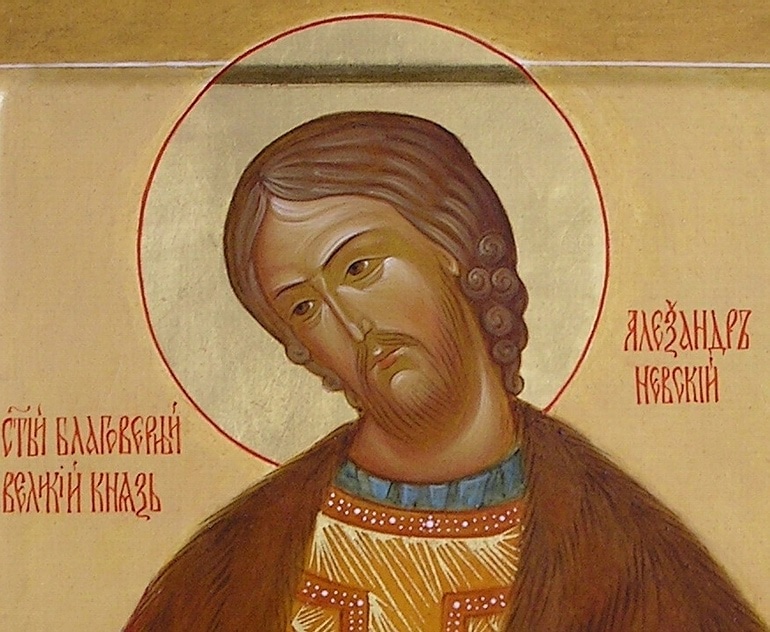
After-Feast of the Presentation at the Church of the Most Holy Mother of God and Ever Virgin Mary (until November 25). Saint Amphilochus, bishop of Iconium (394); Saint Felicity and her seven sons: Saints January, Felix, Philip, Sylvain, Alexander, Vital and Martial, martyrs in Rome (around 164); Saint Clement, first bishop of Metz (3rd century); Saint Sisine, bishop of Cyzicus, and Theodore of Antioch, martyrs (4th century); Saint Columbanus, missionary, abbot of Luxeuil (615); Saint Gregory, bishop of Agrigento (630); Saint Vulfétrude, abbess at Nivelles (669); Saint Trond, priest in Hesbaye, Belgium (around 690); Saint Alexander of the Neva, Russian prince (1623); Saint Mitrophane, bishop of Voronège (1703); Saint Anthony of Lezeru-Vâlcea in Romania (18th century).
At the most critical time in the turbulent history of the Russian people, Saint Alexander shone for his courage and his virtues as a Christian head of state. Energetic, valiant, defender of faith and justice, he received from God the mission to offer his life in the service of his people assailed from all sides. Son of Yaroslav Vsevolodovitch, prince of Pereïaslavl-Zalesski, north of Moscow, Saint Alexander was born in 1220. From an early age, the prince was initiated into the profession of arms and the art of government by his father; but he also learned to use both with wisdom and moderation for the cause of piety and justice, thanks to assiduous attendance at church and meditation on the Holy Scriptures. Alexander was so handsome, so valiant and behaved with such an evangelical spirit that he was admired even by his enemies. In 1228, aged only ten, he and his elder brother, Theodore, had become prince of the proud and great city of Novgorod. He early experienced the difficulties of government, because the inhabitants of the city were divided by fratricidal struggles, which opposed the rich in power and the poor crushed by taxes and the tyranny of the notables. In 1231, this situation was aggravated by a terrible famine and an exceptionally harsh winter, which caused many victims. The young prince then demonstrated his Christian virtues by opening all his reserves and personally coming to the aid of both rich and poor. He thus endeared himself to his subjects and was able, little by little, to impose his authority on the inhabitants who had until then refused to recognize him. Friend of the clergy, monks and the poor, he devoted all his energy to saving his threatened city. Since 1223, the Tatars (Mongols), coming from the steppes of Central Asia, had invaded and ravaged immense territories and, between 1237 and 1239, they swept over Russia, massacring the population and pillaging everything in their path. They captured Vladimir, but stopped about a hundred kilometers from Novgorod to head towards kyiv, which they reduced to ashes. They then settled in the southeastern part of Russia, on a territory of great strategic importance, the Golden Horde, which controlled access to the Black Sea, the Caucasus and Central Asia. For more than two hundred years, they subjected the Russian principalities to very heavy tributes, constantly threatening them with murderous invasions in the event of rebellion. Becoming the sole prince of Novgorod upon the death of his brother in 1236, Alexander had to face an even more pressing danger from the West: the kingdom of Sweden, that of Lithuania and the Teutonic knights were in fact converging their efforts to seize the Russian principalities weakened by the Mongol invasion and their divisions. On July 15, 1240, Alexander was forced to assemble a weak army to oppose a violent and mas