November 16 (old calendar) / November 29 (new)translated
Nativity Lent - fish exemption Saint apostle and evangelist Matthew (60); Saint Fulvian, king of Ethiopia, named Matthew at baptism (1st century); Saint Eucher, bishop of Lyon (449)
26th Sunday after Pentecost
Nativity Lent - exemption from fish
Saint apostle and evangelist Matthew (60); Saint Fulvian, king of Ethiopia, named Matthew at baptism (1st century); Saint Eucher, bishop of Lyon (449); Saint Céronne, evangelist of Perche (490); Saint Domine, hermit in Corrèze (6th century); Saint Emilion, hermit in Aquitaine (around 767); holy neo-martyrs of Russia: Theodore (Kolerov), priest and with the martyrs Ananias (Boikov) and Michael (Boldakov) (1929); John (Tsvetkov), Nicholas (Troitsky), Victor (Voronov), Basil (Sokolov), Macarius (Soloviev) and Michael (Abramov), priests, Panteleimon (Arjanykh) (1937), Dimitri (Spiridonov) (1938).
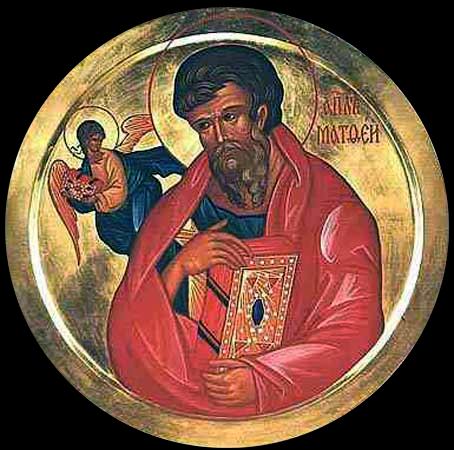
THE HOLY APOSTLE AND EVANGELIST MATTHEW
The holy Apostle Matthew first bore the name Levi and was the son of Alphaeus, exercising the profession of tax collector (publican). One day while he was standing at the customs office, Jesus came passing by and behind him a whole crowd, who eagerly received his teaching. The Lord looked at Matthew and said to him: “Come after me! » The publican immediately got up and followed him, without a thought or even a glance at what he left behind. Before setting out on the road to follow Christ, he offered a great banquet at his home, in which Jesus and his disciples took part, as well as a large number of tax collectors and public sinners. As the Pharisees were scandalized, the Lord said: “It is not the healthy who need the doctor, but the sick. I did not come to call the righteous, but sinners to repentance” (Lk V, 27; Mt IX, 13; Mk III, 17). Following Christ on all his journeys throughout Palestine, Matthew witnessed His teachings and miracles before his Crucifixion and after his Resurrection. After being filled with the grace of the Holy Spirit, on the day of Pentecost, with the other apostles, he was designated to evangelize his fellow Jews. This is why, eight years after the Ascension, he was the first to write the Gospel, that is to say the presentation of the acts and teachings of the Savior, intended for populations that his oral teaching could not reach. This Gospel was, it is said, translated into Greek a few years later by Saint James, first bishop of Jerusalem, and copied by the holy Apostle Bartholomew. It did not take long to replace the Aramaic original, of which no copy remains. Subsequently, Saint Matthew went to spread the Good News in the country of the Parthians and was subjected to numerous tribulations on the part of the pagans. Then, the holy Apostle went to live in the harsh solitudes of a high mountain to devote himself to asceticism and contemplation. It was there that the Lord appeared to him in the form of a child and gave him a staff, ordering him to go and plant it near the church in the town of Myrmène. The bishop of the city, Plato, solemnly received Matthew in the company of all his clergy. As soon as the Apostle had planted the stick in the ground, it sprouted and gave fruit from which delicious honey oozed, like a foretaste of the delights of Paradise. A spring of fresh water also gushed from the foot of the tree and all those who bathed in it were delivered from their passions and the darkness of idolatry. Despite all the benefits he provided to the Parthians and even to the royal family, the holy Apostle was subjected by King Fulvian to terrible tortures, before being delivered to the fire. However, he managed to convert the tyrant to the faith, through the numerous miracles performed by his holy relics. When he was baptized, the king asked to be given the name Matthew. He overturned