November 15 (old calendar) / November 28 (new)translated
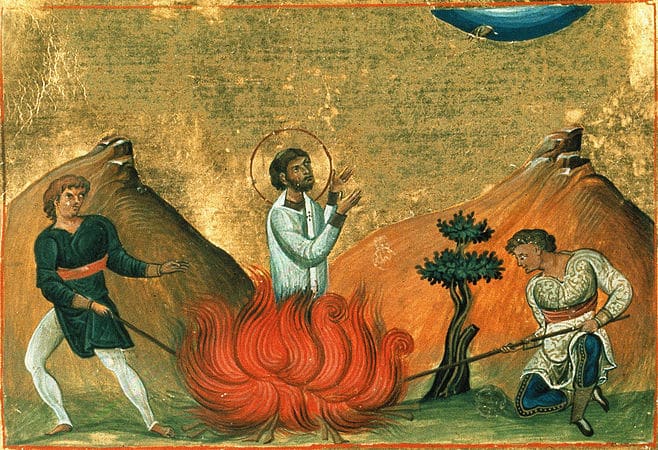
Beginning of Nativity Lent Saints Gourias and Samonas, priests, martyrs in Edessa (306); Saint Habib, deacon, martyr in Edessa (322); Saints Elpidus, Marcel and Eustoche, martyrs
Start of Nativity Lent
Saints Gourias and Samonas, priests, martyrs in Edessa (306); Saint Habib, deacon, martyr in Edessa (322); saints Elpide, Marcel and Eustoche, martyrs in Carthage (4th century); Saint Dimitri of Thrace, martyr (307); Saint Malo, bishop of Aleth (460); Saints Aurelius, Suacre, Scutaire, Armentaire and Bénigne, bishops of the diocese of Puy-en-Velay (4th-5th centuries), Saint Didier, bishop of Cahors (655); Saint Pavin, abbot near Le Mans (around 700); Saint Païssy (Velitchkovsky) of Moldavia (1794); neo-martyr saints of Russia: Nicholas (Shtcherbakov) and Peter (Konardov), priest, Gregory (Dolinin) and Niketas (Almazov), deacons (1937); icon of the Mother of God of Koupiatitsa (1180).
Our holy Father Païssy was born in 1722 into the large family of a priest in the city of Poltava, in Ukraine. Gentle, reserved, gifted with a great capacity for contemplation and a lively intelligence, he very quickly learned to read and immersed himself with passion in the reading of Holy Scripture, the Lives of the holy monks and the writings of the Fathers of the Church, particularly those which dealt with asceticism. Sent to the Ecclesiastical Academy of kyiv to continue his studies, he was quickly disappointed by its drying teaching, influenced by Latin scholasticism. After four years, he abandoned his studies and set out in search of a spiritual father and a monastery where he could live in simplicity, imitating the poverty of Christ. He stayed in various monasteries, became a rasophor under the name of Plato; then, having heard praise of the way of life led in the sketes of Moldo-Walachia (present-day Romania), he went there in haste with a few companions. Plato lived there for several years in ideal conditions for monastic life, with wise spiritual fathers who faithfully followed the teaching of the holy Fathers. He then demonstrated his ardor to acquire the qualities of an exemplary disciple: absolute obedience, humility, love of brothers, constancy and joy in trials, zeal for meditation and prayer. As his superiors, in view of his progress, wanted to have him ordained a priest before the required age of thirty, fearing to infringe in any way the holy Canons, he left his monastery and Romania to head towards the end of his aspirations: Mount Athos. However, due to the Turkish occupation, the situation there was not very bright, and having been unable to find, despite his searches, the spiritual father to whom his soul aspired, Plato settled alone, near the monastery of Pantocrator, having for guides only Holy Scripture, the writings of the holy Fathers and the testimony of his conscience. Reduced to the most extreme poverty, he only ate every other day, fighting every day against the temptations of discouragement, and persevering in prayer and meditation on patristic writings. After four years of struggles, the venerable Basil of Poïana Marului, whom he had known in Romania, came to visit Athos (1756). He tonsured him into a monk under the name of Païssy and advised him to take with him some companions, in order to escape the dangers of a premature eremitical life. Shortly after, a young Romanian monk, Bessarion, who like him had been unable to find a spiritual father, presented himself and asked to receive him as a disciple. Païssy, judging himself unworthy of teaching, agreed to take him with him, not as a disciple but as a brother and companion in asceticism. Soon other brothers, Romanians and Slavs, joined them. In 1758, Païssy, who still refused to consider himself their master, finally gave in to the urgings of his companions and agreed to