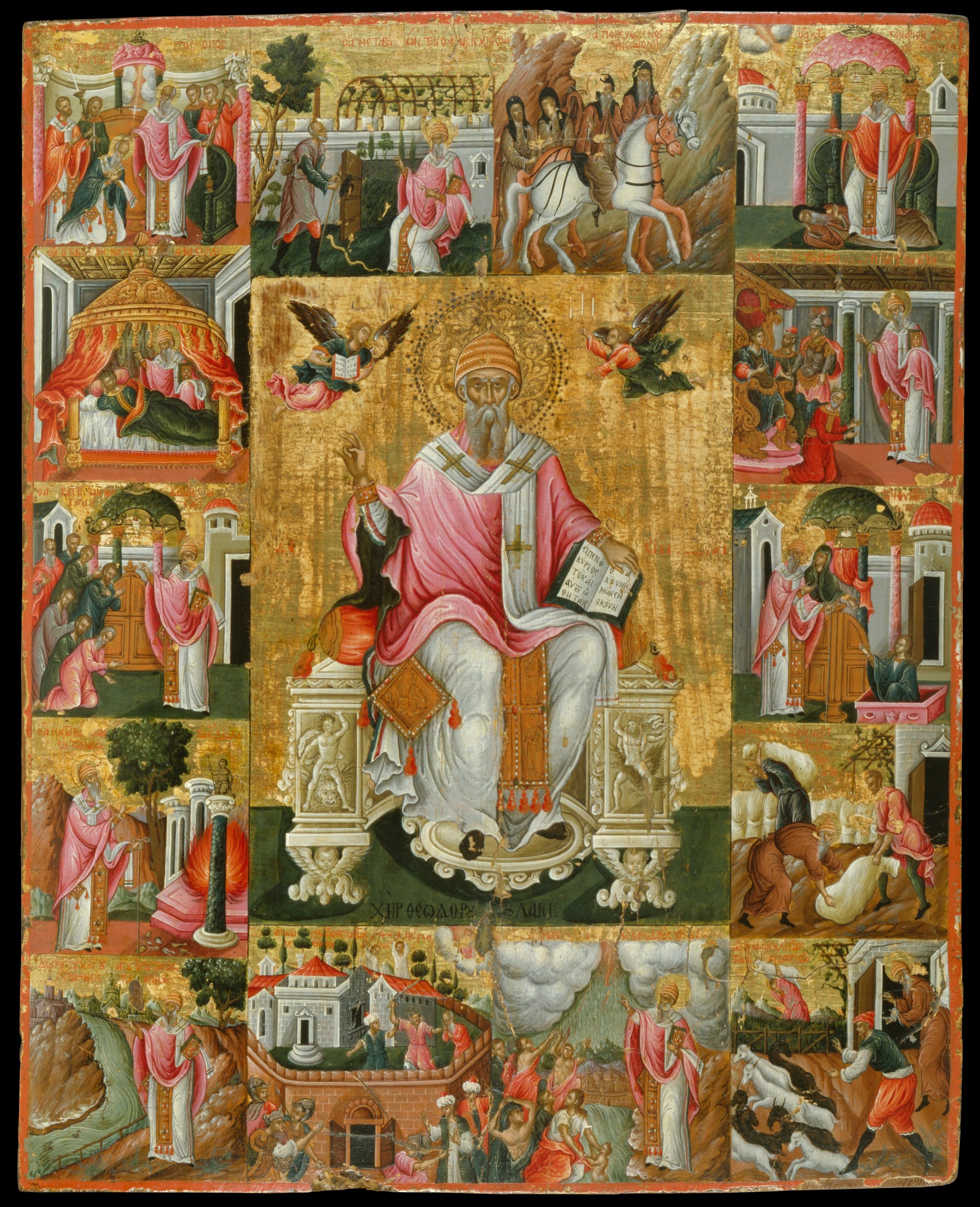
My homeland was the island of Cyprus. I am the son of simple parents and myself simple-minded, humble and virtuous; from childhood I was a shepherd of sheep, and when I came of age I entered into lawful marriage and had children. I led a pure and God-pleasing life, imitating David in meekness, Jacob in simplicity of heart and Abraham in love for strangers.
Having lived but a few years in marriage, I lost my wife: she died, and I began to serve God even more freely and zealously with good deeds, spending all my substance on the reception of strangers and the sustenance of the poor. By this, while living in the world, I so pleased God that I was accounted worthy of the gift of wonderworking from Him: I healed incurable diseases and with a single word drove out demons.
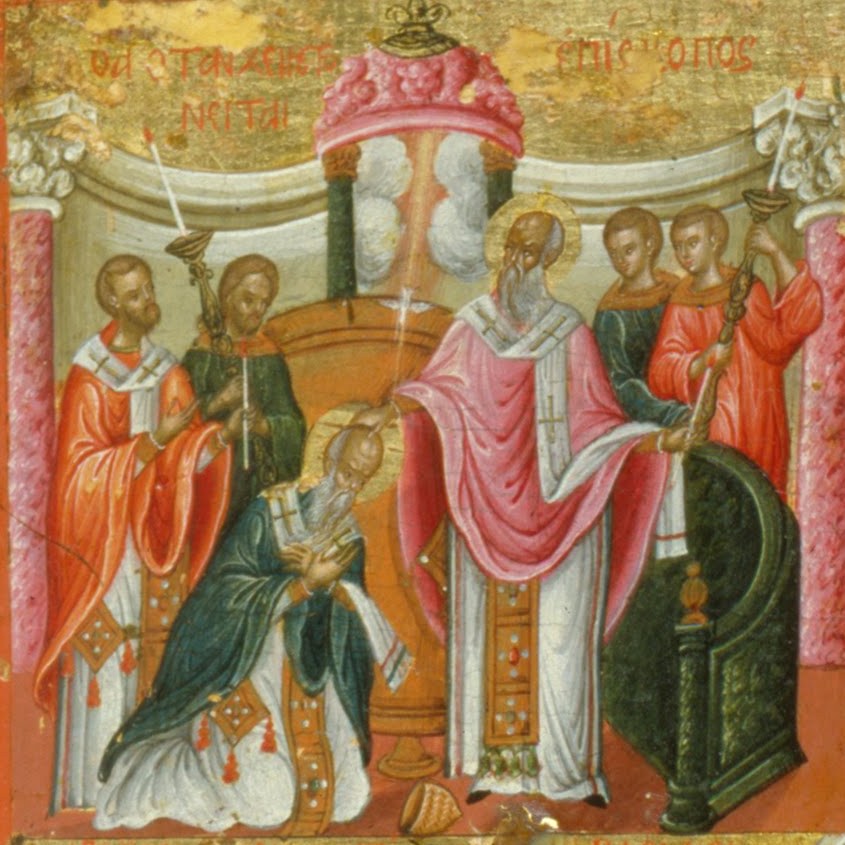
For this I was made bishop of the city of Trimythous in the reign of the Emperor Constantine the Great. And on the episcopal throne I continued to work great and wondrous miracles.

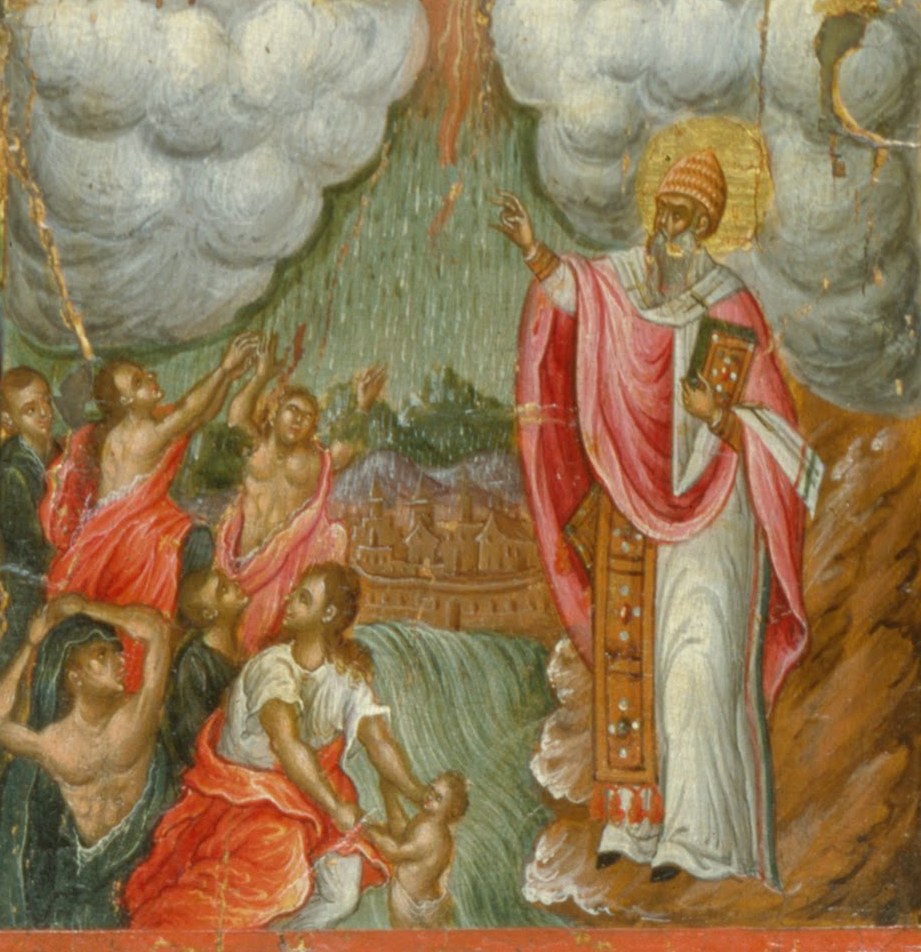
Once on Cyprus there was a drought and a terrible dry spell, followed by famine, and after the famine a pestilence, and many people perished. Seeing the calamity that had befallen the people and pitying them as a father for those perishing from hunger, I turned with fervent prayer to God — and immediately the sky was covered with clouds from every side, and a heavy rain poured down that did not cease for several days; I prayed again, and fair weather came.
But after a few years, because of the sins of the people, famine again struck the land. There was then in Trimythous a grain merchant who suffered from insatiable greed for money. Having bought up a great quantity of grain, he stored it in granaries in order to wait for the famine to worsen and sell it at a higher price. A certain poor man came to him and with tears begged him to give a little grain so that he would not die of hunger together with his wife and children. But the unmerciful rich man said to him: “Go, bring money, and you will have everything you buy.”
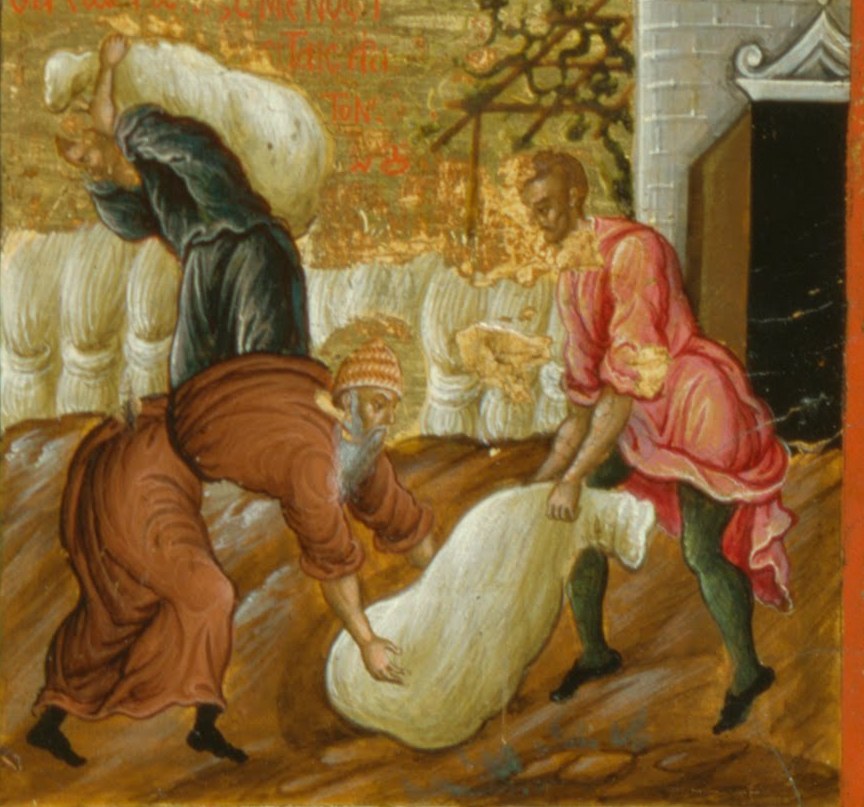
The poor man, faint with hunger, came to me and with weeping told me of the hard-heartedness of the rich man. “Do not weep,” I said to him, “go home, for the Holy Spirit tells me that tomorrow your house will be full of bread, and the rich man will beg you and give you bread for nothing.” Scarcely had night fallen when, at God’s command, a very heavy rain began, which washed away the granaries of the unmerciful lover of silver, and the water carried off all his grain. Poor people gathered up the grain that had been carried by the streams along the roads; the poor man also gathered more than enough for himself. Seeing the manifest punishment of God upon himself, the rich man began to beg him to take as much grain as he wished for nothing. Thus God punished the rich man for his lack of mercy and delivered the poor man from poverty and hunger.

During the same famine one farmer known to me came to that same rich man with a request to lend him grain for sustenance, promising to return what was given with interest after the harvest. But the rich man was merciless to this poor man as well: «Without money,» he said, «you will not receive a single grain from me».
Then the farmer wept and came to tell me of his trouble. I comforted him, and in the morning I myself came to him and brought a whole heap of gold: «Take this gold, brother, to that grain merchant and give it as a pledge,» — and after the harvest let him redeem the pledge and bring it back to me. The rich man released grain to the poor man. Then the famine passed, there was a good harvest; the farmer gave the rich man the grain he had taken, redeemed the pledge and with gratitude brought it to me.
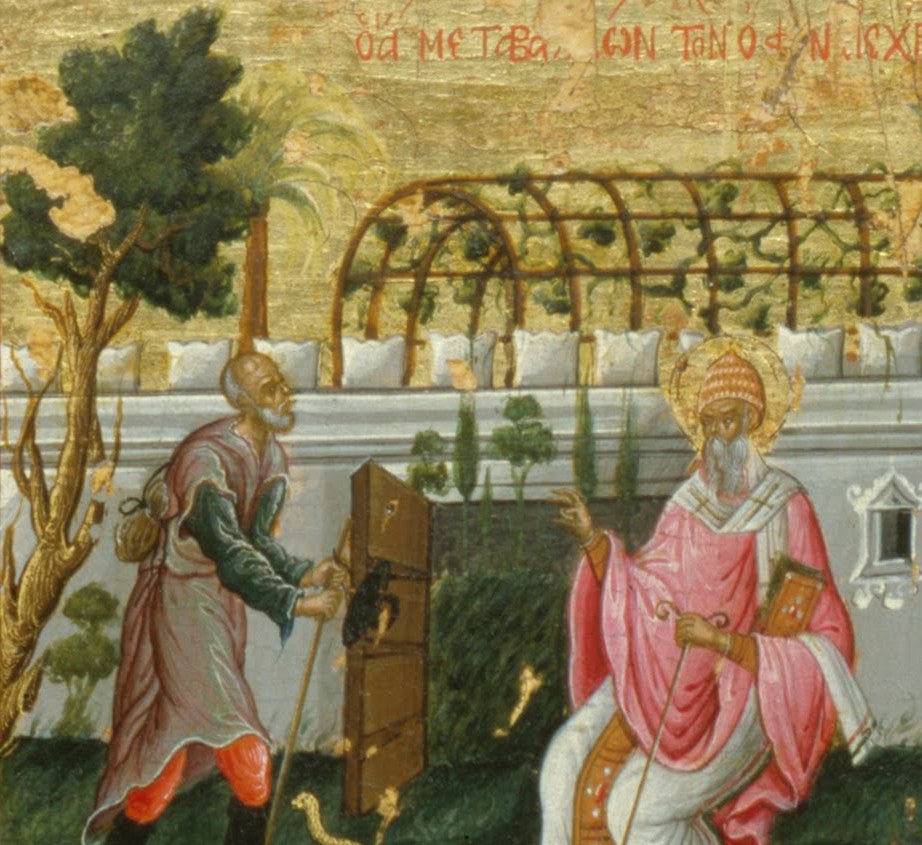
I took the gold and set out for my garden, taking the farmer with me as well: «Come,» I said to him, «and together let us give this back to Him Who so generously lent it to us». Entering the garden, I placed the gold by the fence, lifted my eyes to heaven and cried out to my Lord Jesus Christ: as once He turned Moses’ rod before the eyes of the king of Egypt into a serpent, so let Him command this gold, formerly transformed by Him from an animal, to take again its original form — then this man too will know what care God has for us, for «the Lord does whatever He pleases» (Ps. 134:6).
While I was praying thus, the piece of gold suddenly stirred and turned into a snake. Thus first the snake was turned into gold, and then from gold it became a snake again. The farmer trembled with fear and fell to the ground; the snake crawled away into its hole, and he returned home, marvelling at the greatness of the miracle wrought by God.

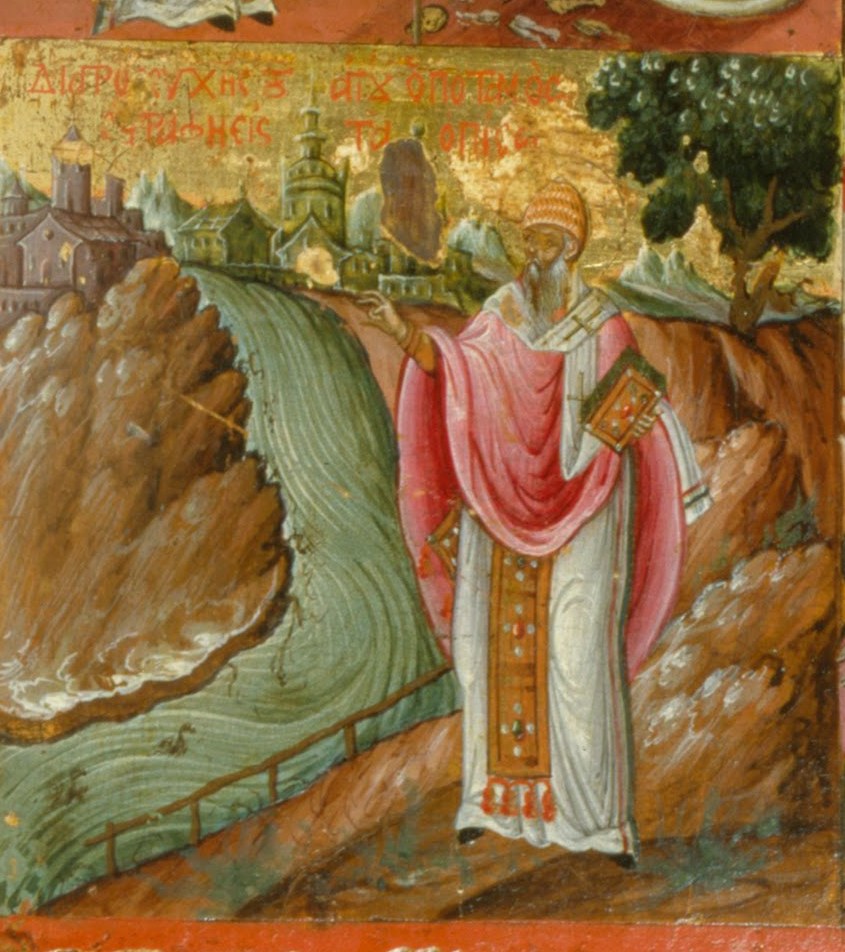
One virtuous man, my friend, through the envy of evil people was slandered before the city judge and condemned to death without any guilt. Learning of this, I went to deliver my friend from an undeserved execution. At that time there was a flood in the land, and the stream on my way had overflowed its banks and become impassable. Recalling how Joshua the son of Nun with the ark of the covenant crossed the flooded Jordan on dry ground, I, believing in the omnipotence of God, commanded the stream as a servant: «Stand still! Thus the Master of all the world commands you, that I may cross and the man for whose sake I hasten may be saved». The stream immediately stopped its flow and opened a dry path — both for me and for all who were going with me. The witnesses of the miracle hastened to the judge, and he at once released the condemned man.
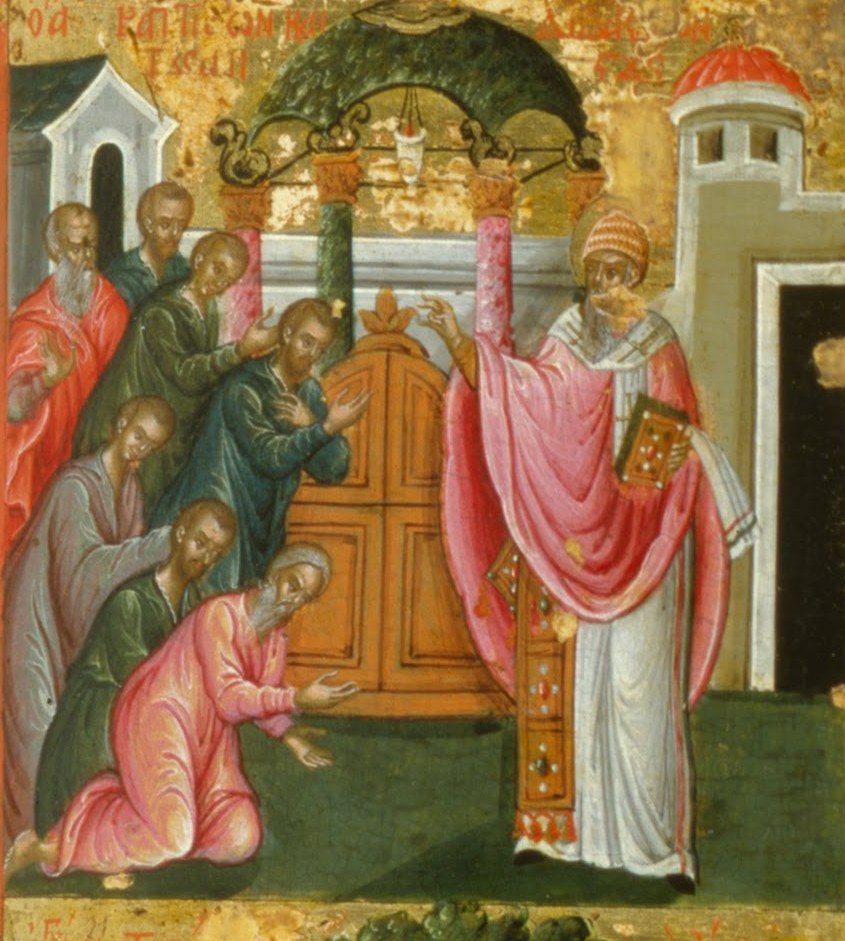
I also foresaw people’s secret sins. Once, when I was resting from the road at the house of a hospitable man, a woman living in unlawful cohabitation wished to wash my feet, according to the local custom. But I, knowing her sin, told her not to touch me — not because I abhorred the sinner: how can a disciple of the Lord, Who ate and drank with tax collectors and sinners, abhor sinners? When she persistently continued trying to touch my feet, I reproved her with love and meekness and urged her to repent.
Shame seized her; with a contrite heart she fell at my feet and washed them no longer with water but with tears, and openly confessed the sins of which she had been convicted. And I, imitating the Lord, mercifully said to her: «your sins are forgiven» (Lk. 7), and again: «you have been made well; sin no more» (Jn. 5:14). From that time that woman was completely corrected.

Until now I have spoken of miracles; now it is fitting to speak also of my zeal for the Orthodox faith. In the reign of Constantine the Great, the first Christian emperor, in the year 325, the First Ecumenical Council was convened in Nicaea — to depose the heretic Arius, who impiously called the Son of God a creature and not the Creator of all, and to confess Him as consubstantial with God the Father. Arius in his blasphemy was supported by bishops of churches that were then significant.
The champions of Orthodoxy, however, were men adorned with life and teaching: the great among the saints Alexander, at that time still a presbyter and deputy of Saint Metrophanes, Patriarch of Constantinople, who lay on his sickbed, and the renowned Athanasius, who was then performing diaconal service in the Church of Alexandria. With them was I also, and the grace dwelling in me was more useful and stronger in the work of persuading the heretics than the speeches of others, their proofs and eloquence.
With the consent of the emperor, Greek sages called peripatetics were also present at the council; the wisest among them came to the aid of Arius and prided himself on his especially skilful speech, striving to mock the teaching of the Orthodox. I, an unlearned man who knew only Jesus Christ, «and Him crucified» (1 Cor. 2:2), asked the fathers to allow me to enter into debate with this sage, but the holy fathers, knowing that I was a simple man, entirely unfamiliar with Greek wisdom, forbade me to do so. Nevertheless, knowing what power the wisdom from above possesses and how powerless before it is human wisdom, I turned to the sage: «Philosopher! In the name of Jesus Christ, listen to what I shall say to you». When the philosopher agreed to listen, I began to converse.

«There is one God», — I said, — «who created heaven and earth and formed man from the earth and arranged all the rest, visible and invisible, by His Word and Spirit; and we believe that this Word is the Son of God and God, who, having mercy on us who had gone astray, was born of a Virgin, lived with men, suffered and died for our salvation, and rose again, and with Himself raised up the whole human race; we expect that He will come to judge us all with righteous judgment and render to each according to his deeds; we believe that He is of one essence with the Father, of equal power and honour with Him». «Thus do we confess, and we do not attempt to investigate these mysteries with a curious mind».
After remaining silent a little, I asked: «Does not all this seem the same to you, philosopher?» But the philosopher was silent, as though he had never had to contend. He could say nothing against my words, in which some divine power was evident, in fulfilment of what is said in Scripture: «for the kingdom of God is not in word, but in power» (1 Cor. 4:20). At last he said: «I too think that everything is indeed as you say». Then I said: «Go then and take the side of the holy faith».
The philosopher, turning to his friends and disciples, declared that he had refuted proofs by his art of disputation: «But when, instead of rational proofs, from the mouth of this elder there began to issue some special power — proofs are powerless against it, for man cannot resist God». And the philosopher, accepting the Orthodox Christian faith, rejoiced that he had been defeated in the debate for his own benefit. All the Orthodox also rejoiced, while the heretics suffered great disgrace.

After the council, following the condemnation and excommunication of Arius, all who had been at the council, and I with them, returned to their homes. At that time my daughter Irene died; she had spent the time of her blooming youth in pure virginity in such a way that she was accounted worthy of the Kingdom of Heaven.
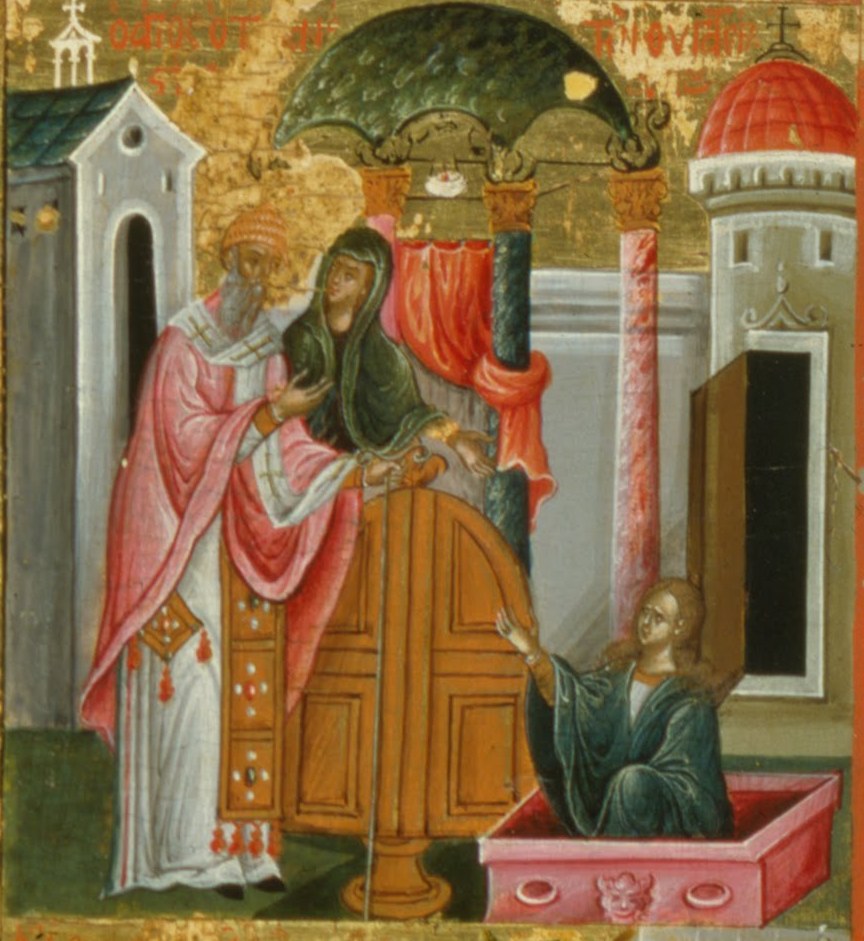
Meanwhile a certain woman came to me with weeping and told me that she had given my daughter some gold ornaments for safekeeping, but since she had soon afterwards died, what had been given was lost without trace. I searched the whole house to see if the ornaments were hidden somewhere, but I did not find them. Moved by the woman’s tears, I together with my household approached my daughter’s tomb and, addressing her as though she were alive, I cried out: «My daughter Irene! Where are the ornaments entrusted to you for safekeeping?»
Irene, as if awakening from a deep sleep, answered: «My lord! I hid them in this place in the house», — and she indicated the place. Then I said to her: «Sleep now, my daughter, until the Lord of all shall awaken you at the time of the general resurrection». Fear fell upon all who were present at the sight of such a wondrous miracle. And I found what had been hidden in the place indicated by the deceased and gave it to the woman.

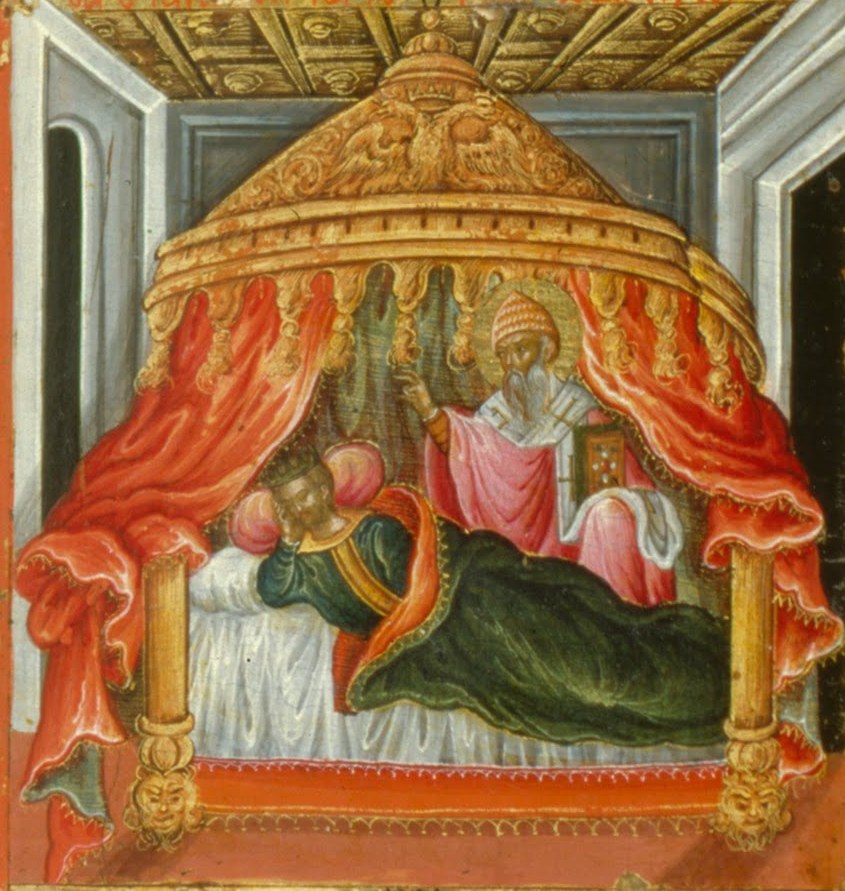
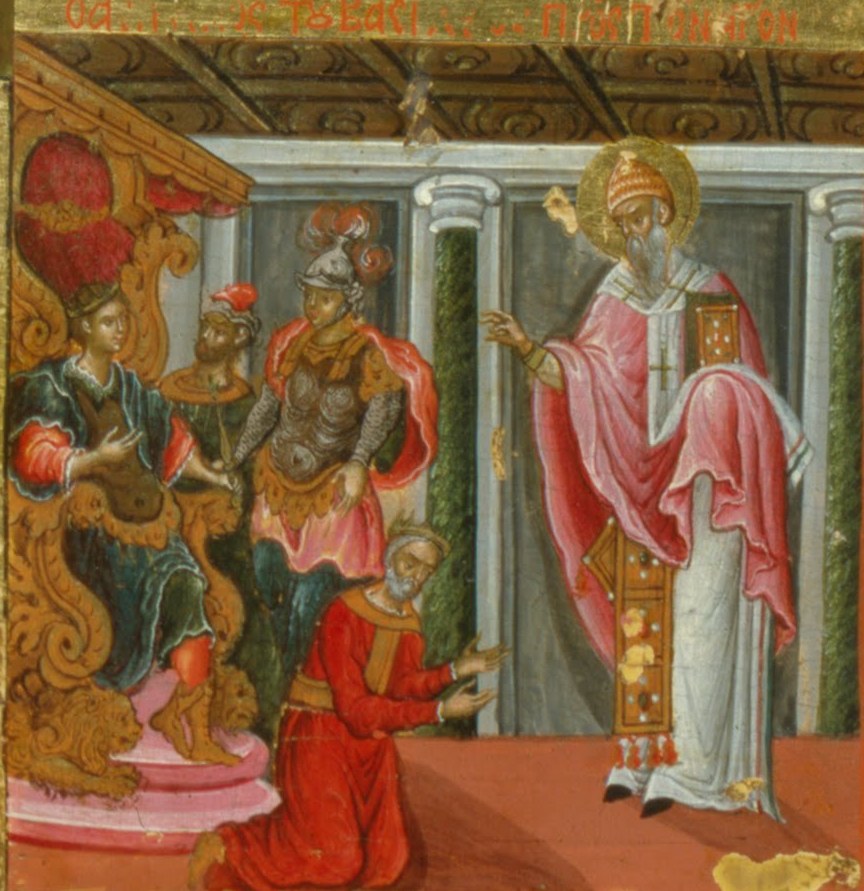
After the death of Constantine the Great his empire was divided into two parts; the eastern half fell to his elder son Constantius. While he was in Antioch, Constantius fell into a grievous illness which the physicians could not heal. And then one night in a vision the emperor saw an Angel who showed him a whole assembly of bishops and among them especially two who seemed to be the leaders of the rest; the Angel told the king that only these two could heal his illness. When he awoke, he could not guess who these two bishops were; one of them was not even a bishop at that time.
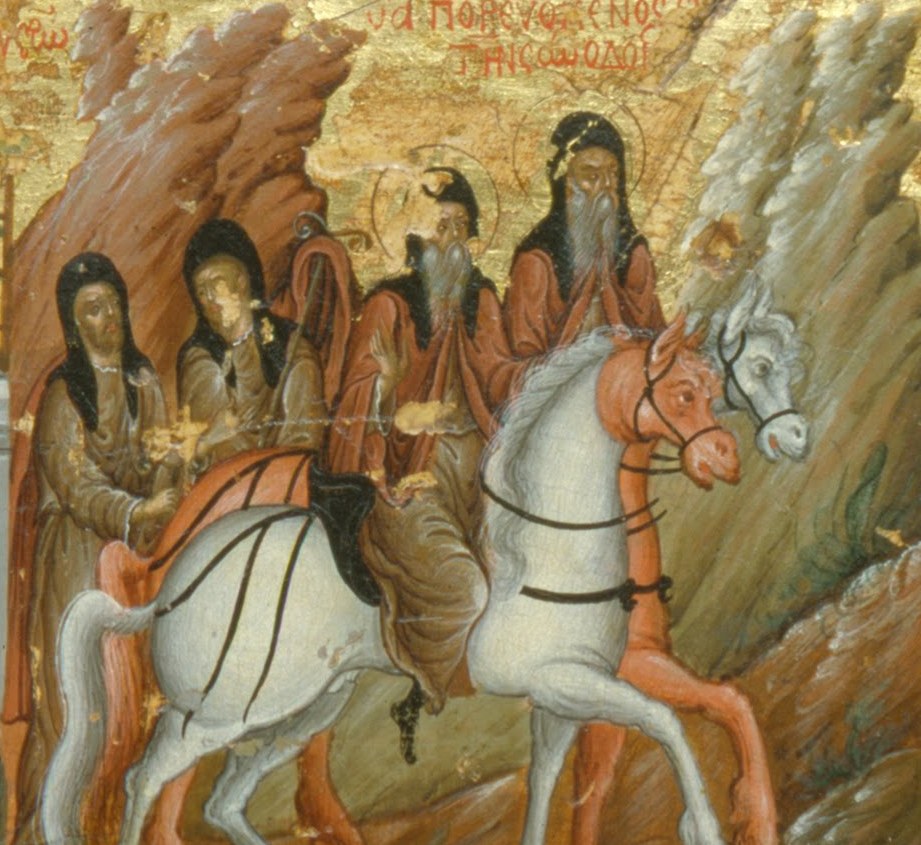
The king gathered bishops to himself from the neighbouring cities, then from more distant regions, but he did not find the two he had seen. Finally he ordered all the bishops of his empire to assemble before him. The royal request reached even the island of Cyprus and the city of Trimithous, where I was bishop and where everything concerning the king had already been revealed to me by God. I immediately set out for the emperor, taking with me my disciple Triphyllius, with whom I had appeared to the king in the vision and who at that time was not yet a bishop.
When we arrived in Antioch, we went to the palace to the king. I was dressed in poor garments and held in my hands a staff of palm-wood; on my head was a woven palm-leaf mitre, and on my breast there hung a small clay vessel, as was the custom among the inhabitants of Jerusalem. When I entered the palace in such attire, one of the palace servants, richly dressed, took me for a beggar, mocked me and, not allowing me to enter, struck me on the cheek; but I, remembering the words of the Lord, turned the other cheek to him. The servant understood that an bishop stood before him and, acknowledging his sin, asked forgiveness, which he received.

As soon as I entered to the king, he immediately recognised me: it was in exactly this form that I had appeared to him in the vision. Constantius rose, came to me and bowed, with tears asking my prayers to God and begging to be healed of his illness. As soon as I touched the king’s head, he was immediately healed.
Triphyllius meanwhile was greatly struck by the royal splendour, the beauty of the palace and the multitude of nobles standing before the king seated on the throne. I said to him: «Why are you so amazed, brother? Does royal majesty and glory make the king more righteous than others?»
I also gave much instruction to the king himself, that he should remember God’s benefit and himself be kind to his subjects, merciful to those who sin, generous to those who ask and be a loving and good father to all, for he who does not rule in this way ought to be called not a king but rather a tormentor. In conclusion I commanded the king to keep the rules of piety, accepting nothing contrary to the Church of God.
The king wished to thank me for the healing and offered me a great quantity of gold, but I refused: «It is not good, O king, to repay love with hatred», — for what I had done for him was love: «in truth, to leave home, to sail across such a distance by sea, to endure severe cold and winds — is this not love?» Only by the king’s most urgent entreaties was I persuaded to accept the gold — but not to keep it for myself: I immediately distributed all that I had received to those who asked. Moreover, in accordance with my exhortations, the Emperor Constantius freed the priests, deacons and all clerics and servants of the Church from taxes, judging it improper for the servants of the Immortal King to pay tribute to a mortal king.

When I returned home, a man came to me who wished to buy one hundred goats from my flock. I told him to leave the agreed price and then to take what he had bought. But he left the price of ninety-nine goats and concealed the price of one, thinking that this would not be known to me, who by my heartfelt simplicity was completely alien to all worldly cares.
When we both were in the cattle pen, I told the buyer to take as many goats as he had paid for, and the buyer, having separated one hundred goats, drove them out beyond the fence. But one of them, as though an intelligent and good servant knowing that she had not been sold by her master, quickly returned and ran back into the enclosure. The buyer again took her and dragged her after him, but she broke free and again ran into the pen. Thus she broke free from his hands and ran to the enclosure three times, while he forcibly led her away and finally hoisted her onto his shoulders and carried her home, all the while she bleated loudly, butted him in the head with her horns, struggled and broke free, so that all who saw it were amazed.
Then I, understanding what the matter was and not wishing to expose the dishonest buyer before everyone, said to him quietly: «Look, my son, it is probably not without reason that this animal is acting in this way, not wishing to be led away to you: have you not concealed the due price for her? Is that not why she is breaking free from your hands and running to the enclosure?» The buyer was ashamed, confessed his sin and asked forgiveness; then he gave the money and took the goat – and she herself went meekly and humbly into the house of the one who had bought her, walking ahead of her new master.

Even as a bishop I did not disdain to pasture irrational sheep and I myself tended them. Once thieves broke into the pen at night, stole several sheep and wanted to leave. But God, guarding my meagre possessions, bound the thieves with invisible bonds so tightly that they could not leave the enclosure until morning. At dawn I came to the sheep and, seeing the thieves bound hand and foot by the power of God, I loosed them by my prayer and instructed them not to covet what belongs to another but to feed themselves by the labour of their hands; then I gave them one ram so that “their labour and sleepless night should not be in vain”, and I let them go in peace.
One merchant of Trimithous was accustomed to borrow money from me for his trading ventures, and when he brought back what he had taken, I would tell him to put the money himself into the chest from which he had taken it: so little did I care about temporal gain. But once the merchant, carried away by covetousness, did not put the gold he had brought into the chest but kept it for himself, and told me that he had deposited it. Soon afterwards he became destitute: the hidden gold, like fire, consumed all his property.
Then the merchant again came to me to ask for a loan. I sent him to the chest: “Go and take it if you yourself deposited it.” The merchant did not find any money in the chest and returned empty-handed. I said to him: “But until now, my brother, no other hand but yours has been in that chest. Therefore, if you had deposited the gold then, now you could take it again.” The merchant, ashamed, fell at my feet and asked forgiveness. I forgave him, but said for his instruction that he should not covet what belongs to another and should not defile his conscience with deceit and falsehood. Thus profit wrongly acquired is not profit, but in the end – loss.

A certain woman named Sophronia, virtuous and pious, had a pagan husband. She came to me more than once and earnestly begged me to make every effort to turn her husband to the true faith. Her husband was my neighbour and held me in respect.
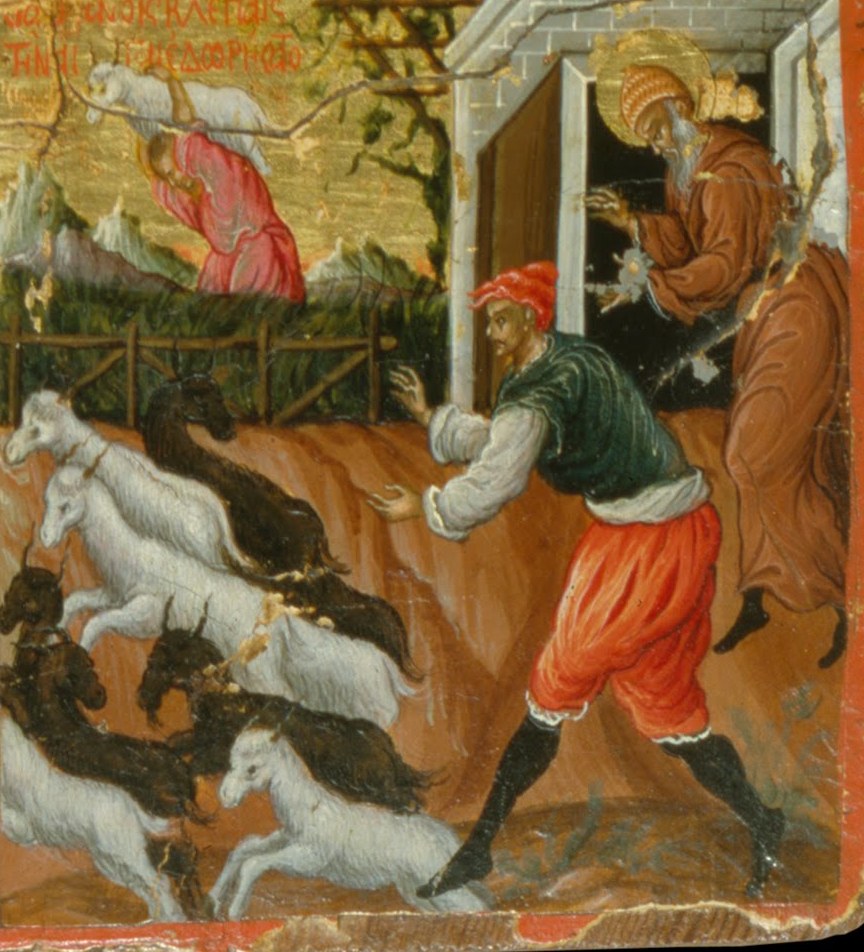
One day many neighbours — both mine and the pagan’s — gathered together; we ourselves were also present. And suddenly I said aloud to one of the servants: «There at the gate stands a messenger sent by the herdsman who pastures my flock, with news that all the cattle, while the herdsman slept, have gone astray and are lost in the mountains: go, tell him that the herdsman who sent him has already found all the cattle safe and sound in a certain cave». Soon afterwards, before those who were gathered had yet risen from the table, another messenger came from the shepherd with the news that the whole herd had been found.
Hearing this, the pagan was inexpressibly amazed that I knew what was happening at a distance as though it were taking place nearby; he imagined that I was one of the gods and wished, as once the people of Lycaonia had done with the apostles Barnabas and Paul, to offer me a sacrifice. But I said to him: «I am not a god, but only a servant of God and a man in all things like you. That I know what is happening at a distance is granted me by my God, and if you too will believe in Him, you will come to know the greatness of His omnipotence and power».
For her part, the pagan’s wife Sophronia, seizing an opportunity, began to persuade her husband to renounce pagan errors and to know the One True God and believe in Him. At last, by the power of the grace of Christ, the pagan was turned to the true faith and enlightened by holy baptism. Thus was saved «the unbelieving husband» (1 Cor. 7:14), as the apostle Paul says.

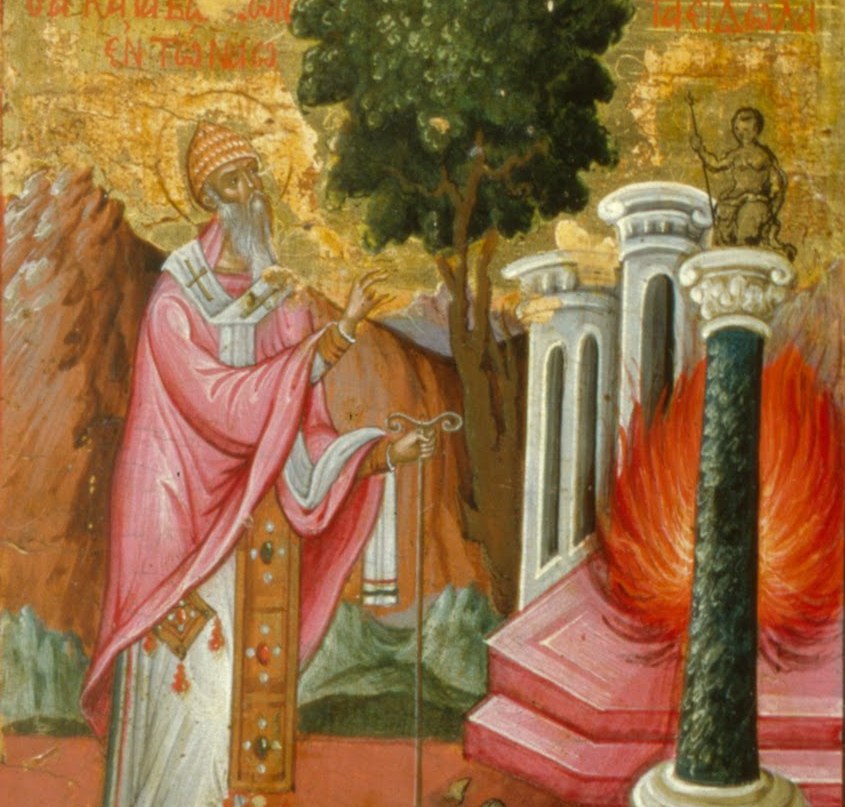
Once a council of bishops was convened in Alexandria: the Patriarch of Alexandria called together all the bishops subject to him and wished by common prayer to overthrow and smash all the pagan idols, of which there were still very many there. And so, while numerous fervent prayers were being offered to God — both conciliar and private — all the idols both in the city and in the surrounding regions fell, except for one idol especially venerated by the pagans which remained intact in its place.
After the patriarch had prayed long and fervently for the destruction of this idol, one night while he stood at prayer a certain divine vision appeared to him, and he was commanded not to grieve that the idol was not being destroyed, but rather to send to Cyprus and summon from there me, Spyridon, Bishop of Trimithous, for the idol had been left for this very purpose: to be smashed by my prayer. The patriarch immediately wrote me a letter in which he called me to Alexandria and spoke of his vision, and at once dispatched this letter to Cyprus.
Upon receiving the letter, I boarded a ship and sailed to Alexandria. When the ship stopped at the harbour called Neapolis and I was coming ashore, at that very moment the idol in Alexandria with its numerous altars was destroyed, and thus in Alexandria they learned of my arrival. For when the patriarch was told that the idol had fallen, he said to the other bishops: «Friends! Spyridon of Trimithous is approaching». And all, having made ready, came out to meet me and received me with honour, rejoicing at my arrival.

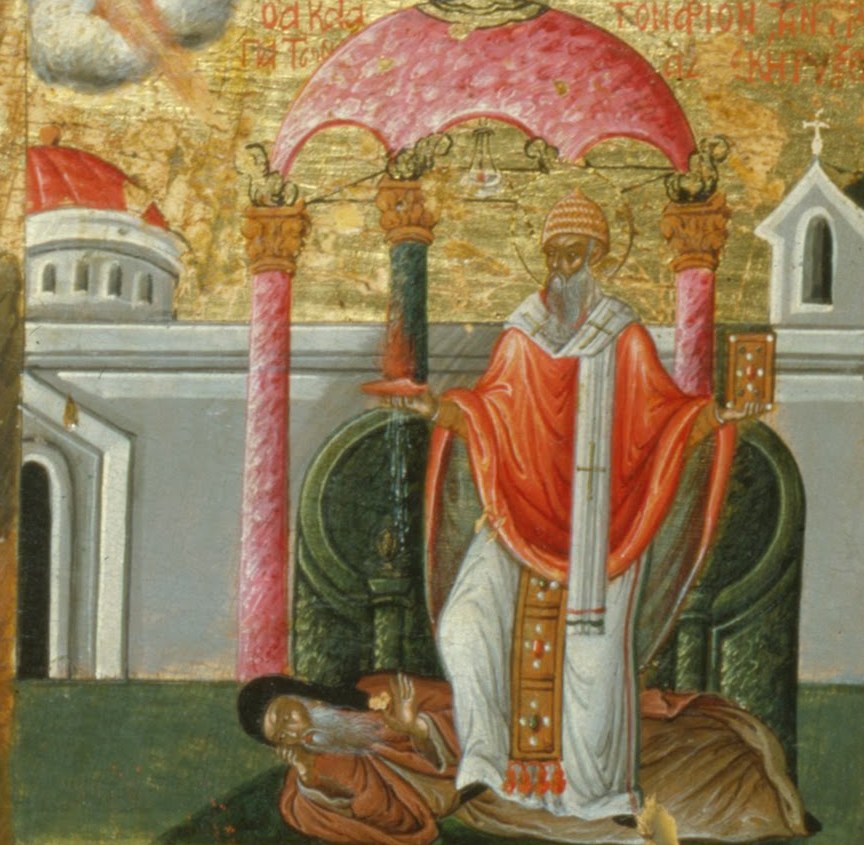
Once I entered the church in my city for vespers; there was no one in the church except the church servants. But I ordered many candles and lamps to be lit and stood before the altar. When at the appointed time I exclaimed: «Peace be to all!» — and there was no people to give the customary response, suddenly from above was heard a great multitude of voices exclaiming: «And to thy spirit». This choir was great and harmonious and sweeter than any human singing.
At another time, during the evening singing, the lamp lacked oil, and the flame began to go out. But God, Who fulfilleth the desire of them that fear Him, commanded the lamp to overflow with oil over the edges, as once the vessel of the widow in the days of the prophet Elisha.
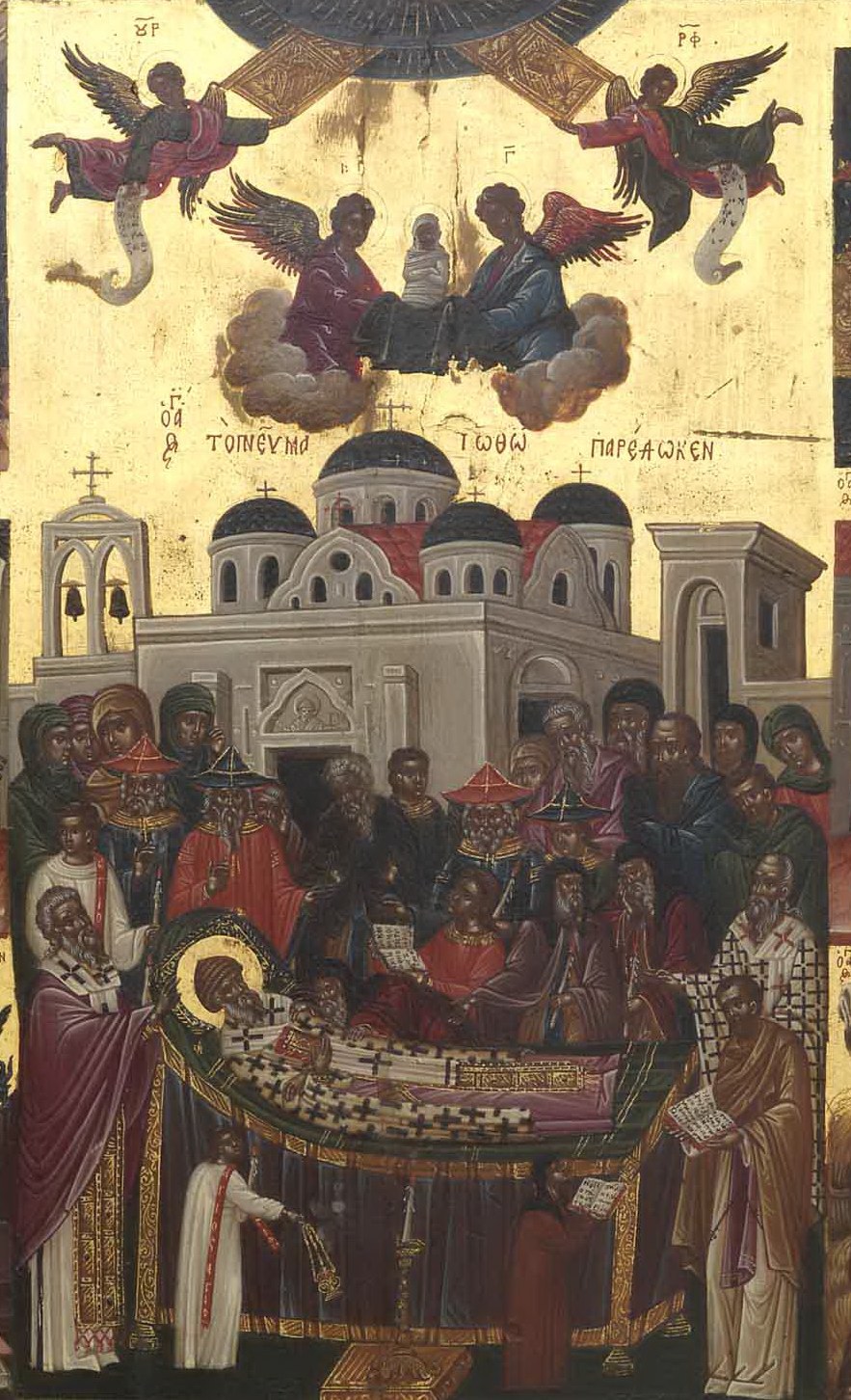
In the last year of my life, during the harvest, I went out to reap together with the reapers, for I worked myself, not being proud of the height of my rank. When I was reaping my field, suddenly, in the very heat, my head was moistened with cool dew descending from above, as once was Gideon’s fleece, and all who were with me in the field marvelled. Then the hair on my head suddenly changed: some became yellow, others black, and some white. I felt my head with my hand and said to those who were with me that the time of the separation of my soul from my body was approaching, and I began to instruct all in good works, and especially in love for God and neighbour.
After the passage of several days, during prayer, I committed my soul to the Lord, Whom I had served all my life, and was honourably buried in the church of the Holy Apostles in Trimithous. There it was established to celebrate my memory annually, and at my tomb many miracles are wrought to the glory of the wondrous God, Who is glorified in His saints.
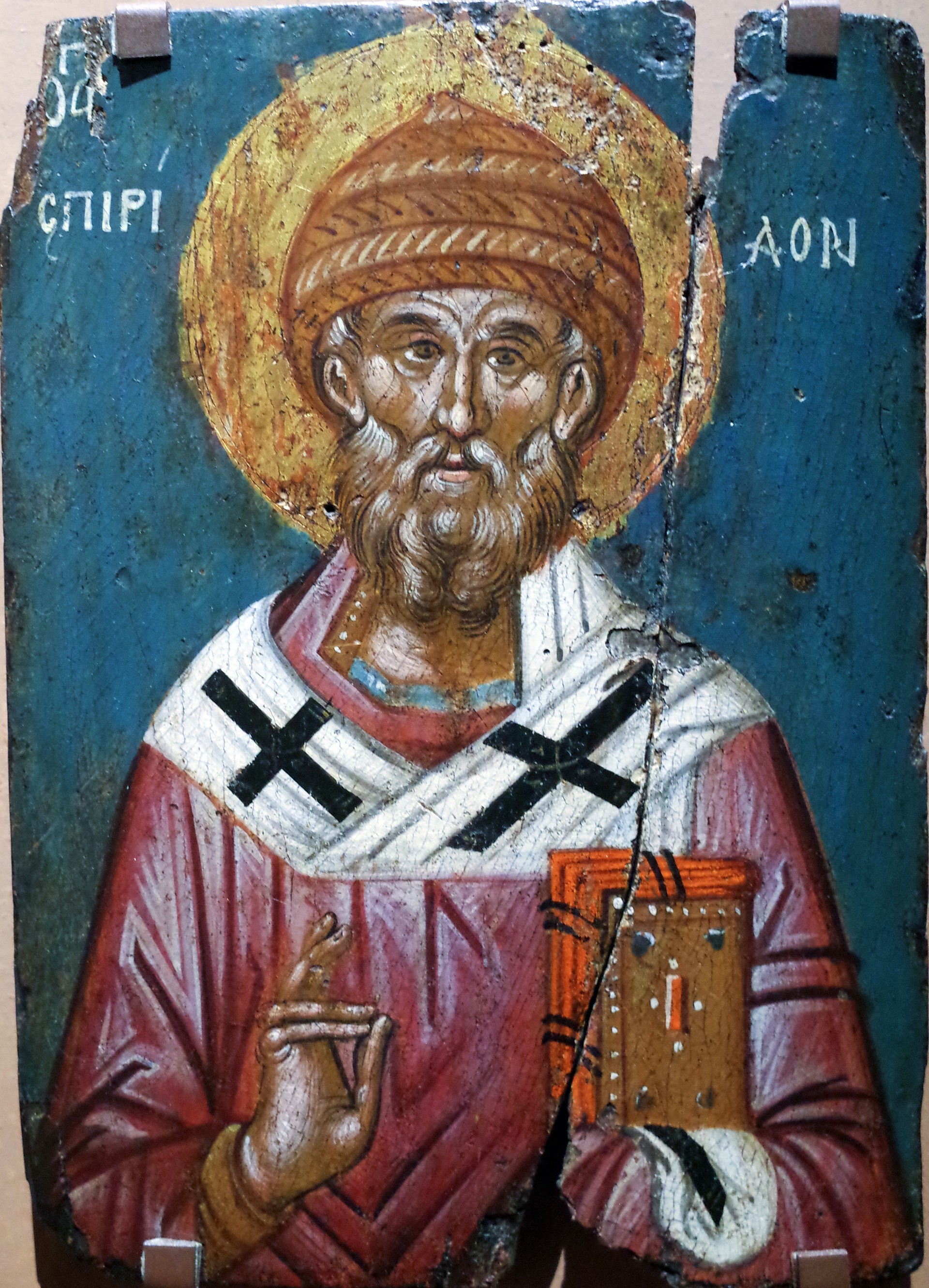
At the First Council, you appeared as a champion and wonderworker,/ to God-bearing Spyridon, our father./ Moreover, you cried out to the dead in the tomb,/ and you turned the serpent into gold,/ and forever I sang holy prayers to you/ You had the angels concelebrating with you, the Most Holy One./ Glory to Him who gave you strength,/ glory to Him who crowned you,// glory to Him who brings healing to all through you.