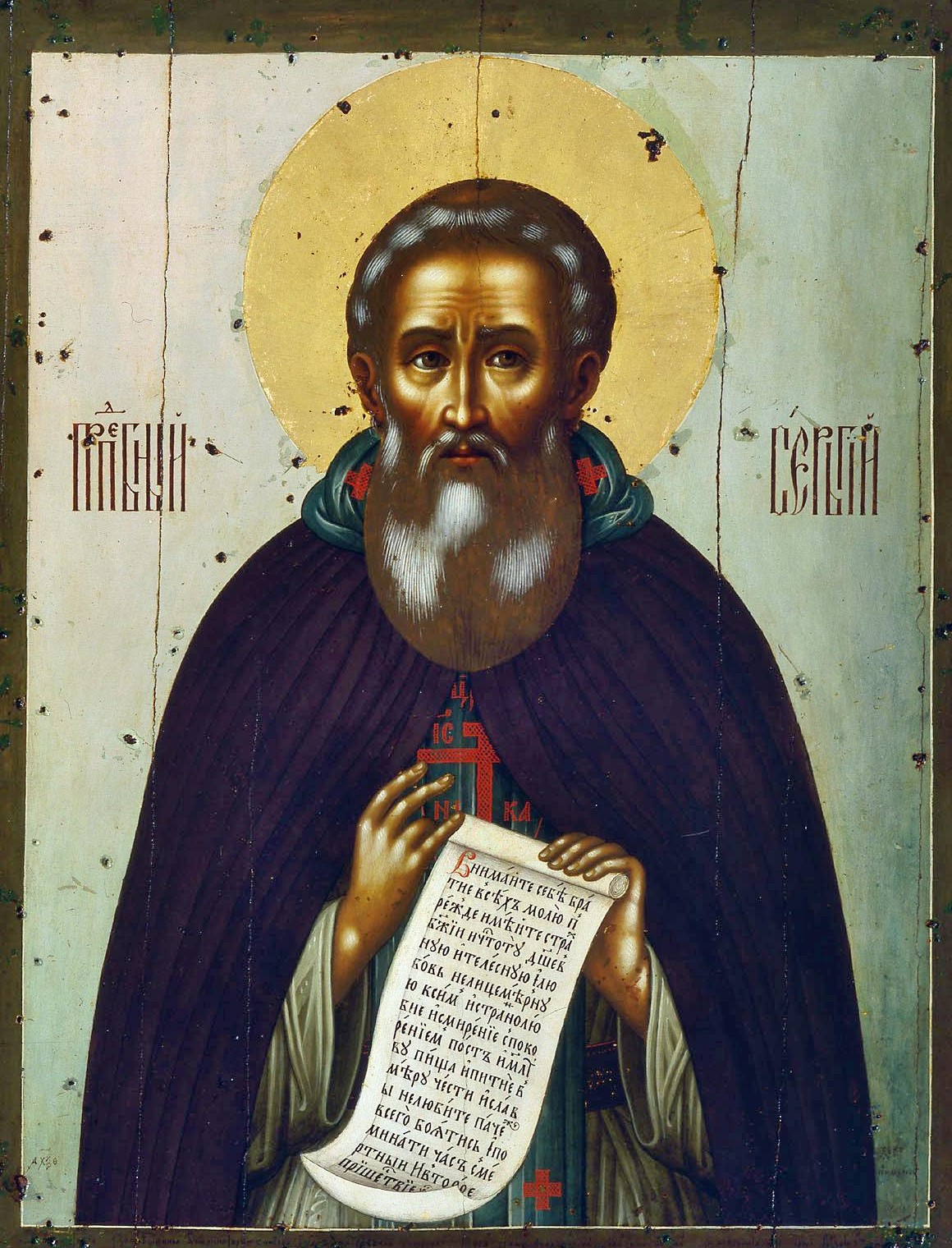
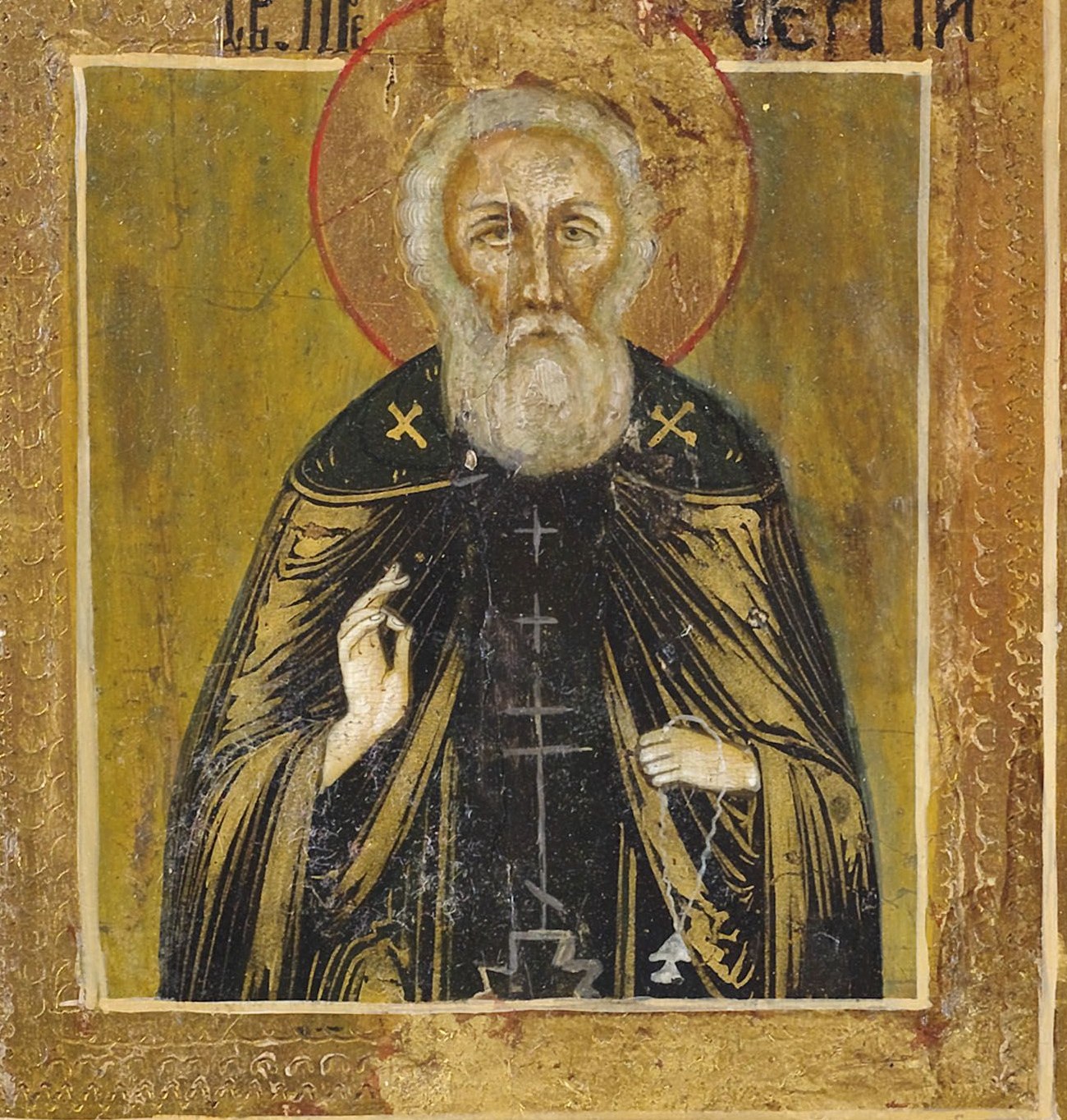
I was born in the land of Rostov to pious parents Cyril and Maria. Even from the womb my mother God chose me for His service: shortly before my birth, my mother came to the Liturgy in church on a Sunday, and before the reading of the Holy Gospel began I cried out so loudly from her womb that my voice was heard by all who stood in the temple; during the Cherubic Hymn I cried out a second time, and when the priest pronounced «Holy Things to the Holy» — a third time. When the day of my birth came, I was given the name Bartholomew. From the first days of my life I did not take milk from my mother’s breast on Wednesdays and Fridays.
At the age of seven I was sent to learn letters together with my brothers — the elder Stephen and the younger Peter. They studied well, but I lagged far behind: learning came to me with difficulty, and although the teacher worked with me very diligently, I made little progress. This was by God’s providence, that I might receive book-learning not from men but from God. With tears I prayed that God would grant me understanding of letters.
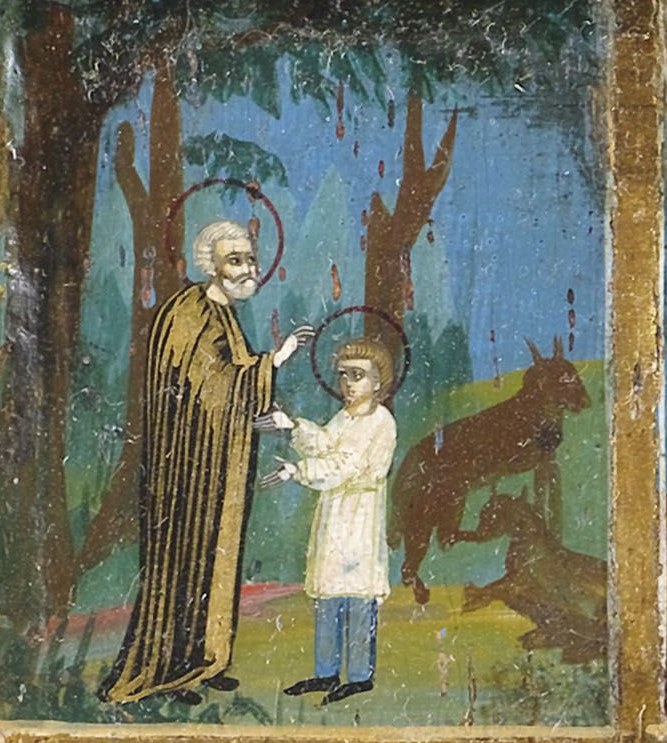
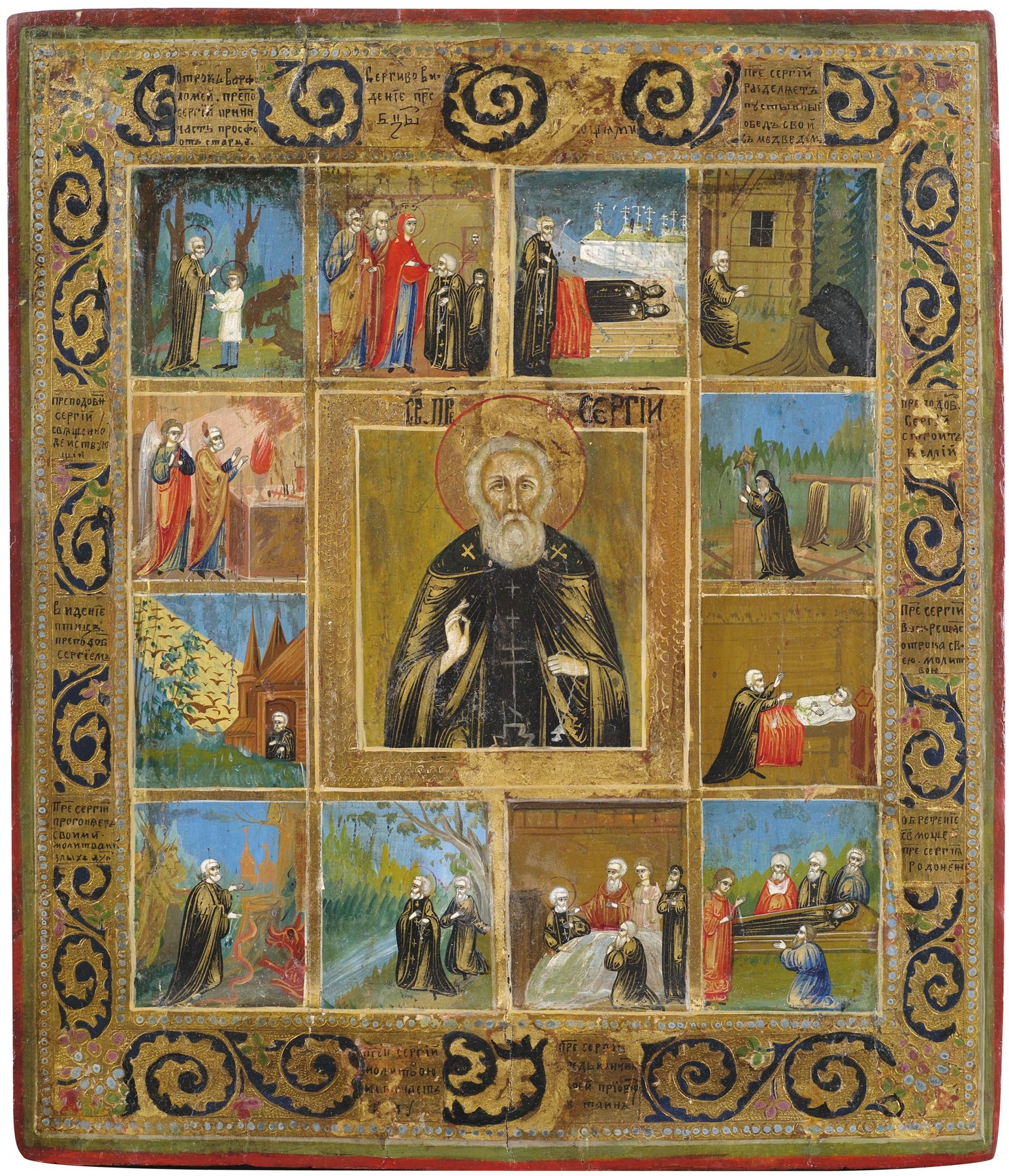
Once my father sent me to fetch the horses. My way lay through the forest, and there I met a certain monk, or rather an Angel sent by God in the form of a monk: he stood in the midst of the forest and was saying prayers. I bowed to him and, when he had finished his prayer, said: «I have been given, father, to book-learning, but I understand little of what my teacher says to me; I grieve greatly over this». The elder prayed for me and said: «From now on God will give you, my child, to understand what is needed, so that you may also teach others». He took out a small vessel and gave me what seemed a particle of prosphora: «Take, child, and eat; this is given to you as a sign of God’s grace and for the understanding of Holy Scripture».

I asked the monk to visit the house of my parents. When all began to pray, the elder told me to read the Psalms. «I do not know how, father», I replied. But the monk said prophetically: «From now on the Lord grants you knowledge of letters», and I at once began to read the Psalms harmoniously. At parting the elder said to my parents: «Great will your son be before God and men; he will one day become a chosen dwelling of the Holy Spirit and a servant of the Most Holy Trinity».
I grew in years, and together with them in understanding and virtue, and I imposed upon myself a strict fast: on Wednesdays and Fridays I ate nothing, and on the other days I took only bread and water. My mother tried to persuade me to abandon so austere a way of life, but I answered her: «Do not turn me away from abstinence, for it is so sweet and beneficial for my soul».
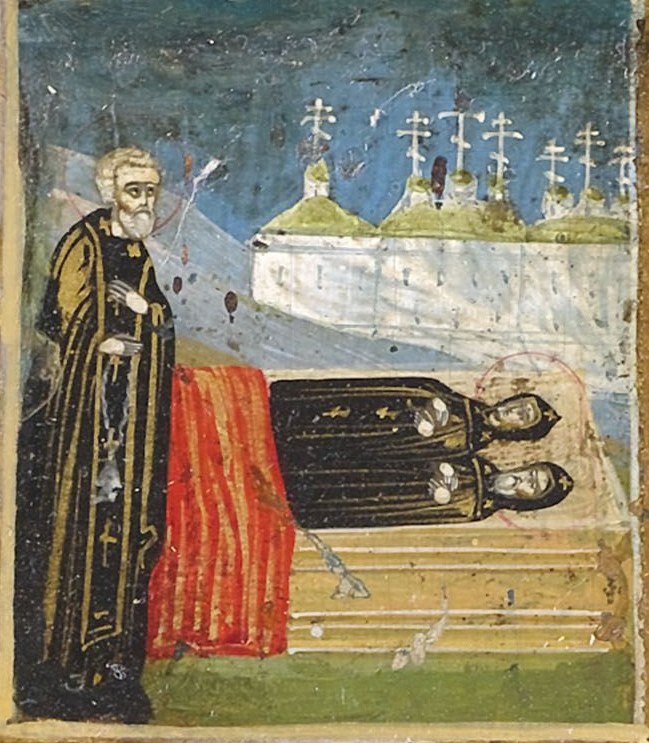
Meanwhile Cyril and Maria moved from Rostov to a place called Radonezh; I was then about fifteen years old. When I turned twenty, I began to ask my parents to bless me to be tonsured a monk, but they asked me to wait, for there was no one besides me to serve them in their old age: «Wait yet a little while, and commit us to burial». I obeyed. Shortly before their repose Cyril and Maria received the monastic tonsure in the Pokrovsky Khotkov Monastery, about three versts from Radonezh; my elder brother Stephen, now widowed, also came there. A little later my parents, one soon after the other, departed in peace to the Lord and were buried in that monastery. All their property they left to me, but I reflected: «I am mortal, and I too shall die, as did my parents», and I gave everything away, keeping nothing for myself, for I trusted in God, «Who gives food to the hungry» (Ps. 145:7).

Striving after the eremitic life, I set out with my brother Stephen to seek a place suitable for desert dwelling. For a long time we walked through the forests and came to where the monastery of the Most Holy Trinity now stands. This place was covered with a thick, dense forest, where only wild beasts and birds dwelt. With fervent prayer we turned to God and, having built a hut, we raised a small church; we went to Moscow and asked Metropolitan Theognostus to bless its consecration in the name of the Most Holy Trinity. The hierarch received us kindly and sent priests with us. Thus modestly was laid the foundation of the Holy Trinity Monastery.
My brother Stephen, wearied by life in such a desert place, left me and moved to Moscow, to the Theophany Monastery. Left in solitude, I strengthened myself in labours and resolved to receive the tonsure. An igumen named Mitrofan came to me; he tonsured me in the twenty-third year of my life, on the day of the commemoration of the holy martyrs Sergius and Bacchus, and I was given the name Sergius. For seven days I remained unceasingly in the church, and each day Mitrofan communed me with the Holy Mysteries. As he departed, he foretold: “On this place God will raise up a great and glorious monastery”.
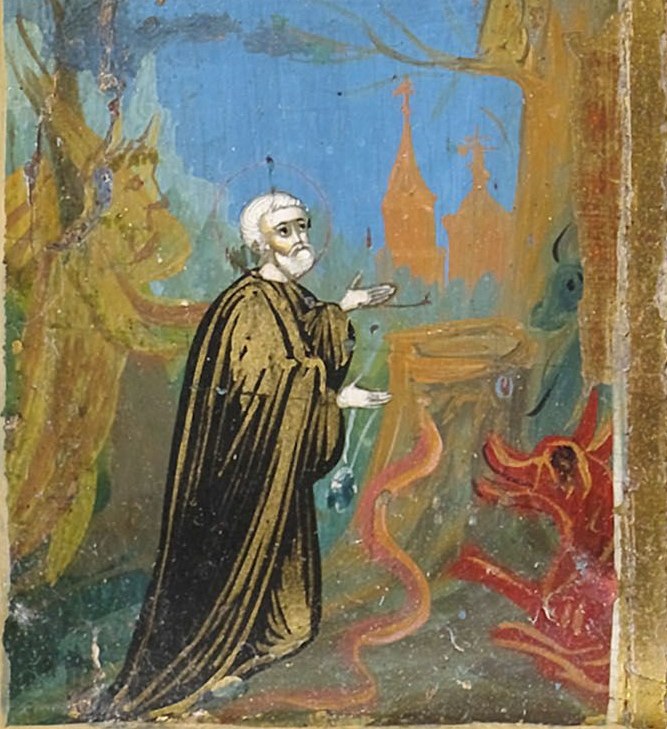
I mortified the flesh by fasting, vigil and labours, and during the harsh winter, when the earth cracked from the frost, I endured the cold in but a single garment. The demons, appearing now as wild beasts, now as serpents, sought to frighten me so that I would leave that place. One night the demons approached me in a whole host and cried: “Depart from this place, depart, or thou shalt perish by a cruel death!” — and flame issued from their mouths. But, calling upon the name of the Lord, I destroyed the demonic delusions as a spider’s web.

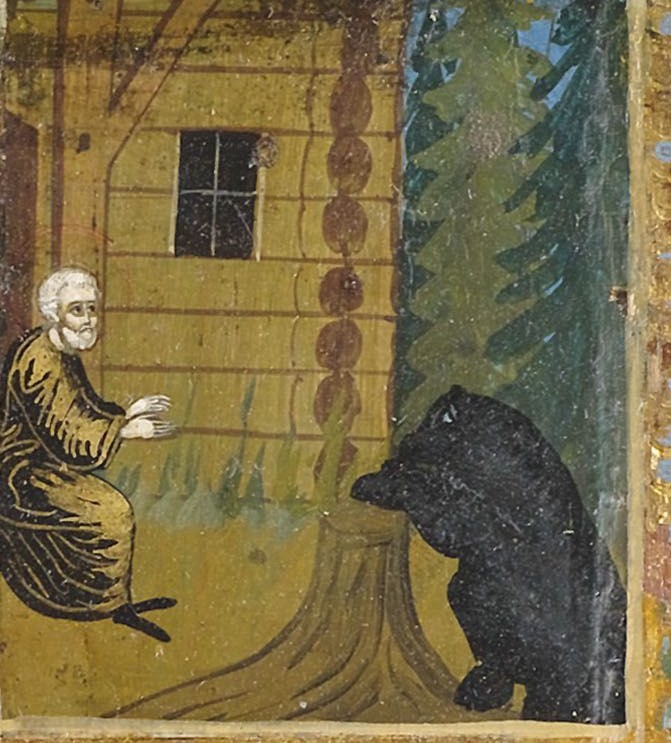
After the demonic visions the sight of wild beasts was not so fearsome to me: packs of hungry wolves ran past my solitary cell, and bears also came here, but the power of prayer saved me. Once I noticed a bear in front of the cell; seeing that the beast was very hungry, I took pity on it, brought out a piece of bread and laid it on a stump. From then on the bear began to come often to the cell, awaited the usual alms and looked at me meekly; I shared my food with it, often even giving it the last piece. And the wild beast became so meek that it obeyed even my call.
Meanwhile glory of me began to spread everywhere, and many from the surrounding towns and villages began to flock to me: some for counsel, some for soul-profiting conversation. Some asked permission to live with me, but I dissuaded them, pointing out that these places were desert and wild and that many deprivations awaited here. Seeing the firmness of their intention, I had to yield. Soon twelve men gathered, and this number did not change for a long time: if death befell any of the brethren, another would come in his place. Those who came built twelve cells, and I together with the brethren enclosed them with a wooden fence. Thus the monastery arose, which by the grace of God exists to this day.
Quietly and peacefully our life passed: seven times a day the church received the monks under its roof — we performed the midnight office, matins, the third, sixth and ninth hours, vespers and compline, and for the celebration of the Divine Liturgy we invited a priest from the nearest villages.

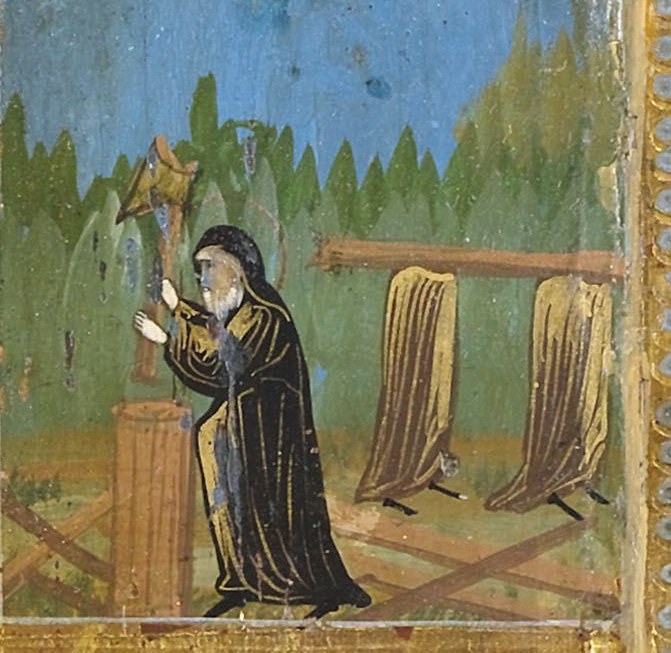
A year after the brethren came to me, the hieromonk Mitrofan who had tonsured me settled in the monastery; he was unanimously elected hegumen, but soon he gave up his soul to the Lord. Then the brethren began to ask that I receive the rank of priesthood and be their hegumen. I refused: I wished to imitate the Lord and be a servant to all. I myself built several cells, dug a well, carried water and placed it at the cell of each brother, chopped wood, baked bread, sewed clothing, prepared food.
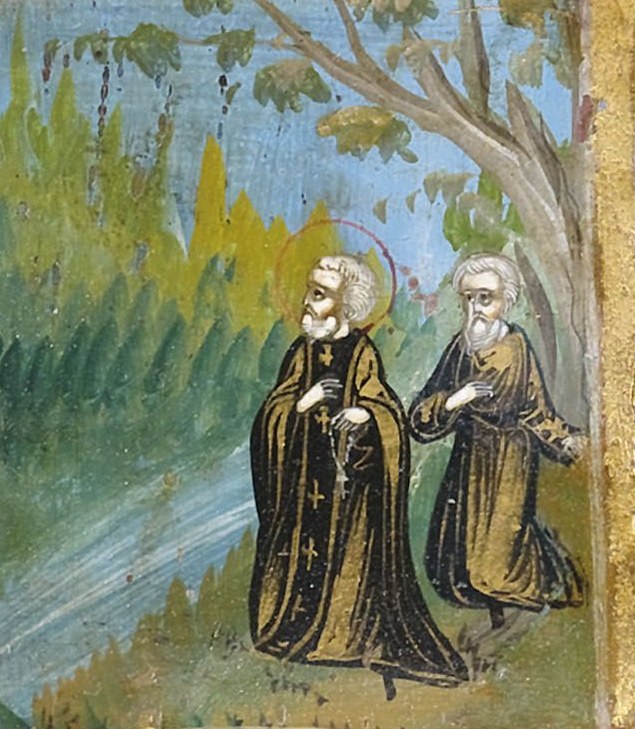
More than ten years passed, and with each day the need for a hegumen and a priest was felt more strongly. The monks, gathering together, said to me: “Father, we cannot live without a hegumen, we desire that you be our instructor and guide,” — and they asked: “Celebrate the holy Liturgy among us, that we may commune of the Divine Mysteries from your venerable hands.” I refused strongly and for a long time, saying that “I have never had the thought of hegumenship; my soul desires only one thing — to end my days as a simple monk.” Overcome by their entreaties, I set off with two elders to Pereslavl Zalessky to Athanasius, Bishop of Volyn, and began to ask him for a hegumen for my monastery. The hierarch replied: “From now on be father and hegumen to the brethren whom you yourself have gathered in the new monastery of the Life-Giving Trinity!” He ordained me first as hierodeacon, then as hieromonk, and, filled entirely with fear and compunction, I celebrated the first Liturgy, after which I was elevated to hegumen.
Having become hegumen, I did not change my former strictness; I celebrated the Divine Liturgy daily and always prepared the prosphoras myself; I was the first to come to church and the last to leave the temple of God.

In the early days our monastery was poor. There was not enough wine for the Liturgy, wheat for prosphoras, wax for candles, or oil for the lamps — the monks would light splinters. The vessels for Communion were made of wood, the vestments were of plain dyed cloth, and the service books were written on birch bark. I strictly forbade the monks to ask the laity for food, requiring them to place their hope in God.
Once I had not a single piece of bread left; for three days I endured. At dawn on the fourth day I took an axe and came to the elder Daniel: “I have heard, elder, that you wish to add a porch to your cell”, — and I asked him to allow me to build it. He hesitated to entrust the task to me, for I needed to be well rewarded. I asked only for a few pieces of old, mouldy bread, but said: “Unless I do the work, I will not take payment”. I worked all day and in the evening received the bread; the monks noticed that dust from the mouldy bread flew from my mouth.
I settled in a waterless place, and when the brethren multiplied, water had to be carried from afar; some grumbled, asking why I had established the monastery where there was no water. I answered: “Brethren, I desired to dwell alone in silence in this place, but it was God’s will that a monastery should arise here. He can grant us water as well”. With one of the brethren I secretly went down into the thicket below the monastery, found a little rainwater in a ditch, knelt down and prayed that the Lord, as through Moses He brought forth water from the rock, might grant water in this place also. Then suddenly a plentiful spring gushed forth. The monks began to call it “Sergius’”, but I said: “It is not I, brethren, who gave you this water, but the Lord Himself sent it to us unworthy ones. Therefore do not call it by my name”.

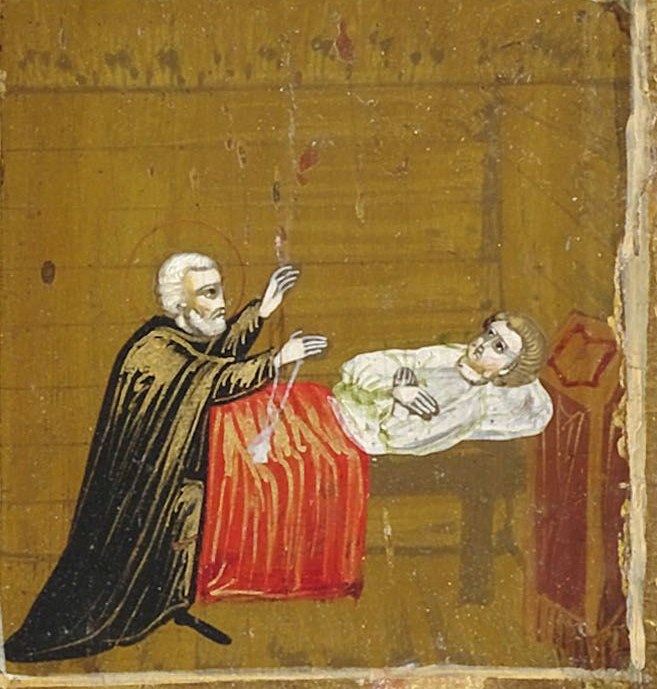
In the vicinity of the monastery there lived a certain man who had great faith in me; his only son was afflicted with an incurable disease, and the father brought him to me. But when he came to the cell and began to ask for help for the sick boy, the youth died. The father wept bitterly and went out to bring all that was needed for the burial. I took pity on him and, having offered a prayer, raised the youth. When the villager returned with the coffin, I said to him: “It is in vain that you so heedlessly give yourself over to grief: the youth is not dead, but alive”. The father began to thank me, but I said: “When you were carrying the youth here, he grew faint from the severe cold — you thought he had died; now in the warm cell he has grown warm — and it seems to you that he has risen”, — and I forbade him to speak of this. One of my disciples told of the miracle.
I always wore old and simple clothing, so that many did not recognise me. A certain peasant came to the monastery to ask where Saint Sergius was. I was then digging the earth in the vegetable garden; the brethren pointed to me, but the peasant, seeing an elder in poor, torn clothing, thought they were mocking him and turned away. But I called him to me, set food before him and said: “Do not grieve, friend, you will soon see the one you wished to see”. Then a prince arrived; seeing me, he bowed to the ground from afar, asking for a blessing, and we sat down together to converse. The villager asked one of those standing by what elder this was who sat with the prince, and heard: “This is the Venerable Sergius”. When the prince left, the peasant bowed down at my feet. I encouraged him: “Child, do not grieve, for you alone thought rightly of me, saying that I am a simple man; all the others are mistaken in supposing that I am great!”

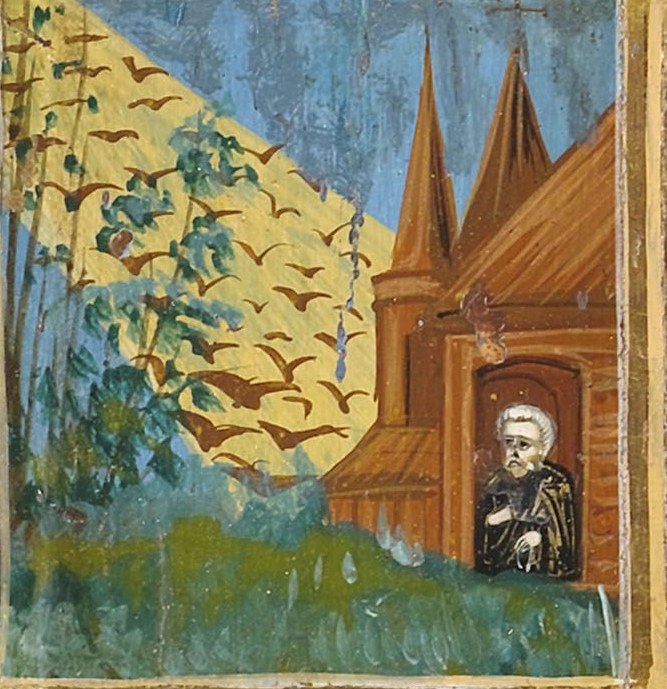
Once late in the evening I was performing the rule and praying for my disciples; suddenly I heard a voice calling me: “Sergius!” Opening the window, I saw a great radiance from heaven; it became brighter than day. The voice was heard a second time: “Sergius! You are praying for your children, and your prayer is heard: look – you see the number of monks gathering under your guidance in the name of the Most Holy Trinity.” Looking around, I saw a multitude of beautiful birds in the monastery and around it, singing ineffably sweetly. And again the voice was heard: “Thus shall the number of your disciples be multiplied, like these birds; and after you it shall not fail or diminish.” I called Simeon, who lived closer than the others; he beheld only a part of this heavenly light, and the two of us spent the whole night without sleep, glorifying God.
Soon after this envoys came to me from the most holy Patriarch Philotheus of Constantinople and delivered gifts: a cross, a paramand, and a schema. “Have you not been sent to someone else?” I said. – “Who am I, a sinner, to receive gifts from the most holy Patriarch?” But they brought a letter in which the Patriarch advised the establishment of cenobitic life. Metropolitan Alexis approved the same counsel. From that time I established cenobitic life in my monastery and strictly ordered the cenobitic rules to be observed: to acquire nothing for oneself, to call nothing one’s own, but to have everything in common.
Burdened by human glory, I secretly left the monastery and, having gone about sixty versts, settled near the Kirzhach River, where my disciples built a monastery with me. But the monks of the Lavra asked Metropolitan Alexis to persuade me to return, and I unquestioningly fulfilled the request of the hierarch, by which the brethren were greatly comforted.

Even during my lifetime I was granted to have communion with the bodiless ones. Once I was celebrating the Divine Liturgy together with my brother Stephen and my nephew Theodore; the silent Isaac was also present in the church. Suddenly Isaac saw a fourth man in the altar, clad in wondrously shining vestments; at the Little Entrance with the Gospel the heavenly concelebrant followed after me, and his face shone like snow. Isaac asked Father Macarius who this man was; Macarius thought that perhaps a clergyman had come with Prince Vladimir, who was then in the church, but there was no priest with the prince. After the Liturgy the disciples came to me. At first I did not wish to reveal the mystery, but they continued to entreat me, and I said: «Children, if the Lord God Himself has revealed it to you, how can I conceal it? The one whom you saw was an Angel of the Lord; not only now, but always, whenever it falls to me, the unworthy, to celebrate the Liturgy, he, by God’s will, serves with me. But keep this strictly secret as long as I live».
Saint Alexis, Metropolitan of Moscow, desired to see me as his successor. Perceiving the approach of his own death, he summoned me and gave me his hierarchal cross adorned with gold and precious stones. I bowed humbly: «Forgive me, holy master, from my youth I have not been a bearer of gold, and in old age I desire all the more to remain in poverty». He himself placed the cross upon me and proposed that I receive the rank of bishop. «Forgive me, master», I replied to the hierarch, «you wish to lay upon me a burden above my strength. This is impossible: I am a sinner and the last of all men». The hierarch long urged me, but I remained unmoved, and he dismissed me in peace to the monastery.

For more than a hundred and fifty years the Russian land had endured the Tatar yoke. By God’s permission, for the sins of the people, Khan Mamai rose up against Rus’ with all his countless hordes, threatening to devastate the Christian churches. The Great Prince Demetrius Ioannovich came to the monastery of the Trinity to ask a blessing for the campaign: «Pray then, father, that God may deliver us from this great calamity». I encouraged the prince: «It behoves you to care for the flock entrusted to you by God, and to go forth against the godless». After the Liturgy and the meal I sprinkled him with holy water: «The enemy awaits utter destruction, while for you there will be mercy, help and glory from God», — and to the prince alone I said: «Go, lord, without fear: the Lord will help you against the godless; you will defeat your enemies».
At that time two monks were labouring in the monastery, Alexander Peresvet and Andrew Oslyabya; in the world they had been warriors. The Great Prince asked them of me, and I ordered that the great schema with the image of the Cross of Christ be placed upon them: «Behold, children, an invincible weapon: let it be for you instead of helmets and shields of war!»
The army crossed the Don and stood on the field of Kulikovo; just before the battle I sent the prince, by the monk Nectarius, the blessing of the Most Holy Trinity, a Theotokos prosphora and a letter. The humble monk Peresvet went out against the champion Chelubey; with terrible force they clashed, and both fell dead. The terrible battle ended in the complete defeat of the enemies. Throughout the time of the battle I, having gathered the brethren, stood with them in prayer; foreseeing all, I told the brethren of the victory, named the fallen by name and myself offered prayer for them. The Great Prince, who received the name Donskoy, ordered that pannikhidas be served for all the warriors slain on the field of Kulikovo.

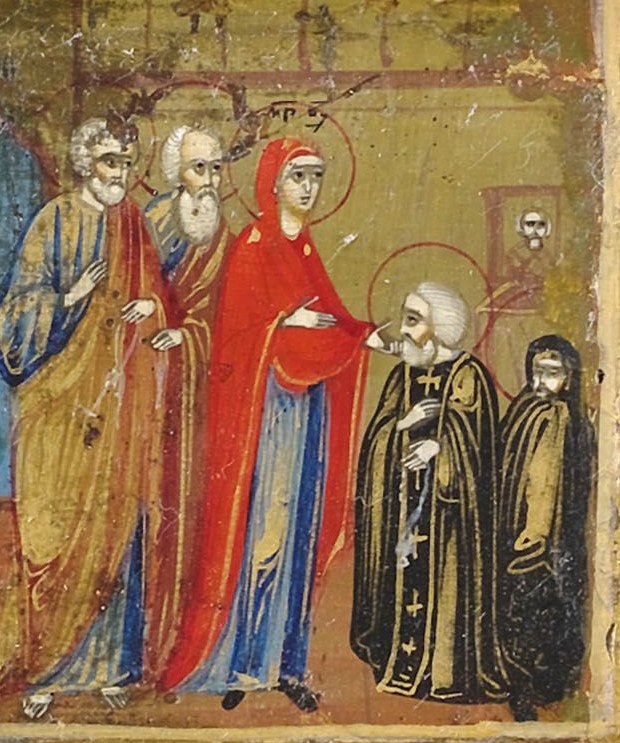
One night I stood before the icon of the Most Pure One, performing my usual rule, and prayed that She would look upon this holy place. Having finished the prayer, I sat down to rest and suddenly said to my disciple Micah: «Child, be watchful and sober! At this very hour an unexpected and wondrous visitation will come to us». Suddenly a voice was heard: «Behold, the Most Pure One comes». I hastened out into the porch; there a light brighter than the sun shone upon me, and I was counted worthy to behold the Most Pure One, accompanied by the two Apostles Peter and John. Unable to bear the radiance, I fell prostrate. The Most Pure One touched me with Her hands and said: «Fear not, My chosen one! I have come to visit you, for your prayers for the disciples have been heard. Grieve no more for this monastery: from now on it will have abundance in all things not only during your lifetime but also after your departure to God. I for My part will never forsake this place».
Having spoken thus, the Most Pure One became invisible. Coming to myself, I saw that my disciple was lying as if dead; I raised him and could only say: «Child, wait a little, for even in me the soul trembles from this wondrous vision!» Then I called Isaac and Simon, and together we performed a moleben to the Theotokos.
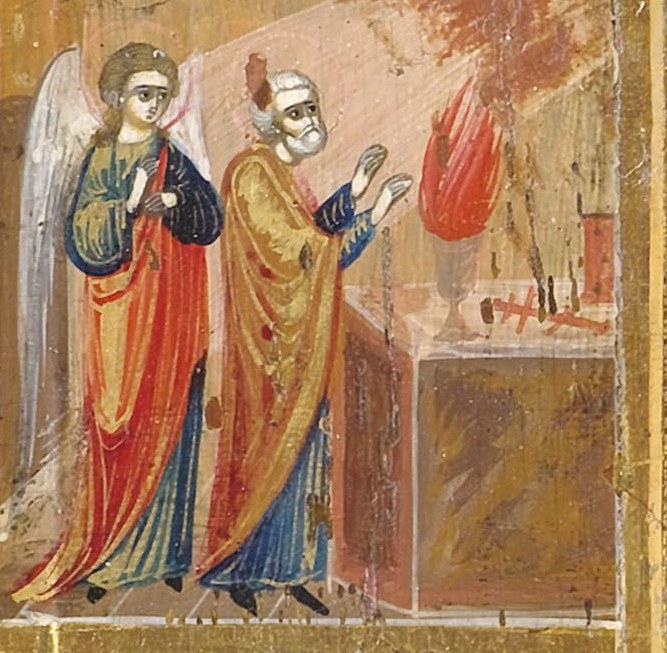
On another occasion, when I was celebrating the Liturgy, my disciple Simon, who was then the ecclesiarch, saw that fire was moving about the holy altar, encircling me, and when I approached to partake of Christ’s Mysteries, the fire coiled itself like some marvellous veil and entered the holy chalice, from which I then communed. «Father, I have seen a wondrous vision: I have seen the grace of the Holy Spirit acting with you», he said to me. But I forbade him: «Tell this to no one until the Lord calls me to Himself».

Having lived many years in great abstinence amid unceasing labours, I reached deep old age: I was already seventy-eight years old. Six months before my death, foreseeing my departure to God, I called the brethren to me and entrusted the guidance of them to my disciple Nikon: though he was young in years, he was wise with spiritual experience. Having appointed him igumen, I myself gave myself over to complete silence and began to prepare for my departure from this temporal life.
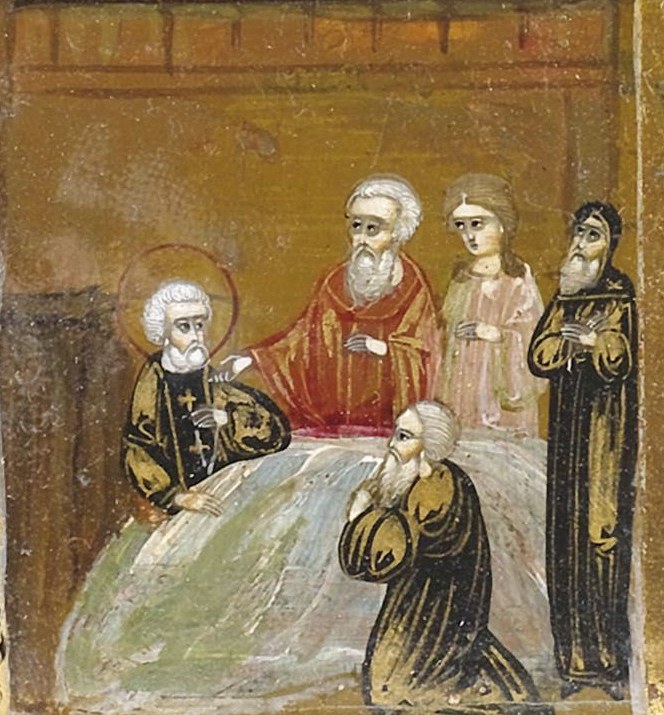
In the month of September I fell into a grievous illness and, sensing my end, I called the brethren. For the last time I addressed them with instruction: I exhorted the monks to abide in faith and like-mindedness, I implored them to preserve purity of soul and body, I charged them to nourish unfeigned love for all, to shun evil desires and passions, to observe moderation in food and drink, not to forget hospitality, to be humble and to flee earthly glory. Finally I said to them: «I depart to God Who calleth me, and I commit you to the Almighty Lord and His Most Pure Mother; may She be to you a refuge and a wall from the arrows of the evil one».
In the very last moments I desired to be vouchsafed the Holy Mysteries of Christ. I could no longer rise from my bed myself: the disciples reverently supported me under the arms as I partook for the last time of the Body and Blood of Christ; then, raising my hands, I with prayer committed my soul to the Lord. As soon as I had reposed, an ineffable fragrance spread through the cell. The brethren poured forth bitter tears, like sheep that had lost their shepherd; with funeral hymns and psalmody they buried my body and laid it in the monastery where I had laboured so zealously throughout my life.

Having left the brethren in a visible manner, I did not abandon invisible communion with them: the monk Ignatius saw me standing at the all-night vigil in my place and joining with the other brethren in the church singing. More than thirty years passed after my repose, and the Lord desired to glorify His servant yet more. A pious man who lived near the monastery often came to my tomb; once at night after prayer he fell into a light sleep, and I appeared to him: «Tell the igumen of this monastery: why do you leave me so long under the cover of earth in the grave, where water surrounds my body?»
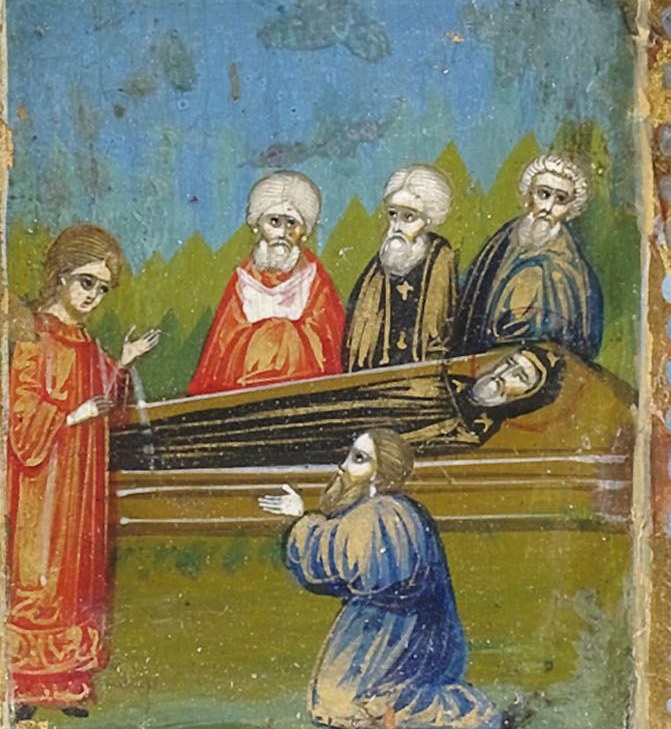
He told Nikon, who was then igumen, of the vision, and many people gathered at the monastery; there also came Prince Yury Dmitrievich, who venerated me as a father. As soon as those assembled opened the grave, a great fragrance spread around, and they beheld a wondrous miracle: my body was preserved whole and unharmed, and corruption had not touched even the clothing; on both sides of the grave stood water, but it touched neither the relics nor the vesture. With rejoicing the relics were laid in a new shrine. This finding took place on the fifth of July in the year one thousand four hundred and twenty-eight, in memory of which the feast was established.
Since then numerous miracles are granted to all who with faith call upon my name and fall down before the shrine. A certain poor blind man, who had lost his sight at the age of seven, stood outside the church on the feast of the Most Holy Trinity and wept bitterly that he could not enter and venerate; I took him by the hand, led him into the church and brought him to the shrine — the blind man venerated it, and immediately his blindness vanished. And to this day my tomb is an inexhaustible source of miracles for all who come with faith.
Even an ascetic of virtues, like a true warrior of Christ God, you labored in the passion of the great one in your temporary life, in singing, vigils and fasting, and the image became your disciple: in the same way, the Most Holy Spirit dwelled in you, with whose action you are brightly adorned. But since you have boldness towards the Holy Trinity, remember the flock that you gathered wisely: and do not forget, as you promised, when you visited your children, O Reverend Sergius, our Father.