ORTHODOX HOUSENewsCommunityCalendarPrayer BookLives of the Saints
Venerable Seraphim, Wonderworker of Sarov
Lives of the Saints · the saint tells his own story

Venerable Seraphim, Wonderworker of Sarov

Commemorated: 2 (15) January — Repose · 19 July (1 August) — Birth and Glorification · XVIII–XIX century · Kursk — Sarov Hermitage — Diveyevo
«The provincial city of Kursk is memorable for my birth…»
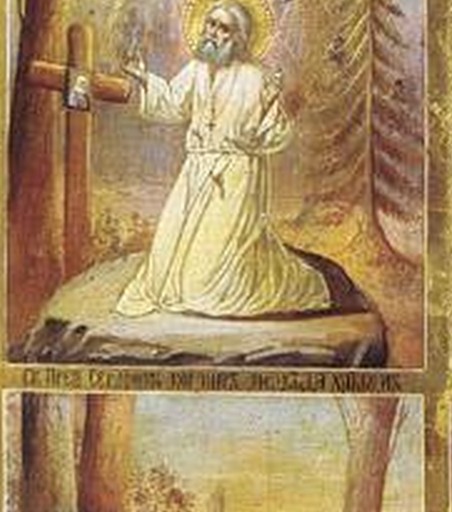
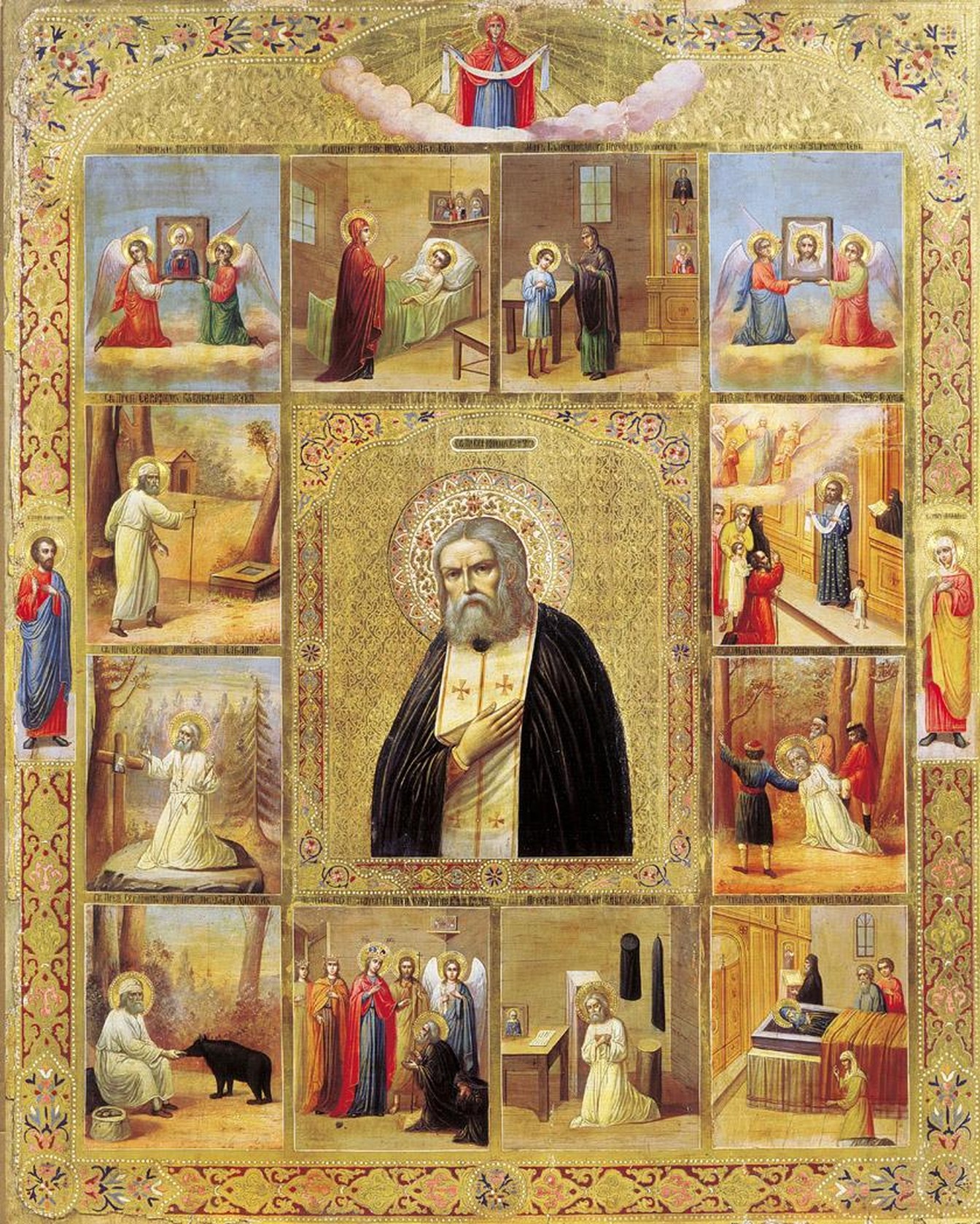
Central panel of the hagiographical icon of Venerable Seraphim of Sarov with 12 border scenes. Late 19th – early 20th century; private source, photograph from Wikimedia Commons (PD-Art licence). Public domain.
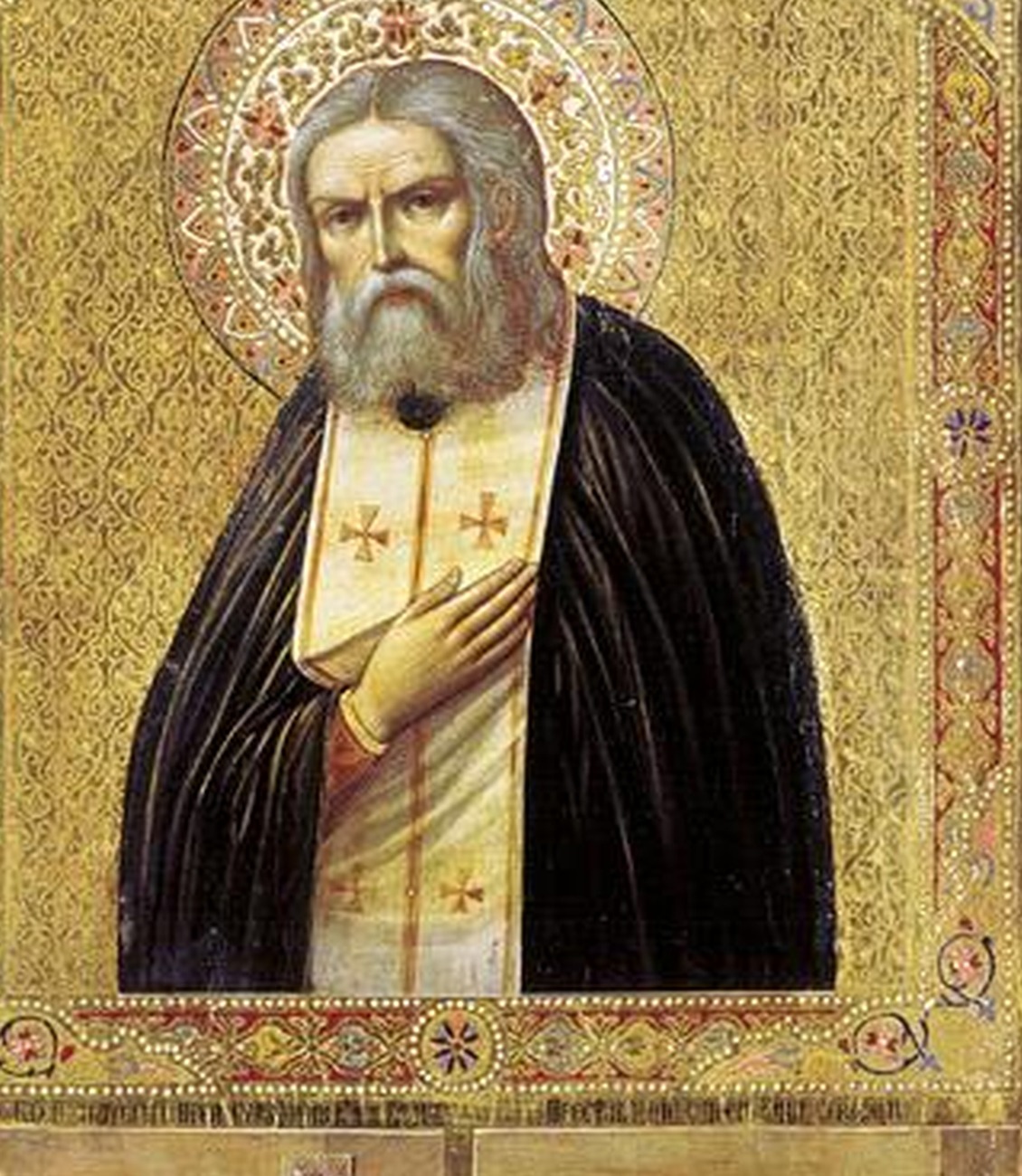
How this is made. First-person narrative — a literally close paraphrase of the first (1863) edition of the Life compiled by N. V. Yelagin from the testimonies of the Sarov brethren; not a single fact absent from the source. Beneath each excerpt is Yelagin’s own text. Source: Nikolai Vasilyevich Yelagin. The Life of Elder Seraphim, Hieromonk of the Sarov Monastery, Hermit and Recluse (first edition 1863) — The Life of Elder Seraphim, Hieromonk of the Sarov Monastery, Hermit and Recluse. The face is an authentic icon; the light and breathing make it a “living icon”, with no talking lips. The pictures beside the passages are the border scenes of the icon of his life. There is no voice: the reading is yours.
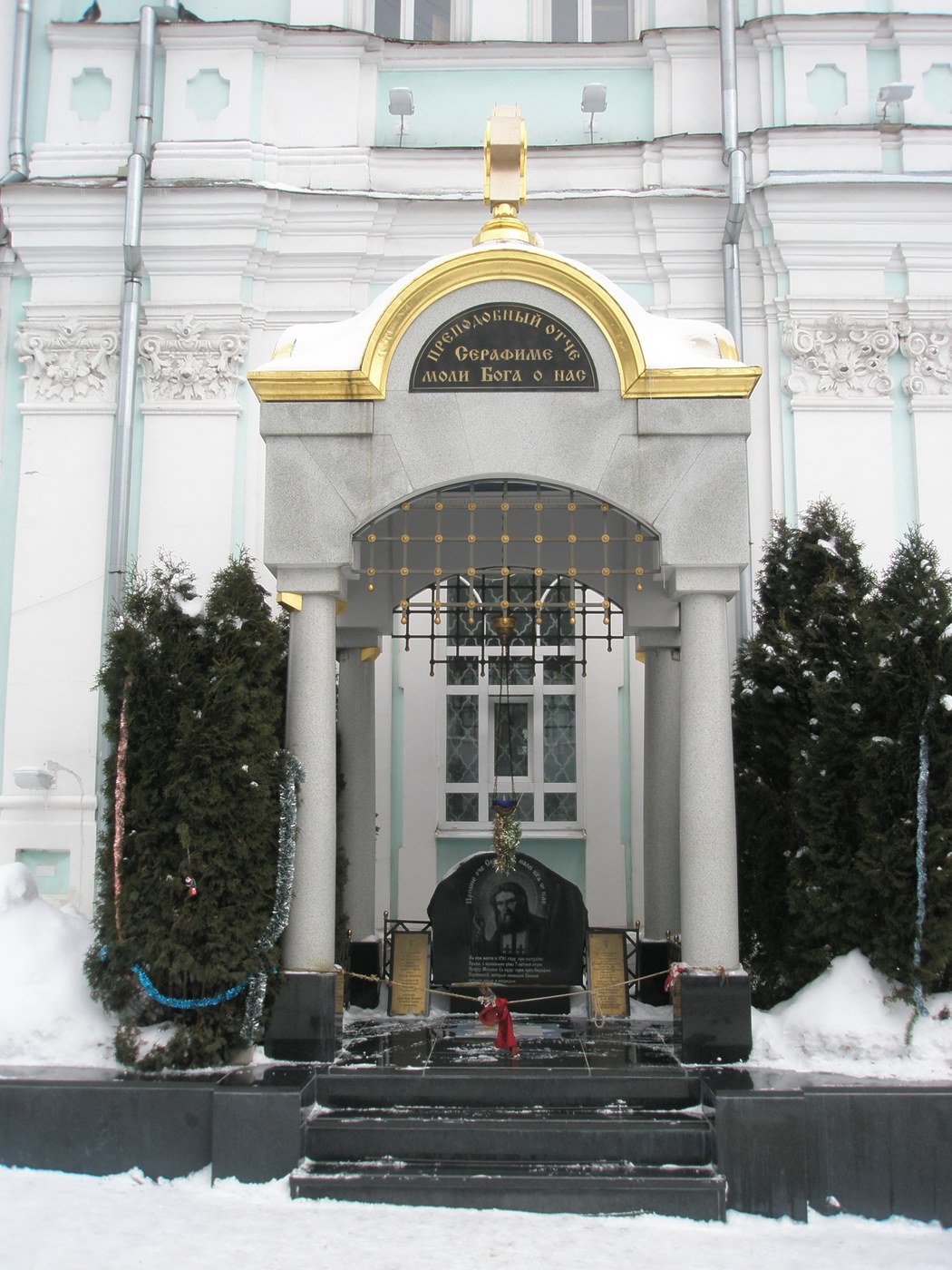
The place in Kursk where the youth Prokhor fell from the bell tower of the Sergius-Kazan Cathedral under construction
Photograph: The place in Kursk where the youth Prokhor fell from the bell tower of the Sergius-Kazan Cathedral under construction · Kursk, photograph of our days
1 · Kursk

Kursk. Birth and Childhood

The provincial city of Kursk is memorable for my birth. My parents were called Isidore and Agathia, of the surname Moshnin; my father had his own brick factories near Kursk and, as a contractor, built stone buildings, churches and houses. I was born on the night of the nineteenth to the twentieth of July and was named Prokhor, in honour of Saint Prokhor, one of the Seventy Apostles. I lost my father when I was no more than three years of age; my mother alone remained my educator in childhood.

I was seven years old when my mother, inspecting the construction of the Sergius church, took me with her to the very top of the bell tower then being built. There I slipped out of my mother’s sight and, left alone, through carelessness fell to the ground. In great fright she ran down from the bell tower, imagining she would find me dashed to death, but with amazement and inexpressible joy she saw me whole and unharmed: I was standing on my feet. My mother with tears of joy recognised this as the work of special Divine protection and gave thanks to God.

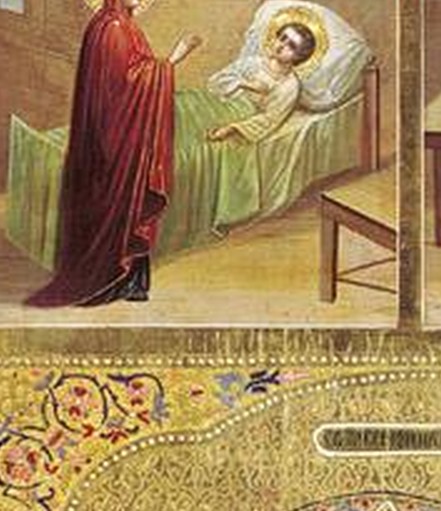
I was ten years old when they began to teach me church literacy, and soon I became so gravely ill that there was no hope of my recovery. At the most difficult time of the illness, in a dream vision, I saw the Most Holy Theotokos, Who promised to visit me and heal me of the sickness. When I awoke, I told my mother of this vision. Soon afterwards a cross procession was carrying the wonderworking icon of the Sign of the Theotokos through the city, and its path lay through the courtyard of our house; my mother carried me, sick as I was, into the courtyard and pressed me to the wonderworking icon. From that time I began to improve and soon recovered completely.

Source — St Demetrius of Rostov, “Lives of the Saints”
The provincial city of Kursk is memorable as the birthplace of Fr Seraphim. […] The parents of Fr Seraphim were called Isidore and Agathia, of the surname Moshnin. […] Fr Seraphim was born in 1759 on the night of the 19th to the 20th of July and named Prokhor, in honour of Saint Prokhor, one of the Seventy Apostles and seven deacons of the Primitive Church […] He lost his father when he was no more than three years of age. His mother alone remained his educator in childhood. […] He was seven years old when his mother, inspecting the construction of the Sergius church, took her son with her to the very top of the bell tower then being built. Here Prokhor slipped out of his mother’s sight and, left alone, through carelessness fell to the ground. […] with amazement and inexpressible joy she saw him whole and unharmed. The child was standing on his feet. […] He was ten years old; he had a good bodily constitution, and in his mental powers there appeared sharpness of mind and quick memory […] Prokhor became so gravely ill that there was no hope of his recovery. At the most difficult time of the illness, in a dream vision, Prokhor saw the Most Holy Theotokos, Who promised to visit him and heal him of the sickness. […] During one of the cross processions the wonderworking icon of the Sign of the Theotokos was being carried through the city of Kursk along the street where the Moshnin house stood. […] Agathia carried her sick son into the courtyard and pressed him to the wonderworking Icon […] It was noticed that from this time Prokhor began to improve in health and soon recovered completely.
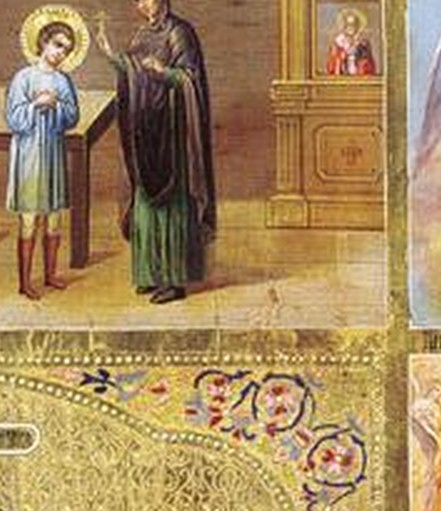
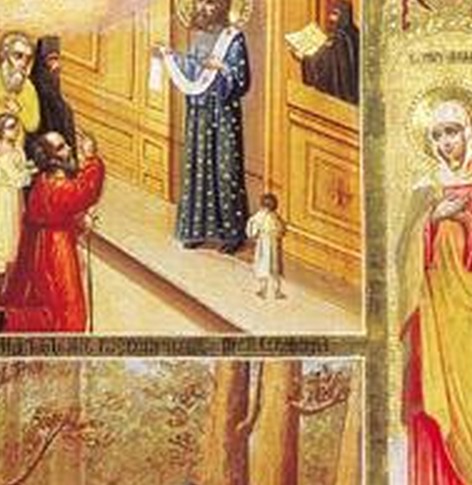
The youth at book learning — border scene of the Life
Icon: The youth at book learning — border scene of the Life · Border scene of the Life, early 20th c.
2 · Kursk

Youth. Departure for Monastic Life

Since my elder brother Alexei was engaged in trade and had his own shop in Kursk, I too was made to learn trade in that shop. I am by birth a merchant of Kursk, and when I was not yet in the monastery we used to trade in such goods as gave more profit: belts, tar, cords, bast shoes, iron. But my heart did not incline to trade or to profit; it drew me where one could acquire spiritual treasure, the eternal salvation of the soul. I scarcely missed a single day without visiting the temple of God, and on Sundays I loved to occupy myself with the reading of spiritually edifying books, sometimes gathering my companions to listen to the reading.

In our city there then lived a certain fool-for-Christ; out of my piety I first made his acquaintance, and afterwards became attached to him with all my heart, and he inclined my soul even more to the solitary life. This inclination did not remain hidden from my mother; in her soul she agreed with me and rejoiced. I began to speak of the monastery, cautiously sounding out her thoughts; seeing that she did not contradict me, the desire for monastic life burned within me ever more strongly. In my seventeenth year of life the intention to leave the world finally matured within me.

My parting from my mother was touching. I prayed to God and, bowing down at her feet, asked for a parental blessing. She let me venerate the icons of the Saviour and the Theotokos, and then blessed me with a copper cross. I took this cross with me as a sign of my mother’s blessing and wore it openly on my breast until the end of my life.

Source — St Demetrius of Rostov, “Lives of the Saints”
Since my elder brother Prokhor, Alexei, was engaged in trade and had his own shop in Kursk, Prokhor too was made to learn the trade in that shop. […] «I am from the Kursk merchants,» he would say later, conversing in Sarov with N. A. M., «and when I was not yet in the monastery, we used to trade in such goods as bring the greater profit.» […] The objects of trade were things necessary in peasant life, such as: belts, tar, cords, yokes, horse-collars, bast shoes, iron, and the like. […] He would scarcely let a single day pass without visiting the temple of God. […] On Sundays and feast days he especially loved to occupy himself with the reading of spiritually edifying books, sometimes gathering his companions to listen to the reading. […] At that time there lived in the city of Kursk a certain fool-for-Christ… By his piety Prokhor first made his acquaintance, and afterwards became attached to him with all his heart. […] His mother did not fail to notice the direction of her son, which he manifested with a simple heart; in her soul she agreed with him, approved of him, and rejoiced. […] Prokhor began to speak about the monastery, cautiously sounding out his mother’s thoughts […] In the seventeenth year of his life the intention to leave the world and enter upon the path of monastic life fully matured in Prokhor. […] he prayed to God and, bowing down at his mother’s feet, asked her parental blessing. Agafia had him venerate the icons of the Saviour and the Theotokos, then blessed him with a copper cross. Taking this cross with him as a sign of his mother’s blessing, as a symbol in which are united all the duties of a monk, Fr. Seraphim preserved it until the end of his life, always wearing it openly upon his breast.
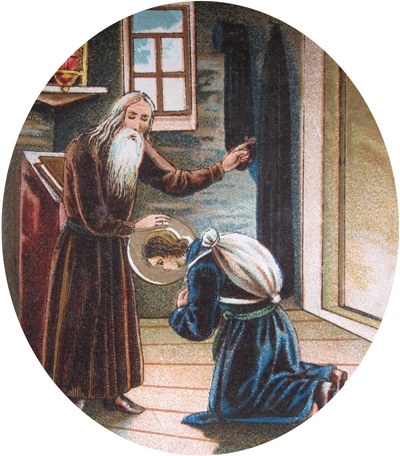
The recluse of the Kitaev Hermitage, Dositheus, blesses Prokhor Moshnin
Lithograph: The recluse of the Kitaev Hermitage, Dositheus, blesses Prokhor Moshnin · Lithograph, early 20th c.
3 · Kiev — Kitaev Hermitage · Sarov Hermitage

The Way to Kiev. Arrival at the Sarov Hermitage

The fame of the ascetic life of the monks of the Sarov Hermitage, where many from among the inhabitants of Kursk had already struggled and where the superior at that time was a native of Kursk, Pachomius, inclined me to go to these ascetics. But first I wished to visit Kiev, so that in the Kiev Caves Lavra, that nursery of Russian monasticism, I might pray and receive a blessing at the holy relics of the venerable Anthony and Theodosius. And so, with my mother’s blessing around my neck and with a staff in my hands, I set out for Kiev.

In Kiev I fell with fervent prayer and tears before the relics of the saints of God. Going round the fathers labouring there, I heard that not far from the Lavra, in the Kitaev monastery, there was a recluse named Dositheus, of a truly God-pleasing life, who possessed the gift of clairvoyance. Coming to him, I fell at his feet, kissed them, opened before him my whole soul and asked for instruction and blessing. The clairvoyant elder, perceiving my intention, pointed out to me the Sarov monastery for my dwelling and blessed me, saying: «Go, child of God, and abide in the Sarov monastery; this place will be unto thee for salvation; with God’s help, there thou shalt end also thy earthly pilgrimage. The Holy Spirit, the Treasury of all good things, will guide thy life in holiness. In Sarov the superior Pachomius is also of a God-pleasing life».

The conversation with the blessed elder finally confirmed me in my good intentions. Returning to my homeland and bidding farewell to my mother, I directed my steps to the Sarov Hermitage and arrived there on the eve of the feast of the Entry of the Most Holy Theotokos into the Temple. Standing in church at the all-night vigil of the feast, seeing the orderly performance of the divine service, I was enraptured in spirit, rejoicing that the Lord had shown me here a place for the salvation of my soul. The builder Pachomius received me with love, the youth in whom he saw a true aspiration to monasticism, enrolled me among the novices and, for instruction in the paternal way, gave me over to the elder hieromonk Joseph, who fulfilled in the monastery the obedience of treasurer.

Source — St Demetrius of Rostov, “Lives of the Saints”
The fame of the ascetic life of the monks of the Sarov Hermitage, where many from among the inhabitants of Kursk had already struggled, and where the superior at that time was a native of Kursk, Pachomius, inclined him to go to these ascetics. But first he wished to be in Kiev […] And so Prokhor set out, with his mother’s blessing around his neck and with a staff in his hands, for Kiev. […] In Kiev Prokhor fell with fervent prayer and tears before the holy relics of the saints of God, especially the venerable Anthony and Theodosius […] he heard that not far from the holy Caves Lavra, in the Kitaev monastery, there was a recluse by the name of Dositheus, of a truly God-pleasing life and possessing the gift of clairvoyance. Coming to him, Prokhor fell at his feet, kissed them, opened before him his whole soul, and asked for instruction and blessing. […] «Go, child of God, and abide in the Sarov monastery; this place will be unto thee for salvation; with God’s help, there thou shalt end also thy earthly pilgrimage. The Holy Spirit, the Treasury of all good things, will guide thy life in holiness. In Sarov the superior Pachomius is also of a God-pleasing life» […] Standing in church at the all-night vigil of the feast, seeing the orderly performance of the divine service, hearing the harmonious singing of the monks, noticing how all—from the superior to the last novice—were zealous for prayer, he was enraptured in spirit, rejoicing that the Lord had shown him here a place for the salvation of his soul. […] Pachomius received the youth with love, in whom he saw a true aspiration to monasticism, enrolled him among the novices and, for instruction in the paternal way, gave him over to the elder hieromonk Joseph, who fulfilled in the monastery the obedience of treasurer.
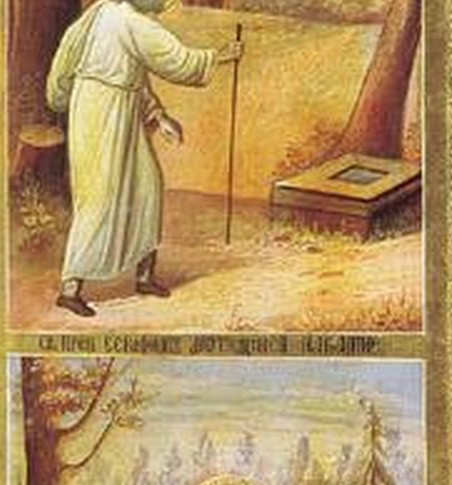
A monk on the way — a panel from the life
Icon: A monk on the way — a panel from the life · Panel from the life, early 20th c.
4 · Sarov Hermitage

Obediences and the temptation of despondency

At first I was in the cell obedience to the elder and precisely fulfilled all the monastery rules and statutes at his direction. Then, besides the cell obedience, I was also assigned common fraternal obediences: at the beginning I was in the bakery, from there transferred to the prosphora bakery, then to the carpentry workshop, further appointed as the wakener — I went around the brethren’s cells before the beginning of the divine services and notified them by knocking on the door of the time to go to church; after this I also fulfilled the obedience of sacristan.

I endured no small temptations in those years: the spirit of despondency and boredom acted upon me strongly, even to the exhaustion of the soul. Boredom, according to the remark of the fathers, attacks a monk around noon and produces in him such a terrible restlessness that both the place of his dwelling and the brethren living with him become unbearable to him; at reading some kind of aversion is aroused, frequent yawning and strong hunger. A monk overcome by boredom is like a desert tumbleweed, which sometimes stops a little, then is again carried along by the wind: he, like a cloud without water, is driven by the wind.

This sickness is healed, according to my own experience, by prayer, abstinence from idle talk, feasible handiwork, reading the word of God and patience; for it is born of faint-heartedness, idleness and idle talk. It is difficult, difficult for one beginning the monastic life to avoid this sickness, for it is the first to attack him; therefore above all it is necessary to forestall it by strict and unquestioning fulfilment of all the duties laid upon the novice. When your occupations come into proper order, boredom will find no place in your heart: only those whose affairs are not in order become bored. And so obedience is the best remedy against this dangerous sickness.

Source — St Demetrius of Rostov, “Lives of the Saints”
At first Prokhor was in the cell obedience to the elder. He precisely fulfilled all the monastery rules and statutes at his direction, and in the cell he served not only without complaint but always with zeal. […] So at the beginning he was in the bakery, from there transferred to the prosphora bakery, then to the carpentry workshop, further appointed as the wakener. […] After these duties he also fulfilled the obedience of sacristan. […] Prokhor also endured many temptations: the spirit of despondency, boredom and despondency acted upon him strongly, even to the exhaustion of his soul. […] Boredom, according to the remark of the fathers, attacks a monk around noon and produces in him such a terrible restlessness that both the place of his dwelling and the brethren living with him become unbearable to him, and at reading some kind of aversion is aroused, and frequent yawning, and strong hunger. […] And a monk overcome by boredom is like a desert tumbleweed, which sometimes stops a little, then is again carried along by the wind. He, like a cloud without water, is driven by the wind. […] «This sickness is healed,» he says from his own experience, «by prayer, abstinence from idle talk, feasible handiwork, reading the word of God and patience; for it is born of faint-heartedness, idleness and idle talk. […] It is difficult,» he said, «difficult for one beginning the monastic life to avoid this sickness, for it is the first to attack him. Therefore above all it is necessary to forestall it by means of strict and unquestioning fulfilment of all the duties laid upon the novice. When your occupations come into proper order, then boredom will find no place in your heart. Only those whose affairs are not in order become bored. And so obedience is the best remedy against this dangerous sickness.»
The appearance of the Mother of God to the youth during his illness — a panel of the life
Icon: The appearance of the Mother of God to the youth during his illness — a panel of the life · Panel of the life, early 20th c.
5 · Sarov Hermitage

A grievous illness and the appearance of the Theotokos

I fell gravely ill and took to my hard bed: my body became swollen, I lay motionless; the malady was stubborn and prolonged, lasting three years, half of which I spent in bed. I wholly committed my body and soul to God, prayed, washed my bed with tears; the word of murmuring never left my lips. The elder Father Joseph served me in those days, and the builder Pachomius and the elder Isaiah also took great care of me.

When my malady grew worse, the builder father resolutely suggested that I call a physician or have blood let. But I answered him: «I have committed myself, holy father, to the true Physician of souls and bodies, our Lord Jesus Christ and His Most Pure Mother; if however your love should judge it right, provide me, the wretched one, for the Lord’s sake, with heavenly medicine.» Then Father Joseph, at my request and by his own zeal, served a special all-night vigil and liturgy for my health; the brethren gathered out of zeal to pray for the sufferer, and I was confessed and communed of the Holy Mysteries of Christ, which were brought to my cell, to my bed.

At that time, after the communion of the Holy Mysteries, the Most Holy Virgin Mary appeared to me in ineffable light with the apostles John the Theologian and Peter and, turning her face to the Theologian and pointing at me with her finger, said: «This one is of our kind.» Then She placed Her right hand on my head — and the matter that filled my body began to exit through an opening that formed in my right side. In a short time my body was completely freed from the malady.

Source — St Demetrius of Rostov, “Lives of the Saints”
In the year 1780 the novice Prokhor fell gravely ill. He took to his hard bed: his body became swollen; the sick man lay motionless. […] But there is no doubt that the malady was stubborn and prolonged, lasting for three years, half of which the sufferer spent in bed. The sick man wholly committed his body and soul to God, prayed, washed his bed with tears; the word of murmuring never left his lips. […] During the illness the elder Father Joseph, his instructor and guide, served Prokhor as a novice […] The builder Pachomius and the elder Father Isaiah also took great care of him. […] Then the builder father resolutely suggested that he call a physician, or at least have blood let. […] «I have committed myself, holy father, to the true Physician of souls and bodies, our Lord Jesus Christ and His Most Pure Mother; if however your love should judge it right, provide me, the wretched one, for the Lord’s sake, with heavenly medicine.» […] The elder Joseph, at his request and by his own zeal, served a special all-night vigil and liturgy for the health of the sick man. The brethren gathered for the divine service out of zeal to pray for the sufferer; Prokhor was confessed and communed of the Holy Mysteries of Christ, which were brought to his cell, to his bed. […] at that time, after the communion of the Holy Mysteries, the Most Holy Virgin Mary appeared to him in ineffable light with the apostles John the Theologian and Peter and, turning her face to the Theologian and pointing at Prokhor with her finger, said: this one is of our kind. […] Then She placed Her right hand on the head of the sufferer: then the matter that filled the sick man’s body began to exit through an opening that formed in his right side. In a short time his body was completely freed from the malady.
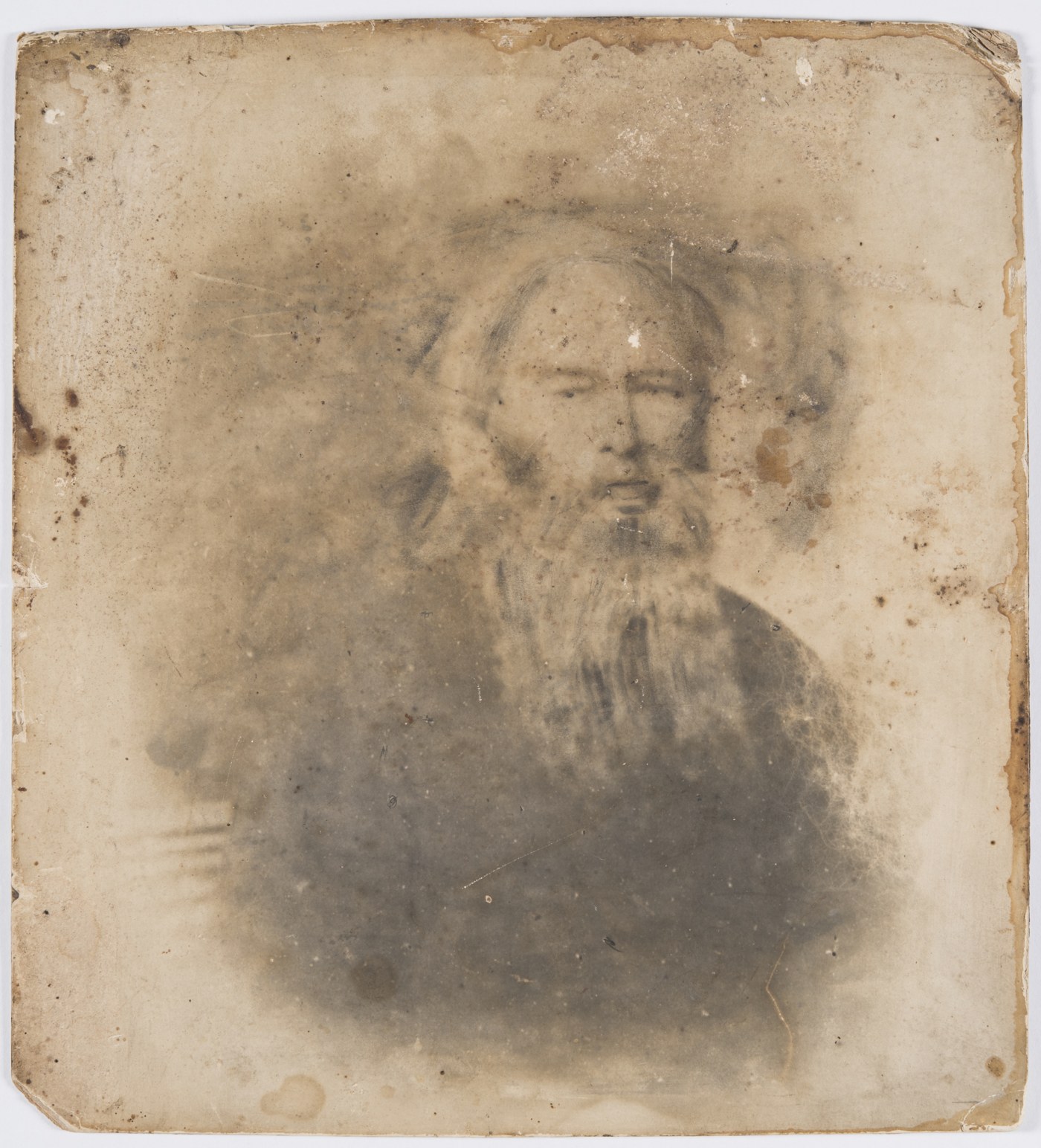
Portrait of Venerable Seraphim
Portrait: Portrait of Venerable Seraphim · photograph of the portrait, Wikimedia Commons, CC BY-SA 4.0 (Top secrett)
6 · Sarov Hermitage

Tonsure. Hierodeaconate. Vision of the Saviour

For eight years I lived in the rank of novice; I was then a little over twenty-five years of age. With the consent of the Most Holy Synod, on the thirteenth of August my tonsure was performed by the builder hieromonk Pachomius; the godfathers at this were the elders Joseph and Isaiah. At my tonsure I was given the new name — Seraphim. In the same year, in October, I was ordained by His Grace Victor, Bishop of Vladimir and Murom, to the rank of hierodeacon and, preserving the purity of soul and body, for six years and ten months I remained almost unceasingly in the service.

It happened that I was serving with father Pachomius and the treasurer Joseph on Holy Great Thursday. After the Little Entrance and the readings from the Prophets I, the unworthy, cried out at the holy altar, and entering through the royal doors I covered the people with the orarion. Then a light shone upon me like a ray of the sun. Turning my eyes to the radiance, I beheld the Lord God our Jesus Christ — in the form of the Son of Man, in glory, shining brighter than the sun with ineffable light and surrounded, as though by a swarm of bees, by the heavenly powers: Angels, Archangels, Cherubim and Seraphim. From the western doors of the church He came through the air, stopped opposite the ambo and, raising His hands, blessed those serving and those praying; then He entered the local icon that is near the royal doors. My heart then rejoiced purely, enlightened, in the sweetness of love for the Lord.

From this mysterious vision I was instantly changed in appearance and could neither move from my place nor utter a word; two hierodeacons came up, took me by the arms and led me into the holy altar, and for about two hours I stood thereafter motionless in one place. When I turned thirty-four years of age, I was summoned to Tambov, and on the second of September Bishop Theophilus ordained me to the priesthood.

Source — St Demetrius of Rostov, “Lives of the Saints”
Upon entering the Sarov Hermitage, Prokhor spent eight years in the rank of novice. […] Prokhor had now come of age: he was a little over twenty-five years old. […] With the consent of the Holy Synod, on the 13th of August 1786, his tonsure was performed by the builder hieromonk Pachomius. His godfathers at this were the venerable elders Joseph and Isaiah […] At his tonsure he was given the new name Seraphim (fiery). […] In the same year of 1786 […] in October, the monk Seraphim, at the intercession of the builder Pachomius, was ordained by His Grace Victor, Bishop of Vladimir and Murom, to the rank of hierodeacon. […] From the day of his elevation to the rank of hierodeacon, preserving the purity of soul and body, for six years and ten months he remained almost unceasingly in the service […] It happened that I was serving with father Pachomius and the treasurer Joseph on Holy Great Thursday. […] I, the unworthy, cried out at the holy altar: O Lord, save the pious and hearken unto us, and entering through the royal doors I covered the people with the orarion […] Then a light shone upon me like a ray of the sun. Turning my eyes to the radiance, I beheld the Lord God our Jesus Christ — in the form of the Son of Man in glory, shining brighter than the sun with ineffable light and surrounded, as though by a swarm of bees, by the heavenly powers: Angels, Archangels, Cherubim and Seraphim. From the western doors of the church He came through the air, stopped opposite the ambo and, raising His hands, blessed those serving and those praying. Then He entered the local icon that is near the royal doors. My heart then rejoiced purely, enlightened, in the sweetness of love for the Lord. […] From this mysterious vision Fr. Seraphim was instantly changed in appearance — and could neither move from his place nor utter a word. […] Immediately two hierodeacons came up, took Fr. Seraphim by the arms and led him into the holy altar. For about two hours Fr. Seraphim stood thereafter motionless in one place. […] In the year 1793, on the 19th day of July, Fr. Seraphim turned thirty-four years of age from his birth. […] Fr. Seraphim was summoned to Tambov, and on the 2nd of September 1793 Bishop Theophilus ordained him to the priesthood.
A Monk among the Senior Brethren — a panel from the Life
Icon: A Monk among the Senior Brethren — a panel from the Life · Panel from the Life, early 20th c.
7 · Sarov Hermitage

Hieromonk. The Repose of Elder Pachomius. Departure to the Desert

Having received the grace of the priesthood, I began to struggle in the spiritual life with greater zeal and redoubled love, daily partaking with fervent faith of the Holy Mysteries of Christ. But from constant vigil in my cell, from continual attendance at the services, from many years of standing on my feet, I fell into illness: my legs swelled, wounds opened on them, and for a time I lost the ability to celebrate the divine services. And so, instead of asking for rest in the monastery cells, I began to ask the superior, father Pachomius, for a blessing to withdraw into the desert — to pass from lesser labours to greater and more grievous ones. The seventy-year-old elder Pachomius blessed me; this was the last blessing I received from him.

At that time elder Pachomius was already unwell and was preparing for death; I noticed that to his painful sufferings was added yet another sorrow. «Why, holy father, are you so sorrowful?» I asked him. The elder replied: «I grieve for the sisters of the Diveyevo community: who will guide them after me?» Wishing to comfort him in his last moments, I promised to guide them myself and to support everything in the same way after his death. My promise calmed and gladdened father Pachomius as he was departing to the Lord: he kissed me with a joyful last kiss and soon fell asleep with the peaceful sleep of the righteous. Bitterly did I weep for the loss of the elder who loved me as his beloved child in the Lord, under whose guidance I had passed through all the degrees of monastic life.

With the blessing of the new superior Isaiah I withdrew to the desert cell on the very day of my arrival at the Sarov Hermitage. For unimpeded dwelling in it I was issued a certificate stating that I had been released on account of inability to live in community, because of illness and by my own desire, after many years of trial in that monastery and in the desert, solely for the peace of spirit for the sake of God.

Source — St Demetrius of Rostov, “Lives of the Saints”
with the reception of the highest grace of the priesthood, he began to struggle in the spiritual life with greater zeal and redoubled love. In the rank of hieromonk he continued for a long time his uninterrupted sacred service, communing daily, with fervent love, with faith and reverence, of the Holy Mysteries of Christ. […] from unceasing vigil in his cell, from constant attendance at the services in church – in a word: from standing for many years upon his feet, with but little rest during the night, Fr. Seraphim fell into an illness: his legs swelled, wounds opened upon them; for a time he lost the ability to celebrate the divine services. […] yet he asked the superior Fr. Pachomius for a blessing to withdraw into the desert, that is, he wished to pass from lesser labours to greater and more grievous ones. The seventy-year-old elder Pachomius blessed him. This was the last blessing received by Fr. Seraphim from the wise, virtuous and venerable elder. […] Once Fr. Seraphim noticed that to the bodily sufferings of Fr. Pachomius was joined yet another spiritual care and sorrow. «Why, holy father, art thou so sorrowful?» asked him Fr. Seraphim. The elder Pachomius replied: – I grieve for the sisters of the Diveyevo community: «who will guide them after me»? […] Fr. Seraphim, desiring to comfort the elder in his last moments, promised to guide them himself and to support them in the same manner after his death as it had been during his life. The promise of Fr. Seraphim calmed and gladdened the one departing to the Lord, Fr. Pachomius; he kissed him joyfully with a last kiss, and soon after this he fell asleep with the peaceful sleep of the righteous. […] Fr. Seraphim bitterly wept for the loss of the elder Pachomius, who loved him as his own beloved child in the Lord, under whose guidance he had passed through all the degrees of monastic life […] Fr. Seraphim in the year 1794 on the 20th of November, on the day of his arrival at the Sarov hermitage, withdrew into the desert cell. For unimpeded dwelling in it there was issued to him, under the signature of the builder Isaiah, a permit […] on account of his inability to live in community, because of illness and by his zeal, after many years of probation (that is, trial) in that monastery and in the desert, he was released, solely for the peace of his spirit, for the sake of God.
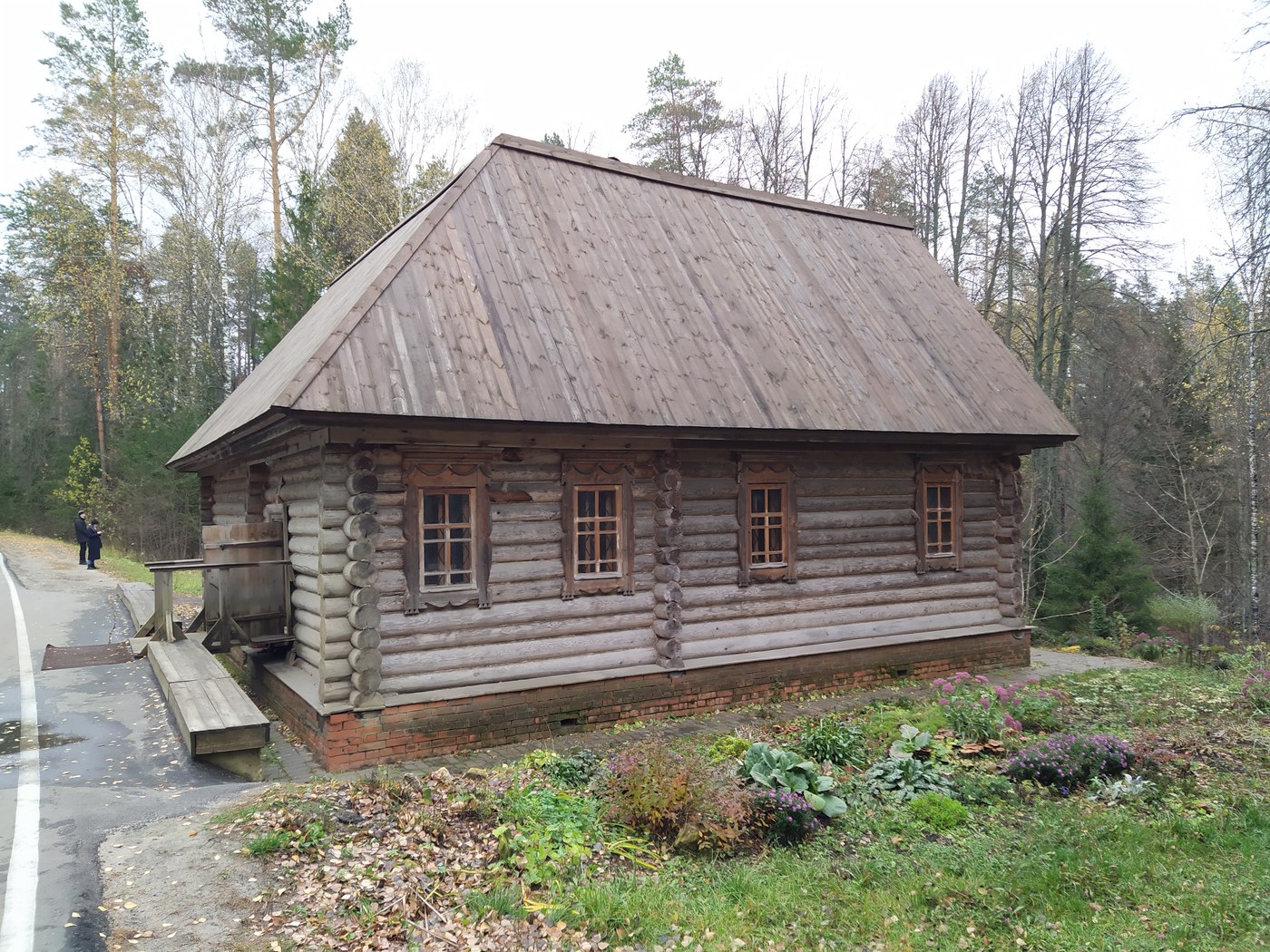
The hut built on the site of the far desert cell of Venerable Seraphim
Photograph: The hut built on the site of the far desert cell of Venerable Seraphim · Photograph of the site of the hermitage, our days
8 · The Far Hermitage, Sarov Forest

The Far Hermitage. Mount Athos

The cell in which I struggled was situated in a dense pine forest, on the bank of the River Sarovka, upon a high hill, built of wood, with one room and a stove; around it I arranged a small vegetable garden with beds, and later also a beehive. This hill I named Mount Athos, and certain other solitary places in the forest I named in a spiritual sense with the names of holy places: here I had the holy city of Jerusalem, Nazareth, Bethlehem, where Christ was born, the River Jordan, where He received baptism, Tabor, upon which was the wondrous Transfiguration, Golgotha, upon which He was crucified, the Mount of Olives, from which He ascended into heaven.

Desiring that women should have no access to my hill, I asked this of the Lord and the Most Holy Theotokos, and God gave me a sign of His good pleasure. Then I approached the father builder Isaiah in the holy altar and said: «Father, father builder! Bless that women should have no access to my hill, upon which I now live». He replied: «I bless that women should have no access to thy hill, and do thou thyself guard it». From that time I myself blocked the path to myself with logs.

In summer I cultivated the beds in my desert vegetable garden: I sowed seeds upon them, watered the earth, grew vegetables for the strengthening of my strength – potatoes, beetroot, onions and the herb called goutweed. By the blessing of father Isaiah I fed myself with the vegetables of my garden alone, and for winter I dried the goutweed and with this alone I fed myself: I would gather it, put it into a little pot, pour in a little water and place it in the stove – a splendid dish would result. Thus, in my Bethlehem garden, contemplating with the mind the God-Child wrapped in swaddling clothes in the manger, I sang, imitating the heavenly powers: «Glory to God in the highest» (Lk. 2:14).

Source — St Demetrius of Rostov, “Lives of the Saints”
The cell in which the elder struggled was situated in a dense pine forest, on the bank of the River Sarovka, upon a high hill, about five versts from the monastery, to the east of the winter sun. It was built of wood and consisted of one room with a stove […] Around the cell a small vegetable garden with beds was arranged. All this space was enclosed by a fence. Moreover, in time he also established a beehive […] For this reason the elder Seraphim named his desert hill Mount Athos. […] There were: the holy city of Jerusalem, Nazareth, where the Holy Virgin Mary received the Annunciation from the Archangel; Bethlehem, where Christ was born; the River Jordan, where He received baptism from John; Tabor, upon which was the wondrous Transfiguration; the Brook Kedron, through which the Saviour passed; Golgotha, upon which He was crucified; the Garden in which He was buried and rose again; the Mount of Olives, from which He ascended into heaven […] He asked the Lord God and the Most Holy Theotokos that his desire might be fulfilled […] «Father, father builder! Bless that women should have no access to my hill, upon which I now live». […] – I bless that women should have no access to thy hill, and do thou thyself guard it. […] Then Fr. Seraphim himself blocked the path to himself with logs […] In summer he cultivated the beds in his desert vegetable garden […] he sowed seeds upon them, watered the earth, cleared it of harmful, inedible grass and grew certain vegetables, using them for the strengthening of his strength. […] by the blessing of the superior Isaiah, he fed himself with the vegetables of his garden alone. These were potatoes, beetroot, onions and the herb called goutweed. […] «Dost thou know goutweed? I would gather it, put it into a little pot; I would pour in, as it were, a little water and place it in the stove – a splendid dish would result. […] for winter I dried the goutweed, and with this alone I fed myself […] Thus, in his Bethlehem garden, contemplating with the mind the God-Child wrapped in swaddling clothes in the manger for our sake, he sang, imitating the heavenly powers: Glory to God in the highest, and on earth peace, good will toward men.
The prayer of Venerable Seraphim upon the stone – a panel from his Life
Icon: The prayer of Venerable Seraphim upon the stone – a panel from his Life · Panel from the Life, early 20th c.
9 · The Far Hermitage, a granite stone in the forest

A thousand days upon the stone

The devil, the ancient enemy of every good, armed himself against me with various temptations. Once during prayer I heard behind the walls of my cell the howling of a wild beast; then, as if a crowd of people, they began to break down the door, knocked out the doorposts and threw at my feet an extremely thick log, which eight men could hardly carry out of the cell. At other times it seemed to me that my cell was falling apart on four sides and that from all sides terrible beasts were rushing at me with a wild roar. By God’s permission the devil would lift me up into the air and strike me against the floor with such force that, were it not for my Guardian Angel, my very bones could have been crushed. But even by this he did not overcome me: all the visions and attacks of the enemy I vanquished by the power of the sign of the Cross and by prayer.

Seeing that he could not break my humility by terrors, the devil raised up against me mental warfare and despondency; I therefore resolved to increase my monastic labours. In the deep forest, halfway from the cell to the monastery, lay a granite stone of extraordinary size. Remembering the difficult exploit of the holy stylites, I resolved to take part in that kind of asceticism as well: at night I would ascend this stone and pray upon it, kneeling with hands raised upwards, crying with the voice of the Publican: «God, be merciful to me a sinner». In order to equalise my night labours with those of the day, I also had in my cell a stone upon which I prayed from morning until evening. Such a prayerful labour I bore at times for the space of a thousand days.

One of the listeners to this account remarked afterwards that this was beyond human strength. I answered with humility: «St Simeon the Stylite stood upon a pillar for forty-seven years; are my labours like his exploit? Otherwise human strength would not have sufficed; inwardly I was strengthened and comforted by this heavenly gift descending from above from the Father of lights. When there is compunction in the heart, then God is with us».

Source — St Demetrius of Rostov, “Lives of the Saints”
by God’s permission, would lift him up into the air and from there strike him against the floor with such force that, were it not for the Guardian Angel, his very bones could have been crushed by such blows. […] once during prayer he suddenly heard behind the walls of the cell the howling of a wild beast; then, as if a crowd of people, they began to break down the door of the cell, knocked out the doorposts and threw at the feet of the praying elder an extremely thick log (stump), which eight men could hardly carry out of the cell. […] it visibly seemed to him that his cell was falling apart on four sides and that from all sides terrible beasts were rushing at him with a wild and furious roar and cry. […] All the visions, temptations and attacks of the enemy the elder vanquished by the power of the sign of the Cross and by prayers. […] In the deep forest, halfway from the cell to the monastery, lay a granite stone of extraordinary size. Remembering the difficult exploit of the holy stylites, Fr Seraphim resolved to take part in that kind of asceticism. […] He prayed usually either standing or kneeling, with hands raised upwards like St Pachomius, crying with the voice of the Publican: God, be merciful to me a sinner. […] Fr Seraphim also had a stone in his cell. Upon it he prayed during the day from morning until evening […] Such a prayerful labour he bore at times for the space of a thousand days. […] One of the listeners to this account, moved by wonder at the labours of prayer upon the stones, remarked that this was beyond human strength. […] «St Simeon the Stylite stood upon a pillar for forty-seven years; are my labours like his exploit?» […] «Yes, answered the elder: otherwise human strength would not have sufficed… Inwardly I was strengthened and comforted by this heavenly gift descending from above from the Father of lights…» […] «when there is compunction in the heart, then God is with us».
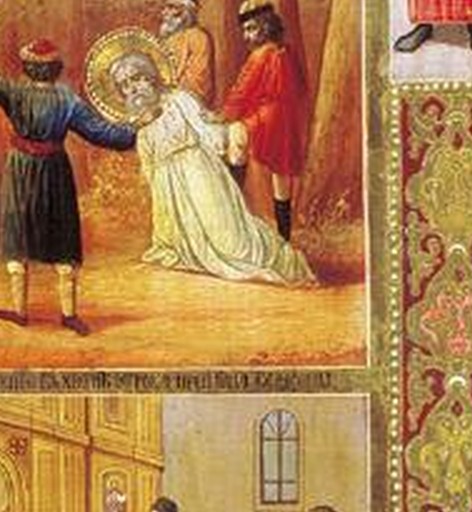
The Attack of the Robbers upon Venerable Seraphim — a panel from his Life
Icon: The Attack of the Robbers upon Venerable Seraphim — a panel from his Life · Panel from the Life, early 20th c.
10 · The Far Hermitage, Sarov Forest

The Attack of the Robbers

Once, when I was chopping wood in the forest, three men unknown to me, dressed as peasants, approached me and began demanding money, saying that worldly people came to me and brought money. I said to them: «I take nothing from anyone». They did not believe me; one of them rushed at me from behind, wishing to throw me to the ground, but fell himself. I, armed with an axe, could have defended myself, but I remembered the words of the Saviour: «All they that take the sword shall perish with the sword» (Mt. 26:52), — and did not wish to resist; I quietly laid the axe on the ground and said, folding my hands crosswise upon my breast: «Do what you need to do».

Then one of them, picking up my axe from the ground, struck me so hard on the head with the butt that blood gushed from my mouth and ears; I fell to the ground and lost consciousness. The evildoers dragged me to the porch of the cell, continuing to beat me furiously, some with the butt of the axe, some with a log; they bound my hands and feet and, having laid me on the porch, rushed into the cell themselves to look for riches, but found nothing except a holy icon and a little potato. Scarcely coming to my senses, I untied myself, thanked the Lord that I had been counted worthy to bear wounds innocently for His sake, and prayed that God would forgive the murderers; the next day with great difficulty I myself came to the monastery during the very Liturgy.

The doctors, having examined me, found that my head was fractured, my ribs broken, my chest crushed, and they marvelled that I remained alive; they wanted to bleed me, but in a dream the Most Holy Theotokos appeared to me in royal purple, with the Apostles Peter and John the Theologian, and turning to the doctors said: «Why do you labour?» — and to me: «This one is of our race». From this visitation I was filled with ineffable joy and began to recover. The peasants who had beaten me I forgave and I entreated the superior to impose no punishment upon them, saying that otherwise I would leave the Sarov monastery and depart to an unknown place.

Source — St Demetrius of Rostov, “Lives of the Saints”
On the 12th of September 1804 three men unknown to the elder approached him, dressed in peasant clothing. […] The peasants insolently came up to him and demanded money, saying that “worldly people come to you and bring money”. The elder said: “I take nothing from anyone”. But they did not believe him. Then one of those who had come threw himself upon him from behind, wishing to throw him to the ground, but instead he himself fell. […] Fr. Seraphim had great physical strength and, armed with an axe, could have defended himself not without hope. […] But at that moment he remembered the words of the Saviour: all they that take the sword shall perish with the sword (Mt. 26:52), and he did not wish to resist; he calmly lowered the axe to the ground and said meekly, folding his arms crosswise upon his breast: “Do what you need to do”. […] one of the peasants, picking up the axe from the ground, struck Fr. Seraphim so hard on the head with the butt that blood gushed from his mouth and ears. The elder fell to the ground and lost consciousness. The evildoers dragged him to the porch of the cell along the path, furiously continuing to beat him […] then they tied his hands and feet with ropes and, having laid him in the porch, rushed into the cell themselves, imagining that they would find untold riches in it […] they saw only a holy icon with him, and a few potatoes came to hand. […] Fr. Seraphim from the cruel mortal blows could scarcely come to his senses, somehow untied himself, thanked the Lord that he had been accounted worthy to bear wounds innocently for His sake, and prayed that God would forgive the murderers […] the next day with great difficulty, yet by himself, he came to the monastery during the very Liturgy. […] his head was broken, his ribs were smashed, his chest was trampled, and his whole body in various places was covered with mortal wounds. They marvelled how the elder could have remained alive after such a beating. […] The Most Holy Theotokos approached him from the right side of the bed, in a royal mantle… Behind her followed the holy Apostles Peter and John the Theologian. […] turning her most pure face to the side where the physicians stood, she pronounced: “Why do you labour?” Then again, turning her face to the elder, she said: this one is of our race […] Father Seraphim himself forgave them and entreated the superior to impose no punishment upon them. […] “Otherwise,” said Fr. Seraphim, “I shall leave the Sarov monastery and depart to other holy places unknown to anyone”.
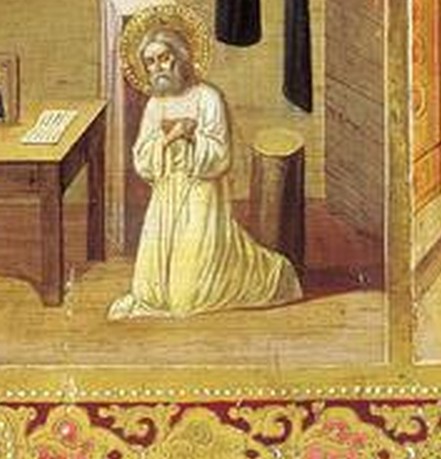
The prayer rule in the enclosure — a panel of the life
Icon: The prayer rule in the enclosure — a panel of the life · Panel of the life, early 20th c.
11 · Sarov Monastery, cell

Silence and Enclosure

After the death of the builder Isaiah I took upon myself the monastic labour of silence. Above all one must adorn oneself with silence, for, says Saint Ambrose of Milan, by silence he had seen many saved, but by much talking not one. If visitors came to me in the desert, I did not appear to them; if it happened that I unexpectedly met someone in the forest — I would fall with my face to the ground and would not raise my eyes until the one I had met had passed by. In this silence I remained for about three years.

In the spring, on the eighth of May, I entered the monastery gates after fifteen years’ sojourn in the desert and, having received a blessing from the builder Niphont, I settled in my former monastery cell: I received no one to myself, I myself went nowhere and spoke not a word with anyone. In my cell I wished to have nothing, not even the most necessary things: an icon before which a lampada burned, and a block of wood instead of a chair, comprised all my furnishing. To mortify the flesh I wore on my shoulders under my shirt a large iron cross on cords; my drink was water, and for food I used only oat flour and chopped white cabbage.

That I might never forget the hour of death, I asked that a coffin be made for me and placed in the porch of the enclosure cell; unpainted, it always stood there, and here I often prayed, preparing for my departure from this life — entreating the brethren to lay me in it when I should die. In the course of a week I read through the entire New Testament in order: on Monday the Gospel according to Matthew, on Tuesday according to Mark, on Wednesday according to Luke, on Thursday according to John, and on the remaining days the Acts and Epistles of the holy Apostles. Thus I spent about five years in the enclosure, and afterwards somewhat relaxed its strictness.

Source — St Demetrius of Rostov, “Lives of the Saints”
After the death of the builder Isaiah, remaining to dwell in the desert, the elder Seraphim took upon himself the monastic labour of silence. “Above all one must adorn oneself with silence,” he said, “for, says Saint Ambrose of Milan, by silence I have seen many saved, but by much talking not one.” […] if visitors came to him in the desert, he did not appear to them. If it happened that he himself unexpectedly met someone in the forest, the elder would fall with his face to the ground and would not raise his eyes until the one he had met had passed by. With this in view he preserved his silence for about three years. […] This was in the spring of the 8th of May 1810. Entering the monastery gates after fifteen years’ sojourn in the desert, Fr. Seraphim […] After coming out of the church, he directed his steps to the cell of the builder Niphont and, having received a blessing from him, settled in his former monastery cell; he received no one to himself, he himself went nowhere and spoke not a word with anyone […] In his cell, to cut off self-will, he wished to have nothing, not even the most necessary things. An icon before which a lampada burned, and a block of wood that served instead of a chair, comprised everything. […] he wore on his shoulders under his shirt a large five-vershok iron cross on cords […] His drink was only water, and for food he used only oat flour and chopped white cabbage. […] That he might never forget the hour of death, that he might more clearly imagine and see it closer before him, Fr. Seraphim asked that a coffin be made for him and placed in the porch of the enclosure cell. […] unpainted, it always stood in the porch. Here the elder often prayed, preparing for his departure from the present life. […] “when I die, I entreat you, brethren, lay me in my coffin”. […] In the course of a week he read through the entire New Testament in order: on Monday — the Gospel according to Matthew, on Tuesday — according to Mark, on Wednesday — according to Luke, on Thursday — according to John, on the remaining days — the Acts and Epistles of the holy Apostles. […] The elder spent about five years in the enclosure, then somewhat relaxed its outward form.
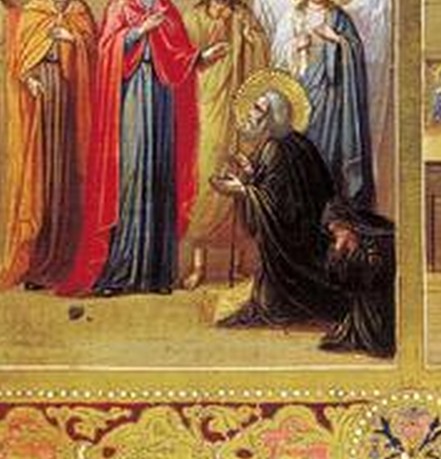
The appearance of heavenly guests to Venerable Seraphim — a panel of the life
Icon: The appearance of heavenly guests to Venerable Seraphim — a panel of the life · Panel of the life, early 20th c.
12 · Sarov Monastery, cell

Rapture to the Heavenly Mansions

Once, late in the evening, the God-loving brother, the monk John Tikhonov, visited me, desiring that I should tell him of the great mercy of God — how I was accounted worthy to be caught up into the heavenly abodes. I bolted the door behind him with a hook, and when he wished to entreat me to reveal this mystery to him, I stopped his mouth with my hand and said: «Guard thyself with silence». Then I began to unfold before him the history of the prophets, the apostles, the holy fathers and martyrs: all of them were like us in their passions, but by the exact fulfilment of Christ’s commandments they attained perfection, acquired grace and inherited the Kingdom of Heaven.

Behold, I, the wretched Seraphim, for this cause read the Gospel every day: on Monday I read from Matthew from the beginning to the end, on Tuesday from Mark, on Wednesday from Luke, on Thursday from John, and on the remaining days — the Acts and the Apostolic Epistles, and I omit not a single day. Through this not only my soul, but my very body is sweetened and vivified, because I converse with the Lord. My joy! I beseech thee, acquire a peaceful spirit, and then thousands of souls shall be saved around thee.

I was sweetened by the word of my Lord Jesus Christ: «In My Father’s house are many mansions» (Jn. 14:2). On these words I, the wretched one, paused and desired to behold those heavenly abodes, and the Lord did not deprive me of His mercy: He fulfilled my desire — I was indeed caught up into those heavenly abodes, only I know not whether with the body or apart from the body, God knoweth. But of that joy and sweetness of heaven which I tasted there, it is impossible to speak. If even this our cell were full of worms and if these worms were to eat our flesh throughout our temporal life, we should consent to it with every desire, only that we might not be deprived of that heavenly joy which God hath prepared for them that love Him.

Source — St Demetrius of Rostov, “Lives of the Saints”
The novice John Tikhonov (later the hieromonk Joasaph) relates it thus: «Once, already after Father Seraphim had come out of his seclusion, a certain God-loving brother visited me […] And so, after seeing the brother off and with impatience awaiting the evening hour, I set out at the usual time, about the sixth hour, to Father Seraphim […] The elder met me at my arrival like a loving father and, after me, bolted the door with a hook. […] he at once stopped my mouth with his hand, and his first word was: «Guard thyself with silence». […] he began to unfold before me the history of the Prophets, the Apostles, the Holy Fathers and Martyrs with his characteristic simplicity. He said that all the Saints whom the Church of Christ glorifies left us, after their departure, their life as an example for imitation and that all of them were like us in their passions, but by the exact fulfilment from the whole soul of Christ’s commandments they attained perfection and salvation, acquired grace, were accounted worthy of diverse gifts of the Holy Spirit and inherited the Kingdom of Heaven […] «Behold, I, the wretched Seraphim, for this cause read the Gospel every day. On Monday I read from Matthew from the beginning to the end, on Tuesday from Mark, on Wednesday from Luke, on Thursday from John; and on the remaining days I divide the Acts and the Apostolic Epistles and omit not a single day without reading the Gospel and the Apostle of the day and to the saint. Through this not only my soul, but my very body is sweetened and vivified, because I converse with the Lord» […] «My joy! I beseech thee, acquire a peaceful spirit and then thousands of souls shall be saved around thee». […] «I was sweetened by the word of my Lord Jesus Christ, where He said: In My Father’s house are many mansions, that is, for those who serve Him and glorify His holy Name. On these words of Christ the Saviour, I, the wretched one, paused and desired to behold those heavenly abodes, and the Lord did not deprive me, the wretched one, of His mercy, He fulfilled my desire and petition: behold, I was caught up into these heavenly abodes; only I know not whether with the body or apart from the body, God knoweth. This is unattainable. But of that joy and sweetness of heaven which I tasted there, it is impossible to tell thee». […] «If even this our cell (at this he pointed to his cell) were full of worms and if these worms were to eat our flesh throughout our temporal life, we should consent to it with every desire, only that we might not be deprived of that heavenly joy which God hath prepared for them that love Him».
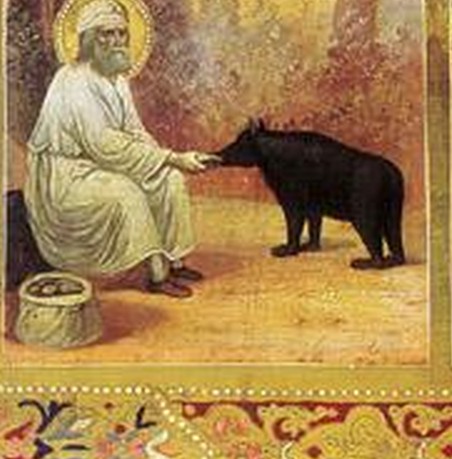
Venerable Seraphim Feeds the Bear — a panel from his Life
Icon: Venerable Seraphim Feeds the Bear — a panel from his Life · Panel from the Life, early 20th c.
13 · Near Hermitage · Diveyevo Convent

The Bear in the Near Hermitage

Once a sister came to me from the Diveyevo community who, through infirmity and the enemy’s temptation, had fallen into such despondency that she resolved to leave the convent altogether without a blessing: her obedience seemed to her beyond her strength. Foreseeing her sorrow, I sent word that she should come to me. When she came all in tears, I wiped away her tears with my handkerchief, saying: «Mother, thy tears fall not in vain upon the floor», and, leading her to the icon of the Queen of Heaven of Tenderness, I said: «Kiss it, mother, the Queen of Heaven will comfort thee». Then I bade her come in the morning to the Far Hermitage.

Approaching the Far Hermitage, she saw that I was sitting by my cell on a log, and beside me stood a bear of terrible size; she cried out in fear and fell. But I, striking the bear and waving my hand to him, sent him into the depths of the forest, approached her and said: «Be not terrified and be not afraid». She kept crying: «This is my death!» — but I answered: «No, mother, this is not death; death is far from thee, but this is joy». And I led her to that same log, seated her beside me, and at once the same bear came out of the forest and lay at my feet.

Seeing that she was gradually calming down, I fed the beast bread from my hands, and afterwards gave her the remaining piece and told her to feed him herself. She was afraid that he would bite off her hand, but I said: «Believe that he will not bite off thy hand». She fed him all the bread and was comforted. Then I said to her: «Dost thou remember, mother, how at the Jordan a lion served Venerable Gerasimus, and a bear serves the wretched Seraphim. Behold, even the beasts obey us, yet thou, mother, dost despond». And I forbade her to speak of this for many years.

Source — St Demetrius of Rostov, “Lives of the Saints”
Having entered the Diveyevo community, I came, with the blessing of Father Seraphim, to the obedience of preparing food for the sisters. […] I fell into such confusion and despondency that I resolved to leave the monastery altogether in a quiet manner, without a blessing: to such a degree did this obedience seem difficult and unbearable to me. Without doubt, Fr. Seraphim foresaw my temptation, for he suddenly sent to tell me that I should come to him. […] Then Fr. Seraphim wiped away my tears with his handkerchief, saying: «Mother, thy tears do not fall to the ground in vain»; and then, leading me to the icon of the Queen of Heaven of Tenderness, he said: kiss it, mother, the Queen of Heaven will comfort thee. […] «Now, mother, go to the guesthouse, and tomorrow come to the distant hermitage». […] Approaching the distant hermitage, I suddenly saw that Fr. Seraphim was sitting near his cell on a log, and beside him stood a bear of terrible size. I froze with fear and cried out at the top of my voice: «Father, my death!» — and fell. Father Seraphim, hearing my voice, struck the bear and waved his hand at it. Then the bear, as if understanding, immediately went in the direction in which Fr. Seraphim had waved, into the depths of the forest. […] When Father Seraphim came up to me with the words: «Be not afraid and be not terrified», I continued to cry as before: «Oh, my death!» To this the elder replied: «No, mother, this is not death; death is far from thee; but this is joy». […] He led me to the same log on which he had sat before, and having prayed, seated me upon it and sat down himself! We had scarcely sat down when suddenly the same bear came out of the depths of the forest and, approaching Father Seraphim, lay down at his feet. […] Seeing that Father Seraphim dealt with him without any fear, as with a meek lamb, and even fed him bread from his own hands […] he gave me the remaining piece and told me to feed the bear myself. But I answered: «I am afraid, father, he will bite off my hand». Father Seraphim, looking at me, smiled and said: «No, mother, believe that he will not bite off thy hand». Then I took the bread given to me and fed it all to him. […] «Dost thou remember, mother, how with the Venerable Gerasimus on the Jordan a lion served, and to the poor Seraphim a bear serves. Behold, even the beasts obey us, and thou, mother, dost despond […] remember not to tell this to anyone for eleven years after my death».
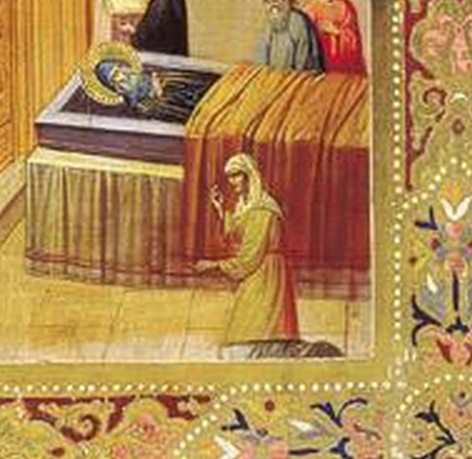
The Repose of Venerable Seraphim — a panel from the life
Icon: The Repose of Venerable Seraphim — a panel from the life · Panel from the life, early 20th c.
14 · Sarov Hermitage

Repose

On the first of January I came for the last time to the hospital church, placed candles myself before all the icons and venerated them — something not previously noticed in me — then I received Communion, according to custom, of the Holy Mysteries of Christ. At the end of the Liturgy I took leave of all the brethren who were praying, blessed everyone and, comforting them, said: «Save your souls, do not despond, keep watch: crowns are being prepared for us this day». I had the custom of leaving lit candles burning from the morning before the icons in my cell; Brother Paul more than once told me that a fire might break out from them, but I answered him: «While I am alive, there will be no fire; but when I die, my end will be revealed by a fire».

And so it came to pass. On the second of January, at about the sixth hour of the morning, Brother Paul, going to the early Liturgy, sensed in the porch near my cell the smell of smoke; the door was locked from within with a hook, and there was no answer to his prayer. One of the brethren tore the door off the hook: some canvas items and books on the bench were smouldering, probably from candle drippings, but there was no flame. Brother Paul and the novice John, wishing to make certain whether I was resting, began in the darkness to feel about the cell and found me: I was kneeling in my usual place of prayer before the icon of the Mother of God of Tenderness, with uncovered head, with a brass crucifix on my breast, with my hands crossed upon my chest. My body was still warm, but no one could any longer awaken me to life: I had finished my ascetic course.

According to my will they placed me in an oak coffin, with an enamel image of Venerable Sergius that had been sent to me by the honourable Archimandrite Anthony, the abbot of the Lavra, and for eight days my body lay uncovered in the Dormition Cathedral. The burial was performed by Abbot Niphont; they committed me to the earth on the right side of the cathedral altar, beside the grave of Mark the Recluse. As the Life relates, soon afterwards an officer travelling through Kursk found my brother Alexis already at the point of death: not long before, while still alive, I had said to him: «Know that when I die, thy end also will soon follow», — and so it came to pass.

Source — St Demetrius of Rostov, “Lives of the Saints”
On January 1, 1833, on the Lord’s Day, Father Seraphim came for the last time to the hospital church dedicated to the holy Zosimas and Savvaty. He himself placed candles before all the icons and venerated them, which had not been noticed in him before; then he received Communion, according to custom, of the Holy Mysteries of Christ. At the end of the Liturgy, he took leave of all the brethren who were praying there, blessed them all, kissed them, and, comforting them, said: «Save yourselves, do not lose heart, watch: crowns are being prepared for us this day». […] The Elder Seraphim had the custom, when leaving the monastery for his hermitage, of leaving burning in his cell the candles that had been lit in the morning before the icons. […] Father Seraphim always replied to this: «While I am alive, there will be no fire; but when I die, my end will be revealed by fire». And so it came to pass. […] On the second day of January, at about the sixth hour of the morning, the brother Paul, coming out of his cell to the early Liturgy, sensed in the vestibule near Father Seraphim’s cell the smell of smoke. Having made the usual prayer, he knocked at the door of Father Seraphim, but the door was fastened from within with a hook, and there was no answer to the prayer. […] the novice Anikita, rushing to Father Seraphim’s cell and, feeling that it was locked, with a strong effort tore it off the inner hook. […] It was they that were smouldering, probably from the candle snuff or from a fallen candle […] There was no flame, but only the things and some books were smouldering. […] Brother Paul and the novice John, who had come from church, wishing to make sure whether the Elder was resting, began in the darkness to feel about the small space of his cell, and found him himself. […] they saw that the Elder, in his usual white habit, was standing on his customary place of prayer before the icon of the Theotokos of Tenderness, on his knees, with uncovered head, with a brass Crucifix on his breast, with his hands crossed on his chest […] The body of the Elder was warm, as though his spirit had only that very moment left its dwelling. But no one could now awaken him to life […] They thought that he had fallen asleep; they began cautiously to rouse him – but there was no answer: the Elder had finished his ascetic life. […] The body of Father Seraphim was placed in the coffin, according to his testament, with the enamel image of Venerable Sergius received from the Trinity-Sergius Lavra. […] his body for the space of eight days stood open in the Dormition Cathedral. […] The burial of Father Seraphim was performed by Abbot Niphon. His body was committed to the earth on the right side of the altar of the cathedral, beside the grave of Mark the recluse. […] an officer, Mr. Karat-v, who was setting out for the Kursk province, to his regiment, stopped at Sarov […] «The news of his repose», he said, «troubled all my soul» […] Upon arriving in Kursk, Mr. K-v at once went to the relatives of Father Seraphim and found his brother Alexis already dead: he had only just reposed. […] he, being once in Kursk, had foretold to his brother of his end in such words, which have come down to us: «Know that when I die, your end also will soon follow».
The Church sings

Troparion, tone 4

From your youth you loved Christ, O blessed one, / and you ardently desired to work for Him alone, / you labored with unceasing prayer and labor in the desert, / with a tender heart having acquired the love of Christ,/ the chosen one is beloved of God, you appeared to the Mother./ For this reason, we cry out to you: save us with your prayers, Seraphim, like our Father.

The life in the border scenes of the icon
Venerable Seraphim of Sarov с клеймами жития
Hagiographical icon of Venerable Seraphim of Sarov with his Life in 12 border scenes. Late 19th – early 20th century; private collection, photograph from Wikimedia Commons (PD-Art licence). Public domain. Captions to the border scenes follow the order of subjects on the icon.
Prayers to Venerable Seraphim of SarovSt Dimitry of Rostov, “Lives of the Saints”, in our libraryAll lives