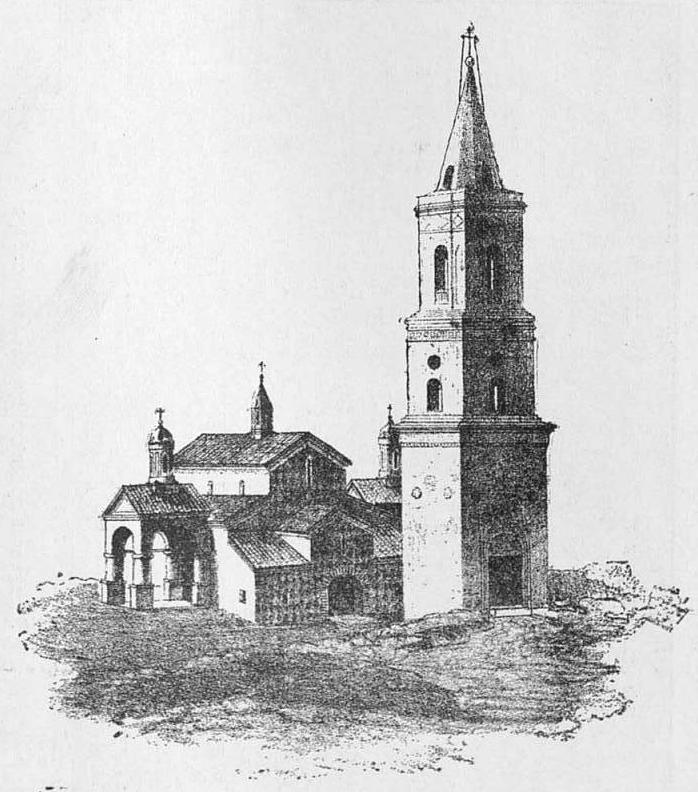
I was born in Cappadocia and was the only daughter of noble and pious parents: the Roman general Zabulon, a kinsman of the holy Great-Martyr George, and Susanna, sister of the Patriarch of Jerusalem.
At the age of twelve I came with my parents to the holy city of Jerusalem. Here my father Zabulon, burning with love for God and desiring to serve Him with monastic labours, with the consent of his wife received a blessing from the blessed Patriarch of Jerusalem; then, bidding me, his young daughter, farewell with tears and entrusting me to God, the Father of orphans and Protector of widows, he departed and hid himself in the Jordanian desert. And the place of his ascetic labours remained unknown to all, as did the place of his death.
My mother Susanna was appointed by her brother the patriarch as a deaconess at the holy temple, to serve poor and sick women; as for me, I was given to be raised by a certain pious elderly woman, Nianphora. After the passage of only two years, with the help of the grace of God, I came to understand and firmly assimilate the rules of faith and piety. Every day with zeal and prayer I read the Divine Scriptures, and my heart burned with love for Christ, the Son of God, Who endured cross-bearing sufferings and death for the salvation of mankind.

When with tears I read the Gospel accounts of the crucifixion of Christ the Saviour and of all that took place at His Cross, my thought paused upon the fate of the Robe of the Lord. «Where now is this earthly purple of the Son of God? – I asked my instructress. – It cannot be that so great a holy thing has perished upon the earth».
Then Nianphora told me what she herself knew from tradition: that to the north-east of Jerusalem there is the land of Iberia and in it the city of Mtskheta, and that it was thither that the Robe of Christ was taken by the soldier to whom it fell by lot at the crucifixion of Christ (Jn. 19:24). Nianphora added that the inhabitants of that land, called Kartvelians, as well as the Armenians neighbouring them and many mountain tribes, still remain immersed in the darkness of pagan delusion and impiety.
These accounts of the elder sank deeply into my heart. Days and nights I spent in fervent prayer to the Most Holy Theotokos and Virgin, that She might vouchsafe me to see the Iberian land, to find and kiss the Robe of Her beloved Son, the Lord Jesus Christ, woven by the fingers of Her, the Theotokos, and to preach the holy name of Christ to the peoples there who knew Him not.

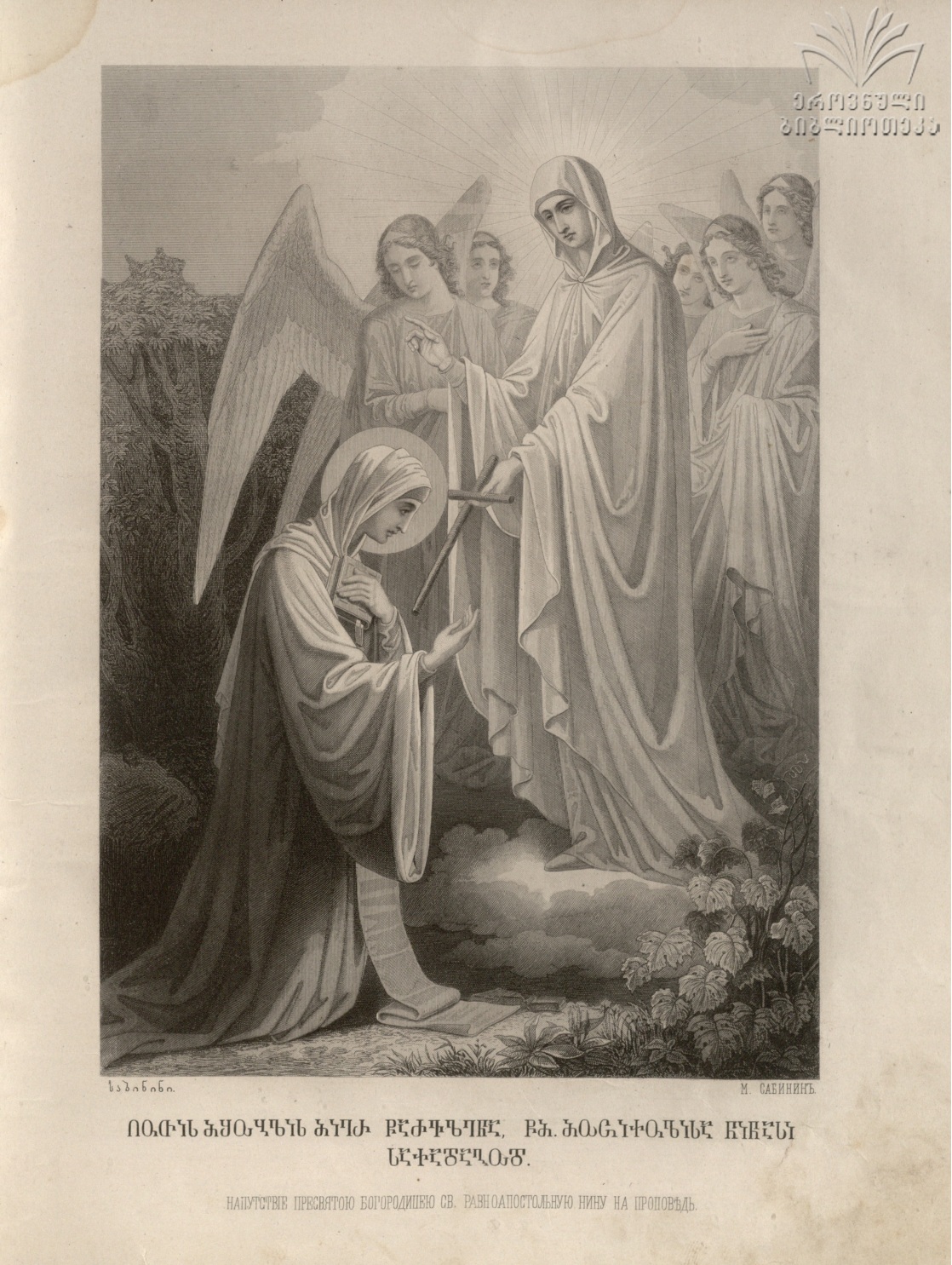
The Most Holy Theotokos Virgin heard my prayer. She appeared to me in a dream vision and said: «Go to the land of Iberia, preach there the Gospel of the Lord Jesus Christ, and you will find favour before His Face; I will be your Protectress». «But how, – I asked, a humble maiden, – shall I, a weak woman, be able to accomplish so great a ministry?»
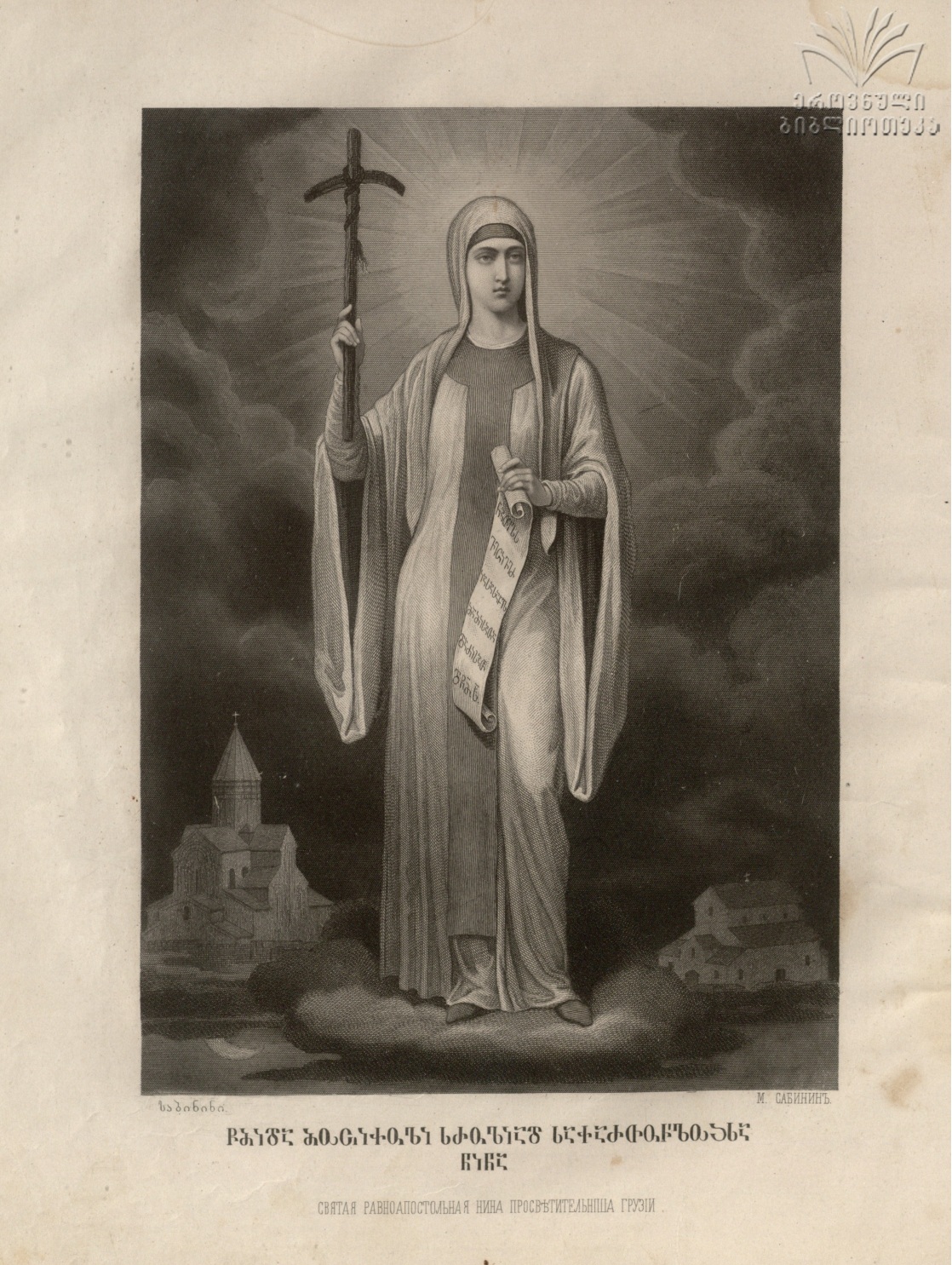
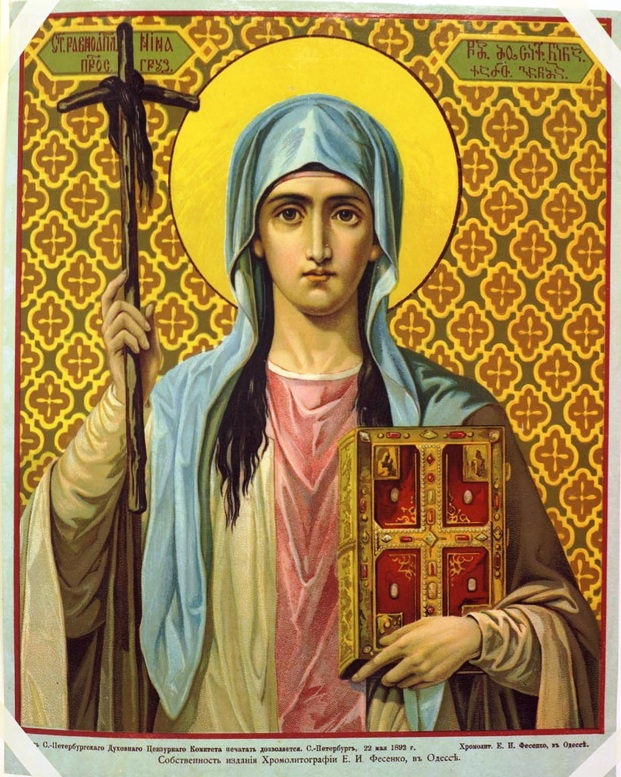
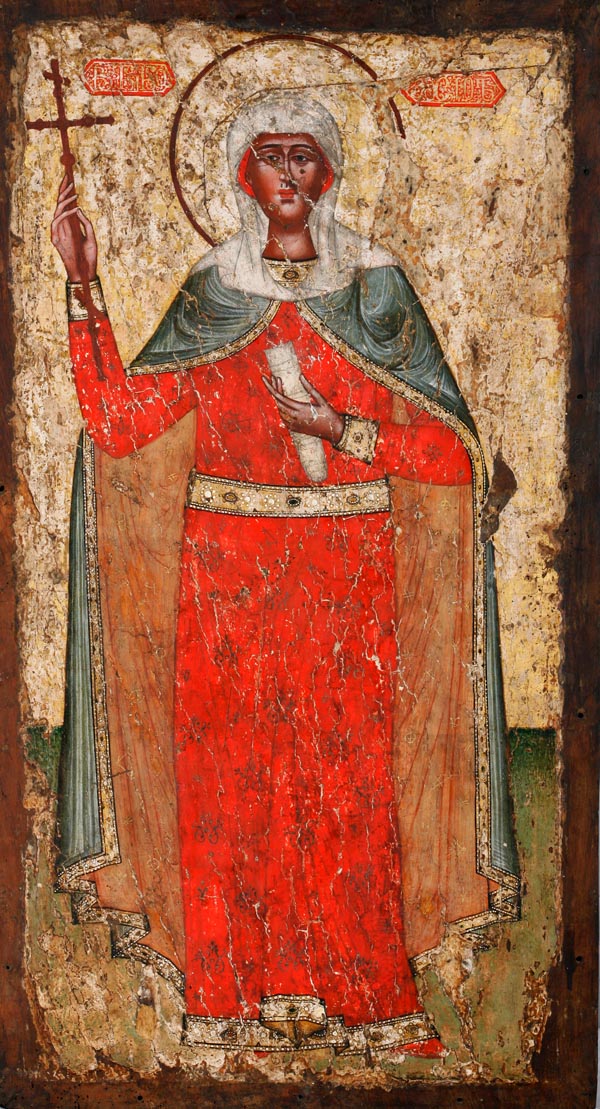
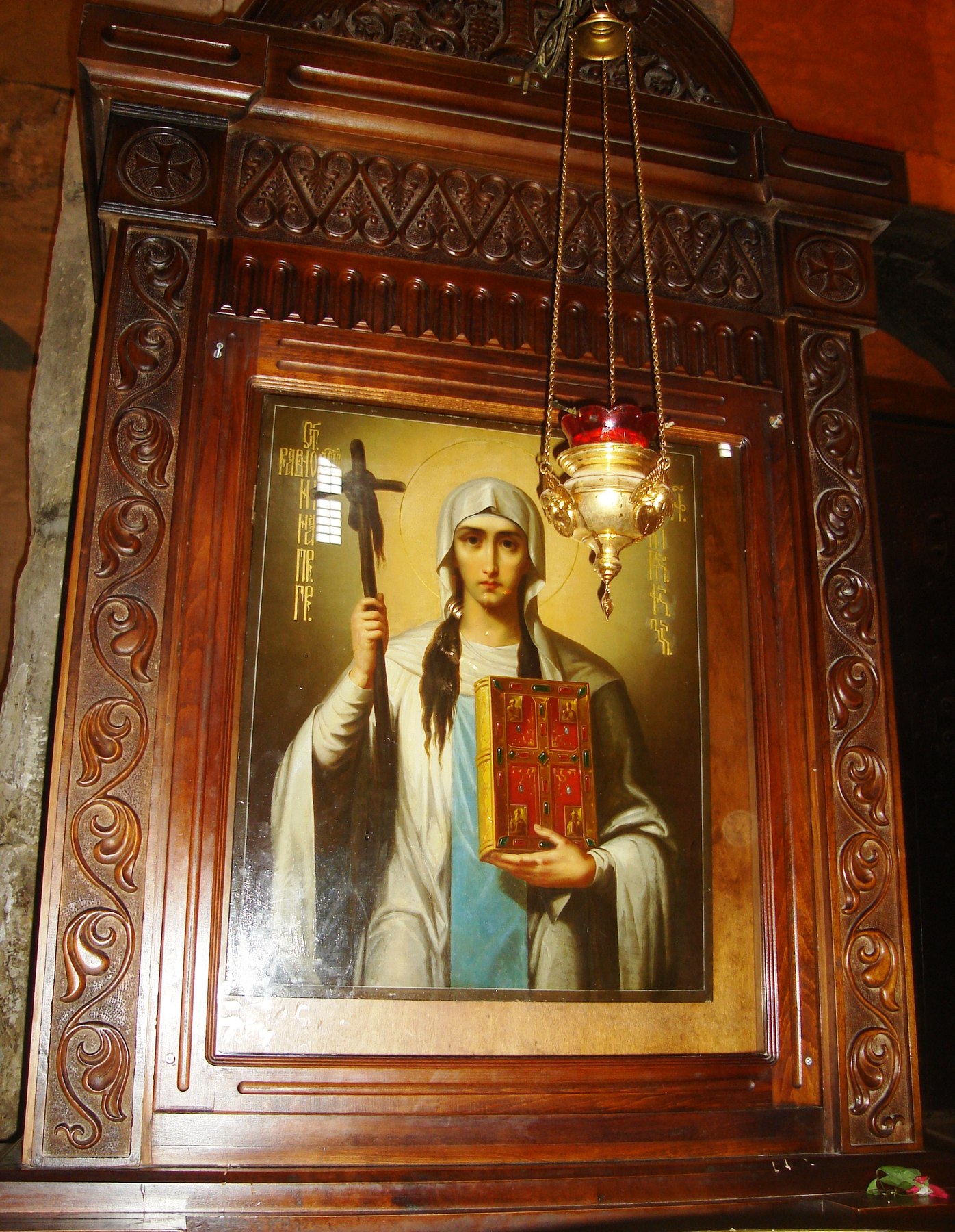
In answer to this the Most Holy Virgin, handing me a cross woven of grapevines, said: «Take this cross. It shall be for you a shield and rampart against all visible and invisible enemies. By the power of this cross you will plant in that land the saving banner of faith in My beloved Son and Lord». «Who desires all men to be saved and to come to the knowledge of the truth» (1 Tim. 2:4).
Awakening and seeing in my hands the wondrous cross, I began to kiss it with tears of joy and exultation; then I bound it with my hair and went to my uncle the patriarch. When the blessed patriarch heard from me of the appearance to me of the Mother of God and of the command to go to the Iberian land to preach the Gospel, seeing in this a clear expression of the will of God, he did not hesitate to give me, a young virgin, his blessing to go forth to the labour of evangelism.
When the time came that was convenient for setting out on the distant journey, the patriarch brought me into the temple of the Lord to the holy altar and, laying his hierarchal hand upon my head, prayed: «O Lord God, our Saviour! Sending forth this orphan maiden to preach Thy Divinity, I commit her into Thy hands. Deign, O Christ God, to be her Companion and Guide everywhere she shall preach of Thee».

At that time fifty-three virgin companions set out from the holy city to Armenia together with a certain princess, Rhipsime, and their instructress Gaiane. They were fleeing from ancient Rome from the persecution of the impious emperor Diocletian, who wished to marry the princess Rhipsime, although she had given a vow of virginity and had betrothed herself to the Heavenly Bridegroom Christ. I reached the borders of Armenia and the capital city of Vagharshapat together with these holy virgins. We settled outside the city, under a shelter built over a winepress, and obtained our food by the labour of our hands.
Soon the cruel Diocletian learned that Rhipsime was hiding in Armenia. He sent a letter to the Armenian king Tiridates, then still a pagan, that he should find Rhipsime and send her to Rome or, if he wished, take her to wife, for she was, he wrote, exceedingly beautiful. The servants of Tiridates soon found Rhipsime, and when the king saw her, he declared to her that he desired to have her as his wife. But she boldly said to him: «I am betrothed to the Heavenly Bridegroom Christ; how then, O impious one, will you dare to touch the bride of Christ?»
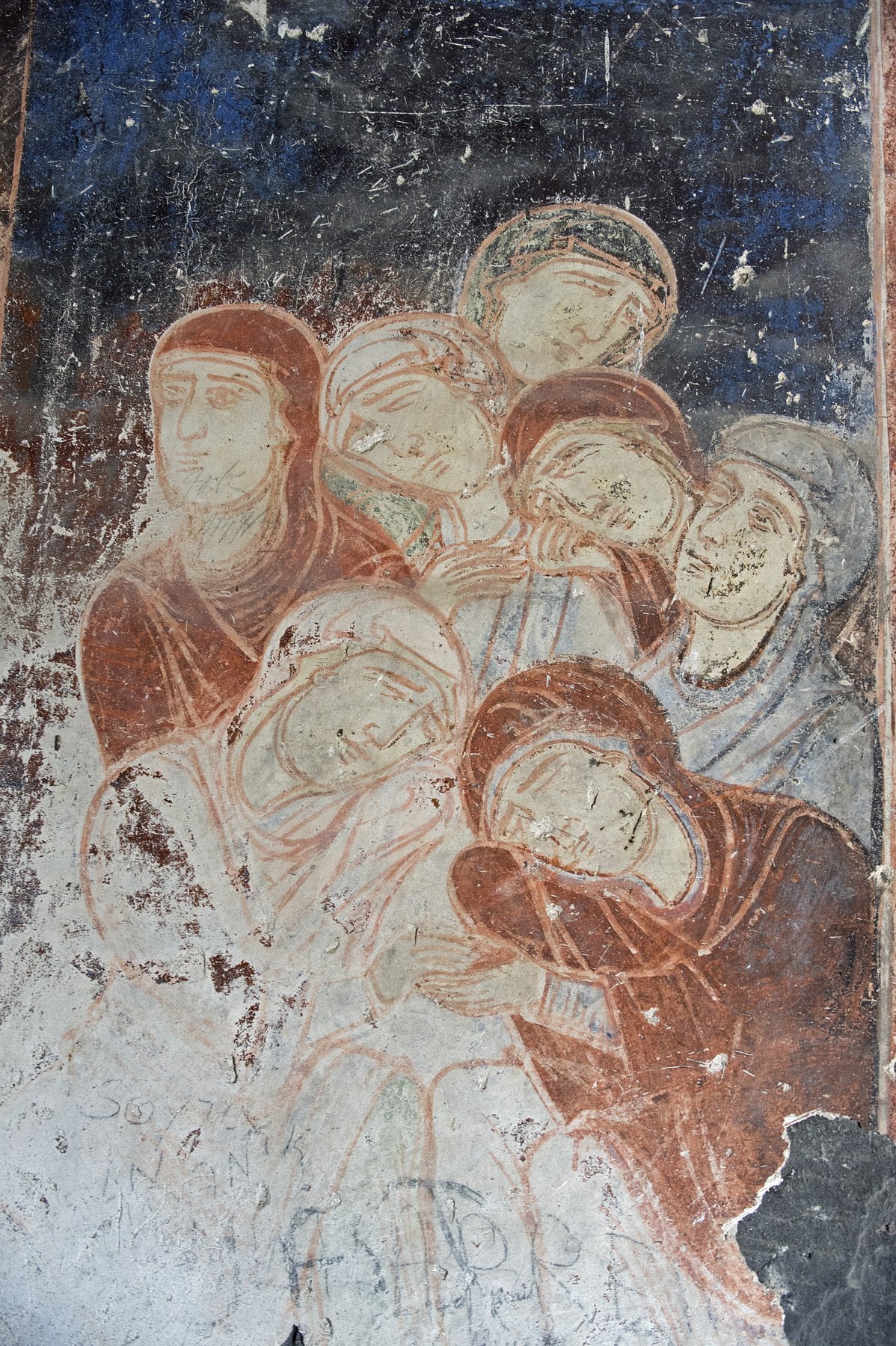
The impious Tiridates, stirred by bestial passion, anger and shame, gave orders to subject her to tortures. After many and cruel torments they cut out the tongue of Rhipsime, gouged out her eyes and cut her whole body into pieces. Exactly the same fate befell all her companions and their instructress Gaiane. Only I was saved from death in a miraculous manner: guided by an invisible hand, I hid in the bushes of a wild rose that had not yet blossomed.

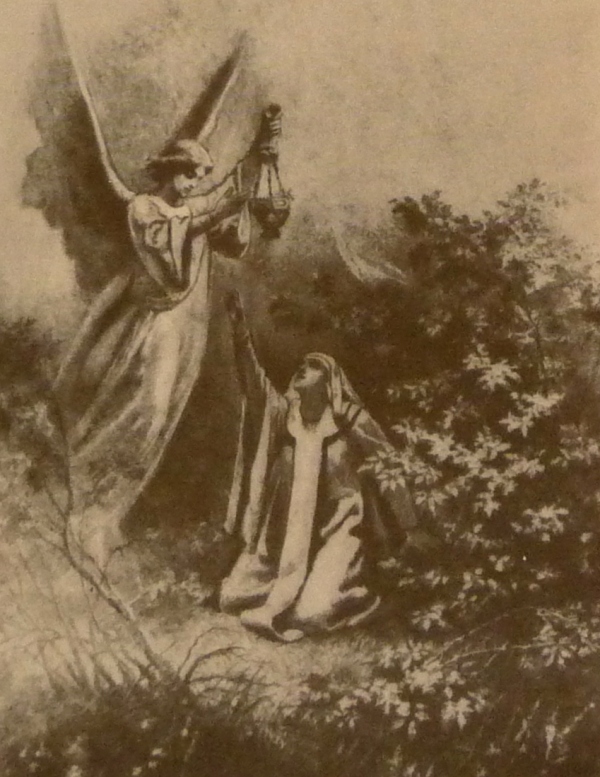
Shaken with fear at the sight of the fate of my companions, I lifted up my eyes to heaven with prayer for them and saw above a light-bearing Angel, girded with a luminous orarion. With a fragrant censer in his hands, accompanied by a multitude of the heavenly host, he was descending from the heavenly heights; and from the earth – as though to meet him – the souls of the holy martyrs were ascending, who joined the assembly of the radiant heavenly ones and together with them were taken up into the heavenly heights.
Seeing this, I cried out with sobbing: «Lord, Lord! Why then do You leave me alone among these vipers and asps?» In answer to this the Angel said to me: «Do not grieve, but wait a little, for you too shall be taken into the Kingdom of the Lord of glory; this shall be when the thorny and wild rose that surrounds you becomes covered with fragrant flowers, like a rose planted and cultivated in a garden. Now arise and go to the north, where there is a great harvest, but no reapers» (Lk. 10:2).

At the command of the Angel I set out alone on the further journey and, after a long journey, came to the bank of a river unknown to me, near the village of Khertvisi. This river was the Kura, which, flowing from the west to the southeast as far as the Caspian Sea, waters all the central part of Iberia. On the bank I met shepherds of sheep, who gave a little food to the traveler wearied by the length of the road. These people spoke in the Armenian dialect; I understood the Armenian language – the elder Nianfora had acquainted me with it. I asked one of the shepherds where the city of Mtskheta was. He answered: «Along the banks of this river, far downstream, stands the great city of Mtskheta, in which our gods hold sway and our kings reign».
Continuing on my way, I once sat down, wearied, upon a stone and began to ponder where the Lord was leading me. Amid such thoughts I fell asleep in that place and saw a dream: there appeared to me a man of majestic appearance; his hair fell upon his shoulders, and in his hands he held a book-scroll written in Greek. Unrolling the scroll, he gave it to me and commanded me to read it, then suddenly became invisible.
Awakening and seeing the wondrous scroll in my hand, I read in it: «There is neither male nor female: for you are all one in Christ Jesus» (Gal. 3:28); «Go therefore and make disciples of all nations, baptizing them in the name of the Father and of the Son and of the Holy Spirit, and lo, I am with you always, even to the end of the age. Amen» (Mt. 28:19–20).
Strengthened by this divine vision, I continued my journey with enthusiasm and renewed zeal. Having overcome heavy labors, hunger, thirst and fear of wild beasts, I reached the ancient Kartlian city of Urbnisi, in which I remained about a month, living in Jewish houses and studying the manners, customs and language of the people new to me.

Learning one day that all the men of this city, as well as those who had come from the surrounding areas, were gathering to go to the capital city of Mtskheta to worship their false gods, I too set out there with them. As we approached the city, we met near Pompey’s bridge the procession of King Mirian and Queen Nana; accompanied by a great crowd of people, they were heading to a mountain summit opposite the city in order to perform there worship of a soulless idol called Armaz.
Carried along by the crowd, I went to the mountain, to the place where the idolatrous altar stood, and saw the chief idol Armaz. He was in appearance like a man of extraordinarily great stature; wrought of gilded copper, he was clad in a golden breastplate, with a golden helmet on his head; one of his eyes was a ruby, the other was made of emerald. To the right of Armaz stood another small golden idol, named Gatsi, and to the left a silver idol, named Gaim. The whole crowd of people, together with their king, stood in senseless reverence before their gods, while the priests made preparations for offering bloody sacrifices. When the incense was kindled, the sacrificial blood flowed, the trumpets and timbrels thundered, the king and the people fell on their faces to the ground before the soulless statues.
Then the heart of the Prophet Elijah burned with zeal within me. Sighing from the depth of my soul and raising my eyes with tears to heaven, I began to pray: «Almighty God! Bring this people, according to the multitude of Your mercy, to the knowledge of You, the only true God. Scatter these statues, as the wind scatters dust and ashes from the face of the earth. Deign, O Lord, to let my eyes see the final destruction of the proudly standing idols here».
I had not yet finished this prayer when suddenly storm clouds rose from the west and swiftly rushed along the course of the Kura River. Noticing the danger, the king and the people turned to flight; I took shelter in a rocky cleft. The cloud with thunder and lightning burst over the place where the idolatrous altar stood. The proudly towering idols were smashed to dust, the walls of the temple were destroyed, torrents of rain cast them into the abyss, and the waters of the river carried them downstream; not a trace remained of the idols or the temple. I, preserved by God, stood unharmed in the rocky cleft and calmly watched as the elements subsided and the radiant sun shone again from heaven. And all this took place on the day of the glorious Transfiguration of the Lord.

Long after that I entered, in the guise of a wanderer, the city of Mtskheta, calling myself a captive. When I was heading to the royal garden, the gardener’s wife, Anastasia, quickly came out to meet me, as though to an acquaintance long expected. Bowing to me, she led me into her house and then, having washed my feet and anointed my head with oil, offered me bread and wine. Anastasia and her husband entreated me to remain living with them in the house as a sister, for they were childless and grieved over their solitude. Later, at my desire, Anastasia’s husband built for me a small tent in the corner of the garden. Placing in this tent the cross given to me by the Theotokos, I spent there days and nights in prayers and the singing of psalms.
From this tent began the bright series of my labors and miracles performed to the glory of Christ’s Name. The first acquisition of Christ’s Church in Iberia was the honorable married couple who had sheltered the handmaid of Christ: at my prayer Anastasia was freed from her barrenness and later became the mother of a numerous and happy family, and the first woman who believed in Iberia in Christ before the men.
One woman with loud weeping carried through the streets of the city her dying child, calling on everyone for help. Taking the sick child, I laid him on my bed made of leaves; having prayed, I placed upon the little one my cross of grapevines and then returned him alive and healthy to his weeping mother. From that time I began openly and publicly to preach the Gospel and to call the Iberian pagans and Jews to repentance and faith in Christ.

Many – and especially the Jewish women – began to come to me often, to hear from my lips the new teaching about the Kingdom of God and eternal salvation, and they began secretly to accept faith in Christ. Such were Sidonia, the daughter of the high priest of the Kartlian Jews, Aviathar, and six other Jewish women. Soon Aviathar himself also believed in Christ – after he had heard my explanations of the ancient prophecies concerning Jesus Christ and how they were fulfilled in Him as the Messiah.
Often conversing with this Aviathar, I heard from him the account of the Lord’s tunic. He said: «I heard from my parents, and they had heard from their fathers and grandfathers, that when Herod reigned in Jerusalem, the Jews living in Mtskheta and throughout the Kartlian land received news that Persian kings had come to Jerusalem seeking the newborn Child. Thirty years passed after this, and then my great-grandfather Elios received a letter from Jerusalem from the high priest Annas. Elios, together with Longinus of Kareni, came to Jerusalem and was present at the crucifixion of Christ. His mother, however, remained in Mtskheta. On the eve of Pascha she suddenly felt in her heart as it were the strokes of a hammer driving in nails, and she cried aloud: «The kingdom of Israel has perished today, for they have put to death its Saviour and Deliverer». Having said this, she died.
Elios, who had been present at the crucifixion of Christ, acquired His tunic from the Roman soldier to whom it had fallen by lot, and brought it to Mtskheta. Elios’s sister, Sidonia, greeting her brother on his safe return, told him of the sudden death of their mother and her last words. When Elios showed his sister the Lord’s tunic, Sidonia took it, began to kiss it with tears, pressed it to her breast, and immediately fell dead. And no human power could wrest this sacred garment from the hands of the deceased. Elios committed his sister’s body to the earth and buried with her also the tunic of Christ, and he did this so secretly that even to this day no one knows the place of Sidonia’s burial».

Queen Nana fell gravely ill; and the more efforts the physicians made, the stronger the disease became, so that she was at the point of death. The women close to her began to entreat her to summon the stranger Nina, who by prayer alone to the God she preached heals every infirmity. The queen ordered that I be brought to her; testing the queen’s faith and humility, I said to those sent: «If the queen wishes to be well, let her come to me here in this tent, and I believe that she will receive healing here by the power of Christ, my God». The queen obeyed and ordered that she be carried on a litter to my tent. I, having arranged for the sick woman to be laid on my leafy bed, knelt and prayed fervently to the Lord, the Physician of souls and bodies; then, taking my cross, I placed it on the head of the sick woman, on her feet and on both shoulders, and signed her with the sign of the Cross. As soon as I had done this, the queen at once rose from her bed of sickness healed, and giving thanks to the Lord Jesus Christ, there before me and the people, and later at home before her husband King Mirian, she loudly confessed that Christ is the true God.
But King Mirian still delayed openly to confess Christ as God, and instead strove to be a zealous idolater; once he even resolved to destroy the confessors of Christ and me with them. Agitated by such hostile thoughts, he set out for the Mukhran forests to distract himself with hunting and said to his companions: «We have brought upon ourselves the terrible wrath of our gods because we have allowed the Christian sorcerers to preach their faith in our land. However, I shall soon destroy with the sword all who worship the Cross and the One crucified upon it».
With these words the king ascended to the summit of the steep Mount Tkhot’i. And suddenly the bright day turned into impenetrable darkness, and a storm arose like that which had overthrown the idol of Armaz; the flash of lightning blinded the king’s eyes, the thunder scattered all his companions. In despair the king began to cry out for help to his gods, but they gave no voice; feeling over himself the punishing hand of the Living God, the king cried out: «God of Nina! Dispel the darkness before my eyes, and I will confess and glorify Thy name!» And at once it became light all around, and the storm ceased.
The king, turning his face to the east, raised his hands to heaven and with tears cried out: «God, whom Thy handmaid Nina preaches! Thou alone art truly God above all gods. On this place I will erect the tree of the Cross, that the sign shown to me by Thee today may be remembered for all time!» The king sought me and asked: «Where is that stranger, whose God is my Deliverer?» The king and the queen who came out to meet him arrived at my tent and, seeing me, fell at my feet; the king exclaimed: «O my mother! Teach me and make me worthy to call upon the name of thy great God, my Saviour!»

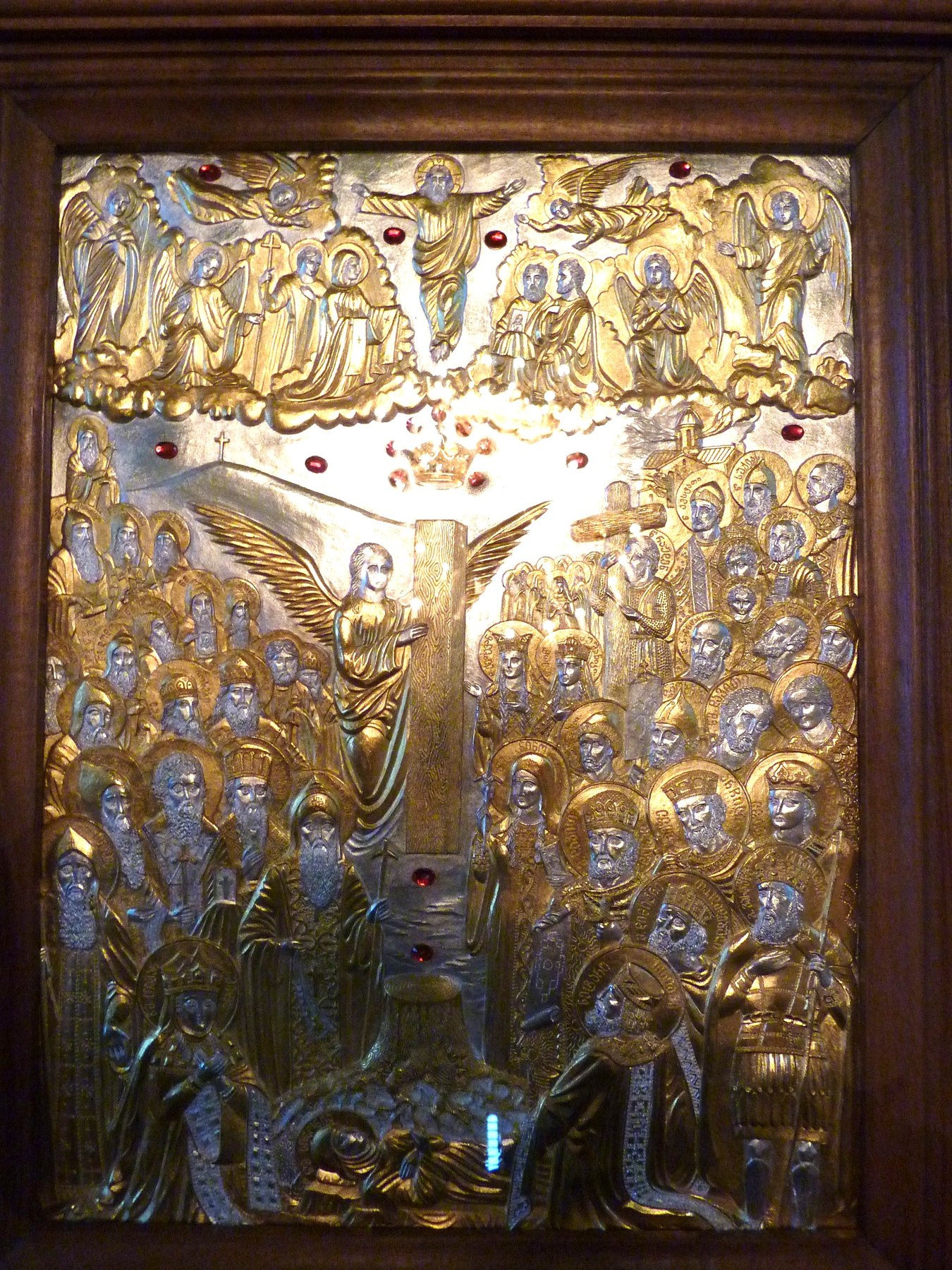
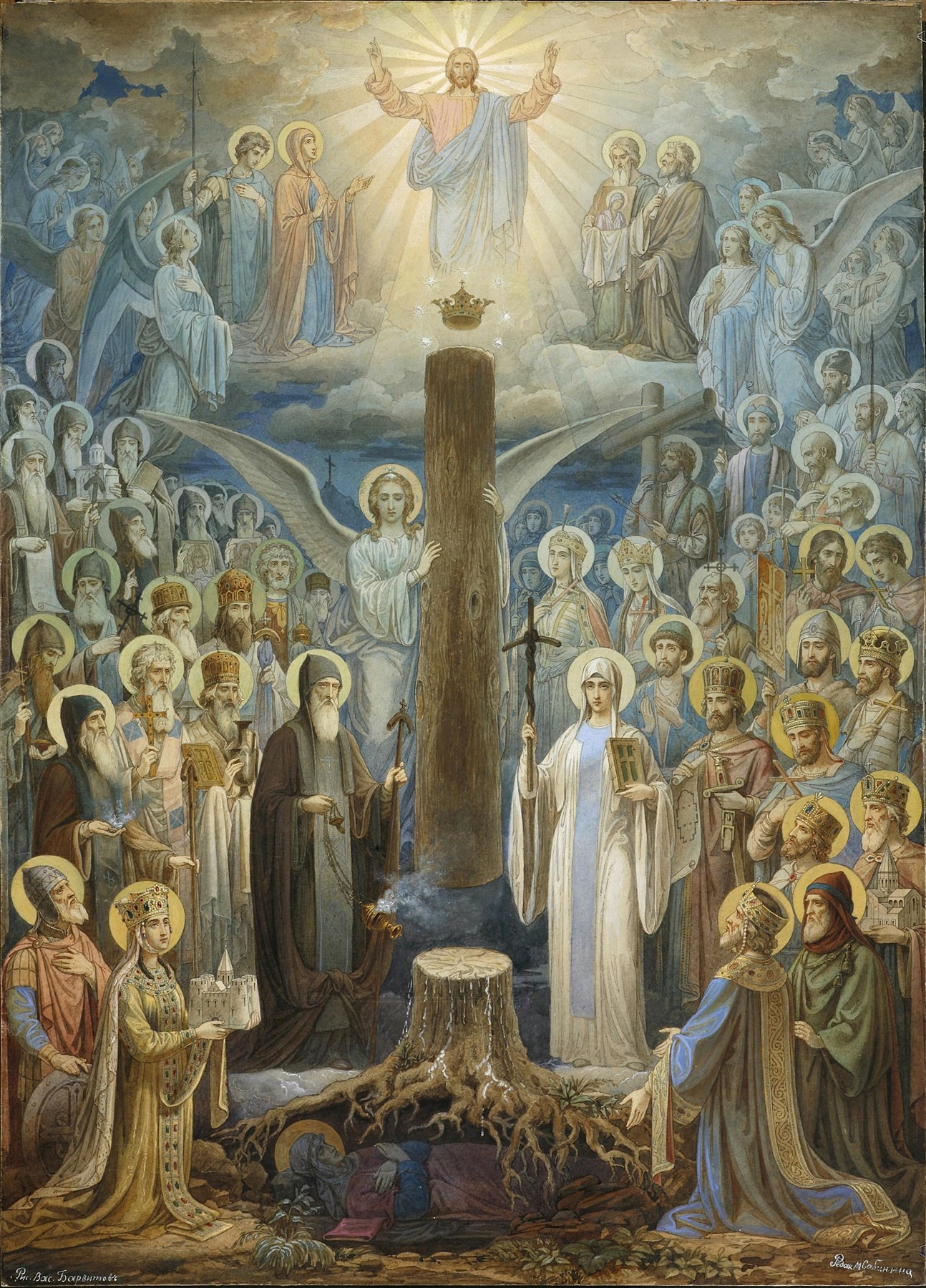
Mirian sent envoys to Greece to King Constantine with a request to send him a bishop and priests. The king desired even before the arrival of the priests to build a temple of God and chose for this a place according to my indication, in his garden, where the great cedar stood, saying: «Let this perishable and transient garden be turned into an incorruptible and spiritual garden, bringing forth fruits unto life eternal!» The cedar was felled, and from its six branches six pillars were hewn, which were set without any difficulty in the places appointed for them. But when the carpenters wished to raise the seventh pillar, hewn from the trunk of the cedar itself, in order to set it as the foundation of the temple, all were amazed, for by no force was it possible to move it from its place.
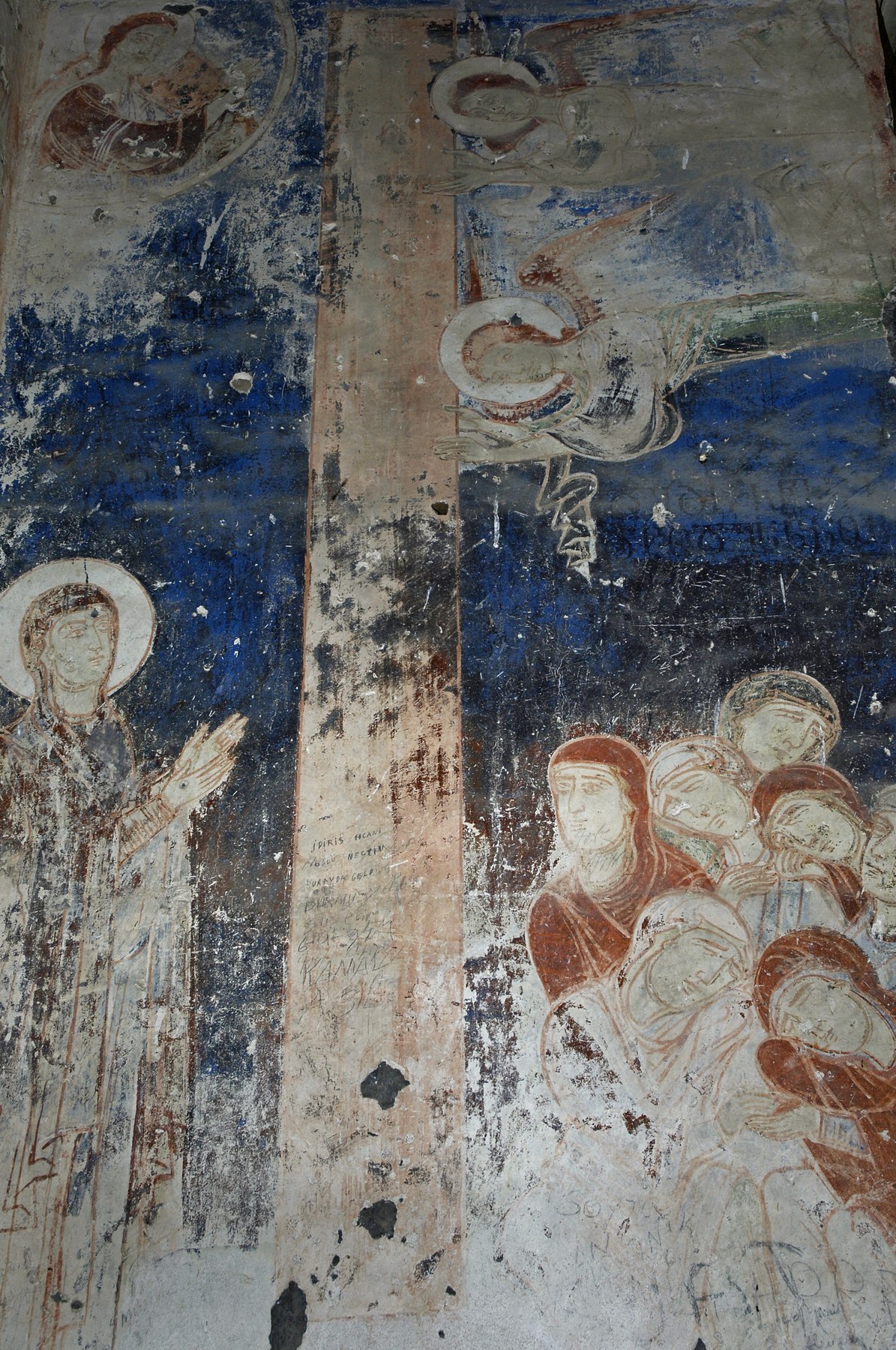
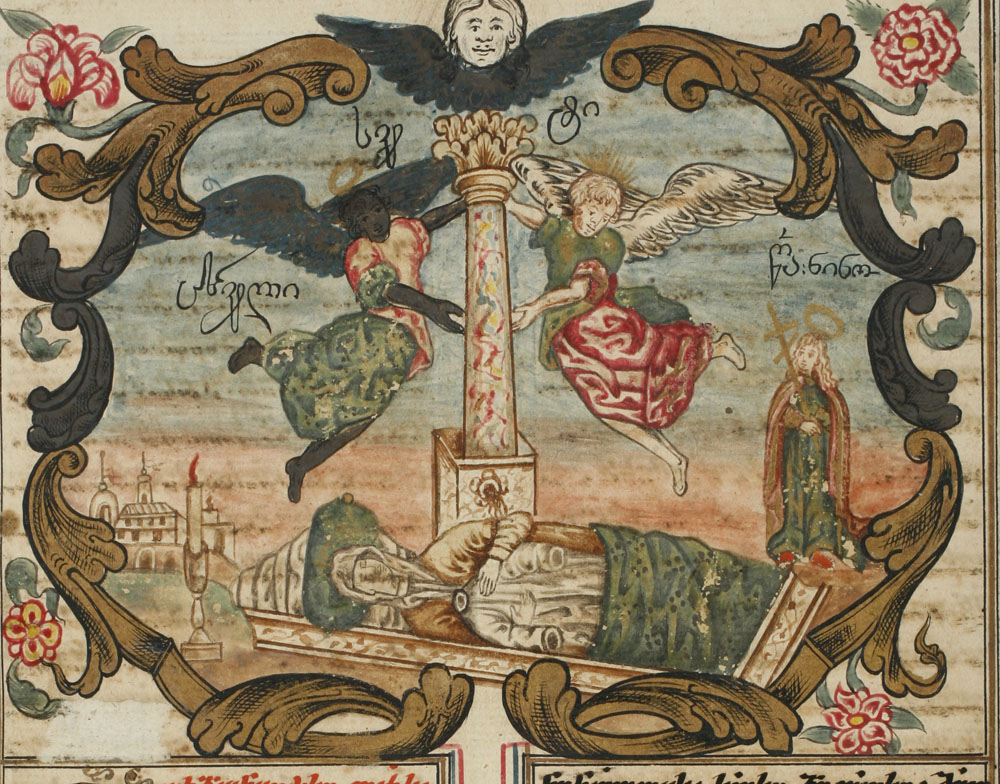
At the coming of evening the saddened king went to his home. Only I remained for the whole night at the place of construction, with my disciples, praying and watering with tears the stump of the felled tree. Early in the morning there appeared to me a wondrous youth, girded with a fiery belt, and he said three mysterious words in my ear; upon hearing them, I fell to the ground and bowed to him. Then this youth approached the pillar and, embracing it, lifted it with himself high into the air. The pillar shone like lightning, so that it illumined the whole city.
The king and the people gathered at this place; with fear and joy beholding the wondrous vision, all marvelled how this heavy pillar, supported by no one, now rose upwards, now descended and touched the stump upon which it had grown; finally it stopped and stood immovable in its place. From beneath the base of the pillar there began to flow fragrant and healing myrrh, and all who suffered from various diseases and wounds, anointing themselves with faith with this myrrh, received healing.

Then King Mirian gave orders to all the rulers of the regions, to the commanders and to the courtiers, that all should come to him in the capital city. And when they had gathered, the king, the queen and all their children immediately, in the presence of all, received holy baptism; with great zeal and joy the people also went to be baptized. Thus soon the whole Kartalinian land was peacefully baptized.
Avoiding the glory and honors that both the king and the people bestowed upon me, burning with the desire to serve for yet greater glorification of the name of Christ, I departed from the populous city into the mountains, to the waterless heights of Aragva. Finding a small cave hidden behind the branches of trees, I began to live in it; here by tearful prayer I caused water to flow for myself from the stone.
Taking with me the presbyter Jacob and one deacon, I went into the mountainous regions, to the north of Mtskheta. Then, passing through Kokabeti and converting all the inhabitants to the Christian faith, I directed my way to the south of Kakheti and, reaching the village of Bodbi, the boundary of my holy labors and earthly wandering, I settled there. Having made myself a tent on the mountainside, I spent days and nights in prayer before the holy cross. In a short time Sophia, the queen of Kakheti, together with her courtiers and a multitude of people, received holy baptism from the presbyter Jacob.
Having thus accomplished in Kakheti the final work of my apostolic ministry in the Iberian land, I received from God a revelation concerning the approach of my end and wrote to King Mirian: «I ask you, O king, send to me Bishop John, that he may prepare me for the eternal way, for the day of my death is already near». The king, his courtiers and all the consecrated clergy hastened to me and found me still alive. Toward the end of my life, at the insistent request of the disciples weeping at my bedside, I told them of my origin and my life; then I gave them a few instructions concerning eternal life, reverently partook from the hands of the bishop of the saving Mysteries of the Body and Blood of Christ, bequeathed that my body be given burial in the same poor tent where I then was, so that the newly founded Kakhetian Church might not remain orphaned, and with peace I committed my spirit into the hands of the Lord.
The king and the bishop, together with all the people, deeply grieved, intended to transfer my remains to the Mtskheta cathedral church, but they could not move the coffin from the place of rest that I myself had chosen. My body was buried at the site of the poor tent in the village of Budi. At the grave King Mirian laid the foundation, and his son, King Bakur, completed and consecrated a temple in the name of my kinsman, the holy great-martyr George. The all-good God glorified with incorruption my body, hidden at my command under a bushel; at my tomb there occurred numerous and unceasing signs and miracles. These gracious signs moved the young Iberian Church to recognize me as the Equal-to-the-Apostles Enlightener of Iberia, to join me to the choir of the saints and to establish in my honor an annual feast on the 14th of January, on the day of my blessed repose.
The Words of God to the servant, / in the apostle’s sermon to the first-called Andrew, / and to the other apostles, who imitated, / the enlightener of Iberia and the Holy Spirit, the saint Equal to the Apostles Nino,/ pray to Christ God // for our souls to be saved.