ORTHODOX HOUSENewsCommunityCalendarPrayer BookLives of the Saints
Venerable Mary of Egypt
Lives of the Saints · the saint tells his own story

Venerable Mary of Egypt

Commemorated: April 1 (14) · Fifth Sunday of Great Lent; Thursday of the Fifth Week — “Mary’s Standing” · 5th–6th century · Egypt — Alexandria — Jerusalem — the Desert beyond the Jordan
“I was born in Egypt. When I was twelve years of age and my parents were still alive, I rejected their love and set off for Alexandria…”
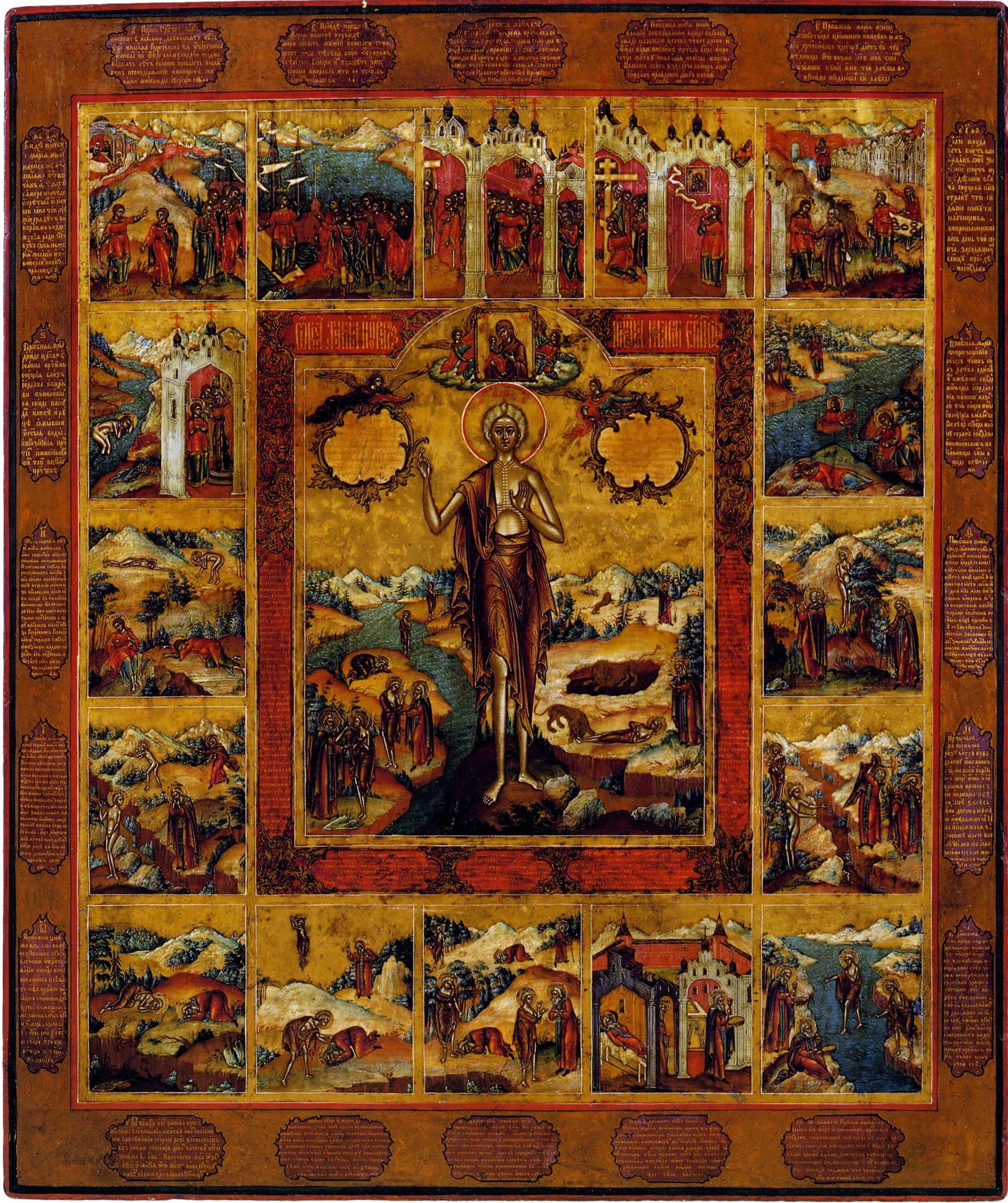
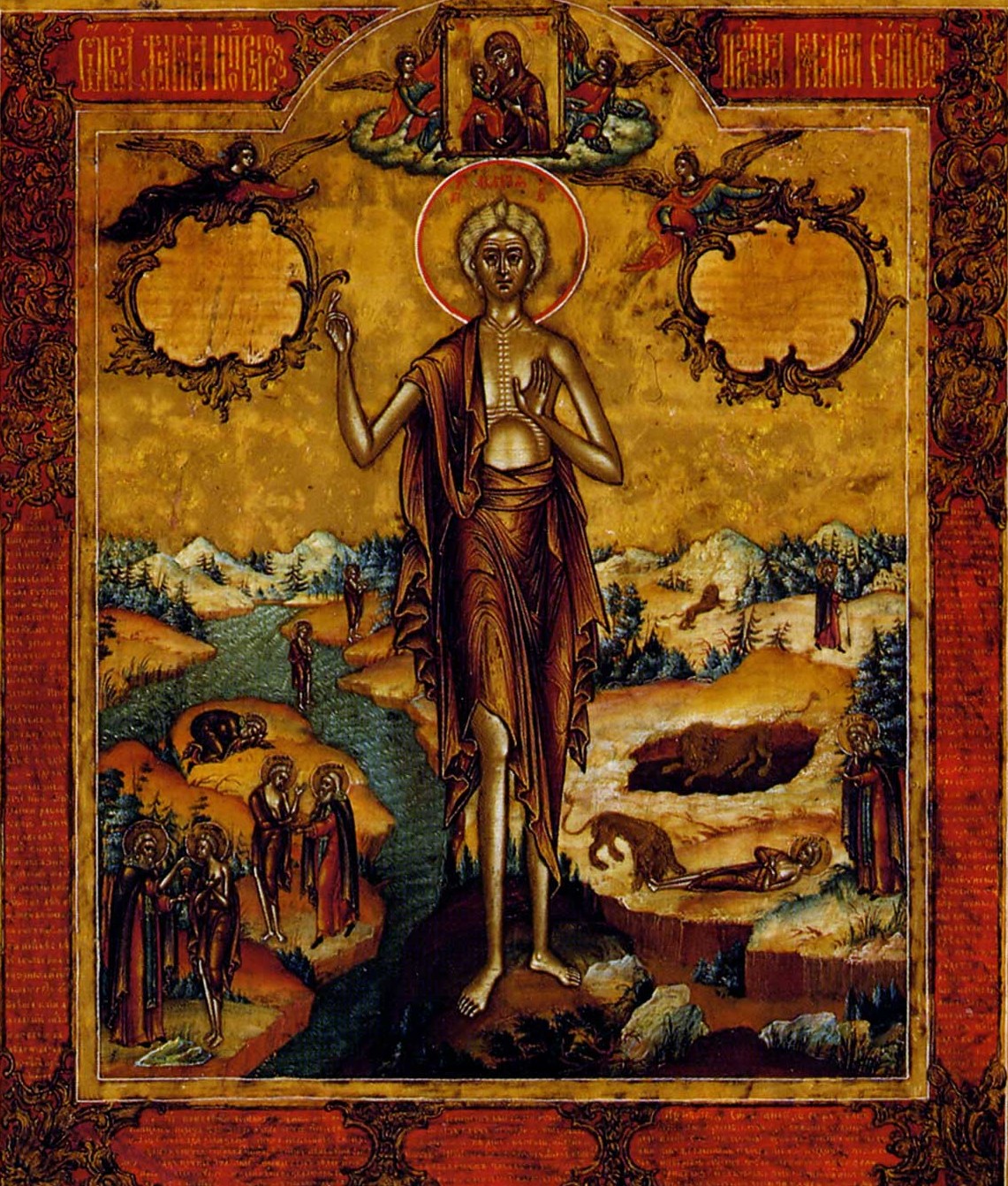
Venerable Mary of Egypt — the central panel of the icon “Venerable Mary of Egypt, with Scenes from Her Life in 16 Border Scenes.” Ivan Bogatyryov, Nevyansk, 1804. State Museum of the History of Religion (St Petersburg), inv. B-7355-IV. Public domain.
How this is made. First-person narrative — a close paraphrase of this Life; not a single fact that is absent from the source. The Life was recorded by St Sophronius from the words of the elder Zosimas, to whom the venerable one herself related her story; what she could not have known (the elder’s life before their meeting, her burial) is conveyed with the note “as the Life relates.” Beneath each excerpt stands the actual text of St Dimitry. Source: St Dimitry of Rostov. Lives of the Saints. Month of April, Day 1 — The Life of Our Venerable Mother Mary of Egypt. The face is an authentic icon; the light and breathing make it a “living icon”, with no talking lips. The pictures beside the passages are the border scenes of the icon of his life. There is no voice: the reading is yours.
Mary in Alexandria among the men going to the sea
Border scene of the icon: Mary in Alexandria among the men going to the sea · Nevyansk, 1804
1 · Egypt — Alexandria

Egypt. Alexandria

I was born in Egypt. When I was twelve years of age and my parents were still alive, I rejected their love and set off for Alexandria.

How I lost my virginal purity and began uncontrollably and insatiably to give myself over to fornication — of this I cannot even think without shame, much less relate at length; I shall say only briefly. For seventeen years, and more, I committed fornication with all — not for any gift or payment, since I wished to take nothing from anyone, but I reasoned thus: that more would come to me freely and satisfy my lust.

I was not rich, and that was not why I refused payment — no, I lived in poverty, often hungry, spinning flax, but I was always possessed by the desire to sink still deeper into the mire of fornication: I saw life in constant dishonour.

Source — St Demetrius of Rostov, “Lives of the Saints”
I, holy father, was born in Egypt, but being twelve years of age, when my parents were still alive, I rejected their love and set off for Alexandria […] How I lost my virginal purity and began uncontrollably and insatiably to give myself over to fornication — of this I cannot even think without shame, much less relate at length; I shall say only briefly, that you may know of my unbridled lust. […] For seventeen years, and more, I committed fornication with all, not for any gift or payment, since I wished to take nothing from anyone, but I reasoned thus: that more would come to me freely and satisfy my lust. […] Do not think that I was rich and therefore refused payment — no, I lived in poverty, often hungry, spinning flax, but I was always possessed by the desire to sink still deeper into the mire of fornication: I saw life in constant dishonour.
Mary asks to board the ship of those sailing to Jerusalem
Border scene of the icon: Mary asks to board the ship of those sailing to Jerusalem · Nevyansk, 1804
2 · Alexandria, seashore — ship of pilgrims

Ship to Jerusalem

One day, at harvest time, I saw many men — both Egyptians and Libyans — going toward the sea. I asked one man I met where these people were hurrying. He replied that they were going to Jerusalem for the feast of the Exaltation of the Honourable and Life-giving Cross that was soon to take place. When I asked whether they would take me with them, he said that if I had money and food, no one would hinder me. I said to him: “No, brother, I have neither money nor food, yet I shall go and board the same ship with them, and they will feed me: I shall give them my body as payment.”

The young man I had met, hearing my shameless words, laughed and walked away. But I, throwing aside the distaff I happened to have with me, hastened to the sea. Looking over the travellers, I noticed among them some ten or more men standing on the shore; they were young and seemed suited to my desire. Others had already boarded the ship. Shamelessly, as was my custom, I ran up to those standing there and said: “Take me with you; I shall please you.” They laughed at these and similar words and, seeing my shamelessness, took me with them on the ship, and we set sail.

What tongue or ear could bear the tale of the shameful deeds I committed on the ship during the voyage: I drew even the unwilling into sin, and there was no shameful act that I did not teach them. I am horrified that the sea endured such debauchery, that the earth did not open and swallow me alive into hell after I had corrupted so many people! But I think that God was awaiting my repentance, not desiring the death of the sinner, but with long-suffering awaiting his conversion.

Source — St Demetrius of Rostov, “Lives of the Saints”
One day, at harvest time, I saw many men — both Egyptians and Libyans […] going toward the sea. I asked one man I met where these people were hurrying. He replied that they were going to Jerusalem for the feast of the Exaltation of the Honourable and Life-giving Cross that was soon to take place. When I asked whether they would take me with them, he said that if I had money and food, no one would hinder me. I said to him: “No, brother, I have neither money nor food, yet I shall go and board the same ship with them, and they will feed me: I shall give them my body as payment.” […] The young man I had met — she continued — hearing my shameless words, laughed and walked away. But I, throwing aside the distaff I happened to have with me, hastened to the sea. Looking over the travellers, I noticed among them some ten or more men standing on the shore; they were young and seemed suited to my desire. Others had already boarded the ship. […] Shamelessly, as was my custom, I ran up to those standing there and said: “Take me with you; I shall please you.” They laughed at these and similar words and, seeing my shamelessness, took me with them on the ship, and we set sail. […] What tongue or ear could bear the tale of the shameful deeds I committed on the ship during the voyage: I drew even the unwilling into sin, and there was no shameful act that I did not teach them. Believe me, father, I am horrified that the sea endured such debauchery, that the earth did not open and swallow me alive into hell after I had corrupted so many people! But I think that God was awaiting my repentance, not desiring the death of the sinner, but with long-suffering awaiting his conversion.
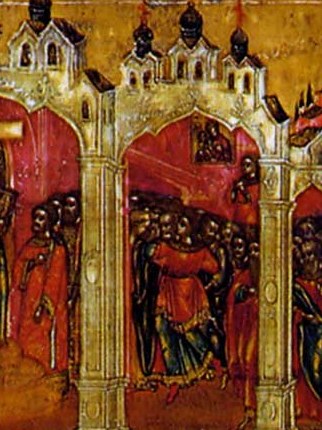
An invisible force does not allow Mary into the church
Border scene of the icon: An invisible force does not allow Mary into the church · Nevyansk, 1804
3 · Jerusalem, the narthex of the church, the feast of the Exaltation

Jerusalem. The Door That Would Not Admit Her

Thus I arrived in Jerusalem and all the days until the feast I continued as before, and even worse.

At last the feast of the Exaltation of the Honourable Cross arrived, and I, as before, went out to seduce young men. Seeing that early in the morning everyone was going to the church one after another, I too set out, entered the narthex with them all, and when the hour of the holy Exaltation of the Honourable Cross of the Lord came, I tried to enter the church with the people. No matter how I tried to press through, the people pushed me back. At last, with great difficulty, I, the wretched one, drew near to the doors of the church. But while everyone entered the church unhindered, some Divine power prevented me. I tried again to enter and was again repelled, and remained alone in the narthex.

Thinking that this was happening because of my womanly weakness, I joined another crowd, but my effort proved in vain; my sinful foot already touched the threshold, the church received all unhindered, but me alone, the wretched one, it did not allow — an unknown power held me back, and again I found myself in the narthex. Thus three or four times I strained my strength but had no success. From exhaustion I could no longer join the crowd of those entering; my whole body ached from the press and the crush.

In despair, I drew back with shame and stood in a corner of the narthex. Coming to myself, I thought: what guilt forbids me to see the Life-giving Tree of the Cross of the Lord? The light of saving reason, the truth of God that enlightens the eyes of the soul, touched my heart and showed me that the abomination of my deeds forbids me to enter the church. Then I began to weep bitterly, striking my breast with sobs and sighing from the depths of my heart.

Source — St Demetrius of Rostov, “Lives of the Saints”
With such feelings I arrived in Jerusalem and all the days until the feast I continued as before, and even worse. I not only was not satisfied with the young men who had been with me on the ship, but I also gathered for fornication the local inhabitants and strangers. At last the feast of the Exaltation of the Honourable Cross arrived, and I, as before, went out to seduce young men. Seeing that early in the morning everyone was going to the church one after another, I too set out, entered the narthex with them all, and when the hour of the holy Exaltation of the Honourable Cross of the Lord came, I tried to enter the church with the people. No matter how I tried to press through, the people pushed me back. At last, with great difficulty, I, the wretched one, drew near to the doors of the church. But while everyone entered the church unhindered, some Divine power prevented me. I tried again to enter and was again repelled, and remained alone in the narthex. Thinking that this was happening because of my womanly weakness, I joined another crowd, but my effort proved in vain; my sinful foot already touched the threshold, the church received all unhindered, but me alone, the wretched one, it did not allow; as if a numerous military guard had been deliberately stationed there, an unknown power held me back — and again I found myself in the narthex. Thus three or four times I strained my strength but had no success. From exhaustion I could no longer join the crowd of those entering; my whole body ached from the press and the crush. In despair, I drew back with shame and stood in a corner of the narthex. Coming to myself, I thought: what guilt forbids me to see the Life-giving Tree of the Cross of the Lord? The light of saving reason, the truth of God that enlightens the eyes of the soul, touched my heart and showed me that the abomination of my deeds forbids me to enter the church. Then I began to weep bitterly, striking my breast with sobs and sighing from the depths of my heart.
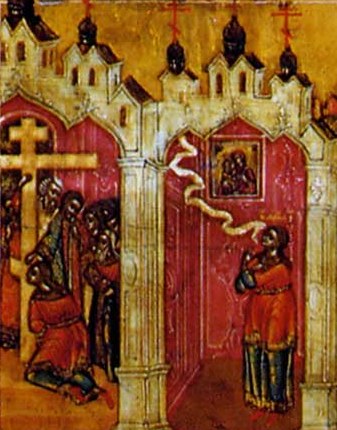
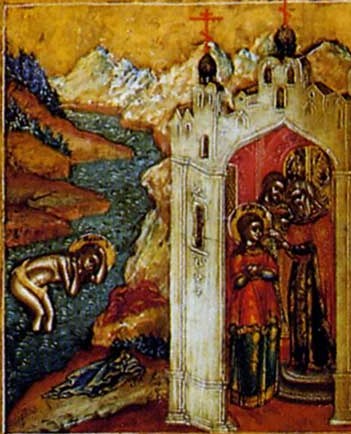
Mary prays before the icon of the Theotokos and venerates the Honourable Cross
Border scene of the icon: Mary prays before the icon of the Theotokos and venerates the Honourable Cross · Nevyansk, 1804
4 · Jerusalem, narthex of the church, before the icon of the Most Holy Theotokos

An icon in the narthex. A vow to the Theotokos

Thus I wept, standing in the narthex. Raising my eyes, I saw on the wall an icon of the Most Holy Theotokos and, directing to her both the eyes of the body and of the soul, I cried out:

“O Lady, Virgin, who gave birth to God in the flesh! I know, I know full well that there is neither honour nor praise for Thee when I, unclean and defiled, gaze upon Thine image, O Ever-Virgin, pure in body and soul. Rightly would Thy virginal purity loathe and hate me, a harlot. But I have heard that God, born of Thee, became incarnate precisely to call sinners to repentance. Come then to my help, for I am forsaken by all! Command that the entrance to the church be not forbidden to me; grant me to see the Honourable Tree on which in the flesh was crucified He who was born of Thee, who shed His holy Blood for the deliverance of sinners and for me. Command, O Lady, that even for me, the unworthy, the doors of the church be opened for the veneration of the Divine Cross! Be my faithful surety before Thy Son that I will no longer defile my body with the impurity of fornication, but that, having looked upon the Tree of the Cross, I will renounce the world and its temptations and go wherever Thou, the surety of my salvation, shalt lead me.”

Thus I spoke. Strengthened by faith and convinced of the mercy of the Theotokos, I, as though at someone’s prompting, moved from the place where I had prayed and mingled with the crowd entering the church. Now no one pushed me back or hindered me from reaching the doors of the church.

Source — St Demetrius of Rostov, “Lives of the Saints”
Thus I wept, standing in the narthex. Raising my eyes, I saw on the wall an icon of the Most Holy Theotokos and, directing to her both the eyes of the body and of the soul, I cried out: “O Lady, Virgin, who gave birth to God in the flesh! I know, I know full well that there is neither honour nor praise for Thee when I, unclean and defiled, gaze upon Thine image, O Ever-Virgin, pure in body and soul. Rightly would Thy virginal purity loathe and hate me, a harlot. But I have heard that God, born of Thee, became incarnate precisely to call sinners to repentance. Come then to my help, for I am forsaken by all! Command that the entrance to the church be not forbidden to me; grant me to see the Honourable Tree on which in the flesh was crucified He who was born of Thee, who shed His holy Blood for the deliverance of sinners and for me. Command, O Lady, that even for me, the unworthy, the doors of the church be opened for the veneration of the Divine Cross! Be my faithful surety before Thy Son that I will no longer defile my body with the impurity of fornication, but that, having looked upon the Tree of the Cross, I will renounce the world and its temptations and go wherever Thou, the surety of my salvation, shalt lead me.” […] Thus I spoke. Strengthened by faith and convinced of the mercy of the Theotokos, I, as though at someone’s prompting, moved from the place where I had prayed and mingled with the crowd entering the church. Now no one pushed me back or hindered me from reaching the doors of the church.
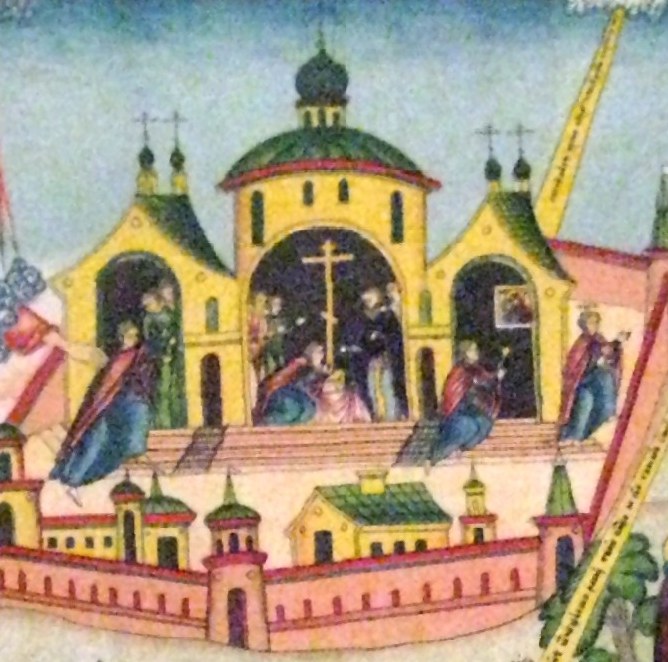
The Jerusalem Temple: the Exaltation of the Honourable Cross
Lubok: The Jerusalem Temple: the Exaltation of the Honourable Cross · Lubok, 19th–20th centuries
5 · Jerusalem, church — at the Honourable Cross and at the icon of the Theotokos

The Life-giving Tree. A voice

Fear and horror seized me, and I trembled all over. Reaching the doors that had previously been closed to me, I entered the holy church without difficulty and was granted to see the Life-giving Tree. I comprehended the mysteries of God and understood that God will not reject the penitent. Falling to the ground, I venerated the Honorable Cross and kissed it with trembling.

Then I went out of the church to the image of my surety, the Theotokos, and, bending my knees before her holy icon, I prayed thus: “O Ever-blessed Virgin, Sovereign Lady Theotokos, who did not disdain my prayer, You have shown Your great loving-kindness toward me. I, an adulteress unworthy to behold it, have seen the glory of the Lord! Glory to God, who through you accepts the repentance of sinners! This is all that I, a sinner, can conceive and utter in words. Now, Sovereign Lady, it is time to fulfill what I promised, calling upon you as my surety: guide me as is your will, and teach me how to complete my salvation on the path of repentance.”

After these words I heard, as if from afar, a voice: “If you cross the Jordan, you will find complete rest for yourself.” Hearing these words with faith that they were addressed to me, I cried out with tears, gazing at the icon of the Theotokos: “Sovereign Lady, Sovereign Lady Theotokos, do not forsake me!”

Source — St Demetrius of Rostov, “Lives of the Saints”
Fear and horror seized me, and I trembled all over. Reaching the doors that had previously been closed to me, I entered the holy church without difficulty and was granted to see the Life-giving Tree. I comprehended the mysteries of God and understood that God will not reject the penitent. Falling to the ground, I venerated the Honorable Cross and kissed it with trembling. Then I went out of the church to the image of my surety – the Theotokos, and, bending my knees before her holy icon, I prayed thus: “O Ever-blessed Virgin, Sovereign Lady Theotokos, who did not disdain my prayer, You have shown Your great loving-kindness toward me. I, an adulteress unworthy to behold it, have seen the glory of the Lord! Glory to God, who through you accepts the repentance of sinners! This is all that I, a sinner, can conceive and utter in words. Now, Sovereign Lady, it is time to fulfill what I promised, calling upon you as my surety: guide me as is your will, and teach me how to complete my salvation on the path of repentance.” […] After these words I heard, as if from afar, a voice: “If you cross the Jordan, you will find complete rest for yourself.” […] Hearing these words with faith that they were addressed to me, I cried out with tears, gazing at the icon […] of the Theotokos: “Sovereign Lady, Sovereign Lady Theotokos, do not forsake me!”
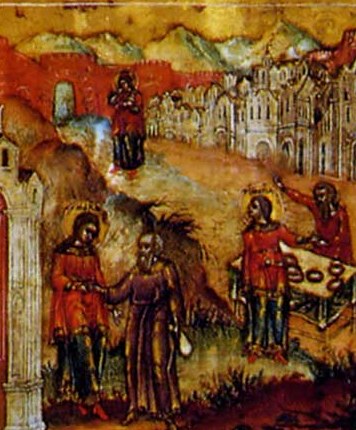
A stranger gives Mary three coins; Mary buys loaves
Border scene of the icon: A stranger gives Mary three coins; Mary buys loaves · Nevyansk, 1804
6 · Jerusalem — the road to the Jordan, the church of Saint John the Baptist

Three coins and three loaves

With these words I came out of the church porch and quickly went forward. On the road someone gave me three coins, saying: “Take this, mother.” I accepted the coins, bought three loaves and asked the seller where the road to the Jordan was. Learning which gate led in that direction, I quickly went on my way, shedding tears.

Thus I spent the whole day on the road, asking the way of those I met, and by the third hour of that day when I had been granted to behold the holy Cross of Christ, already at sunset, I reached the church of Saint John the Baptist by the river Jordan.

Having prayed in the church, I went down to the Jordan and washed my hands and face with the water of that holy river. Returning to the church, I partook of the Most Pure and Life-giving Mysteries of Christ. Then I ate half of one loaf, drank water from the Jordan and fell asleep on the ground.

Source — St Demetrius of Rostov, “Lives of the Saints”
With these words I came out of the church porch and quickly went forward. On the road someone gave me three coins, saying: “Take this, mother.” […] I accepted the coins, bought three loaves and asked the seller where the road to the Jordan was. Learning which gate led in that direction, I quickly went on my way, shedding tears. Thus I spent the whole day on the road, asking the way of those I met, and by the third hour of that day when I had been granted to behold the holy Cross of Christ, already at sunset, I reached the church of Saint John the Baptist by the river Jordan. Having prayed in the church, I went down to the Jordan and washed my hands and face with the water of that holy river. Returning to the church, I partook of the Most Pure and Life-giving Mysteries of Christ. Then I ate half of one loaf, drank water from the Jordan and fell asleep on the ground.
Mary at the church of John the Forerunner on the Jordan: washing and Communion
Border scene of the icon: Mary at the church of John the Forerunner on the Jordan: washing and Communion · Nevyansk, 1804
7 · The Jordan — the Transjordan desert

Beyond the Jordan

Early in the morning, having found a small boat, I crossed to the other bank and again turned with prayer to my guide, the Theotokos, that she might instruct me as it should please her. Thus I withdrew into the desert, where I have been wandering to this day, awaiting the salvation that God will grant me from soul- and body-suffering.

Having crossed the Jordan, I had two and a half loaves; they gradually dried out and became as if petrified, and I ate of them little by little for several years. When the loaves were finished, after seventeen years, I fed on plants; the clothing I had on when I crossed the Jordan rotted from age, and I suffered much, fainting from the heat in summer and shivering from the cold in winter, so that many times I fell to the ground as if lifeless and lay there for a long time, enduring numerous bodily and spiritual adversities.

But from that time until today the power of God has transformed my sinful soul and my humble body in all things, and I only remember my former deprivations, finding for myself inexhaustible food in the hope of salvation: I am fed and covered by the all-powerful word of God.

Source — St Demetrius of Rostov, “Lives of the Saints”
Early in the morning, having found a small boat, I crossed to the other bank and again turned with prayer to my guide, the Theotokos, that she might instruct me as it should please her. Thus I withdrew into the desert, where I have been wandering to this day, awaiting the salvation that God will grant me from soul- and body-suffering.” […] Having crossed the Jordan, the saint said, I had two and a half loaves; they gradually dried out and became as if petrified, and I ate of them little by little for several years. […] When the loaves were finished, after seventeen years, I fed on plants; the clothing I had on when I crossed the Jordan rotted from age, and I suffered much, fainting from the heat in summer and shivering from the cold in winter, so that many times I fell to the ground as if lifeless and lay there for a long time, enduring numerous bodily and spiritual adversities. But from that time until today the power of God has transformed my sinful soul and my humble body in all things, and I only remember my former deprivations, finding for myself inexhaustible food in the hope of salvation: I am fed and covered by the all-powerful word of God.
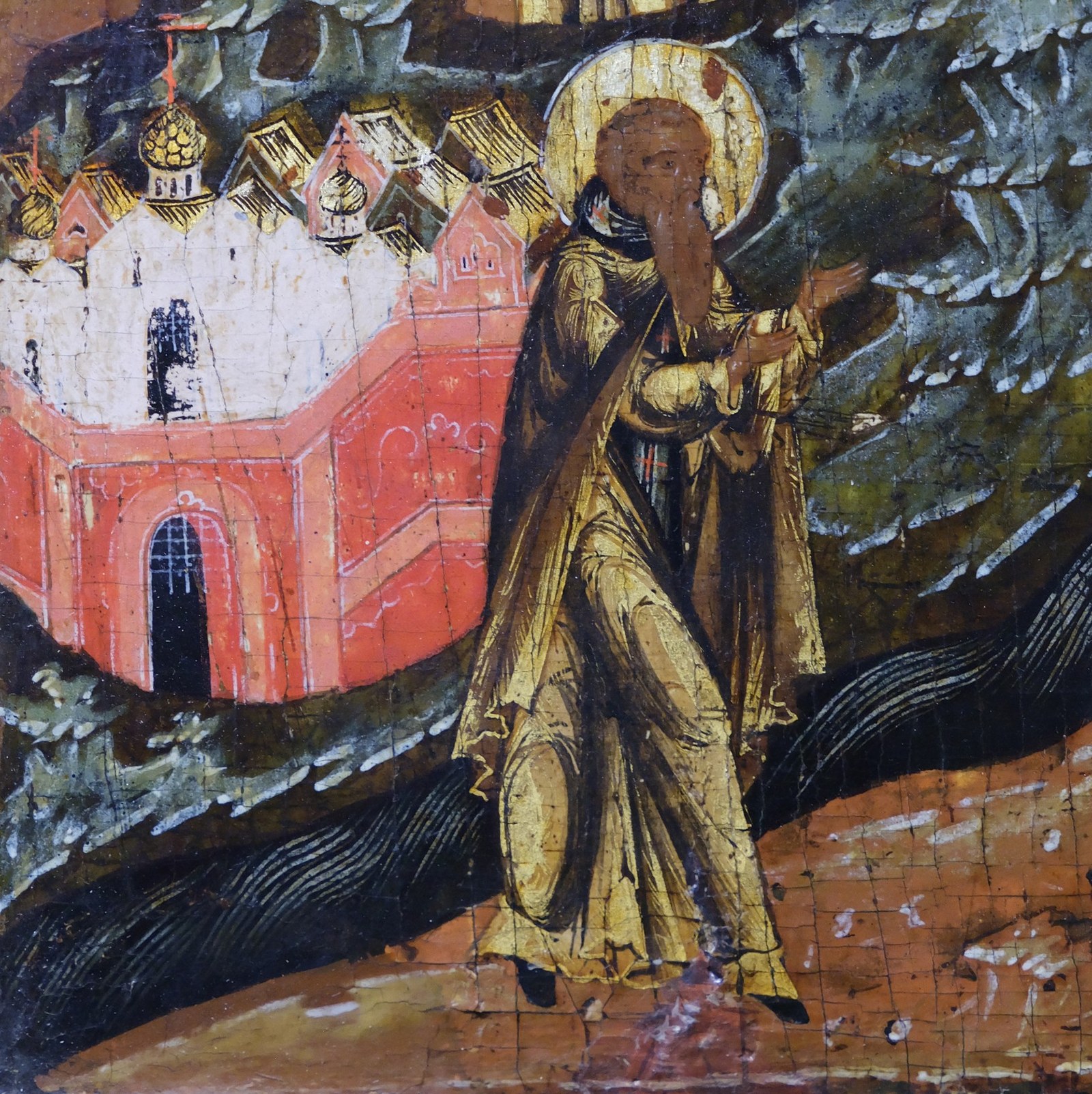
Mary in the desert: struggle with thoughts, tears and prayer
Border scene of the icon: Mary in the desert: struggle with thoughts, tears and prayer · Nevyansk, 1804
8 · The Transjordan desert

Seventeen years of struggle

For seventeen years I lived in this desert, struggling with my insane passions as with fierce beasts. When I partook of food, I would dream of the meat and wine that I had eaten in Egypt; I longed to drink the wine that I had loved. While I was in the world, I drank much wine, but here I had not even water; I languished from thirst and suffered terribly. Sometimes there arose in me a desire, which greatly troubled me, to sing the lewd songs to which I had become accustomed.

Then I would shed tears, strike myself upon the breast, and remember the vows that I had made when I withdrew into the desert. Then in my mind I would stand before the icon of my Surety, the Most Pure Theotokos, and with weeping entreat Her to drive away from me the thoughts that troubled my soul. For a long time I would weep thus, striking myself firmly upon the breast, and at last it was as though light poured out around me, and I would grow calm from my agitations.

How can I confess to the lustful desires that overtook me? The fire of passion would kindle within me and scorch me, driving me to lust. When such a temptation came upon me, I would cast myself to the ground and drench myself with tears, imagining that before me stood my Surety Herself, condemning my transgression and threatening me with severe torments for it. Cast down upon the earth, I would not rise day or night until that light illumined me and drove away the thoughts that troubled me. Then I would raise my eyes to my Surety, fervently seeking help for my sufferings in the desert—and indeed, She gave me help and guidance in repentance.

Thus I spent seventeen years in constant torments. And thereafter, even to this day, the Theotokos is in all things my helper and guide.

Source — St Demetrius of Rostov, “Lives of the Saints”
Believe me, father Zosima, that for seventeen years I lived in this desert, struggling with my insane passions as with fierce beasts. When I partook of food, I would dream of the meat and wine that I had eaten in Egypt; I longed to drink the wine that I had loved. While I was in the world, I drank much wine, but here I had not even water; I languished from thirst and suffered terribly. Sometimes there arose in me a desire, which greatly troubled me, to sing the lewd songs to which I had become accustomed. Then I would shed tears, strike myself upon the breast, and remember the vows that I had made when I withdrew into the desert. Then in my mind I would stand before the icon of my Surety, the Most Pure Theotokos, and with weeping entreat Her to drive away from me the thoughts that troubled my soul. For a long time I would weep thus, striking myself firmly upon the breast, and at last it was as though light poured out around me, and I would grow calm from my agitations. How can I confess, father, to the lustful desires that overtook me? Forgive me, father. The fire of passion would kindle within me and scorch me, driving me to lust. When such a temptation came upon me, I would cast myself to the ground and drench myself with tears, imagining that before me stood my Surety Herself, condemning my transgression and threatening me with severe torments for it. Cast down upon the earth, I would not rise day or night until that light illumined me and drove away the thoughts that troubled me. Then I would raise my eyes to my Surety, fervently seeking help for my sufferings in the desert—and indeed, She gave me help and guidance in repentance. Thus I spent seventeen years in constant torments. And thereafter, even to this day, the Theotokos is in all things my helper and guide.
Elder Zosima leaves the monastery by the Jordan for the desert
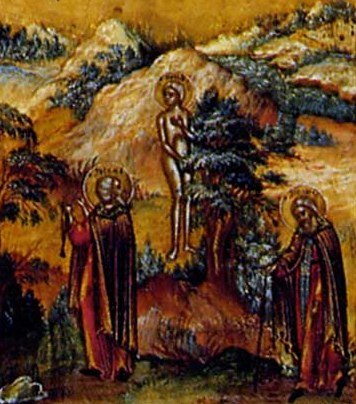
Icon: Elder Zosima leaves the monastery by the Jordan for the desert · Russian icon, c. 1600, Louvre
9 · Monastery by the Jordan—the desert, twenty days’ journey

Elder Zosima—as the Life relates

As the Life relates, in one of the Palestinian monasteries there lived an elder; the elder’s name was Zosima. Even in infancy he had been given over to a monastery, where he had valiantly struggled in asceticism until the age of fifty-three. But later the thought began to trouble him that he had attained complete perfection and no longer needed any instruction. Then an Angel appeared to him and said: “Zosima! You have struggled diligently, as far as is within human power, and have valiantly completed the ascetic course.” But there are, said the Angel, “struggles unknown to you, and harder than those you have passed”—and he bade him leave his own country and go to the monastery that lies by the river Jordan.

There was in that monastery a custom for the sake of which God had brought Zosima there. In the first week of Great Lent, at the Liturgy all partook of the Most Pure Body and Blood of the Lord, and the monks went out into the desert and crossed over the river Jordan; there they all dispersed far in different directions and knew nothing of one another, how each fasted and struggled, and they returned to the monastery a week before the Resurrection of Christ.

Zosima, according to the custom of that monastery, also crossed over the Jordan. He increasingly desired to go deeper into the desert and there to find one of the ascetics who might instruct him. After twenty days’ journey he once stopped and, turning to the east, began to sing the sixth hour. While he was singing thus, he saw on his right side what seemed to be the shadow of a human body; thinking that it was a demonic delusion, he began to cross himself. When the fear had passed, he turned to the south and saw a naked person, burned black by the sun, with white hair like wool, reaching only to the neck. It was I.

Source — St Demetrius of Rostov, “Lives of the Saints”
In one of the Palestinian monasteries there lived an elder, adorned with piety of life and wisdom of speech and from early youth valiantly struggling in the monastic life. The elder’s name was Zosima. […] Even in infancy he had been given over to a monastery, where he had valiantly struggled in asceticism until the age of fifty-three. But later the thought began to trouble him that he had attained complete perfection and no longer needed any instruction. […] While the elder was reflecting thus, an Angel appeared to him and said: “Zosima! You have struggled diligently, as far as is within human power, and have valiantly completed the ascetic course. However, there is no man who could say of himself that he has attained perfection. There are struggles unknown to you, and harder than those you have passed. That you may know how many other paths lead to salvation, leave your own country […] and go to the monastery that lies by the river Jordan.” […] There was in that monastery a custom for the sake of which God had brought Zosima there. In the first week of Great Lent, at the Liturgy all partook of the Most Pure Body and Blood of the Lord […] the monks went out into the desert and crossed over the river Jordan. […] Having crossed the Jordan, they all dispersed far in different directions and knew nothing of one another, how each fasted and struggled. […] Thus the monks spent all of Great Lent and returned to the monastery a week before the Resurrection of Christ. […] Zosima, according to the custom of that monastery, also crossed over the Jordan. […] He increasingly desired to go deeper into the desert and there to find one of the ascetics who might instruct him. […] After twenty days’ journey he once stopped and, turning to the east, began to sing the sixth hour. […] While he was singing thus, he saw on his right side what seemed to be the shadow of a human body. Frightened and thinking that it was a demonic delusion, he began to cross himself. When the fear had passed and the prayer was finished, he turned to the south and saw a naked person, burned black by the sun, with white hair like wool, reaching only to the neck.
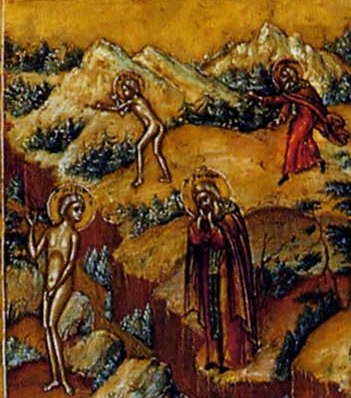
Elder Zosima meets Mary in the desert; she flees
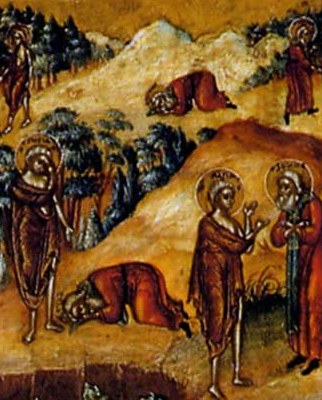
Border scene of the icon: Elder Zosima meets Mary in the desert; she flees · Nevyansk, 1804
10 · Desert beyond the Jordan, bed of a dried-up river

“Abba Zosima!”

When from afar I saw the elder approaching me, I hastily ran deeper into the desert. But Zosima, as if he had forgotten both his old age and the weariness of the journey, rushed to catch up with me. When he had drawn near enough for us to hear each other, he cried out with tears: “Why, O servant of the true God, for Whose sake thou hast settled in the desert, dost thou flee from me, a sinful elder? Wait for me, unworthy and feeble, for the hope of the reward for thy labour! Stop, pray for me, and for the sake of the Lord God, Who despiseth no one, grant me thy blessing.”

Meanwhile we reached a hollow, like the bed of a dried-up river. I hastened to the other side, while Zosima, exhausted and lacking strength to run further, intensified his tearful entreaties and stopped. Then I also stopped and said: “Abba Zosima! Forgive me for God’s sake that I cannot appear before thee: as thou seest, I am a woman, naked, with nothing to cover my nakedness. But if thou desirest to give thy prayer and blessing to me, a sinner, then throw me something from thy clothing to cover myself with, and then I will turn to thee for prayer.”

Fear and terror seized Zosima when he heard his name from the lips of one who had never seen him and had heard nothing about him. He quickly fulfilled my request, took off his old, torn garment and, turning away, threw it to me. Taking the garment, I girded myself and, as far as possible, covered my nakedness. Then I turned to Zosima: “Why, Abba Zosima, didst thou desire to see me, a sinful woman? Dost thou wish to hear or learn something from me, and therefore hast not spared thyself the difficult journey?”

Source — St Demetrius of Rostov, “Lives of the Saints”
When from afar I saw the elder approaching me, I hastily ran deeper into the desert. But Zosima, as if he had forgotten both his old age and the weariness of the journey, rushed to catch up with me. When he had drawn near enough for us to hear each other, he cried out with tears: “Why, O servant of the true God, for Whose sake thou hast settled in the desert, dost thou flee from me, a sinful elder? Wait for me, unworthy and feeble, for the hope of the reward for thy labour! Stop, pray for me, and for the sake of the Lord God, Who despiseth no one, grant me thy blessing.” Meanwhile we reached a hollow, like the bed of a dried-up river. I hastened to the other side, while Zosima, exhausted and lacking strength to run further, intensified his tearful entreaties and stopped. Then I also stopped and said: “Abba Zosima! Forgive me for God’s sake that I cannot appear before thee: as thou seest, I am a woman, naked, with nothing to cover my nakedness. But if thou desirest to give thy prayer and blessing to me, a sinner, then throw me something from thy clothing to cover myself with, and then I will turn to thee for prayer.” Fear and terror seized Zosima when he heard his name from the lips of one who had never seen him and had heard nothing about him. He quickly fulfilled my request, took off his old, torn garment and, turning away, threw it to me. Taking the garment, I girded myself and, as far as possible, covered my nakedness. Then I turned to Zosima: “Why, Abba Zosima, didst thou desire to see me, a sinful woman? Dost thou wish to hear or learn something from me, and therefore hast not spared thyself the difficult journey?”
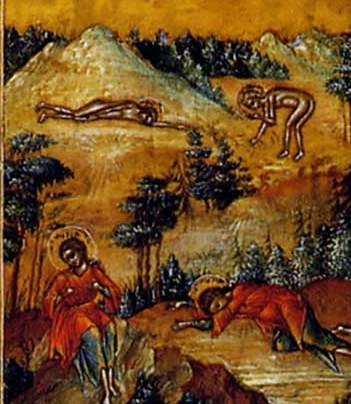
Mary prays, raised into the air; Zosima in trembling
Border scene of the icon: Mary prays, raised into the air; Zosima in trembling · Nevyansk, 1804
11 · The desert beyond the Jordan

“Bless!” Prayer in the air

But Zosima threw himself to the ground and asked my blessing. I also bowed to the ground, and so we both lay, asking each other’s blessing; only one word could be heard: “Bless!” After a long time I said to the elder: “Abba Zosima! Thou must bless and offer the prayer, for thou art invested with the rank of priest and for many years hast stood before the holy altar, celebrating the Divine Mysteries.” Shedding tears, he replied: “O spiritual mother! Thou hast drawn near to God, having put to death the weaknesses of the flesh,” — and he asked that I rather bless him for God’s sake and offer my holy prayer. I blessed him with these words: “Blessed is God, Who desireth the salvation of human souls!” Zosima answered “Amen,” and we both rose from the ground.

The elder asked me to pray to the Lord for the whole world and for him, a sinner. I turned to the east, lifted my eyes upward, and, raising my hands, began to pray, but so quietly that Zosima could not hear or understand the words of the prayer. The Life has preserved his words: “I call God to witness,” he related, “that after a while I lifted my eyes and saw her raised a cubit from the ground; thus she stood in the air and prayed.” Seeing this, Zosima trembled with fear, fell to the ground with tears, and could only utter: “Lord, have mercy!”

Raising the elder from the ground, I said: “Why, Zosima, art thou troubled by the thought of an apparition, why dost thou think that I am a spirit performing prayer? I beseech thee, blessed father, be assured that I am a sinful woman, cleansed only by holy baptism; no, I am not a spirit, but earth, dust and ashes, I am flesh that does not imagine itself to be a spirit.”

Source — St Demetrius of Rostov, “Lives of the Saints”
But Zosima threw himself to the ground and asked her for a blessing. She also bowed to the ground, and so both lay there, asking each other’s blessing; only one word could be heard: «Bless!» After a long time she said to the elder: – Abba Zosima! You must bless and offer the prayer, for you are vested with the rank of priest and for many years have stood before the holy altar, celebrating the Divine Mysteries. […] Shedding tears, he said to her, breathing with difficulty from trembling: – O spiritual mother! You have drawn near to God, having put to death the weaknesses of the flesh. The gift of God is manifested in you more than in others: you have never seen me, yet you call me by name and know my rank of priest. Therefore it is better that you bless me for God’s sake and impart to me your holy prayer. […] Moved by the elder’s insistence, she blessed him with these words: – Blessed is God, Who desires the salvation of human souls! […] Zosima responded «Amen», and both rose from the ground. […] Tell me, father, how do Christians live now, the king and the holy churches? – By your holy prayers, – Zosima answered, – God has granted the Church firm peace. […] But incline to the entreaties of an unworthy elder and pray to the Lord for the whole world and for me a sinner […] But out of the duty of obedience I will fulfil your will. […] With these words she turned to the east; raising her eyes upward and lifting her hands, she began to pray, but so quietly that Zosima could not hear or understand the words of the prayer. […] «I call God to witness,» he related, «that after a while I raised my eyes and saw her lifted up about a cubit […] from the ground; thus she stood in the air and prayed.» Seeing this, Zosima trembled with fear, fell to the ground with tears and could only utter: – Lord, have mercy! […] But then the thought troubled him whether this was a spirit or an apparition praying to God. But the saint, raising the elder from the ground, said: – Why, Zosima, does the thought of an apparition trouble you, why do you think that I am a spirit performing prayer? I implore you, blessed father, be assured that I am a sinful woman, purified only by holy Baptism; no, I am not a spirit, but earth, dust and ashes, I am flesh that does not think to be a spirit. […] With these words she signed her forehead, eyes, lips and breast with the sign of the Cross.
Mary tells the elder Zosima of her life
Border scene of the icon: Mary tells the elder Zosima of her life · Nevyansk, 1804
12 · The Desert beyond the Jordan

Confession. Request for Communion

The elder fell at my feet and with tears adjured me by the name of our Lord Jesus Christ not to conceal anything from him but to tell him everything about my life. I answered: «Forgive me, holy father, I am ashamed to tell of my shameful life. But you have seen my naked body, so I will also bare my soul, and you will know how much shame and disgrace is in it.» And I told him everything that I have related here, omitting nothing; only I asked him, when he learned of my life, not to forget to pray for me. To the elder’s question how many years had passed since I settled in this desert, I answered that I thought forty-seven years had passed since I left the holy city.

Hearing that I recalled the words of Holy Scripture, Zosima asked whether I had studied the Psalms and other books. With a smile I answered that since my crossing of the Jordan I had seen no person except him, and had never learned from books, «but the word of God is everywhere and always enlightens the mind and reaches even me, unknown to the world».

I did not allow the elder to bow to me and adjured him by Jesus Christ to tell no one what he had heard from me until God should take me from the earth, and asked: «In the fast of the coming year do not cross the Jordan as you usually do in the monastery,» but «on the holy and Great Thursday, on the day of the mystic Christ’s Supper, take in a holy vessel befitting this the life-giving Body and Blood, bring it to the settlement on that bank of the Jordan and wait for me, that I may partake of the Life-giving Gifts»: for since I partook in the church of John the Forerunner I have not tasted the holy Gifts. Having asked the elder to pray for me, I withdrew into the depth of the desert.

Source — St Demetrius of Rostov, “Lives of the Saints”
Hearing such words, the elder fell at her feet and with tears exclaimed: – By the name of our Lord Jesus Christ, the true God born of the Virgin, for Whose sake you, naked, have so mortified your flesh, I adjure you not to conceal anything from me but to tell me all about your life […] Forgive me, holy father, I am ashamed to tell of my shameful life. But you have seen my naked body, so I will also bare my soul, and you will know how much shame and disgrace is in it. […] Yet I will tell everything, omitting nothing; only I ask you, when you learn of my life, not to forget to pray for me, that I may receive some mercy on the Day of Judgment. […] How many years, lady, have passed since you settled in this desert? – I think, – she answered, – forty-seven years have passed since I left the holy city. […] Hearing that the saint recalled words of Holy Scripture from Moses, the Prophets and the Psalter, Zosima asked whether she had studied the Psalms and other books. – Do not think, – she answered with a smile, – that since my crossing of the Jordan I have seen any person except you: I have not even seen a single wild beast or animal. And I have never learned from books, I have never heard anyone reading or singing, but the word of God is everywhere and always enlightens the mind and reaches even me, unknown to the world. […] Blessed is God, Who works great and terrible, wondrous and glorious things, of which there is no number! […] The saint did not allow the elder to bow to her and said: – I adjure you, holy father, by Jesus Christ, our God and Saviour, to tell no one what you have heard from me until God takes me from the earth […] in the fast of the coming year do not cross the Jordan as you usually do in the monastery. […] it will be impossible for you to leave even if you wish; on the holy and Great Thursday, on the day of the mystic Christ’s Supper, take in a holy vessel befitting this the life-giving Body and Blood, bring it to the settlement on that bank of the Jordan and wait for me, that I may partake of the Life-giving Gifts: for since I partook before crossing the Jordan in the church of John the Forerunner, until this day I have not tasted the holy Gifts. […] To John, the abbot of the monastery where you live, say: look to yourself and your brethren, for much needs to be corrected among you – but say this not now, but when God instructs you. […] After these words she again asked the elder to pray for her and withdrew into the depth of the desert.
Elder Zosima communes Venerable Mary with the Holy Mysteries
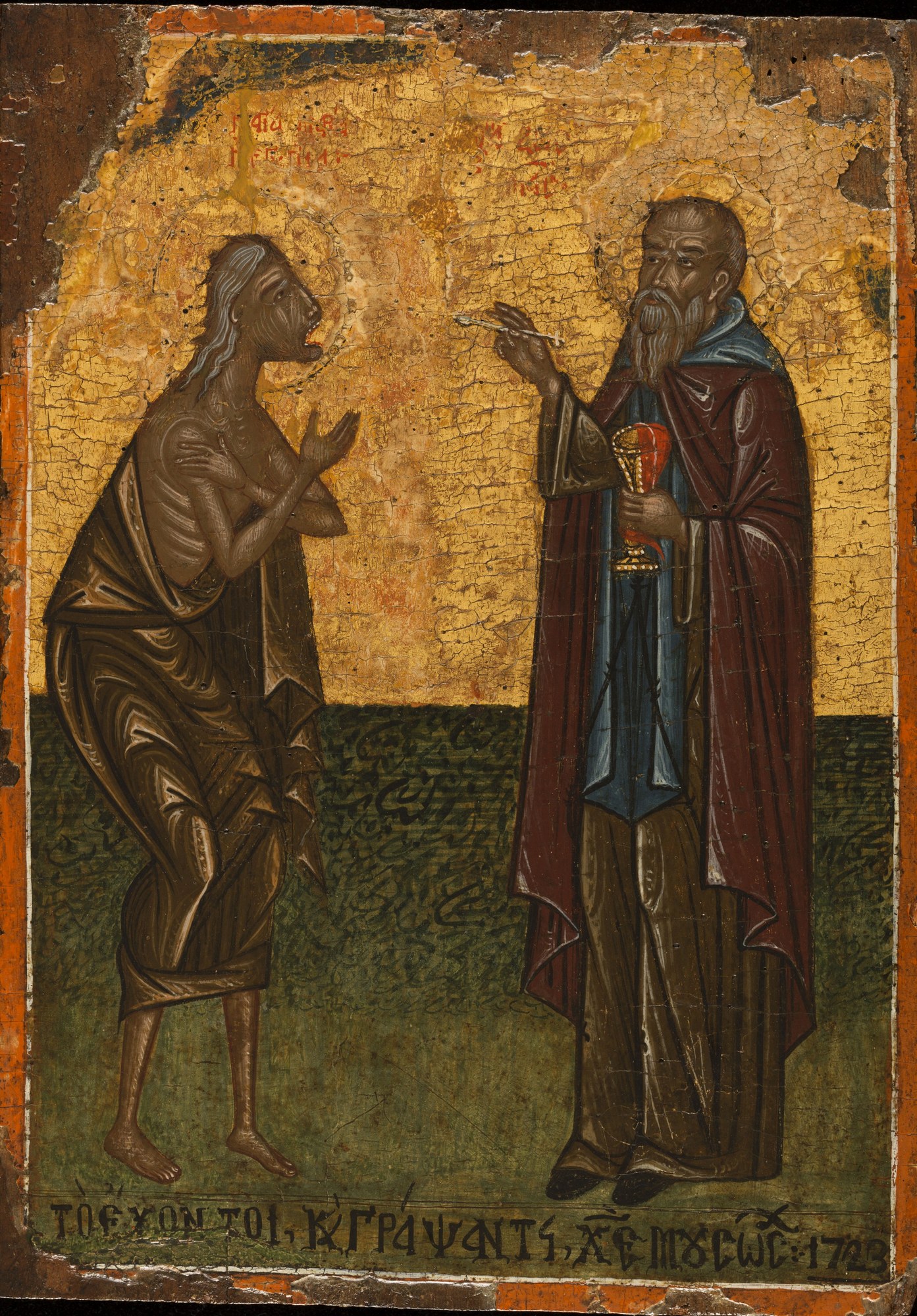
Icon: Elder Zosima communes Venerable Mary with the Holy Mysteries · Serbia, 1723
13 · The bank of the Jordan, the night of Great Thursday

Great Thursday on the Jordan

As the Life relates, when the first week of Great Lent arrived and all the brethren according to custom went out into the desert, only Zosima, who was suffering from a serious illness, was compelled to remain in the monastery — and he remembered my words: «It will be impossible for thee to go, even if thou shouldst wish!» On the day of the Mystical Supper the elder placed in a small vessel of the Most Pure Body and Blood of Christ our God, took in a basket a little food, and late in the evening went out of the monastery and sat on the bank of the Jordan, awaiting my arrival.

I came to the river. Illuminated by the brightness of the moon, I signed the river with the sign of the Cross, descended from the bank onto the water, and walked to the elder upon the water as upon dry land. Zosima wished to bow down to me, but I, while still walking on the water, forbade him and cried out: «What art thou doing? Thou art a priest and bearest the Divine Mysteries!» — and, coming out onto the bank, I asked him to read the Symbol of Faith and the Lord’s Prayer. At the end of the prayer I partook of the Most Pure and Life-giving Mysteries of Christ and, sighing, with tears cried out: «Now lettest Thou Thy servant depart, O Master, according to Thy word, in peace, for mine eyes have seen Thy salvation» (Lk. 2:29–30).

Then I said to Zosima: «I implore thee, father, do not refuse to fulfil yet one more of my desires: now go to thy monastery, and next year come to the same stream where thou didst formerly converse with me.» He asked me to taste of the food he had brought. I touched the wheat with the tips of my fingers, took three grains, and, bringing them to my lips, said: «This is enough: the grace of spiritual food, which preserveth the soul undefiled, will satisfy me.» I again signed the Jordan with the sign of the Cross and, as before, crossed the river as on dry land.
Source — St Demetrius of Rostov, “Lives of the Saints”
When the first week of Great Lent arrived, then all the brethren according to custom and the monastic rule, having prayed, with singing went out into the desert. Only Zosima, who was suffering from a serious illness, was compelled to remain in the monastery. Then he remembered the words of the saint: «It will be impossible for thee to go, even if thou shouldst wish!» […] the elder did everything that had been indicated to him: he placed in a small vessel of the Most Pure Body and Blood of Christ our God, and then taking in a basket several dried figs and dates and a little wheat soaked in water, late in the evening went out of the monastery and sat on the bank of the Jordan, awaiting the arrival of the venerable one. […] the saint, illuminated by the brightness of the moon, signed the river with the sign of the Cross, descended from the bank onto the water, and walked to him upon the water as upon dry land. Seeing this, the astonished Zosima wished to bow down to her, but the saint, while still walking on the water, forbade him and cried out: «What art thou doing? Thou art a priest and bearest the Divine Mysteries!» […] the saint, having come out onto the bank, asked his blessing. […] Then the saint asked him to read the Symbol of Faith and the Lord’s Prayer. At the end of the prayer she partook of the Most Pure and Life-giving Mysteries of Christ and, according to the monastic custom, kissed the elder, after which she sighed and with tears cried out: – Now lettest Thou Thy servant depart, O Master, according to Thy word, in peace, for mine eyes have seen Thy salvation […] I implore thee, father, do not refuse to fulfil yet one more of my desires: now go to thy monastery, and next year come to the same stream where thou didst formerly converse with me; come for God’s sake, and thou shalt see me again: thus God wills. […] The saint touched the wheat with the tips of her fingers, took three grains and, bringing them to her lips, said: – This is enough: the grace of spiritual food, which preserveth the soul undefiled, will satisfy me. Again I ask thee, holy father, pray for me to the Lord, remembering my wretchedness. […] The elder bowed down to her to the ground and asked her prayers for the Church, for the kings and for himself. […] The saint again signed the Jordan with the sign of the Cross and, as before, crossed the river as on dry land.
The lion digs the grave; the elder Zosima weeps for the venerable one
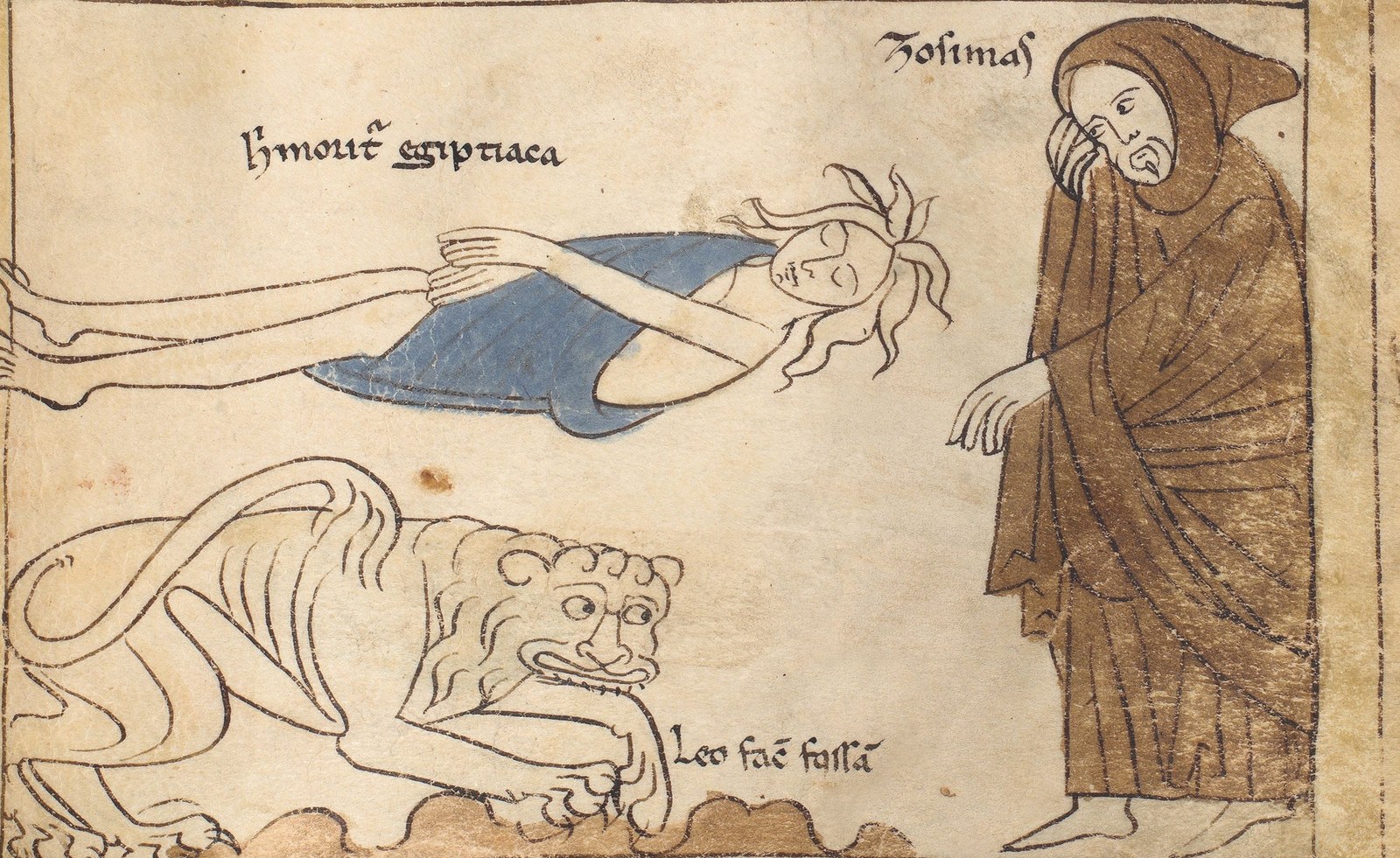
Miniature: The lion digs the grave; the elder Zosima weeps for the venerable one · Navarre, c. 1200
14 · The desert beyond the Jordan, by the stream; the first day of April

Repose. The lion digs the grave — as the Life relates

Having partaken of the Mysteries on the bank of the Jordan, I reached in one hour the place of my repose — that stream to which the elder came after twenty days of a difficult journey — and gave up my soul to God. This was in the month which in Egyptian is Pharmuthi, in Roman April, on the first day, in the night of the saving Passion of Christ, after the Communion of the Divine Mysteries.

As the Life relates, yet another year passed, and Zosima again went out into the desert. Reaching the place where the stream flowed, he saw to the east the venerable one lying dead; her hands were folded as is fitting for those lying in the grave, her face turned to the east. He saw at the head of the blessed one an inscription traced on the ground: «Bury, Abba Zosima, in this place the body of humble Mary, and return dust to dust. Pray to God for me who departed in the month which in Egyptian is Pharmuthi, in Roman April, on the first day, in the night of the saving Passion of Christ, after the Communion of the Divine Mysteries.»

He took a branch of a tree cast away in the desert and began to dig, but the dry earth did not yield to the elder’s efforts. Suddenly, raising his eyes, he saw a huge lion standing by the body of the venerable one and licking her feet. Zosima said to the beast that he was old and could not dig the grave: «Dig thou with thy claws a grave, and I will bury the body of the venerable one.» The lion with its forepaws dug a pit sufficient for burial. The elder covered the body with earth. Then both departed: the lion, meek as a lamb, into the depths of the desert, and Zosima to his monastery.

Having come to the monastery, he told all the monks about the venerable Mary, and all resolved with fear, faith and love to venerate the memory of the venerable one and to celebrate the day of her falling asleep. And Saint Sophronius, having heard the account, wrote it down.

Source — St Demetrius of Rostov, “Lives of the Saints”
he learned that the saint, having received Communion on the bank of the Jordan, had in one hour reached the place of her repose, to which he had come after twenty days of arduous journey, and had straightway given up her soul to God. […] Another year passed. Zosima again went into the desert, following the monastery’s custom […] the elder reached the place where the stream flowed and, standing on the bank, he saw to the east the venerable one lying dead; her hands were folded as is fitting for those laid in the grave, her face turned to the east. […] For a long time he wept; then, having read the appointed psalms and prayers for the burial, he began to consider whether he could bury the body of the venerable one, and whether it would be pleasing to her. Then he saw at the head of the blessed one an inscription traced upon the ground: «Bury, Abba Zosima, in this place the body of humble Mary, and return dust to dust. Pray to God for me who departed in the month, in Egyptian Pharmuthi, in Roman April, on the first day, in the night of the saving Passion of Christ, after the Communion of the Divine Mysteries […]» But he was greatly rejoiced that he had learned the name of the venerable one. […] Then he saw near him a branch of a tree cast away in the desert, took it and began to dig. Yet the dry earth did not yield to the elder’s efforts […] Suddenly, raising his eyes, he saw a huge lion standing by the body of the venerable one and licking her feet. […] He signed himself with the sign of the Cross in the certainty that the power of the departed saint would guard him. […] Then Zosima said to the beast: «The great ascetic commanded me to bury her body, but I am old and cannot dig the grave; neither have I any tool for digging, and the monastery is far away, so I cannot quickly bring one from there. Dig thou with thy claws a grave, and I will bury the body of the venerable one.» […] The lion seemed to understand these words and with its forepaws dug a pit sufficient for the burial. […] and covered her body with earth. […] Then both departed: the lion, meek as a lamb, into the depths of the desert, and Zosima to his monastery, blessing and glorifying Christ our God. […] Having returned to the monastery, he told all the monks about the venerable Mary, concealing nothing of what he had seen and heard. All were amazed at the greatness of God and resolved with fear, faith and love to venerate the memory of the venerable one and to celebrate the day of her departure. […] And I, adds Saint Sophronius, having heard the account, wrote it down.
The Church sings

Troparion, tone 8

In you, mother, it is known that you were saved, even in the image, / having accepted the cross, you followed Christ / and, having taught you to despise the flesh, it passes away, / to be diligent about the soul of things more immortal.// In the same way, O Reverend Mary, your spirit will rejoice with the Angels.

The life in the border scenes of the icon
Venerable Mary of Egypt с клеймами жития
Venerable Mary of Egypt, with Scenes from Her Life in 16 Border Scenes. Ivan Vasilyevich Bogatyryov, Nevyansk, 1804. State Museum of the History of Religion (St Petersburg), inv. B-7355-IV. Public domain. For excerpts 5, 9, 13 and 14 — the authentic depictions of the same subjects: a lubok “The Life of Venerable Mary of Egypt” (A. I. Shangin, Kirillo-Belozersky Museum-Reserve), a Russian icon of c. 1600 (Louvre, RF 1972 52), a Serbian-school icon of 1723 (Petit Palais, Paris, PPP4884) and a miniature from the Pamplona Bible of c. 1200 (University Library of Augsburg, fol. 247r). All — public domain.
Troparion, Kontakion and Prayers to Venerable Mary of EgyptPrayer Book: Mary of EgyptSt Dimitry of Rostov, “Lives of the Saints”, in our libraryAll lives