ORTHODOX HOUSENewsCommunityCalendarPrayer BookLives of the Saints
Holy Prophet, Forerunner and Baptist of the Lord John
Lives of the Saints · the saint tells his own story

Holy Prophet, Forerunner and Baptist of the Lord John

Commemorated: Conception 23 September (6 October) · Nativity 24 June (7 July) · Synaxis 7 (20) January · First and Second Finding of the Head 24 February (9 March) · Third Finding of the Head 25 May (7 June) · Beheading 29 August (11 September) · 1st century · Judea — Jordan — Machaerus — Sebaste
«My father Zacharias was a priest of the lineage of Ithamar, the son of Aaron, and my mother Elizabeth was of the lineage of Aaron and was the sister of Anna, the mother of the Most Holy Theotokos…»
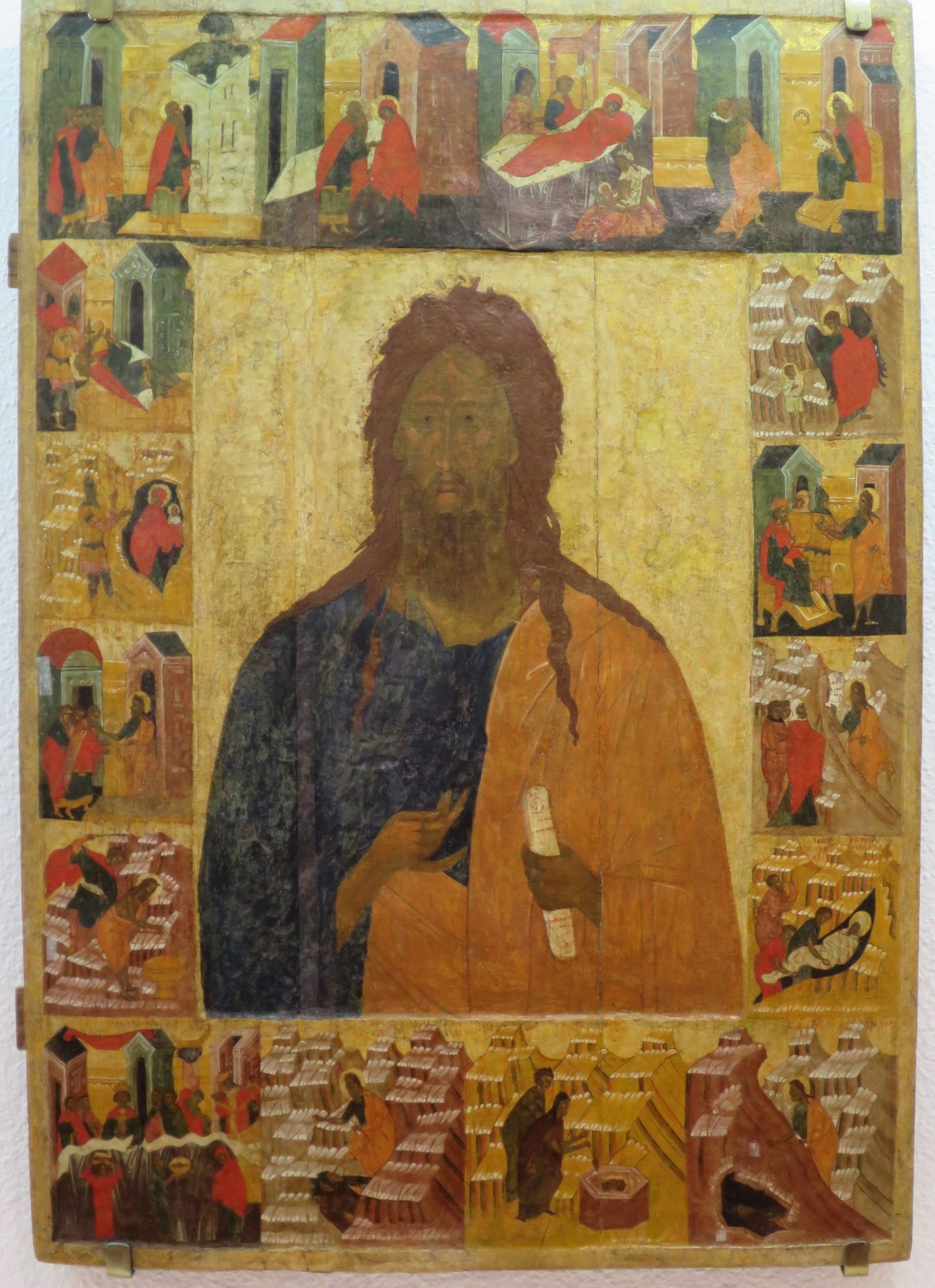
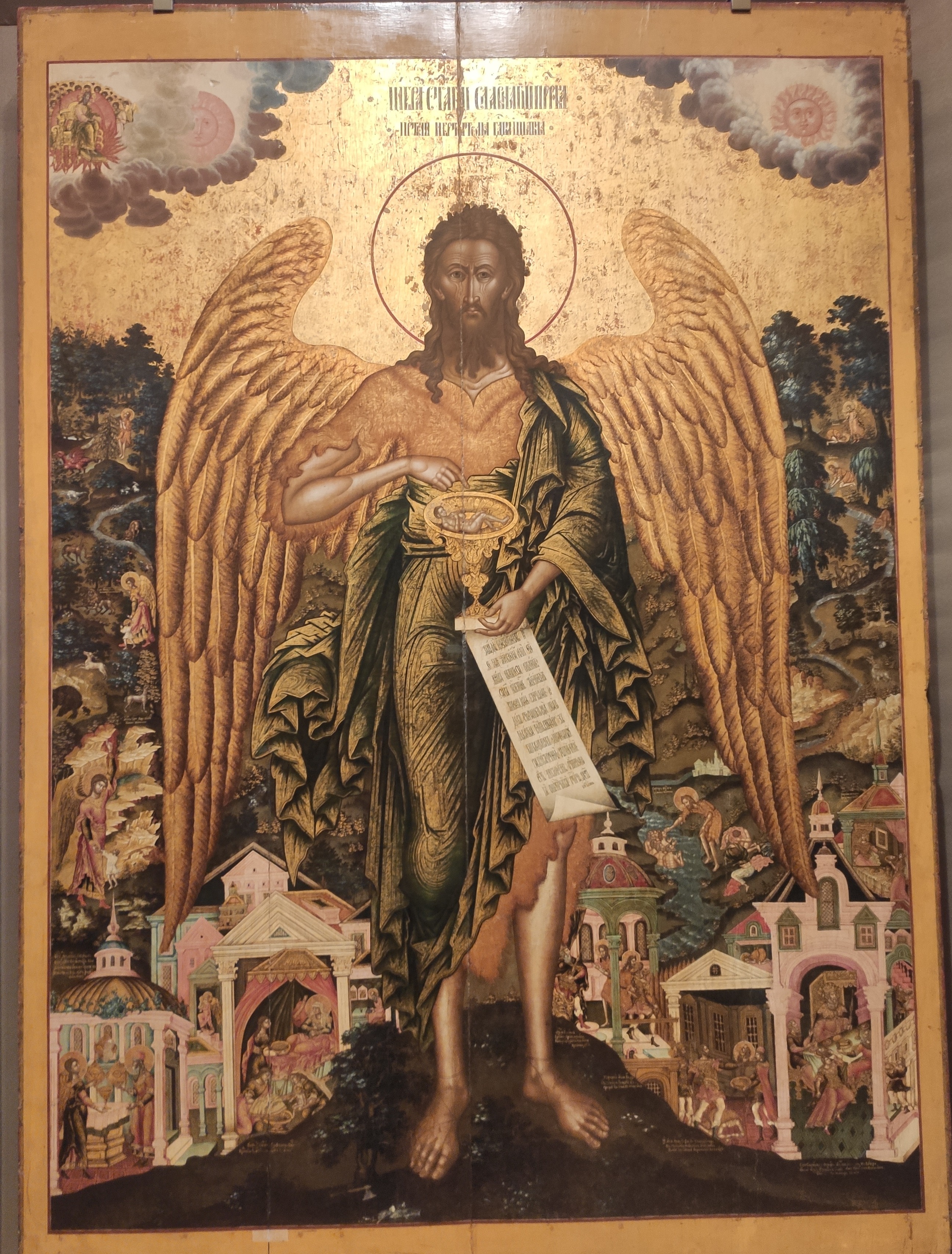
John the Forerunner, Angel of the Desert, in his Life. Yaroslavl school, late 17th century (from the Dormition Cathedral in Yaroslavl). State Tretyakov Gallery, Moscow, inv. 22295. Photo: Sogomon Matevosyan, Wikimedia Commons. CC BY-SA 4.0.
How this is made. First-person narrative — a literally close paraphrase of the Lives by St Dimitry of Rostov for all the commemorations of the Forerunner: Conception (23 September), Nativity (24 June), Synaxis (7 January), Findings of the Venerable Head (24 February), Account of the Right Hand (7 January), Life of the Prophet Zacharias (5 September) and Beheading (29 August). Not a single fact that is absent from the sources. Beneath each excerpt stands the text of the saint himself. Source: St Dimitry of Rostov. Lives of the Saints. Month of August, day 29 — Account of the Beheading of the Holy Prophet, Forerunner and Baptist of the Lord John. The face is an authentic icon; the light and breathing make it a “living icon”, with no talking lips. The pictures beside the passages are the border scenes of the icon of his life. There is no voice: the reading is yours.
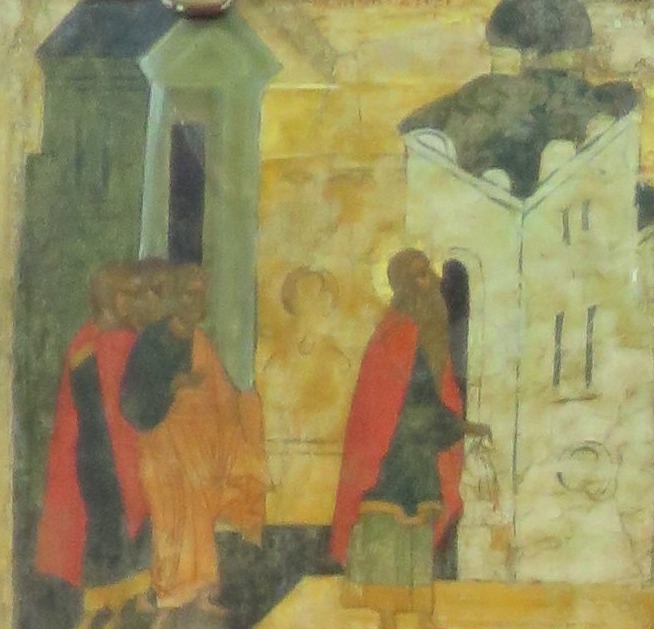
Zacharias in the Temple at the Altar of Incense; the Appearance of the Angel
Border scene of the icon: Zacharias in the Temple at the Altar of Incense; the Appearance of the Angel · Russia, 16th century
1 · Jerusalem, the Temple of the Lord

The Annunciation at the Altar of Incense

My father Zacharias was a priest of the lineage of Ithamar, the son of Aaron, and my mother Elizabeth was of the lineage of Aaron and was the sister of Anna, the mother of the Most Holy Theotokos. The Holy Gospel testifies of them that both were righteous before God, walking in all the commandments and ordinances of the Lord blamelessly; but they had no child, for my mother was barren and both were well advanced in years.

My father was serving as a priest in Jerusalem in the days of Herod, and was of the course of Abijah, whose turn fell in the eighth week; he was the chief among the other priests of his division. Once, while fulfilling his course, he was ministering before God, and according to the custom of the priests it fell to him to enter the Temple of the Lord to burn incense; and the multitude of the people were praying without at that time.

Entering the sanctuary, my father saw an Angel of the Lord standing on the right side of the altar of incense, and fear came upon him at the sight of the Angel. But the messenger of God calmed him and said: «Fear not, Zacharias: thy prayer is heard, and thy wife Elizabeth shall bear thee a son, and thou shalt call his name John. And many shall rejoice at his birth».

Thus the bearer of good tidings, the holy Archangel Gabriel, entering the altar to the priest who was then ministering before God, announced my conception. For there are few mothers whose conception is glorified and celebrated by the Holy Church, and all these conceptions were announced by an Angel and accomplished by the grace of God.

Source — St Demetrius of Rostov, “Lives of the Saints”
The holy prophet Zacharias, a priest of the lineage of Ithamar, the son of Aaron, had a wife named Elizabeth, who was also of the lineage of Aaron and was the sister of Anna, the mother of the Most Holy Theotokos. […] both were righteous before God, walking in all the commandments and ordinances of the Lord blamelessly […] He was of the course of Abijah, that is, of the family of Abijah, whose turn fell in the eighth week. […] according to the custom of the priests, it fell to him to enter the Temple of the Lord to burn incense; and the multitude of the people were praying without at that time […] Entering the sanctuary, Zacharias saw an Angel of the Lord standing on the right side of the altar of incense. At the sight of the Angel, fear came upon Zacharias […] Therefore the bearer of good tidings, the holy Archangel Gabriel, entering the altar to the priest Zacharias who was then ministering before God, said: […] Fear not, Zacharias: thy prayer is heard, and thy wife Elizabeth shall bear thee a son, and thou shalt call his name John. And many shall rejoice at his birth.
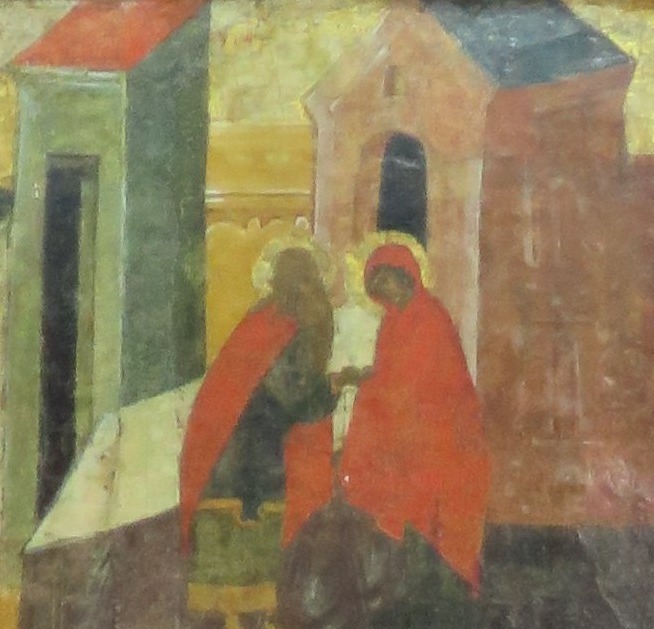
The Conception of John the Forerunner: Zacharias and Elizabeth
Border scene of the icon: The Conception of John the Forerunner: Zacharias and Elizabeth · Russia, 16th century
2 · Jerusalem, the Temple — Hebron, the hill country

The Dumbness of Zacharias and the Loosing of Barrenness

My father answered the Angel: «That which thou proclaimest to me, joyful messenger, is both unexpected and strange, for it is unnatural to bear children in old age; I am old, and my wife is advanced in years: how can we conceive and bear a son?»

The Angel told him that this was the will of God, for Whom nothing is impossible, and reminded him: «Is it unknown to thee that God was able to create Adam from the earth, to form Eve from the bone of Adam, and to grant a son Isaac to the aged Sarah?» And he revealed of himself: «I am Gabriel, that stand in the presence of God». And he said that the son who would be born would be great before the Lord and in spiritual greatness would surpass the prophet Jeremiah: if the latter received sanctification before his birth, the former would be filled with the Holy Spirit even from his mother’s womb; Jeremiah was destined only to prophesy of the Messiah, while this one would be counted worthy both to lay his hand upon Him and to baptise Him.

My father still doubted and asked for a sign, and therefore heard: «But because thou believest not my words, thou shalt be dumb and not able to speak until the day that these things shall be performed». And immediately dumbness bound his lips, while the bonds of my mother’s barrenness were loosed; and the Angel departed to the throne of the Almighty.

Since Zacharias had tarried in the sanctuary while conversing with the Angel, the people who were in the church marvelled. When he came out to the people, he was compelled to make signs that he had become dumb; then those present understood that he had seen a vision in the sanctuary. Having completed his course, my father returned to his house, which was in the hill country, in Hebron, a city of Judah.

Source — St Demetrius of Rostov, “Lives of the Saints”
That which thou proclaimest to me, joyful messenger, is both unexpected and strange, for it is unnatural to bear children in old age; I am old, and my wife is advanced in years: how can we conceive and bear a son? […] Truly, that which I proclaim is not according to thy nature, but this is the will of God, for Whom nothing is impossible […] Is it unknown to thee that God was able to create Adam from the earth, to form Eve from the bone of Adam, and to grant a son Isaac to the aged Sarah? […] I am Gabriel, that stand in the presence of God […] if the latter received sanctification before his birth, the former would be filled with the Holy Spirit even from his mother’s womb; Jeremiah was destined only to prophesy of the Messiah, while this one would be counted worthy both to lay his hand upon Him and to baptise Him […] But because thou believest not my words, thou shalt be dumb and not able to speak until the day that these things shall be performed. And immediately dumbness bound the lips of Zacharias, while the bonds of the barrenness of Elizabeth were loosed. And the Angel departed to the throne of the Almighty. […] Since Zacharias had tarried in the sanctuary while conversing with the Angel, the people who were in the church marvelled. When he came out to the people, Zacharias was compelled to make signs that he had become dumb; then those present understood that he had seen a vision in the sanctuary. Having completed his course, Zacharias returned to his house, which was in the hill country, in Hebron, a city of Judah.
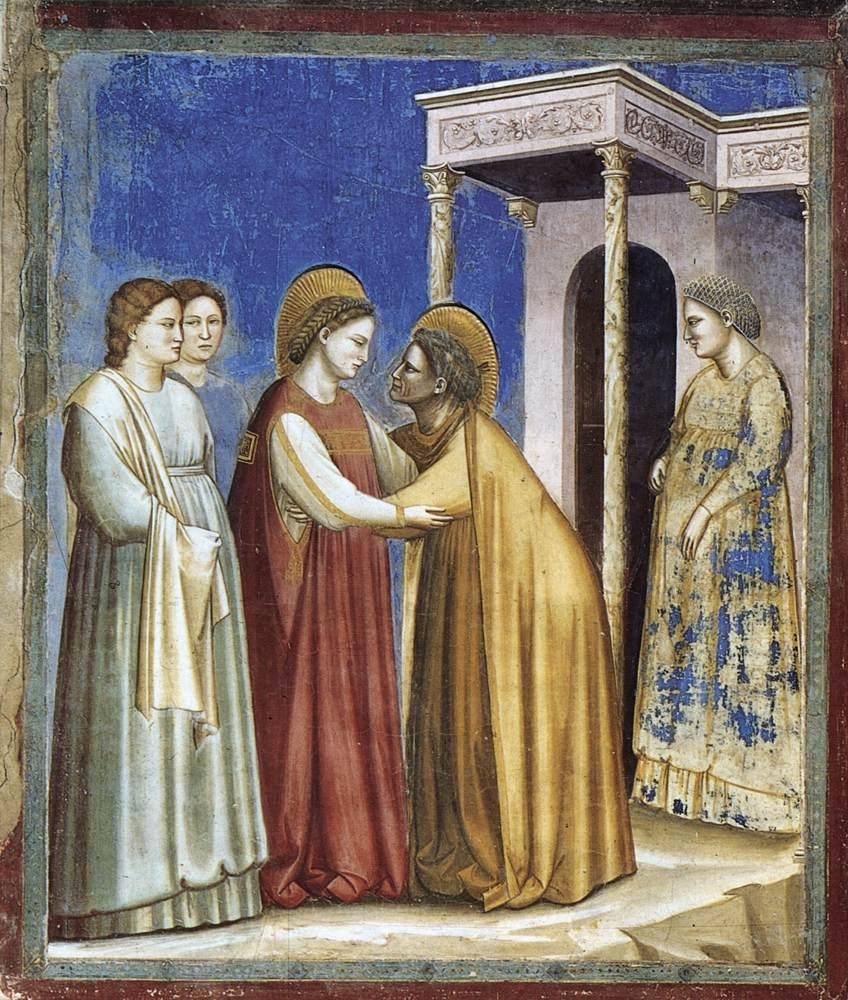
The Meeting of the Most Holy Theotokos and Righteous Elizabeth (the Kiss of Elizabeth).
Fresco: The Meeting of the Most Holy Theotokos and Righteous Elizabeth (the Kiss of Elizabeth). · Fresco, Western tradition, Giotto, 1306
3 · Hebron, the hill country

The Mother of the Lord in the house of Zacharias

When the Unsetting Sun of righteousness — our Saviour — desired to shine upon the world and had already bowed the heavens and dwelt in the most pure virgin womb, at that very time the birth of His Forerunner from a barren woman was to take place. Righteous Anna conceived the Theotokos, Elizabeth — the Forerunner, and the Virgin Mary — Christ our Saviour.

And Mary arose in those days and went into the hill country with haste, into a city of Judah, and entered into the house of Zacharias, and saluted Elizabeth. My mother, having a prophet for a husband and having given birth to a prophet-son, was herself also filled with the prophetic gift and prophetically recognised the coming to her of the Mother of God when she said: «And whence is this to me, that the mother of my Lord should come to me?» (Lk. 1:43).

To my father the Angel announced that I would be filled with the Holy Spirit even from my mother’s womb and would go before the face of the Lord in the spirit and power of Elias; and behold, the Mother of my Lord herself came into the house of my father before my birth.

Thus one wonder preceded another: before the Virgin gives birth to Christ, she who was advanced in days gives birth to Christ’s Forerunner, so that those who had seen the supernatural birth from one grown old might believe also in the preternatural birth from an unwedded virgin and say to themselves that the almighty Right Hand of God, which had loosed the barrenness of the aged woman, is also able to make the incorrupt Virgin a pure Mother.

Source — St Demetrius of Rostov, “Lives of the Saints”
At the time when the conception of our Saviour was drawing near, the conception of the holy John the Forerunner took place in a glorious and miraculous manner. […] Righteous Anna conceived the Theotokos, Elizabeth — the Forerunner, and the Virgin Mary — Christ our Saviour. […] When the Unsetting Sun of righteousness — our Saviour — desired to shine upon the world and had already bowed the heavens and dwelt in the most pure virgin womb, at that very time the birth of His Forerunner from a barren woman was to take place […] she went into the hill country, into a city of Judah, that is, to Hebron, and entered into the house of Zacharias, and saluted Elizabeth […] having a prophet for a husband and having given birth to a prophet-son, holy Elizabeth was herself also filled with the prophetic gift and by prophetic foreknowledge insisted […] And whence is this to me, that the mother of my Lord should come to me? […] before the Virgin gives birth to Christ, she who was advanced in days gives birth to Christ’s Forerunner, so that those who had seen the supernatural birth from one grown old might believe also in the preternatural birth from an unwedded virgin
The Naming: Zacharias writes “John” on the tablet
Border scene of the icon: The Naming: Zacharias writes “John” on the tablet · Russia, 16th century
4 · Hebron, the house of Zacharias

The Birth and Naming

And behold, when the time was fulfilled for my mother to give birth, she brought forth a son in her old age, from a womb grown old, as in the most ancient times Sarah gave birth to Isaac. All her kinsfolk, neighbours and acquaintances, hearing of this birth, rejoiced with her, because the Lord had shown her great mercy — He had taken away from her the reproach of childlessness. Thus were fulfilled the words of God’s messenger: «thy wife Elisabeth shall bear thee a son, and thou shalt have joy and gladness; and many shall rejoice at his birth» (Lk. 1:13–14).

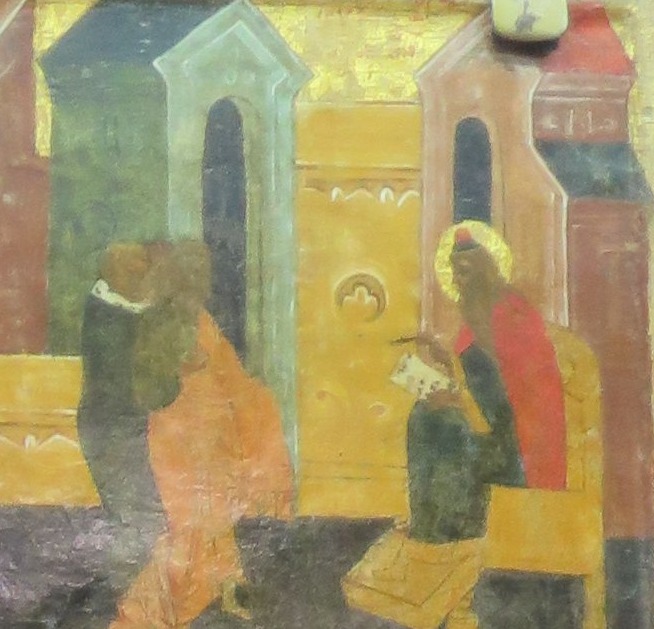
On the eighth day after my birth the priests and kinsmen of my father came to his house to take part in the rite of the circumcision of the child, and they wished to call me by my father’s name — Zacharias. But my mother did not consent to this; guided by the Holy Spirit, she called the child John — prophetically, for she could not have heard this from her husband; Zacharias had returned from the temple to his house with his tongue, as it were, bound.

Then the priests and kinsmen began to ask my father by signs what he would have the child called. He asked for a writing tablet and wrote upon it: «His name is John» (Lk. 1:63). And immediately the mouth of Zacharias was opened and his tongue was loosed from the bonds of muteness, and he began to speak, glorifying God.

All marvelled at so many wonders: both that one grown old had given birth to a child, and that the father who had been mute was of one mind with the mother concerning the child’s name, and that the dumb man, after writing the name, began to speak. And they thought with wonder: «What manner of child shall this be!» (Lk. 1:66). And my father, being filled with the Holy Spirit, prophesied: «And thou, child, shalt be called the prophet of the Highest: for thou shalt go before the face of the Lord to prepare His ways» (Lk. 1:68–79).

Source — St Demetrius of Rostov, “Lives of the Saints”
And behold, when the time was fulfilled for holy Elizabeth to give birth, she brought forth a son in her old age, from a womb grown old, as in the most ancient times Sarah gave birth to Isaac. […] all her kinsfolk, neighbours and acquaintances, hearing of this birth, rejoiced with her, because the Lord had shown her great mercy […] thy wife Elisabeth shall bear thee a son, and thou shalt have joy and gladness; and many shall rejoice at his birth […] the priests and kinsmen of Zacharias came to his house to take part in the rite of the circumcision of the child; and they wished to call him by his father’s name — Zacharias. But the mother of the child did not consent to this […] Thus, guided by the Holy Spirit, the holy mother calls the child John — prophetically […] Then the priests and kinsmen began to ask Zacharias by signs what he would have the child called. He asked for a writing tablet and wrote upon it: «His name is John» […] And immediately the mouth of Zacharias was opened and his tongue was loosed from the bonds of muteness, and he began to speak, glorifying God. […] And thou, child, shalt be called the prophet of the Highest: for thou shalt go before the face of the Lord to prepare His ways
The Flight of Elizabeth with the Infant: the Mountain Parts before the Soldier of Herod
Border of the icon: The Flight of Elizabeth with the Infant: the Mountain Parts before the Soldier of Herod · Russia, 16th century
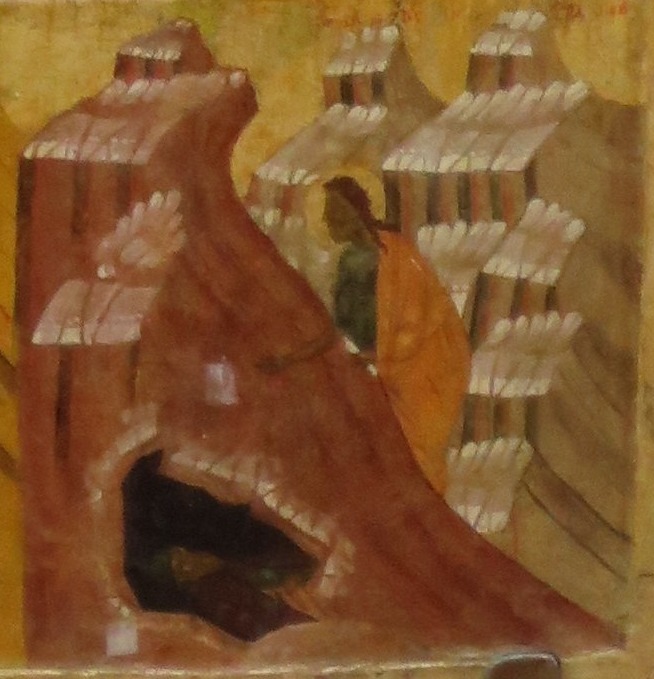
5 · Hebron — the highest mountains of the desert

The Flight to the Mountains: “O Mountain of God, receive the mother with the child!”

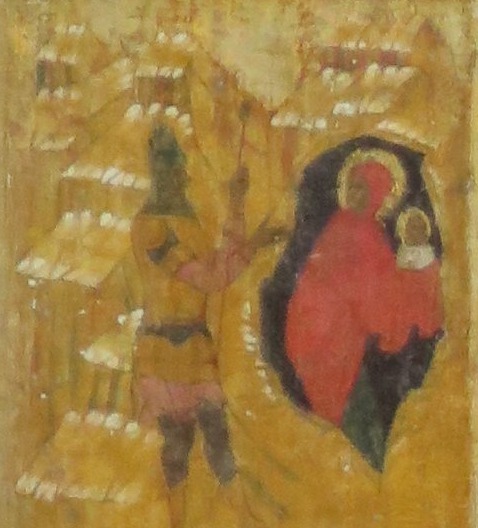
When our Lord Jesus Christ was born in Bethlehem of Judea and wise men came from the east inquiring about the newborn King of the Jews, then Herod, having sent soldiers to Bethlehem with orders to slay all the male children there, remembered also me, the son of Zacharias, of whom he had heard many wondrous things, and began to consider: is he not the future king of the Jews? And, tormented by malice, he devised to slay me also, and for this purpose he deliberately sent murderers to Hebron, to the house of my father.

When the godless slaughter of the children began in Bethlehem, the outcry and lamentation that arose in Bethlehem reached even to Hebron, which stood at no great distance from the city of David, and here they learned the cause of the weeping. I was then already a year and a half old. My mother, taking me, at once hastened to the highest mountains of the wilderness; my father at that time was in Jerusalem, fulfilling the course of his priestly service that had fallen to him.

Having hidden in the mountains, my mother with tears prayed to God, asking Him to protect her with me. And when from the height of the mountains she saw the approaching soldiers, who were diligently seeking us and were already near, she cried out in terror, turning to a rocky cliff: «O mountain of God! Receive a mother with her child!» And immediately the mountain parted, received us within, and thus concealed us from the pursuing murderers. So the soldiers, not finding the one they sought, returned to him who had sent them empty-handed.

Source — St Demetrius of Rostov, “Lives of the Saints”
When our Lord Jesus Christ was born in Bethlehem of Judea and wise men came from the east […] then Herod, having sent soldiers to Bethlehem with orders to slay all the male children there, remembered also John, the son of Zacharias, of whom he had heard many wondrous things […] Therefore, tormented by malice, he devised to slay him also, and for this purpose he deliberately sent murderers to Hebron, to the house of Zacharias. […] When the godless slaughter of the children began in Bethlehem, the outcry and lamentation that arose in Bethlehem reached even to Hebron, which stood at no great distance from the city of David […] Then holy Elizabeth, taking her son, the child John, who was then already a year and a half old, fled with him to the mountains. […] Holy Elizabeth, taking the child John, at once hastened to the highest mountains of the wilderness (at that time holy Zacharias was in Jerusalem, fulfilling the course of his priestly service that had fallen to him). […] O mountain of God! Receive a mother with her child! And immediately the mountain parted, received Elizabeth with the child John within, and thus concealed them from the pursuing murderers.
The Slaying of Zacharias in the Temple
Border of the icon: The Slaying of Zacharias in the Temple · Russia, 16th century
6 · Jerusalem, the Temple of the Lord

The Slaying of Zacharias between the Temple and the Altar

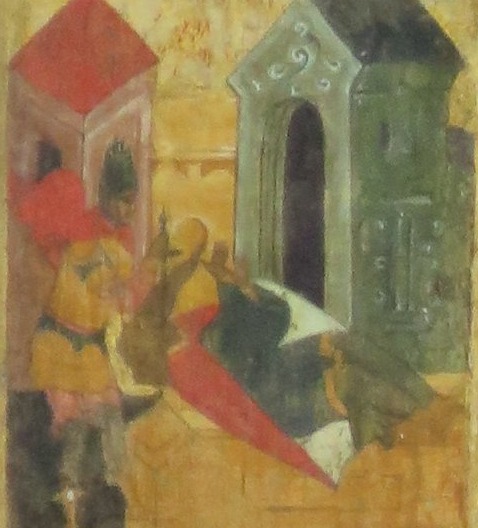
Then Herod sent to the temple to my father his armorbearer to say to him: give me your son. Saint Zacharias answered: «I am now serving the Lord God of Israel, and where my son is at present I do not know».

Herod was greatly enraged and again sent to him his armorbearer to say that if he did not hand over his son, he himself would die. And soldiers came to him, fierce as wild beasts, ready to carry out the command of the lawless king, and with fury they said to the priest of God: where have you hidden your son? Hand him over to us, for the king has commanded us to kill you at once if you do not hand over your son to us.

Zacharias answered them courageously: «You will kill my body, but the Lord will receive my soul». And immediately the murderers, carrying out the lawless command, rushed with fury upon the saint and slew him between the temple and the altar (Mt. 23:35). His shed blood, having soaked in, remained on the marble and became like stone, as a witness to the crime of Herod and his eternal condemnation.

Thus my father, clothed with the vestment of the priesthood, was a lamp and beholder of mysteries and was slain by the sword in the temple of God; and now he prays together with me to Christ for the salvation of your souls.

Source — St Demetrius of Rostov, “Lives of the Saints”
Then Herod sent to the temple to Zacharias his armorbearer to say to him: give me your son […] I am now serving the Lord God of Israel, and where my son is at present I do not know. […] Herod was greatly enraged and again sent to Zacharias his armorbearer to say that if he did not hand over his son, he himself would die. And soldiers came to him, fierce as wild beasts, ready to carry out the command of the lawless king […] Where have you hidden your son? Hand him over to us, for the king has commanded us to kill you at once if you do not hand over your son to us. […] You will kill my body, but the Lord will receive my soul. […] And immediately the murderers, carrying out the lawless command, rushed with fury upon the saint and slew him between the temple and the altar […] His shed blood, having soaked in, remained on the marble and became like stone, as a witness to the crime of Herod and his eternal condemnation. […] you were a lamp and beholder of mysteries
An Angel Leads the Infant John into the Wilderness
Border scene of the icon: An Angel Leads the Infant John into the Wilderness · Russia, 16th century
7 · The Wilderness, the Parted Mountain

The Cave in the Mountain and Growth in the Wilderness

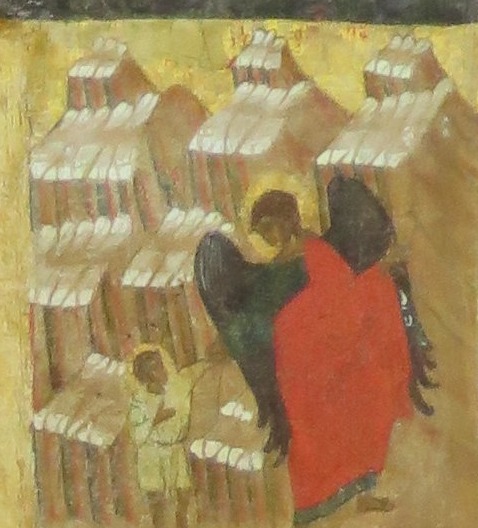
My mother, hidden by God together with me, remained in the parted mountain. In it, by God’s command, a cave was formed for us; near it a spring appeared and a date-palm grew, full of fruit. Every time the hour for taking food came, the tree would bend down, offering us its fruit, and when we were satisfied, it would straighten up again.

Forty days after the slaying of my father, my mother reposed in the said cave. From that time I was fed by an Angel until I came of age and was preserved in the wilderness until the day of my appearing to the people of Israel. Thus the hand of God preserved and sheltered me, that I might go before the face of the Lord in the spirit and power of Elias and prepare the way for Him Who comes to save the human race.

An Angel had foretold to my father that I would be great before the Lord not in body but in spirit, that I would be a faster and would lead such an abstinent life as no other. And such was the testimony of the Son of God Himself: «For John the Baptist came neither eating bread nor drinking wine» (Lk. 7:33). Thus I lived in the wilderness — a virgin and a desert-dweller — until the day of my appearing to Israel came.

Source — St Demetrius of Rostov, “Lives of the Saints”
Meanwhile Elizabeth, hidden by God together with John, remained in the parted mountain. In it, by God’s command, a cave was formed for them; near it a spring appeared and a date-palm grew, full of fruit. […] Every time the hour for taking food came, the tree would bend down, and when they were satisfied with the fruit, it would straighten up again. […] holy Elizabeth reposed in the said cave. From that time Saint John was fed by an Angel until he came of age, preserved until the day of his appearing to the people of Israel. […] Thus the hand of God preserved and sheltered Saint John, that he might go before the face of the Lord in the spirit and power of Elias and prepare the way for Him Who comes to save the human race. […] his son will be great before the Lord not in body but in spirit; he will be a faster and will lead such an abstinent life as no other […] For John the Baptist came neither eating bread nor drinking wine […] as a virgin, as a desert-dweller
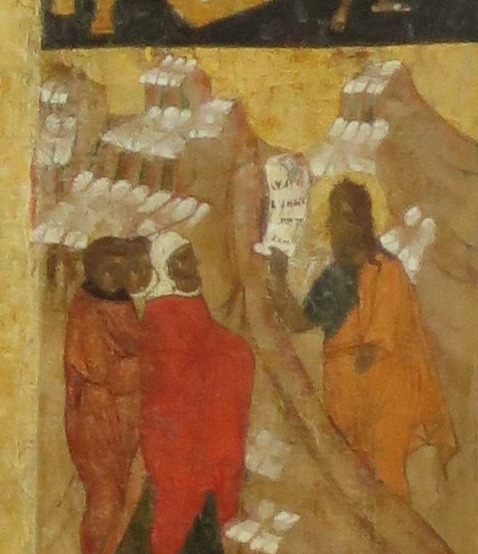
The preaching of John in the wilderness
Border scene of the icon: The preaching of John in the wilderness · Russia, 16th century
8 · The wilderness — the Jordan

Appearance to Israel: the preaching of repentance

When the day of my appearing to the Israelites came, I came forth from the wilderness — a zealot for the law of God, a reprover of human sins and a preacher of repentance. I turned many of the sons of Israel to the true Lord God and prepared the people to receive the Lord and Saviour, going before Him in the spirit and power of the prophet Elijah.

As the forerunner, it was fitting for me to precede the appearance of the Lord, preaching and saying: «There cometh one mightier than I after me» (Mk. 1:7). Thus also did my father prophesy of me on the day when his tongue was loosed: «thou shalt go before the face of the Lord to prepare His ways; to give knowledge of salvation unto His people by the remission of their sins, through the tender mercy of our God; whereby the dayspring from on high hath visited us, to give light to them that sit in darkness and in the shadow of death, to guide our feet into the way of peace» (Lk. 1:76–79).

Many stars appear before the rising of the sun, but only the daystar precedes the sun itself. So also I, the daystar of the Sun of Righteousness that knoweth no setting, went before Him and called the people to repentance; and now, as before in the world, I preach repentance.

Source — St Demetrius of Rostov, “Lives of the Saints”
kept in the wilderness until the day of his appearing to the Israelites […] a zealot for the law of God, a reprover of human sins and a preacher of repentance […] he will turn many of the sons of Israel to the true Lord God, that he will be the Forerunner of Christ in the spirit and power of the prophet Elijah and will prepare the people to receive the Lord and Saviour […] as the forerunner, it was fitting for him to precede the appearance of the Lord, preaching and saying: «There cometh one mightier than I after me» […] to give knowledge of salvation unto His people by the remission of their sins, through the tender mercy of our God; whereby the dayspring from on high hath visited us, to give light to them that sit in darkness and in the shadow of death, to guide our feet into the way of peace […] Many stars appear before the rising of the sun, but only the daystar precedes the sun itself. […] as before in the world, thou preachest repentance
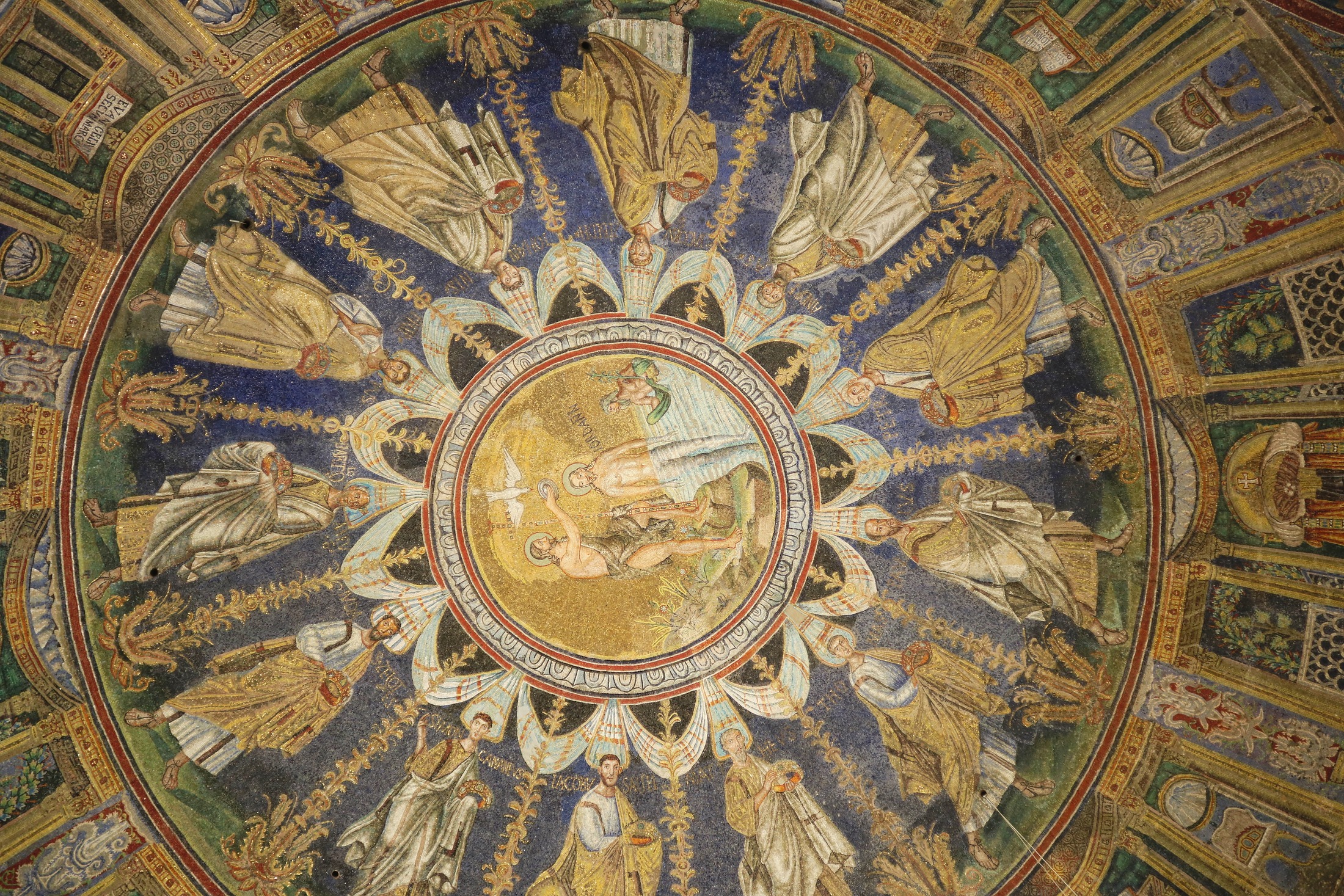
The Baptism of the Lord Jesus Christ in the Jordan; John lays his hand on the head of Christ, the Holy Spirit descends in the form of a dove.
Mosaic: The Baptism of the Lord Jesus Christ in the Jordan; John lays his hand on the head of Christ, the Holy Spirit descends in the form of a dove. · Mosaic, Ravenna, 5th century
9 · The Jordan

The Baptism of the Lord and the testimony: «Behold the Lamb of God»

An angel announced to my father that Jeremiah was destined only to prophesy concerning the Messiah, while his son would be counted worthy both to lay his hand upon Him and to baptise Him. And this was fulfilled at the Jordan, where I baptised Christ: I ministered to the mystery of divine baptism, laying my hand upon the head of the Master.

Jordan was afraid at His coming in the flesh and turned back in fear; I, fulfilling my prophetic ministry, hid myself in trembling; the angelic ranks were in awe, beholding Him being baptised in the streams in the flesh; and all who were in darkness were enlightened. In the streams I was counted worthy to baptise the One foretold, and having laid my hand upon Him in the Jordan, I appeared as prophet and preacher, and at the same time Forerunner.

How could I fail to know Him Whom I myself had baptised, over Whom I had seen the Holy Spirit descending from heaven, and concerning Whom I had heard the voice of the Father bearing witness? Many prophets preached of the coming of the Messiah, but to me it was granted not only to preach with the word, but also with my own finger to point out to the people the Lamb of God that taketh away the sins of the world. And, pointing to Him with my finger, I said: «Behold the Lamb of God» (Jn. 1:36).

Before me all the prophets and the law itself prophesied; but I was the fulfilment of all the prophets, the end of the Old Testament, the forerunner of the new grace. Therefore the Angel also said to my father that his son would be great and greater than all those born of women. And it was not for myself that I gathered disciples: I pointed with my finger to the Lamb of God so that they would follow Him and not me.

Source — St Demetrius of Rostov, “Lives of the Saints”
Jeremiah was destined only to prophesy concerning the Messiah, while this one would be counted worthy both to lay his hand upon Him and to baptise Him […] who ministered to the mystery of divine baptism, laying his hand upon the head of the Master […] in the temple at the Jordan, where he baptised Christ […] for how could he fail to know Him Whom he himself had baptised and over Whom he had seen the Holy Spirit descending from heaven, concerning Whom he had also heard the voice of the Father bearing witness […] having laid his hand upon Him in the Jordan, he appeared as prophet, preacher of the Word of God, and at the same time Forerunner […] not only would he preach with the word, but with his own finger he would point out to the people the Lamb of God that taketh away the sins of the world […] upon Whom, finally, he himself pointed with his finger, saying: – «Behold the Lamb of God» […] Before him all the prophets and the law itself prophesied; but this one would be the fulfilment of all the prophets, the end of the Old Testament, the forerunner of the new grace.
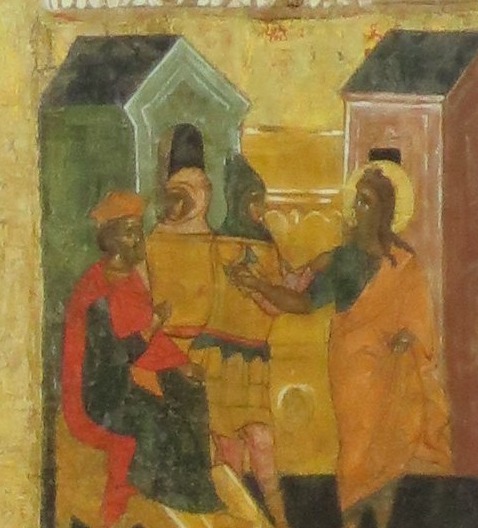
John rebukes Herod
Icon border scene: John rebukes Herod · Russia, 16th century
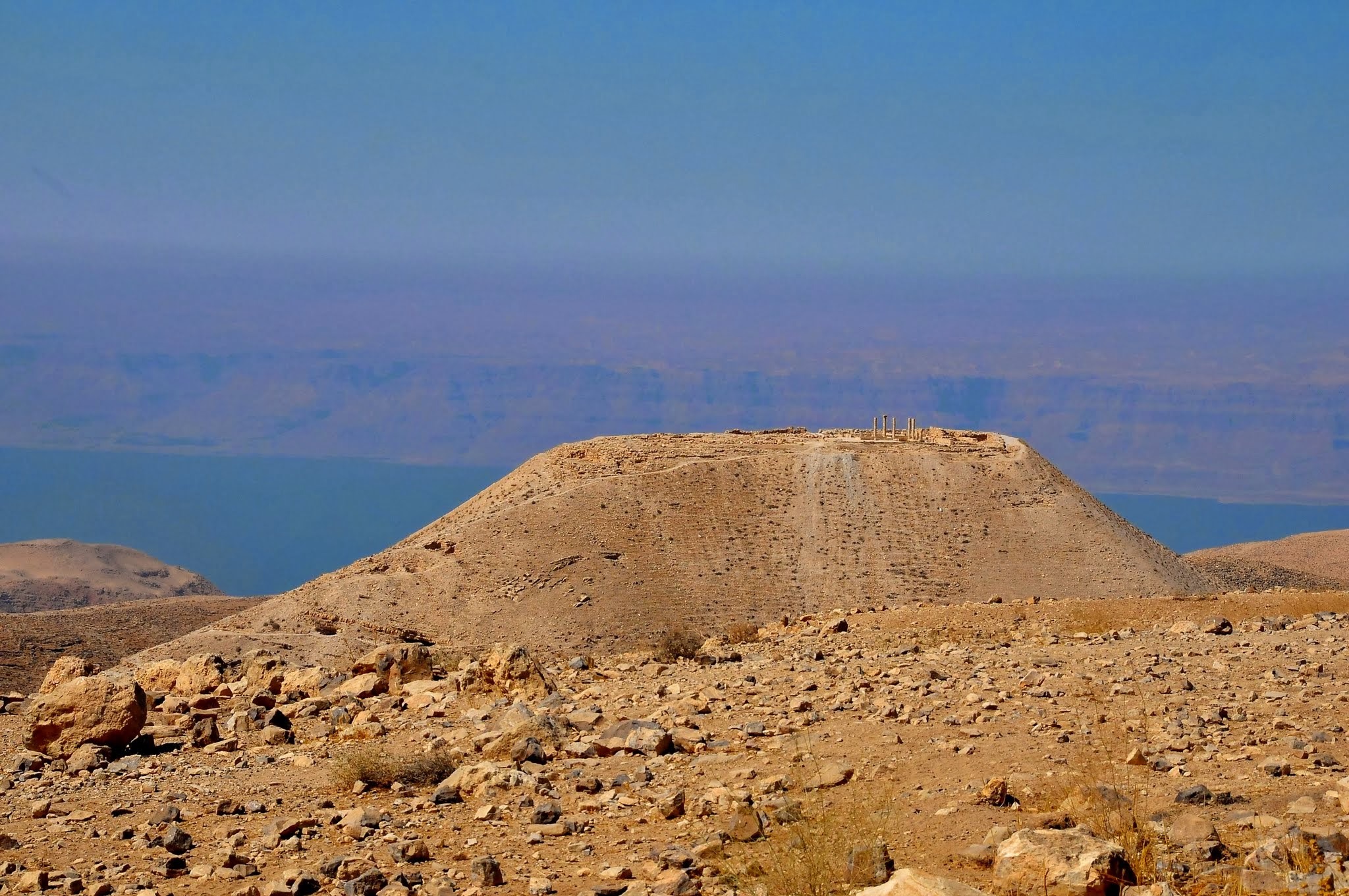
10 · Galilee — the fortress of Machaerus

The reproof of Herod and the prison

Herod, called Antipas, son of the elder Herod who had slain the infants of Bethlehem — an evil shoot from an evil root, who held Galilee in his power — was at first married to the daughter of Aretas, king of Arabia, and lived with her for a considerable time. But afterwards, being captivated by the beauty of Herodias, the wife of his brother Philip, he drove away his first lawful wife and married his brother’s wife, contrary to the law; and he took the wife from his brother while the latter was still alive, committing a great iniquity as a plunderer, an adulterer and an incestuous man.

Seeing such lawlessness, I did not remain silent, but before all I reproved Herod as an adulterer and a robber who had taken his brother’s wife, and I said to him: «It is not lawful for thee to have thy brother’s wife Philip’s wife». Herod, unable to bear the reproof, ordered that I be shut up in prison, bound with fetters — in the fortress of Machaerus, near the Dead Sea, on the border with Arabia.

His wife Herodias was especially angry with me and greatly desired my death, but she could not kill me, for Herod himself protected the prisoner from his wife’s murderous intent. Herod considered me a righteous and holy man; earlier he had listened to me with pleasure and, heeding my words, had done much good. Yet he feared men more than God: «and when he would have put him to death, he feared the multitude, because they counted him as a prophet» (Mt. 14:5). Therefore he did not dare to put the prophet, beloved and honoured by all, to open death, but only tormented me with imprisonment in the dungeon, wishing to close the mouth of his reprover that would not be silenced.

Source — St Demetrius of Rostov, “Lives of the Saints”
Herod, called Antipas, son of the elder Herod who had slaughtered the infants of Bethlehem – an evil branch from an evil root, having Galilee under his power, was at first married to the daughter of Aretas, king of Arabia; he lived with her for no little time. […] But later, being captivated by the beauty of Herodias, the wife of his brother Philip, he drew close to her […] he drove away from himself his first lawful wife and married his brother’s wife, contrary to the law […] thus he committed a great iniquity, as a plunderer, an adulterer and an incestuous man […] the holy John the Baptist did not remain silent, but before all openly rebuked Herod as an adulterer and a robber who had taken his brother’s wife, and said to him: – It is not lawful for you to have your brother Philip’s wife. […] Herod, unable to bear the rebuke, ordered that John be cast into prison, bound with fetters; Herod’s wife Herodias was especially angry with the saint and greatly desired his death, but could not kill him, for Herod himself protected the prisoner from his wife’s murderous intent. […] For this Herod shut him up in the fortress of Machaerus, which stood near the Dead Sea on the border with Arabia. […] and he wanted to kill him, but feared the people, because they held him to be a prophet.
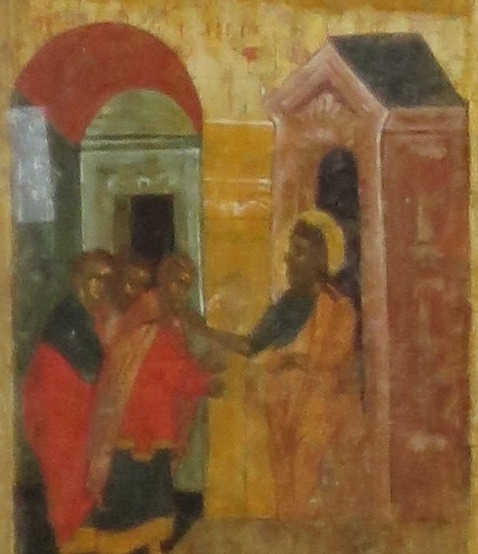
Those who came to John (evidently his disciples)
Icon border scene: Those who came to John (evidently his disciples) · Russia, 16th century
11 · Machaerus, the prison

The disciples in prison and the question to Christ

I remained in prison for a long time. My disciples gathered to me, and I often taught them the virtuous life according to the law of God, and proclaimed to them the Messiah Who had already come into the world, to Whom I also sent them.

Thus it is said in the Gospel: «And when John had heard in the prison the works of Christ, he sent two of his disciples and said unto Him, Art Thou He that should come, or do we look for another?» (Mt. 11:2–3). I sent them to ask not because I myself did not know: for how could I not know Him Whom I had baptized and over Whom I had seen the Holy Spirit descending from heaven, of Whom I had heard the voice of the Father bearing witness, and Whom at last I had pointed to with my finger, saying: «Behold the Lamb of God» (Jn. 1:36).

I sent my disciples to question the Lord so that they might see with their own eyes the glorious miracles which the Lord performed, and that they might be fully convinced that He had come to save the human race. For my bonds were already near their end, and it was needful for me to entrust my disciples to Him Whom I had preached.

Source — St Demetrius of Rostov, “Lives of the Saints”
The holy John remained in prison for a long time; his disciples gathered to him […] And when John had heard in the prison the works of Christ, he sent two of his disciples and said unto Him, Art Thou He that should come, or do we look for another? […] He sent them to ask not because he himself did not know; for how could he not know Him Whom he had baptized and over Whom he had seen the Holy Spirit descending from heaven, of Whom he had heard the voice of the Father bearing witness […] John sent his disciples to question the Lord so that his disciples might see with their own eyes the glorious miracles which the Lord performed and that they might be fully convinced that He (Jesus Christ) had come to save the human race.
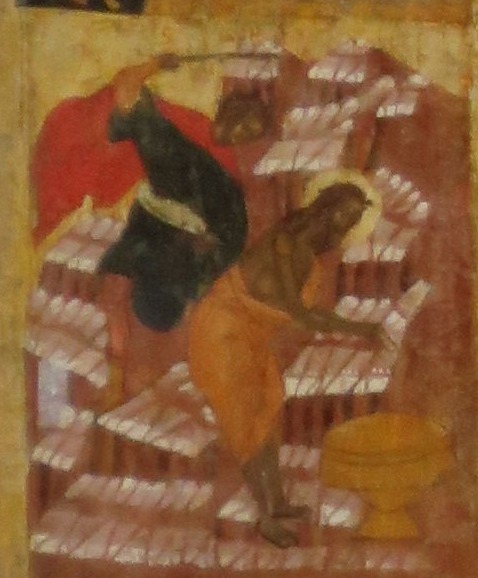
The Beheading of the Head of John the Forerunner
Icon border scene: The Beheading of the Head of John the Forerunner · Russia, 16th century
12 · Machaerus, the prison

Herod’s feast, the dance and the beheading

After some time the day came on which Herod was accustomed to celebrate his birthday. Gathering all his princes, commanders, elders and the tetrarchs of Galilee, he made for them a great feast. During this feast the daughter of Herodias danced and by her dancing greatly pleased Herod and those reclining with him; instructed by her cruel mother, she asked of Herod my head and received what she asked, for Herod had sworn to her to give her whatever she might ask, even up to half his kingdom.

The wretch would not break his oath, would not grieve the vile mother of the dancer, but forgot that fear by which until then he had not dared to kill me, forgot my life also and, as one drunken with wine, was inflamed with the intent to shed innocent blood. And straightway he sent an executioner to the prison, ordering him to cut off my head and bring it on a platter.

Thus for rebuking the unlawful cohabitation of Herod with Herodias was I beheaded in the prison, already late at night; for that abominable feast is called by the holy Evangelist Mark a supper, and that supper lasted far into the night. And my head was brought on a platter in the midst of the feast, with blood still dripping, and, as some relate, the head uttered the same words of rebuke even after the beheading, saying to Herod: «It is not lawful for you to have your brother Philip’s wife».

What great fear seized all those reclining and standing at that supper! And the dancer took this head in her audacious hands and carried it to her mother; Herodias, taking it, pierced the tongue that had rebuked her iniquities with a needle.

Source — St Demetrius of Rostov, “Lives of the Saints”
After some time the day came on which Herod was accustomed to celebrate his birthday. Gathering all his princes, commanders, elders and the tetrarchs of Galilee, Herod made for them a great feast […] During this feast the daughter of Herodias danced and by her dancing greatly pleased Herod and those reclining with him; instructed by her cruel mother, she asked of Herod the head of the holy John the Baptist and received what she asked, for Herod had sworn to her to give her whatever she might ask, even up to half his kingdom. […] as one drunken with wine, was inflamed with the intent to shed innocent blood. And straightway he sent an executioner to the prison, ordering him to cut off the head of John and bring it on a platter. […] that supper lasted far into the night […] And the head of the holy John was brought on a platter in the midst of the feast, with blood still dripping and (as some relate) the head uttered the same words of rebuke even after the beheading, saying to Herod […] and the dancer took this head in her audacious hands and carried it to her mother. Herodias, taking it, pierced the tongue that had rebuked her iniquities with a needle.
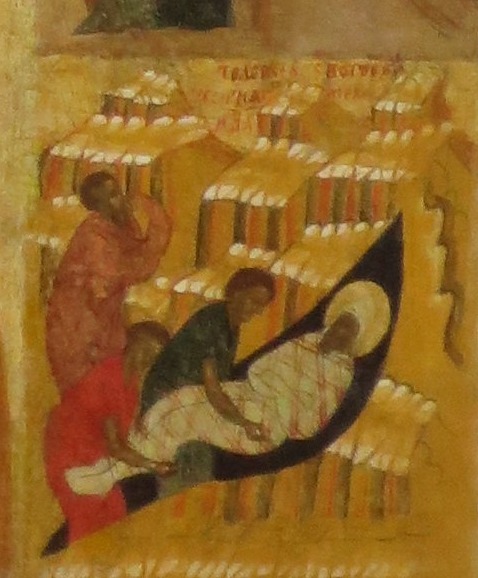
The disciples bury the body of the Forerunner
Border of the icon: The disciples bury the body of the Forerunner · Russia, 16th century
13 · Sebaste of Samaria — hades

Burial in Sebaste and the preaching to those in hades

Herodias did not allow my head to be buried together with my body, for she feared that if the head were joined to the body I might rise again and begin once more to rebuke her and Herod. My disciples, however, took my body that same night from the prison and buried it: it had been cast outside the walls of the fortress and was found there by my disciples, who with honour carried it to Sebaste, a city of Samaria, and there buried it near the tomb of the Prophet Elisha.

And it was meet for me to precede with my death both the birth of the Lord and His death: just as on earth I had preached the coming of the Lord, saying: «There cometh one mightier than I after me» (Mk. 1:7), so also to the souls of the holy forefathers in hades it was meet for me to preach the coming of the Lord and to tell them that the Messiah awaited by the world had already appeared.

Preceding the descent of the Lord into hades, I proclaimed to those in hades God come in the flesh, and I gladdened the holy forefathers; with them I was led forth from hades after its destruction at the Resurrection of Christ, and I was accounted worthy of many crowns in the Kingdom of Heaven — as a virgin, as a desert-dweller, as a teacher and preacher of repentance, as a prophet, as Forerunner and Baptist, and as a martyr.

Herod and Herodias did not escape the vengeance of God: my blood cried out to God against Herod, as once the blood of Abel cried out against Cain, and after no long time he was deprived of his kingdom and his life together with Herodias and the dancing-girl.

Source — St Demetrius of Rostov, “Lives of the Saints”
Herodias did not allow the head of John to be buried together with the body, for she feared that if his head were joined to the body John might rise again and begin once more to rebuke her and Herod. […] The body of the holy Forerunner his disciples took that same night from the prison and buried in Sebaste […] the body had been cast outside the walls of the fortress and was found there by the disciples of the Baptist, who with honour carried it to Sebaste and there buried it […] his honourable body was buried by his disciples near the tomb of the Prophet Elisha in the renowned Samaritan city of Sebaste […] It was meet for Saint John, the Forerunner of the Lord God and our Saviour Jesus Christ, to precede with his death both the birth of the Lord and His death […] For preceding the descent of the Lord into hades, he proclaimed to those in hades God come in the flesh, and he gladdened the holy forefathers; with them he was led forth from hades after its destruction at the Resurrection of Christ, and he was accounted worthy of many crowns in the Kingdom of Heaven, as a virgin, as a desert-dweller, as a teacher and preacher of repentance, as a prophet, as Forerunner and Baptist, and as a martyr. […] the blood of John cried out to God against Herod, as once the blood of Abel cried out against Cain […] after no long time Herod was deprived of his kingdom and his life together with Herodias and the dancing-girl.
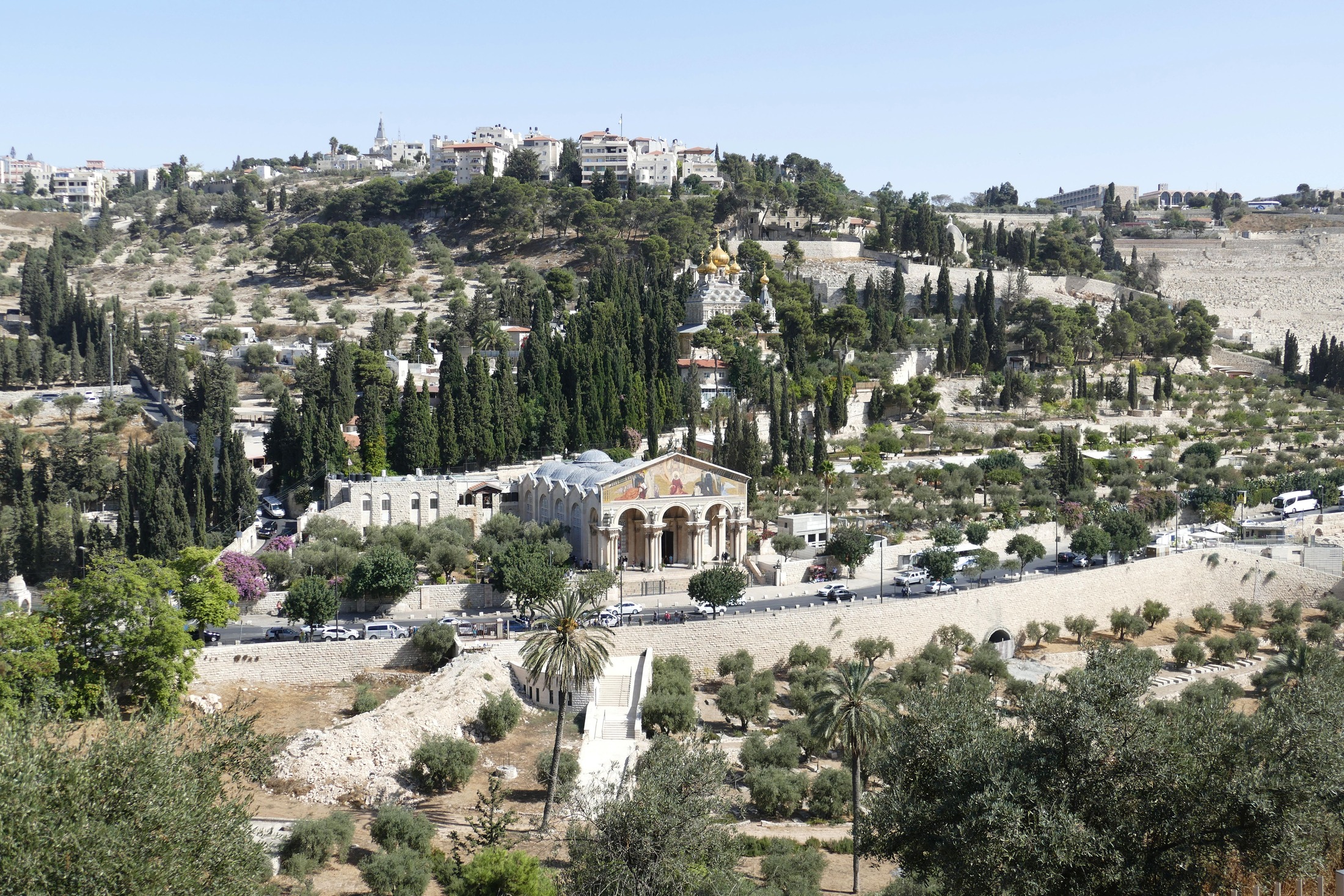
The Mount of Olives in Jerusalem — according to tradition, the place where Joanna, wife of Chuza, hid the honourable head of the Forerunner.
Photo: The Mount of Olives in Jerusalem — according to tradition, the place where Joanna, wife of Chuza, hid the honourable head of the Forerunner. · The Mount of Olives, Jerusalem
14 · Jerusalem — the Mount of Olives

The Honourable Head: Joanna, wife of Chuza, and the Mount of Olives

My head Herodias buried deep in her palace, in a secret dishonourable place. Only the wife of Herod’s steward Chuza, named Joanna, of whom the holy Evangelist Luke makes mention, knew that place. Grieving in her heart over my slaying and the outrage done to my honourable head, she took that head secretly by night, placed it in an earthen vessel and buried it on the Mount of Olives, in one of Herod’s estates.

Meanwhile rumours of Jesus Christ reached Herod, and he together with his wife began to think that this was John risen from the dead. They began to seek my head and, not finding it, were perplexed; Herod even said thus to his household concerning Jesus: «This is John, whom I beheaded. He is risen from the dead, and therefore mighty works do show forth themselves in him» (Mt. 14:2).

After a long time a certain very noble dignitary named Innocent believed in Jesus Christ. Leaving the world, he came to Jerusalem, bought on the Mount of Olives that place which had once belonged to Herod, built himself a cell there and became a monk. Wishing to build for himself a small stone church, he began to dig a trench for the foundation — and by God’s providence he found hidden in the earth an earthen vessel with my head; by various signs and by revelation from God he understood whose head it was, and began to keep it with reverence.

Before his death, seeing the spread of unbelief, the monk again hid the holy head in the bosom of the earth, placing it in the very spot where his cell and church had stood. After his death that church fell into decay, collapsed and was even levelled with the ground, so that for a long time no one knew where the honourable head was to be found.

Source — St Demetrius of Rostov, “Lives of the Saints”
The head of the holy Forerunner Herodias buried deep in her palace in a secret dishonourable place. Only the wife of Herod’s steward Chuza, named Joanna, of whom the holy Evangelist Luke makes mention […] Grieving in her heart over the slaying of the great holy Prophet John and the outrage done to his honourable head, she took that head secretly by night, placed it in an earthen vessel […] and buried it on the Mount of Olives […] This is John, whom I beheaded. He is risen from the dead, and therefore mighty works do show forth themselves in him […] After a long time a certain very noble dignitary named Innocent believed in Jesus Christ. Leaving the world, he came to Jerusalem, bought on the Mount of Olives that place which had once belonged to Herod, built himself a cell there and became a monk, fulfilling the commandments of Christ. […] he began to dig a trench for the foundation. And behold, by God’s providence he found hidden in the earth an earthen vessel with the head of Christ’s Forerunner. […] this monk again hid the holy head of the Forerunner in the bosom of the earth […] After his death that church fell into decay, collapsed and was even levelled with the ground, so that for a long time no one knew where the honourable head of John the Baptist was to be found.
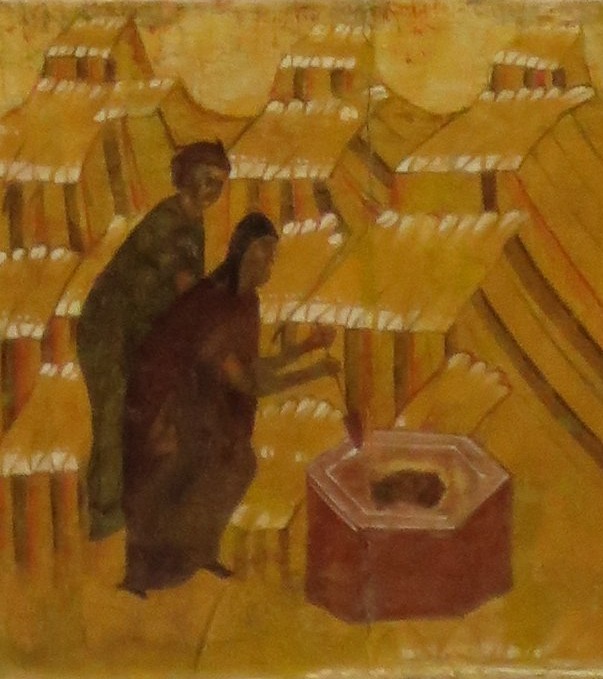
The Finding of the Honourable Head Hidden in the Earth
Border scene of the icon: The Finding of the Honourable Head Hidden in the Earth · Russia, 16th century
15 · Jerusalem — the road to Emesa

The First Finding: two monks and the potter

When the great Emperor Constantine ascended the throne and enlightened his land with holy baptism, then his mother, the holy Helen, began to renew and cleanse all the Jerusalem shrines. At that time two monks who were labouring in the East came to Jerusalem to venerate the Precious Cross and the Tomb of the Lord. To one of them in a dream I appeared, revealed the place where my honourable head had been buried, and commanded him to take it from the depths of the earth; but he considered it all a mere dream, believed it not himself, and persuaded the other likewise.

The following night I appeared a second time, but now to each monk separately, and said: «Awake, forsake your unbelief and sloth, and do what has been announced to you». Awakening, both went to the place that had been shown them, began to dig the earth there, and found the priceless treasure. Placing the head in a bag made of camel’s hair, they set out on their way back.

At that time a certain poor potter from the city of Emesa was forced by poverty to leave his homeland and go to another country; on the road he met those two monks and continued his journey with them. The monks, finding a fellow traveller, gave him the sack with the head to carry, and he, not knowing what he was bearing, calmly continued on his way.

Then I appeared to him and said: «Leave your companions and flee from them with the sack that you hold in your hands». For I saw the sloth and negligence of those monks, who at first had not believed my appearance, and afterwards had not wished to carry my honourable head themselves, but had entrusted it to a simple man unknown to them; to this poor man I wished to show kindness and to direct him onto the path of a good and God-pleasing life.

Source — St Demetrius of Rostov, “Lives of the Saints”
When the great Emperor Constantine ascended the throne and enlightened his land with holy baptism, then his mother, the holy Helen, began to renew and cleanse all the Jerusalem shrines […] Here to one of them, in a dream, the holy Forerunner John appeared, revealed the place where his honourable head had been buried, and commanded him to take it from the depths of the earth. […] but he, considering it all a mere dream, believed it not himself, and persuaded the other likewise […] Awake, forsake your unbelief and sloth, and do what has been announced to you […] They began to dig the earth there and found the priceless treasure – the holy head of Christ’s Baptist. Placing it in a bag made of camel’s hair, they set out on their way back. […] At that time a certain poor potter from the city of Emesa was forced by poverty to leave his homeland, his wife, and go to another country. […] Leave your companions and flee from them with the sack that you hold in your hands […] The saint therefore commanded this because he saw the sloth and negligence of those monks, who at first had not believed his appearance, and afterwards had not wished to carry his honourable head themselves, but had entrusted it to a simple man unknown to them.
The Honourable Head in the Cave (the Second Finding, Emesa)
Border scene of the icon: The Honourable Head in the Cave (the Second Finding, Emesa) · Russia, 16th century
16 · Emesa of Syria

The Second Finding: Emesa and Archimandrite Marcellus

The potter returned home, and the Lord, for the sake of my head, blessed his house with every abundance; he did not become proud, but gave generous alms to the poor and needy and always venerated the honourable head. Before his death he placed the holy head in a vessel, enclosed it in a coffer, sealed it, and gave it to his sister.

Passing from one person to another, the honourable head was finally given to the hieromonk Eustathius, who lived not far from Emesa in a certain cave. He was infected with the heresy of Arius and began, like a thief, to ascribe to himself and to his heresy the grace of healings that came forth from the head. When the inhabitants of Emesa learned of his evil belief and drove him out, he hid the vessel with the holy head by night deep in the earth in that cave; but he could not return: pious monks settled in the cave, and a monastery was founded on that spot.

The archimandrite of that monastery, Marcellus, a man full of virtue, saw me in a vision and received a blessing from me; then a certain hand struck him three times on his right side, and a voice sounded: «Behold, I am given to you; arise, follow the star that will go before you, dig in the place to which it will lead you, and you shall find me». Following the star, he entered the cave, dug for a long time, calling upon the name of the Lord, and found the sacred vessel in which the honourable head rested.

The Bishop of Emesa, Uranius, having celebrated the Divine Liturgy with the assembled clergy, took the vessel with the honourable head and brought it forth from the earth. One of the presbyters, named Malchus, did not believe this and boldly laid his hand upon the vessel – and because of his unbelief his hand withered and stuck to the vessel; but afterwards, at my appearance, he touched the vessel at the translation of the head and received healing.

Source — St Demetrius of Rostov, “Lives of the Saints”
And the Lord, for the sake of the head of John the Baptist, blessed his house with every abundance […] he gave generous alms to the poor and needy from his wealth […] he, at the command of Christ’s Baptist himself, placed the holy head in a water vessel, enclosed this vessel in a coffer and, having sealed it, gave this treasure to his sister […] it was given to a certain hieromonk Eustathius, who lived not far from Emesa in a certain cave; he was infected with the heresy of Arius and had no fear of God […] he hid the vessel with the holy head by night deep in the earth in that cave […] Behold, I am given to you; arise, follow the star that will go before you, dig in the place to which it will lead you, and you shall find me […] there he found the sacred vessel in which the honourable head of the Forerunner rested […] Saying this, he boldly laid his hand upon the vessel and touched the hair of the honourable head of the Baptist. Suddenly, because of his unbelief, his hand withered and stuck to the vessel.
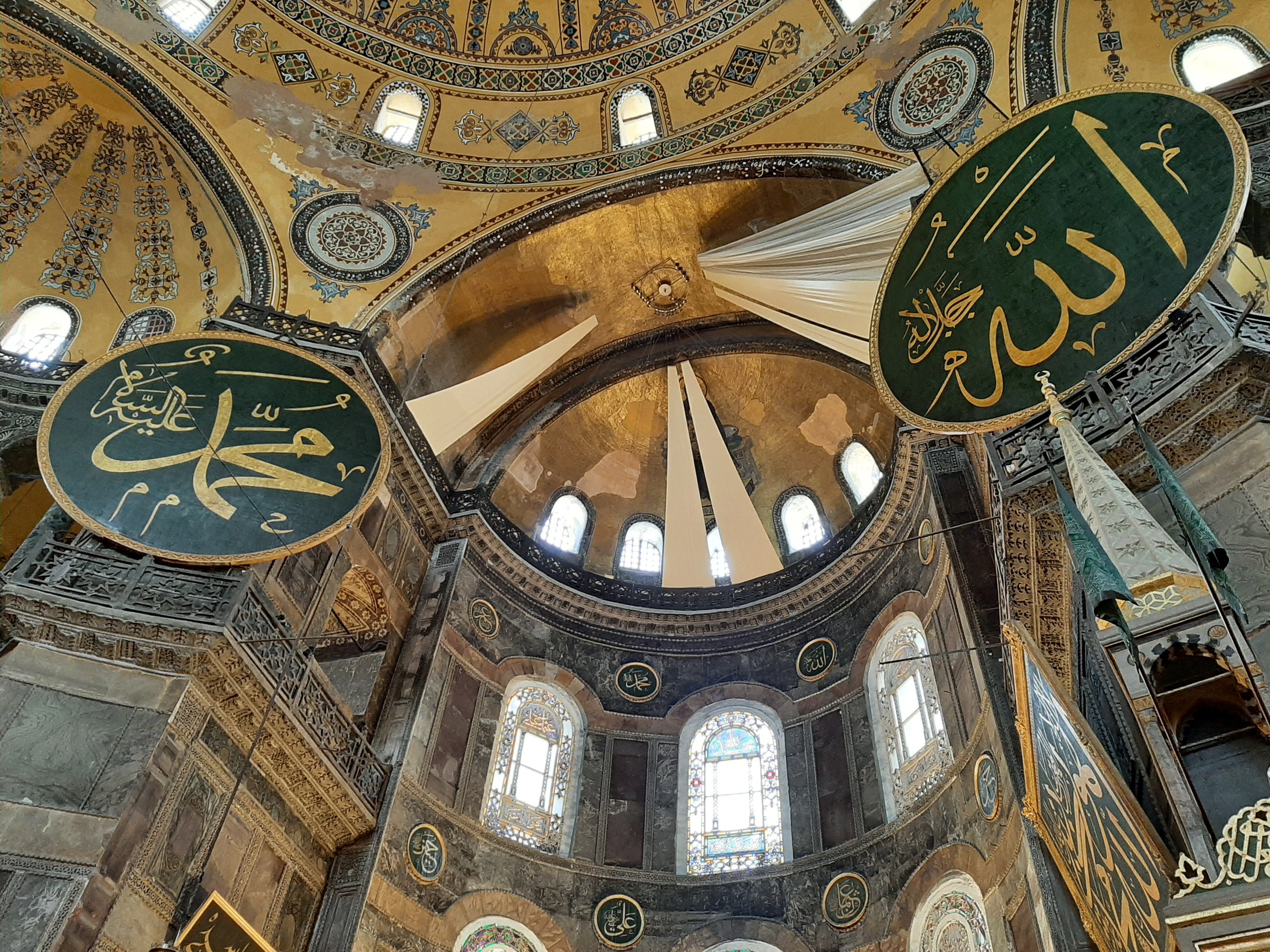
The Imperial City (Constantinople), to which the venerable head of the Baptist was transferred. The photograph shows the interior of Hagia Sophia (an illustrative view of the city, not the place where the head was kept).
Photo: The Imperial City (Constantinople), to which the venerable head of the Baptist was transferred. The photograph shows the interior of Hagia Sophia (an illustrative view of the city, not the place where the head was kept). · Hagia Sophia, Istanbul
17 · Emesa – Constantinople – Comana

Constantinople, Comana, and the Third Finding

After some time my holy head was transferred from Emesa to Constantinople. Here, at the place called Hebdomon, by imperial command a beautiful temple was built, in which the honourable head was laid.

In the time of the iconoclastic heresy, when many holy icons were burned, others cast into the sea and rivers, trampled underfoot and variously desecrated, then certain pious Christians, fleeing from Constantinople filled with heretics, secretly took my head with them and brought it to Comana, where the holy John Chrysostom had once reposed. Here they again hid it in the depths of the earth, placing it in a silver vessel.

This precious shrine remained there unknown until the times of Emperor Michael and his mother, the Empress Theodora, who again established Orthodoxy. In the reign of Michael the shrine was found anew by divine will and transferred to Constantinople by Patriarch Ignatius – to the honour and glory of Christ our God.

From the earth my head shone forth, emitting rays of incorruption and healing to the faithful: from above it gathers a multitude of Angels, and below it calls the human race to send up with one voice glory to Christ God.

Source — St Demetrius of Rostov, “Lives of the Saints”
After some time the holy head of John the Baptist was transferred from Emesa to Constantinople. Here, at the place called Hebdomon, by imperial command a beautiful temple was built, in which the venerable head was laid. […] During the iconoclastic heresy, when many holy icons were burned, others cast into the sea and rivers, trampled underfoot and dishonoured in various ways […] then certain pious Christians, fleeing from Constantinople filled with heretics, secretly took with them the head of the Baptist and brought it to Comana, where once the holy John Chrysostom had reposed. Here they again concealed it in the bowels of the earth, placing it in a silver vessel. […] This precious sacred relic remained here unknown until the times of Emperor Michael, son of Theophilus, and his mother the Empress Theodora, who again established Orthodoxy […] In the reign of Michael this sacred relic was rediscovered by divine will and transferred to the Imperial City by Patriarch Ignatius, to the honour and glory of Christ our God […] Shining forth from the earth, O Forerunner’s head, it emits rays of incorruption, healings for the faithful; it gathers a multitude of Angels from above, and below it summons the human race to send up to Christ God unanimous glory.
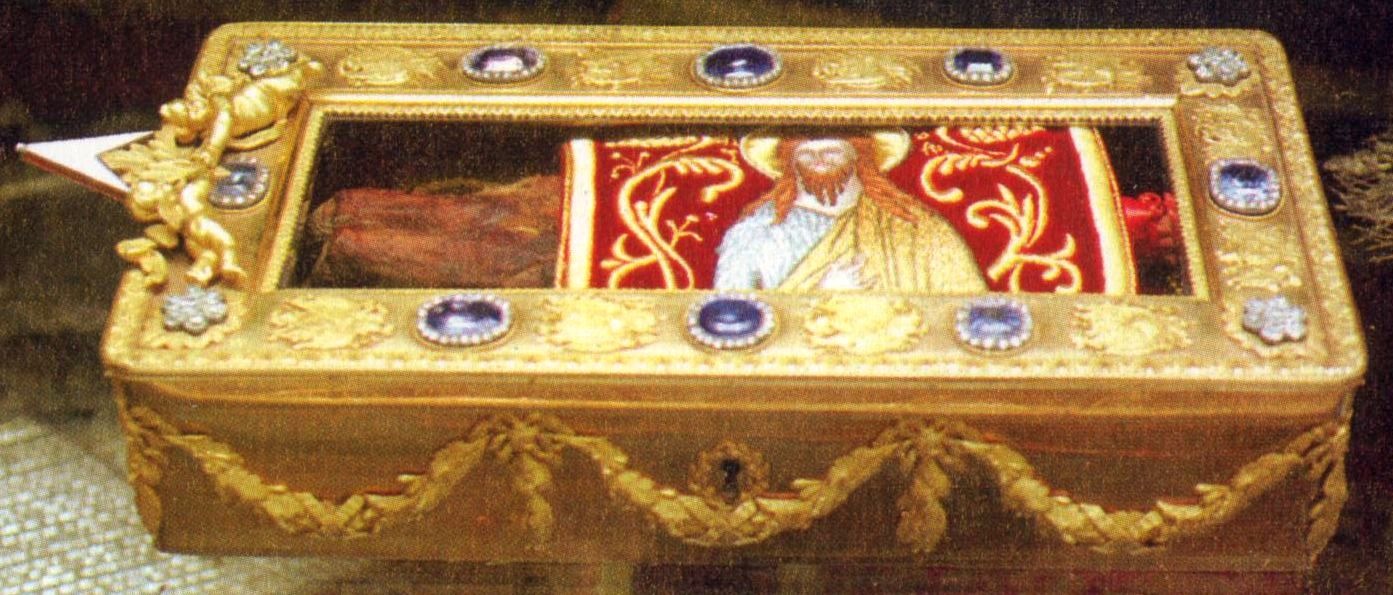
The reliquary with the right hand of the holy John the Forerunner.
Photo: The reliquary with the right hand of the holy John the Forerunner. · Reliquary, the right hand of John the Forerunner
18 · Sebastia — Antioch — Imperial City

The Right Hand: Antioch, the miracle with the serpent and the transfer to the Imperial City

When the holy Evangelist Luke, preaching Christ, came to Sebastia, the thought came to him to take my body to Antioch. But it was impossible to take it: the inhabitants of Sebastia greatly venerated the relics and guarded them carefully. Therefore he was able to separate only the right hand that had baptized the Lord and Master Jesus Christ; this he brought to his city of Antioch as a precious treasure.

In the region of Antioch there dwelt a great and terrible serpent, which the pagans deified and to which as to a god they annually offered in sacrifice a maiden chosen by lot. Once the lot fell upon the daughter of a certain Christian; her father with tears besought Christ God and me for the deliverance of his daughter from a cruel death and, coming to the church where the holy hand was kept, secretly bit off with his teeth one joint of the little finger. And when the serpent crawled quite near and opened its mouth still wider, the father cast the joint of the sacred finger straight into the midst of its throat, and the serpent immediately died; and a multitude of pagans believed in Christ God.

When the Arabs took possession of Antioch, the most venerable hand was, as it were, taken captive. But in the reign of the porphyrogenitus brothers Constantine and Romanus, the deacon Job was inspired by God Himself to carry the holy hand out from under Arab dominion; arriving at Chalcedon, he revealed to the Christians what he had with him. The emperors sent a royal ship for it, and the patriarch himself held the holy hand; the emperors and all the people came out to the shore, meeting it as though the Baptist himself were invisibly coming from heaven.

This translation took place on the eve of the holy Theophany, before the blessing of the waters; therefore my synaxis is celebrated on the day after the Theophany of the Lord with great rejoicing.

Source — St Demetrius of Rostov, “Lives of the Saints”
his venerable body was buried by his disciples near the tomb of the Prophet Elisha in the famous Samaritan city of Sebastia […] Therefore the holy Evangelist Luke was able to separate from the holy body of the Forerunner only the right hand that had baptized our Lord and Master Jesus Christ; this he brought with him to his city of Antioch as a precious treasure […] In the region of Antioch there dwelt a great and terrible serpent, which the pagans deified and to which as to a god they annually offered sacrifices. […] When the serpent crawled quite near and opened its mouth still wider, the maiden’s father cast the joint of the sacred finger of the Baptist straight into the midst of its throat, and the serpent immediately died. […] When, by God’s permission, the Arabs took possession of Antioch and all its region, then the great treasure – the most venerable hand of the holy great John the Baptist – was, as it were, taken captive. […] To one Antiochian deacon named Job it was inspired by God Himself to carry the holy hand of the Baptist out from under Arab dominion into a land where the pious Christian faith shone forth. […] This translation of the holy hand of the Baptist took place on the eve of the holy Theophany, before the blessing of the waters. […] as it had been before in his temple by the Jordan, where he baptized Christ, and in Sebastia
The Church sings

Troparion for the Beheading of John the Baptist, Tone 2

The memory of the righteous is with praise, but the testimony of the Lord is sufficient for you, O Forerunner: for you have shown that you are truly more honorable than the prophets, as in the streams of baptism you were deemed worthy to preach. Moreover, having suffered for the truth, rejoicing, you preached the good news to those in hell of God revealed in the flesh, who takes away the sin of the world and gives us great mercy.

Сверх жития

Свидетельства, камни, святыни

John is the only saint of whom Christ Himself said: «among those born of women there has arisen no one greater» (Mt. 11:11). All four evangelists write about him, the Jewish historian Josephus Flavius recounts his execution, his name stands in the Koran, pilgrims of the fourth century describe his tomb in Sebaste, and archaeologists continue to excavate the fortress where he was beheaded. Below is what is known beyond the Life: ancient testimonies, places, stones and holy relics.

Хронология

От Ирода Великого до наших дней

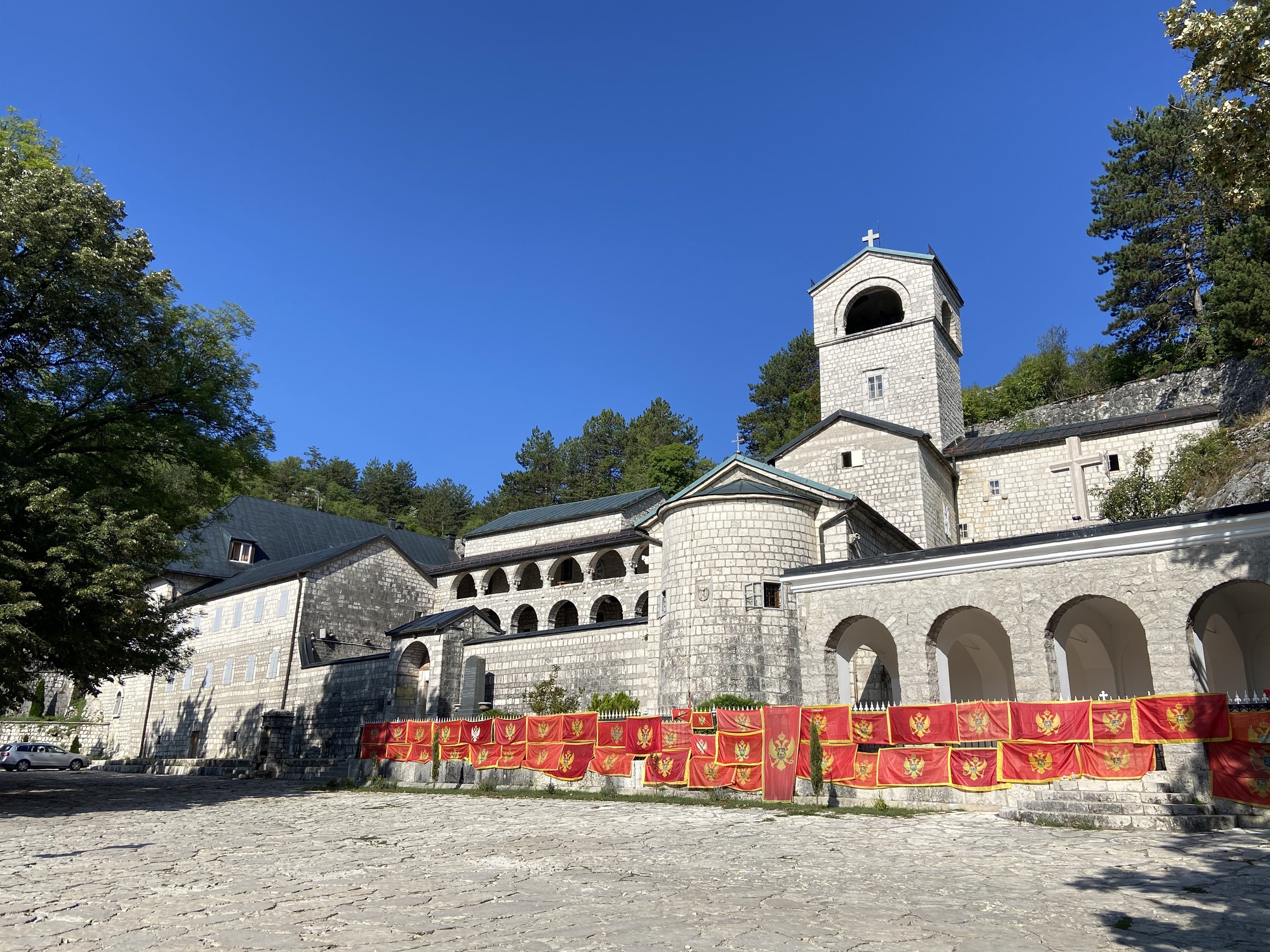
The reign of Herod the GreatAn angel at the altar of incense: Zechariah is promised a son (Lk. 1:5–25).Глава 1 →Six months laterThe Annunciation; Mary comes to Elizabeth «into the hill country» (Lk. 1:26–56).Глава 3 →24 June — Nativity of the Forerunner«His name is John» — and the mouth of Zechariah is opened (Lk. 1:57–80).Глава 4 →The Slaughter of the InnocentsElizabeth with the infant hides in the mountain; Zechariah is slain between the temple and the altar (tradition, Protoevangelium of James 22–24).Глава 5 →The years in the wilderness«And the child grew… and was in the deserts till the day of his showing unto Israel» (Lk. 1:80).Глава 7 →The 15th year of Tiberius — 28/29 A.D.«The word of God» on the Jordan: the preaching of repentance and baptism (Lk. 3:1–18).Глава 8 →TheophanyThe Baptism of the Lord; «Behold the Lamb of God» (Mt. 3:13–17; Jn. 1:29–34).Глава 9 →MachaerusThe reproof of Herod Antipas, imprisonment beyond the Dead Sea; Josephus Flavius names the fortress (Mk. 6:17–20).Глава 10 →c. 30–32 A.D. — the BeheadingThe feast of Herod, the dance of the daughter of Herodias, the head on a platter (Mk. 6:21–29).Глава 12 →SebasteThe disciples bury the body; the soul of the Forerunner proclaims the good news to those in Hades (troparion).Глава 13 →362The pagans under Julian the Apostate open the tomb in Sebaste and burn the relics; part is saved by monks (Rufinus, Church Hist. XI, 28).Подробнее →4th centuryThe First Finding of the Head on the Mount of Olives.Глава 15 →452Emesa: Archimandrite Marcellus finds the head in a cave — the second finding.Глава 16 →c. 850The Third Finding: from Comana to Constantinople, under Patriarch Ignatius.Глава 17 →956The right hand is transferred from Antioch to Constantinople.Глава 18 →1204–1206After the sack of Constantinople by the Crusaders, the facial part of the head is brought to Amiens.Подробнее →1484 → 1530 → 1799The Right Hand: from Sultan Bayazid II to the Knights of Rhodes, then to Malta, then to Emperor Paul I in Gatchina (12 October 1799).Подробнее →1993The Right Hand was returned to the Church — Cetinje Monastery, Montenegro.Подробнее →2010–2020The island of Sveti Ivan near Sozopol: reliquary beneath the altar of the basilica; the bone has been dated to the first century (Oxford).Подробнее →
Карта

Где это было — и где святыни сегодня

места жизнисвятыни сегодняПлитки карты © OpenStreetMap
Свидетельства

Что говорят древние тексты

GospelLuke 1:5–25 — The Annunciation to Zacharias

5Во дни Ирода, царя Иудейского, был священник из Авиевой чреды, именем Захария, и жена его из рода Ааронова, имя ей Елисавета. 6Оба они были праведны пред Богом, поступая по всем заповедям и уставам Господним беспорочно. 7У них не было детей, ибо Елисавета была неплодна, и оба были уже в летах преклонных. 8Однажды, когда он в порядке своей чреды служил пред Богом, 9по жребию, как обыкновенно было у священников, досталось ему войти в храм Господень для каждения, 10а все множество народа молилось вне во время каждения, — 11тогда явился ему Ангел Господень, стоя по правую сторону жертвенника кадильного. 12Захария, увидев его, смутился, и страх напал на него. 13Ангел же сказал ему: не бойся, Захария, ибо услышана молитва твоя, и жена твоя Елисавета родит тебе сына, и наречешь ему имя: Иоанн; 14и будет тебе радость и веселие, и многие о рождении его возрадуются, 15ибо он будет велик пред Господом; не будет пить вина и сикера, и Духа Святаго исполнится еще от чрева матери своей; 16и многих из сынов Израилевых обратит к Господу Богу их; 17и предъидет пред Ним в духе и силе Илии, чтобы возвратить сердца отцов детям, и непокоривым образ мыслей праведников, дабы представить Господу народ приготовленный. 18И сказал Захария Ангелу: по чему я узнаю это? ибо я стар, и жена моя в летах преклонных. 19Ангел сказал ему в ответ: я Гавриил, предстоящий пред Богом, и послан говорить с тобою и благовестить тебе сие; 20и вот, ты будешь молчать и не будешь иметь возможности говорить до того дня, как это сбудется, за то, что ты не поверил словам моим, которые сбудутся в свое время. 21Между тем народ ожидал Захарию и дивился, что он медлит в храме. 22Он же, выйдя, не мог говорить к ним; и они поняли, что он видел видение в храме; и он объяснялся с ними знаками, и оставался нем. 23А когда окончились дни службы его, возвратился в дом свой. 24После сих дней зачала Елисавета, жена его, и таилась пять месяцев и говорила: 25так сотворил мне Господь во дни сии, в которые призрел на меня, чтобы снять с меня поношение между людьми.

The only account of the parents of John. The angel appears to Zacharias on the right side of the altar of incense — just as the border of the icon depicts.
GospelLuke 1:39–45 — The Meeting of Mary and Elizabeth

39Встав же Мария во дни сии, с поспешностью пошла в нагорную страну, в город Иудин, 40и вошла в дом Захарии, и приветствовала Елисавету. 41Когда Елисавета услышала приветствие Марии, взыграл младенец во чреве ее; и Елисавета исполнилась Святаго Духа, 42и воскликнула громким голосом, и сказала: благословенна Ты между женами, и благословен плод чрева Твоего! 43И откуда это мне, что пришла Матерь Господа моего ко мне? 44Ибо когда голос приветствия Твоего дошел до слуха моего, взыграл младенец радостно во чреве моем. 45И блаженна Уверовавшая, потому что совершится сказанное Ей от Господа.

«The babe leaped in the womb» — the first witness of John to Christ, even before birth.
GospelLuke 1:57–80 — The Nativity and the Song of Zacharias

57Елисавете же настало время родить, и она родила сына. 58И услышали соседи и родственники ее, что возвеличил Господь милость Свою над нею, и радовались с нею. 59В восьмой день пришли обрезать младенца и хотели назвать его, по имени отца его, Захариею. 60На это мать его сказала: нет, а назвать его Иоанном. 61И сказали ей: никого нет в родстве твоем, кто назывался бы сим именем. 62И спрашивали знаками у отца его, как бы он хотел назвать его. 63Он потребовал дощечку и написал: Иоанн имя ему. И все удивились. 64И тотчас разрешились уста его и язык его, и он стал говорить, благословляя Бога. 65И был страх на всех живущих вокруг них; и рассказывали обо всем этом по всей нагорной стране Иудейской. 66Все слышавшие положили это на сердце своем и говорили: что будет младенец сей? И рука Господня была с ним. 67И Захария, отец его, исполнился Святаго Духа и пророчествовал, говоря: 68благословен Господь Бог Израилев, что посетил народ Свой и сотворил избавление ему, 69и воздвиг рог спасения нам в дому Давида, отрока Своего, 70как возвестил устами бывших от века святых пророков Своих, 71что спасет нас от врагов наших и от руки всех ненавидящих нас; 72сотворит милость с отцами нашими и помянет святой завет Свой, 73клятву, которою клялся Он Аврааму, отцу нашему, дать нам, 74небоязненно, по избавлении от руки врагов наших, 75служить Ему в святости и правде пред Ним, во все дни жизни нашей. 76И ты, младенец, наречешься пророком Всевышнего, ибо предъидешь пред лицем Господа приготовить пути Ему, 77дать уразуметь народу Его спасение в прощении грехов их, 78по благоутробному милосердию Бога нашего, которым посетил нас Восток свыше, 79просветить сидящих во тьме и тени смертной, направить ноги наши на путь мира. 80Младенец же возрастал и укреплялся духом, и был в пустынях до дня явления своего Израилю.

«And thou, child, shalt be called the prophet of the Highest» — the Song of Zacharias («Benedictus») is read by the Church to this day.
GospelLuke 3:1–18 — The Preaching at the Jordan

1В пятнадцатый же год правления Тиверия кесаря, когда Понтий Пилат начальствовал в Иудее, Ирод был четвертовластником в Галилее, Филипп, брат его, четвертовластником в Итурее и Трахонитской области, а Лисаний четвертовластником в Авилинее, 2при первосвященниках Анне и Каиафе, был глагол Божий к Иоанну, сыну Захарии, в пустыне. 3И он проходил по всей окрестной стране Иорданской, проповедуя крещение покаяния для прощения грехов, 4как написано в книге слов пророка Исаии, который говорит: глас вопиющего в пустыне: приготовьте путь Господу, прямыми сделайте стези Ему; 5всякий дол да наполнится, и всякая гора и холм да понизятся, кривизны выпрямятся и неровные пути сделаются гладкими; 6и узрит всякая плоть спасение Божие. 7Иоанн приходившему креститься от него народу говорил: порождения ехиднины! кто внушил вам бежать от будущего гнева? 8Сотворите же достойные плоды покаяния и не думайте говорить в себе: отец у нас Авраам, ибо говорю вам, что Бог может из камней сих воздвигнуть детей Аврааму. 9Уже и секира при корне дерев лежит: всякое дерево, не приносящее доброго плода, срубают и бросают в огонь. 10И спрашивал его народ: что же нам делать? 11Он сказал им в ответ: у кого две одежды, тот дай неимущему, и у кого есть пища, делай то же. 12Пришли и мытари креститься, и сказали ему: учитель! что нам делать? 13Он отвечал им: ничего не требуйте более определенного вам. 14Спрашивали его также и воины: а нам что делать? И сказал им: никого не обижайте, не клевещите, и довольствуйтесь своим жалованьем. 15Когда же народ был в ожидании, и все помышляли в сердцах своих об Иоанне, не Христос ли он, — 16Иоанн всем отвечал: я крещу вас водою, но идет Сильнейший меня, у Которого я недостоин развязать ремень обуви; Он будет крестить вас Духом Святым и огнем. 17Лопата Его в руке Его, и Он очистит гумно Свое и соберет пшеницу в житницу Свою, а солому сожжет огнем неугасимым. 18Многое и другое благовествовал он народу, поучая его.

Luke dates the beginning of John’s preaching to «the fifteenth year of the reign of Tiberius Caesar» — 28/29 AD by our reckoning.
GospelMatthew 3:1–17 — The Baptism of the Lord

1В те дни приходит Иоанн Креститель и проповедует в пустыне Иудейской 2и говорит: покайтесь, ибо приблизилось Царство Небесное. 3Ибо он тот, о котором сказал пророк Исаия: глас вопиющего в пустыне: приготовьте путь Господу, прямыми сделайте стези Ему. 4Сам же Иоанн имел одежду из верблюжьего волоса и пояс кожаный на чреслах своих, а пищею его были акриды и дикий мед. 5Тогда Иерусалим и вся Иудея и вся окрестность Иорданская выходили к нему 6и крестились от него в Иордане, исповедуя грехи свои. 7Увидев же Иоанн многих фарисеев и саддукеев, идущих к нему креститься, сказал им: порождения ехиднины! кто внушил вам бежать от будущего гнева? 8сотворите же достойный плод покаяния 9и не думайте говорить в себе: «отец у нас Авраам», ибо говорю вам, что Бог может из камней сих воздвигнуть детей Аврааму. 10Уже и секира при корне дерев лежит: всякое дерево, не приносящее доброго плода, срубают и бросают в огонь. 11Я крещу вас в воде в покаяние, но Идущий за мною сильнее меня; я не достоин понести обувь Его; Он будет крестить вас Духом Святым и огнем; 12лопата Его в руке Его, и Он очистит гумно Свое и соберет пшеницу Свою в житницу, а солому сожжет огнем неугасимым. 13Тогда приходит Иисус из Галилеи на Иордан к Иоанну креститься от него. 14Иоанн же удерживал Его и говорил: мне надобно креститься от Тебя, и Ты ли приходишь ко мне? 15Но Иисус сказал ему в ответ: оставь теперь, ибо так надлежит нам исполнить всякую правду. Тогда Иоанн допускает Его. 16И, крестившись, Иисус тотчас вышел из воды, — и се, отверзлись Ему небеса, и увидел Иоанн Духа Божия, Который сходил, как голубь, и ниспускался на Него. 17И се, глас с небес глаголющий: Сей есть Сын Мой возлюбленный, в Котором Мое благоволение.

«I have need to be baptized of Thee, and comest Thou to me?»
GospelJohn 1:19–34 — «Behold the Lamb of God»

19И вот свидетельство Иоанна, когда Иудеи прислали из Иерусалима священников и левитов спросить его: кто ты? 20Он объявил, и не отрекся, и объявил, что я не Христос. 21И спросили его: что же? ты Илия? Он сказал: нет. Пророк? Он отвечал: нет. 22Сказали ему: кто же ты? чтобы нам дать ответ пославшим нас: что ты скажешь о себе самом? 23Он сказал: я глас вопиющего в пустыне: исправьте путь Господу, как сказал пророк Исаия. 24А посланные были из фарисеев; 25И они спросили его: что же ты крестишь, если ты ни Христос, ни Илия, ни пророк? 26Иоанн сказал им в ответ: я крещу в воде; но стоит среди вас Некто, Которого вы не знаете. 27Он-то Идущий за мною, но Который стал впереди меня. Я недостоин развязать ремень у обуви Его. 28Это происходило в Вифаваре при Иордане, где крестил Иоанн. 29На другой день видит Иоанн идущего к нему Иисуса и говорит: вот Агнец Божий, Который берет на Себя грех мира. 30Сей есть, о Котором я сказал: за мною идет Муж, Который стал впереди меня, потому что Он был прежде меня. 31Я не знал Его; но для того пришел крестить в воде, чтобы Он явлен был Израилю. 32И свидетельствовал Иоанн, говоря: я видел Духа, сходящего с неба, как голубя, и пребывающего на Нем. 33Я не знал Его; но Пославший меня крестить в воде сказал мне: на Кого увидишь Духа сходящего и пребывающего на Нем, Тот есть крестящий Духом Святым. 34И я видел и засвидетельствовал, что Сей есть Сын Божий.

The witness of John before those sent from Jerusalem; «these things were done in Bethabara beyond Jordan» (Jn. 1:28).
GospelJohn 3:22–36 — «He must increase, but I must decrease»

22После сего пришел Иисус с учениками Своими в землю Иудейскую и там жил с ними и крестил. 23А Иоанн также крестил в Еноне, близ Салима, потому что там было много воды; и приходили туда и крестились, 24ибо Иоанн еще не был заключен в темницу. 25Тогда у Иоанновых учеников произошел спор с Иудеями об очищении. 26И пришли к Иоанну и сказали ему: равви! Тот, Который был с тобою при Иордане и о Котором ты свидетельствовал, вот Он крестит, и все идут к Нему. 27Иоанн сказал в ответ: не может человек ничего принимать на себя, если не будет дано ему с неба. 28Вы сами мне свидетели в том, что я сказал: не я Христос, но я послан пред Ним. 29Имеющий невесту есть жених, а друг жениха, стоящий и внимающий ему, радостью радуется, слыша голос жениха. Сия-то радость моя исполнилась. 30Ему должно расти, а мне умаляться. 31Приходящий свыше и есть выше всех; а сущий от земли земной и есть и говорит, как сущий от земли; Приходящий с небес есть выше всех, 32и что Он видел и слышал, о том и свидетельствует; и никто не принимает свидетельства Его. 33Принявший Его свидетельство сим запечатлел, что Бог истинен, 34ибо Тот, Которого послал Бог, говорит слова Божии; ибо не мерою дает Бог Духа. 35Отец любит Сына и все дал в руку Его. 36Верующий в Сына имеет жизнь вечную, а не верующий в Сына не увидит жизни, но гнев Божий пребывает на нем.

The last preaching of John while free: the friend of the Bridegroom rejoices at the voice of the Bridegroom.
GospelLuke 7:18–28 — The Question from Prison

18И возвестили Иоанну ученики его о всем том. 19Иоанн, призвав двоих из учеников своих, послал к Иисусу спросить: Ты ли Тот, Который должен придти, или ожидать нам другого? 20Они, придя к Иисусу, сказали: Иоанн Креститель послал нас к Тебе спросить: Ты ли Тот, Которому должно придти, или другого ожидать нам? 21А в это время Он многих исцелил от болезней и недугов и от злых духов, и многим слепым даровал зрение. 22И сказал им Иисус в ответ: пойдите, скажите Иоанну, что вы видели и слышали: слепые прозревают, хромые ходят, прокаженные очищаются, глухие слышат, мертвые воскресают, нищие благовествуют; 23и блажен, кто не соблазнится о Мне! 24По отшествии же посланных Иоанном, начал говорить к народу об Иоанне: что смотреть ходили вы в пустыню? трость ли, ветром колеблемую? 25Что же смотреть ходили вы? человека ли, одетого в мягкие одежды? Но одевающиеся пышно и роскошно живущие находятся при дворах царских. 26Что же смотреть ходили вы? пророка ли? Да, говорю вам, и больше пророка. 27Сей есть, о котором написано: вот, Я посылаю Ангела Моего пред лицем Твоим, который приготовит путь Твой пред Тобою. 28Ибо говорю вам: из рожденных женами нет ни одного пророка больше Иоанна Крестителя; но меньший в Царствии Божием больше его.

«Art Thou He that should come?» — and the answer of Christ: «among them that are born of women there is not a greater prophet than John the Baptist».
GospelMark 6:14–29 — The Beheading

14Царь Ирод, услышав об Иисусе [ибо имя Его стало гласно], говорил: это Иоанн Креститель воскрес из мертвых, и потому чудеса делаются им. 15Другие говорили: это Илия, а иные говорили: это пророк, или как один из пророков. 16Ирод же, услышав, сказал: это Иоанн, которого я обезглавил; он воскрес из мертвых. 17Ибо сей Ирод, послав, взял Иоанна и заключил его в темницу за Иродиаду, жену Филиппа, брата своего, потому что женился на ней. 18Ибо Иоанн говорил Ироду: не должно тебе иметь жену брата твоего. 19Иродиада же, злобясь на него, желала убить его; но не могла. 20Ибо Ирод боялся Иоанна, зная, что он муж праведный и святой, и берег его; многое делал, слушаясь его, и с удовольствием слушал его. 21Настал удобный день, когда Ирод, по случаю дня рождения своего, делал пир вельможам своим, тысяченачальникам и старейшинам Галилейским, — 22дочь Иродиады вошла, плясала и угодила Ироду и возлежавшим с ним; царь сказал девице: проси у меня, чего хочешь, и дам тебе; 23и клялся ей: чего ни попросишь у меня, дам тебе, даже до половины моего царства. 24Она вышла и спросила у матери своей: чего просить? Та отвечала: головы Иоанна Крестителя. 25И она тотчас пошла с поспешностью к царю и просила, говоря: хочу, чтобы ты дал мне теперь же на блюде голову Иоанна Крестителя. 26Царь опечалился, но ради клятвы и возлежавших с ним не захотел отказать ей. 27И тотчас, послав оруженосца, царь повелел принести голову его. 28Он пошел, отсек ему голову в темнице, и принес голову его на блюде, и отдал ее девице, а девица отдала ее матери своей. 29Ученики его, услышав, пришли и взяли тело его, и положили его во гробе.

The most detailed account of Herod’s feast; Mark alone says that Herod «heard him gladly».
ActsActs 19:1–7 — The Disciples of John in Ephesus

1Во время пребывания Аполлоса в Коринфе Павел, пройдя верхние страны, прибыл в Ефес и, найдя там некоторых учеников, 2сказал им: приняли ли вы Святаго Духа, уверовав? Они же сказали ему: мы даже и не слыхали, есть ли Дух Святый. 3Он сказал им: во что же вы крестились? Они отвечали: во Иоанново крещение. 4Павел сказал: Иоанн крестил крещением покаяния, говоря людям, чтобы веровали в Грядущего по нем, то есть во Христа Иисуса. 5Услышав это, они крестились во имя Господа Иисуса, 6и, когда Павел возложил на них руки, нисшел на них Дух Святый, и они стали говорить иными языками и пророчествовать. 7Всех их было человек около двенадцати.

A quarter of a century after the death of John, the Apostle Paul meets in Ephesus people baptized with «John’s baptism».
Historian, 1st centuryFlavius Josephus. «Antiquities of the Jews», XVIII, 5, 2

Now some of the Jews thought that the destruction of Herod’s army came from God, and that very justly, as a punishment for what he did against John, that was called the Baptist; for Herod slew him, who was a good man, and commanded the Jews to exercise virtue, both as to righteousness towards one another, and piety towards God, and so to come to baptism; for that the washing with water would be acceptable to him, if they made use of it, not in order to the putting away of some sins, but for the purification of the body; supposing still that the soul was thoroughly purified beforehand by righteousness. Now when many others came in crowds about him, for they were greatly moved by hearing his words, Herod, who feared lest the great influence John had over the people might put it into his power and inclination to raise a rebellion (for they seemed ready to do anything he should advise), thought it best, by putting him to death, to prevent any mischief he might cause, and not bring himself into difficulties by sparing a man who might make him repent of it when it would be too late. Accordingly he was sent a prisoner, out of Herod’s suspicious temper, to Macherus, the castle I before mentioned, and was there put to death; and the Jews had an opinion that it was God who thus punished Herod for the death of John, in thus destroying his army.

The earliest non-Christian witness. Josephus is a contemporary of the events (born in 37), and he names the place of execution: the fortress of Machaerus. He makes no mention of Herodias or the dance — the execution is explained by the tetrarch’s fear of a popular movement; the Gospel and Josephus do not contradict but complement each other. Josephus dates the rout of the army of Herod Antipas by the Arabian king Aretas to the year 36. This passage is cited by Origen («Against Celsus», I, 47) and Eusebius of Caesarea («Church History», I, 11).
Перевод Г. Г. Генкеля, 1900 (общественное достояние) · источник ↗
Apocryphon, 2nd centuryProtevangelium of James, chapters 22–24

When Herod sought to slay the infants, Elizabeth took John and went up into the hill country, and looked about for a place to hide him; and she groaned and said: «O mountain of God, receive thou a mother with a child.» And straightway the mountain was rent asunder and received them. And that place gave them light, for an angel of the Lord was with them. And Herod sought for John and sent officers to Zacharias at the altar, saying: «Where hast thou hidden thy son?» And Zacharias answered them: «I am a minister of God, serving in the temple; I know not where my son is.» And they slew him at the dawn of day at the altar. And the priests found his blood, turned to stone, but his body they found not.

It is from here that the Church knows of the flight of Elizabeth and the slaying of Zacharias — St. Demetrius of Rostov retells this same tradition. The apocryphon is not Scripture, yet it is an ancient (c. 150) and respected tradition: the borders of icons were painted according to it, and churches were built in Ein Karem.
Пересказ (греческий текст II века; современные русские переводы под охраной права)
Pilgrims, 6th–7th centuriesTheodosius (c. 530), Antoninus of Piacenza (c. 570), Arculf (c. 670)

Theodosius: five miles from the Dead Sea, where the Lord was baptised, stands a column with an iron cross and a church of Saint John the Baptist built by Emperor Anastasius, on high vaults — because of the flooding of the Jordan. Antoninus of Piacenza: on the night of Theophany many people are baptised in this place and, it is said, the water of the river stops flowing. Arculf: right by the bank — a small square church on four stone vaults, standing over the water, where, it is said, the Lord’s garments lay during the Baptism.

Three independent pilgrims, separated by a century and a half, describe the same church by the Jordan — its foundations with steps down to the water have been excavated at Al-Maghtas. On the Madaba mosaic map (6th century) this place is labelled «Bethabara».
Пересказ латинских итинерариев
The Fathers, 4th–5th centuriesJerome and Rufinus on Sebaste

Blessed Jerome, describing the pilgrimage of Saint Paula (385), places in Sebaste the tombs of the prophets Elisha and Obadiah and of John the Baptist. Rufinus of Aquileia (Church History, XI, 28) relates how under Julian the Apostate the pagans opened the tomb of John, burned the bones and scattered the ashes, but monks, mingling with the crowd, saved part of the relics and carried them to Jerusalem, whence they came to Alexandria.

Thus is explained why the relics of the Forerunner have been scattered throughout the world already since the 4th century: what is venerated today in Amiens, Rome, Damascus, on Athos, in Cetinje — are fragments of what survived in 362, and heads that have their own separate history.
Пересказ
Qumran, 2nd–1st centuries B.C.«Community Rule» (1QS 8:13–14) and «the voice of one crying»

The Dead Sea community applied to itself the same words of Isaiah — «in the wilderness prepare the way of the Lord» (Is. 40:3), — withdrawing into the desert to study the Law; it also performed daily ritual washings.

John preached a few hours’ walk from Qumran and with the same words of the prophet. Scholars are cautious: there is no proof that John was an Essene; yet the scrolls show in what atmosphere his preaching grew — the expectation of the Lord in the wilderness and washing as a sign of purification.
Пересказ
Other traditionsThe Qur’an and the Mandaeans

In the Qur’an John is the prophet Yahya, son of Zechariah: his birth is told in surah «Maryam» (19:7–15), and of him it is said «We have not created anyone before with such a name». The Mandaeans — a religious community of Iraq and Iran — venerate John (Yahya Yuhana) as the last great prophet; their «Book of John» (Draša d-Yahya) took shape already in the Islamic era.

Thus the Forerunner became the only saint of the Church whose tomb is venerated by both Christians and Muslims: the mausoleum in Sebaste and the shrine in the Umayyad Mosque are open to both.
Справка
The Church singsKontakion of the Beheading, Tone 5

The glorious beheading of the Forerunner became a certain divine dispensation, that he might proclaim to those in hades the coming of the Saviour. Let Herodias then weep, for she asked for an unlawful murder: for she loved neither the law of God nor the living age, but a false, fleeting one.

«The glorious beheading of the Forerunner was accomplished by a certain dispensation of God, that he might proclaim even to those in hades the coming of the Saviour». Hence the ancient image on icons: John among the righteous in hades, with a scroll. On 29 August the Church established a strict fast — in remembrance of the feast where conscience was forgotten — and on this day commemorates soldiers who have fallen in battle.
Молитвослов Orthodox House
Археология

Камни, которые помнят

Machaerus — the fortress where this happened
Mount Mukawir (Machaerus), Jordan. Photo hikinginjordan, Wikimedia Commons, CC BY-SA 3.0

Machaerus — the fortress where this happened

A rock above the eastern shore of the Dead Sea, seven hundred metres above the water. The fortress was built by the Hasmonean king Alexander Jannaeus around 90 B.C., Herod the Great rebuilt it as a palace-fortress with cisterns and baths, and his son Herod Antipas kept court here — it was here, according to Josephus, that John was sent «in chains». In 71–72 the Roman legate Lucilius Bassus destroyed the fortress on the way to Masada, and since then it has lain empty.

The first trial excavation was carried out in 1968 by the American Jerry Vardaman, in 1978–1981 it was excavated by Franciscans led by Virgilio Corbo, and since 2009 a Hungarian expedition of Győző Vörös has worked here. The royal peristyle courtyard with colonnade and apsidal niche for the throne has been found; in 2019 the niche was restored from original fragments — according to Vörös’s interpretation, it was here that Antipas sat at the feast, here the daughter of Herodias danced and the sentence was pronounced. This is the interpretation of an architect, not an inscription on stone; but that John perished in this very fortress is attested by a historian of the 1st century. Also found was the largest mikveh in Jordan — the ritual bath of the royal family — and a Hasmonean cistern eighteen metres deep.

  • Alexander Jannaeus, c. 90 B.C. — construction; Herod the Great, c. 30 B.C. — palace
  • Josephus Flavius, «Jewish Antiquities» XVIII, 5, 2: John «was sent in chains to Machaerus… and there put to death»
  • Destroyed by the Romans in 71–72; excavations 1968, 1978–81, since 2009 (Hungarian Academy of Arts)
  • Reports: Győző Vörös, «Machaerus I–III» (Studium Biblicum Franciscanum, 2013–2019)
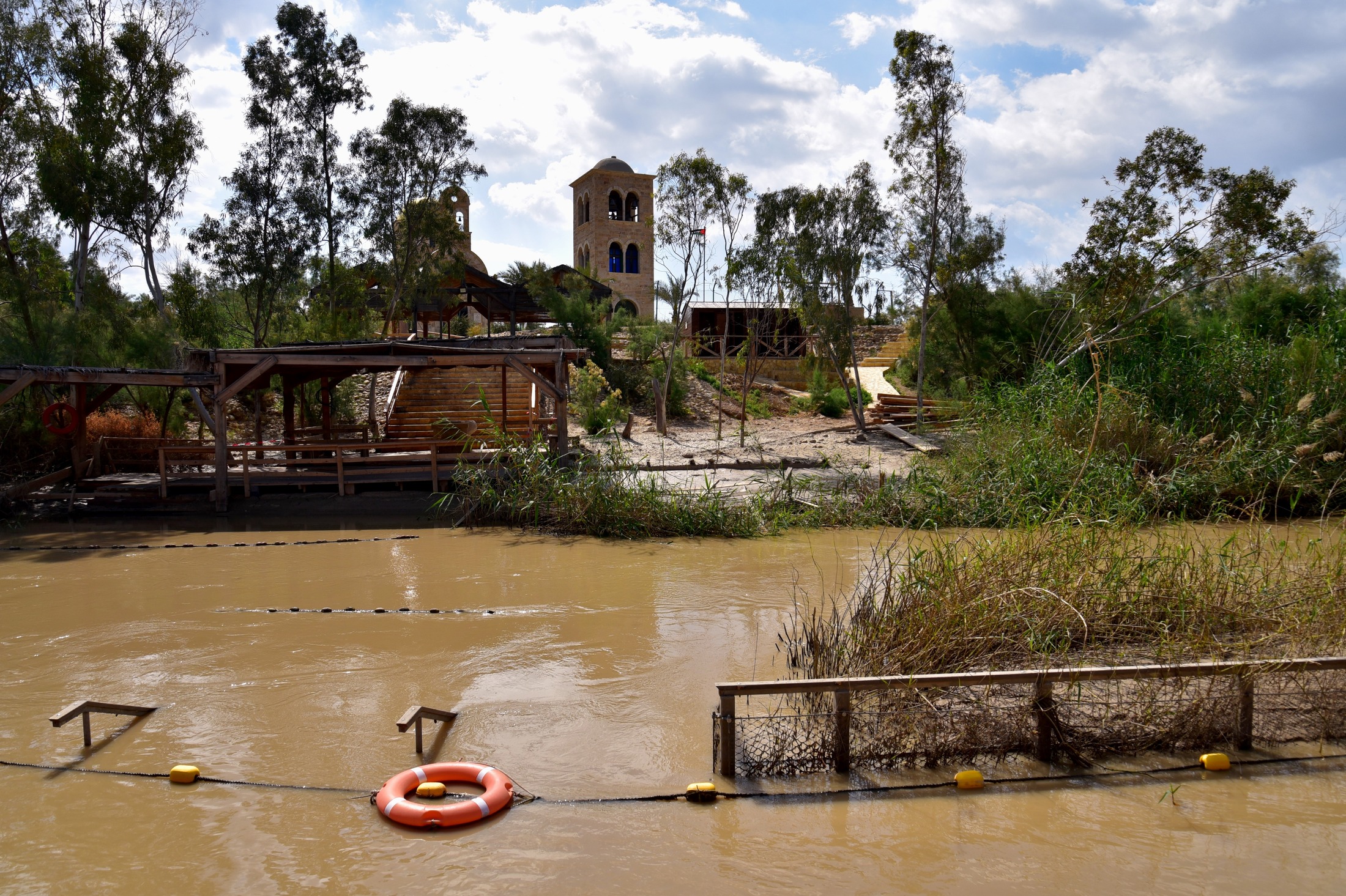
Bethabara: the place of the Baptism on the Jordan
Al-Maghtas, Jordan. Photo Bahnfrend, 2019, Wikimedia Commons, CC BY-SA 4.0

Bethabara: the place of the Baptism on the Jordan

«This took place in Bethabara beyond the Jordan, where John was baptising» (Jn. 1:28). Al-Maghtas — «place of immersion» — lies on the eastern bank of the river nine kilometres from the Dead Sea. Excavations of 1996–2002 uncovered here what the pilgrims wrote of: a church right by the water with marble steps to the river, a cruciform baptismal pool, chapels, cells of hermits on the «Hill of Elijah» (Tell el-Kharrar) — all of the 5th–6th centuries. In 2015 UNESCO inscribed the site on the World Heritage List.

On the western bank, opposite, is Qasr el-Yahud: here on Theophany and at Pascha thousands of pilgrims descend to the water. The river here is narrow and turbid; between the two banks is a border, and above it — the same sky under which «the heavens were opened».

  • UNESCO, 2015: «Baptism Site “Bethany Beyond the Jordan” (Al-Maghtas)»
  • Theodosius (c. 530): church of John the Baptist built by Emperor Anastasius (491–518), on vaults — from the floods
  • Madaba map (6th c.): inscription «Bethabara» at the place of the Baptism
  • Excavations 1996–2002: churches, baptistery, cells, steps to the water
Ein Karem: «the hill country»
Church of the Visitation, Ein Karem. Photo Bahnfrend, 2019, Wikimedia Commons, CC BY-SA 4.0

Ein Karem: «the hill country»

Luke does not name the city — only «the hill country, to a city of Judah» (Lk. 1:39). Tradition from Byzantine times points to Ein Karem, a village seven and a half kilometres south-west of Jerusalem; this distance is given by the pilgrim Theodosius around 530, while the Georgian lectionary of the 7th century knows a feast of Saint Elizabeth here. Two churches stand on the sites of the Byzantine ones: the church of John the Baptist with the grotto of the Nativity and the church of the Visitation — the house of Zechariah, where Mary met Elizabeth. At the entrance to its crypt they show the «stone of hiding» — the crevice in which, according to the tradition of the Protoevangelium, the mountain received the mother with the child. In 1871 the Russian Gorny Monastery was founded in Ein Karem.

Three kilometres further west, near Suba, archaeologist Shimon Gibson in 1999–2004 excavated a cave with thousands of ritually broken vessels of the Roman period and Byzantine drawings of John; in 2004 he declared it the «cave of John the Baptist». Most specialists do not accept this connection — we present it as a hypothesis.

  • Theodosius (c. 530): 7.5 km from Jerusalem — coincides with Ein Karem
  • Churches of John the Baptist and the Visitation: Byzantine foundations, rebuilt in the 11th–12th centuries
  • Franciscan excavations 1938, 1941–42 (S. Saller)
  • Cave at Suba: excavations by S. Gibson 1999–2004 — disputed
Sebastia: the tomb that was burned
Sebastia, tomb of John the Forerunner. Photo 1881, New York Public Library, Wikimedia Commons, public domain

Sebastia: the tomb that was burned

Herod the Great rebuilt the ancient Samaria and named it Sebaste in honour of Augustus. According to the Gospel, it was here that the disciples brought the body of their teacher, and here in 385 Saint Paula, companion of Blessed Jerome, saw his tomb next to the tombs of the prophets Elisha and Obadiah. In 362, under Julian the Apostate, the pagans opened the tomb and burned the bones — but monks, mingling with the crowd, carried off part of the relics to Jerusalem, and from there to Alexandria. The tomb was soon restored, and pilgrims came to it; in the 12th century the Crusaders built over it the cathedral of Saint John, and after 1187 the building became the mosque of Nabi-Yahya — “the prophet John”. The crypt beneath it remains open today to both Christians and Muslims.

  • Jerome, Letters 46 and 108: the tomb of John in Sebastia next to Elisha and Obadiah
  • Rufinus, Church History XI, 28: desecration under Julian, c. 362
  • 12th-century Crusader cathedral → Nabi-Yahya mosque
Sozopol, 2010: reliquary beneath the altar
Saint Ivan Island near Sozopol. Wikimedia Commons, CC BY 2.5

Sozopol, 2010: reliquary beneath the altar

In the summer of 2010 the Bulgarian archaeologist Kazimir Popkonstantinov was excavating a 5th–6th-century basilica on Saint John Island near Sozopol — the ancient Apollonia. Beneath an altar column lay a sealed marble reliquary with a gabled lid, and beside it a small box of Cappadocian tuff with a Greek inscription naming John and the day of his nativity, 24 June. Inside the reliquary were nine bone fragments: six human (a tooth, part of an upper jaw, a rib, a metacarpal bone, fragments of long bones) and three animal.

The Oxford Radiocarbon Laboratory (Thomas Higham) dated the metacarpal bone to the 1st century: AD 5–75. The animal bones proved much older — Iron Age. The first reports of 2012 concerning “Near-Eastern DNA” were not confirmed by the final article of 2020: the sequences obtained are most likely modern contamination. Science is honest here: it cannot prove that these are the bones of the Forerunner — yet neither does it refute what the monks believed when they placed them beneath the altar a thousand and a half years ago. The relics are now in the church of Saints Cyril and Methodius in Sozopol.

  • Excavations of 2010, K. Popkonstantinov (Veliko Tarnovo University)
  • Radiocarbon (Oxford, ORAU): AD 5–75 (68.2 %)
  • Kostova, Popkonstantinov, Schroeder, Willerslev, Higham et al., Journal of Archaeological Science: Reports 29 (2020)
  • DNA: “probably modern contamination” — conclusion of 2020
Святыни

Где почивают мощи Предтечи

Amiens: the face of the Forerunner

Amiens: the face of the Forerunner

In 1204 the Crusaders sacked Constantinople. Wallon de Sarton, a canon from Picardy, carried away from there the facial part of the head of the Forerunner — the frontal bone with eye sockets, without the lower jaw, with a small hole above the left eyebrow which tradition explains as the blow of Herodias’ knife. On 17 December 1206 Bishop Richard de Gerberoy received the holy relic in Amiens; the stream of pilgrims to it became one of the reasons for building the present Gothic cathedral — one of the greatest in France.

Reliquary of the head of John the Baptist, Amiens Cathedral. Photo Mfspecht, 2007, Wikimedia Commons, public domain

Rome: San Silvestro in Capite

The name of the basilica means “Saint Sylvester at the head”: here is preserved the upper part of the skull, set into a wax bust. The relic has been attested in the church since the 12th century; before that, according to tradition, the head was venerated in the Studite monastery of the Forerunner in Constantinople.

Damascus: the shrine of Yahya in the Umayyad Mosque

Damascus: the shrine of Yahya in the Umayyad Mosque

The mosque was built in 706–715 on the site of the Christian cathedral of John the Baptist. According to tradition, while building, the workers found a cave-chapel with an ark and the head of John, and Caliph al-Walid ordered the relic to be left in place; above it stands a marble tomb at which both Muslims and Christians pray. This is tradition, not an archaeological find — yet it is older than the mosque itself.

Tomb of John the Baptist, Umayyad Mosque, Damascus. Photo Frank Kidner, 1995, Dumbarton Oaks collection, Wikimedia Commons, CC BY-SA 4.0

Athos: Dionysiou

The monastery preserves a particle of the venerable head in a golden reliquary — according to tradition, a gift of the Wallachian voivode Neagoe Basarab (16th century). Here also is venerated a particle of the right hand of the Forerunner; this is a separate tradition, not coinciding with the history of the “principal” right hand.

Cetinje: the right hand that baptised the Lord

Cetinje: the right hand that baptised the Lord

The path of the right hand can be traced for a thousand years. From Antioch, where according to tradition the Evangelist Luke brought it, in 956 it was secretly taken by the deacon Job — to Chalcedon, then to Constantinople. After the fall of the city the relic passed to the sultans; in 1484 Bayezid II presented it to the Hospitaller knights of Rhodes in order to win their favour (his brother Jem was their hostage). From Rhodes the knights moved to Malta, and in 1799 they presented the right hand, the Philermos icon and a particle of the Cross to Emperor Paul I, who became their Grand Master: on 12 October the holy relics were met in Gatchina — that day is still in the Russian calendar. The Winter Palace, then 1919: the Dowager Empress Maria Feodorovna took the relics to Denmark; after her death her daughters gave them to Metropolitan Anthony (Khrapovitsky), and he to the King of Yugoslavia. The war — the Ostrog monastery; 1951 — confiscation into the Cetinje museum; 1993 — return to the Church. Now the right hand rests in the Cetinje Monastery in Montenegro.

From the hand, according to tradition, two fingers were separated: the little finger — to the Studite monastery (now in Topkapi), the middle finger — as a gift to Saint Sava of Serbia.

Cetinje Monastery, Montenegro. Photo Desemeus, Wikimedia Commons, CC BY-SA 4.0
Istanbul, Topkapi: “Pazu-yı Yahya”

Istanbul, Topkapi: “Pazu-yı Yahya”

In the palace treasury is a forearm with hand in a silver-gilt reliquary with inscriptions: “beloved of God” on the index finger, “this is the hand of the Baptist” on the wrist. According to museum tradition, the hand came to Constantinople under Constantine VII, was kept in the palace chapel and in the church of the Peribleptos, and after 1453 passed to the sultans. The traditions of the Constantinopolitan and Cetinje right hands diverge — we present both lines without merging them into one.

Topkapi Palace, Istanbul. Photo Phyrexian, Wikimedia Commons, CC BY-SA 4.0

Siena: the right hand from Pope Pius II

In 1464 Pope Pius II presented to the cathedral of his native city the right hand of the Forerunner and composed a deed of gift. The inscription on the reliquary — “The right hand of John the Forerunner, cover me, Sava, Serbian archbishop” — leads to the treasury of the Serbian monastery of Žiča. Here the church tradition (one middle finger given to Saint Sava) and the art-historical attribution (a whole forearm with hand) diverge; every year before 24 June the relic is brought out for veneration.

Иконография

Ангел пустыни

On Russian icons the Forerunner is often shown with wings: this is the “Angel of the Desert” — an image from the prophet Malachi, “Behold, I send My Angel, and he will prepare the way before Me” (Mal. 3:1), — words which the Gospel applies to John (Mk. 1:2). In his hand he holds a scroll with his preaching, at his feet his own severed head in a dish, and around, in the border scenes, is this whole story. In the Deisis of the iconostasis John stands at the left hand of Christ, opposite the Theotokos: the last prophet and the first witness.

Touch the border scene on the icon below — the corresponding chapter of the story will open.

Житие в клеймах иконы
John the Forerunner с клеймами жития
John the Forerunner, with sixteen scenes from his Life. Russia, first half of the 16th century. Arkhangelsk Museum of Fine Arts. Photograph by Wmpearl (Wikimedia Commons), CC0; the icon is in the public domain. · Наведите на клеймо — подпись; нажмите — откроется глава.
Prayers to John the ForerunnerChurch CalendarSt Dimitry of Rostov, “Lives of the Saints”, in our libraryAll lives