ORTHODOX HOUSENewsCommunityCalendarPrayer BookLives of the Saints
Great-Martyr George the Trophy-Bearer
Lives of the Saints · the saint tells his own story

Great-Martyr George the Trophy-Bearer

Commemorated: 23 April (6 May) · 3 (16) November — consecration of the church in Lydda · 3rd–4th century · Cappadocia — Nicomedia — Lydda
«I was born in Cappadocia, in a family of Christian parents, and from infancy was brought up by them in piety. Still in childhood I lost my father: he died, tortured for confessing Christ…»
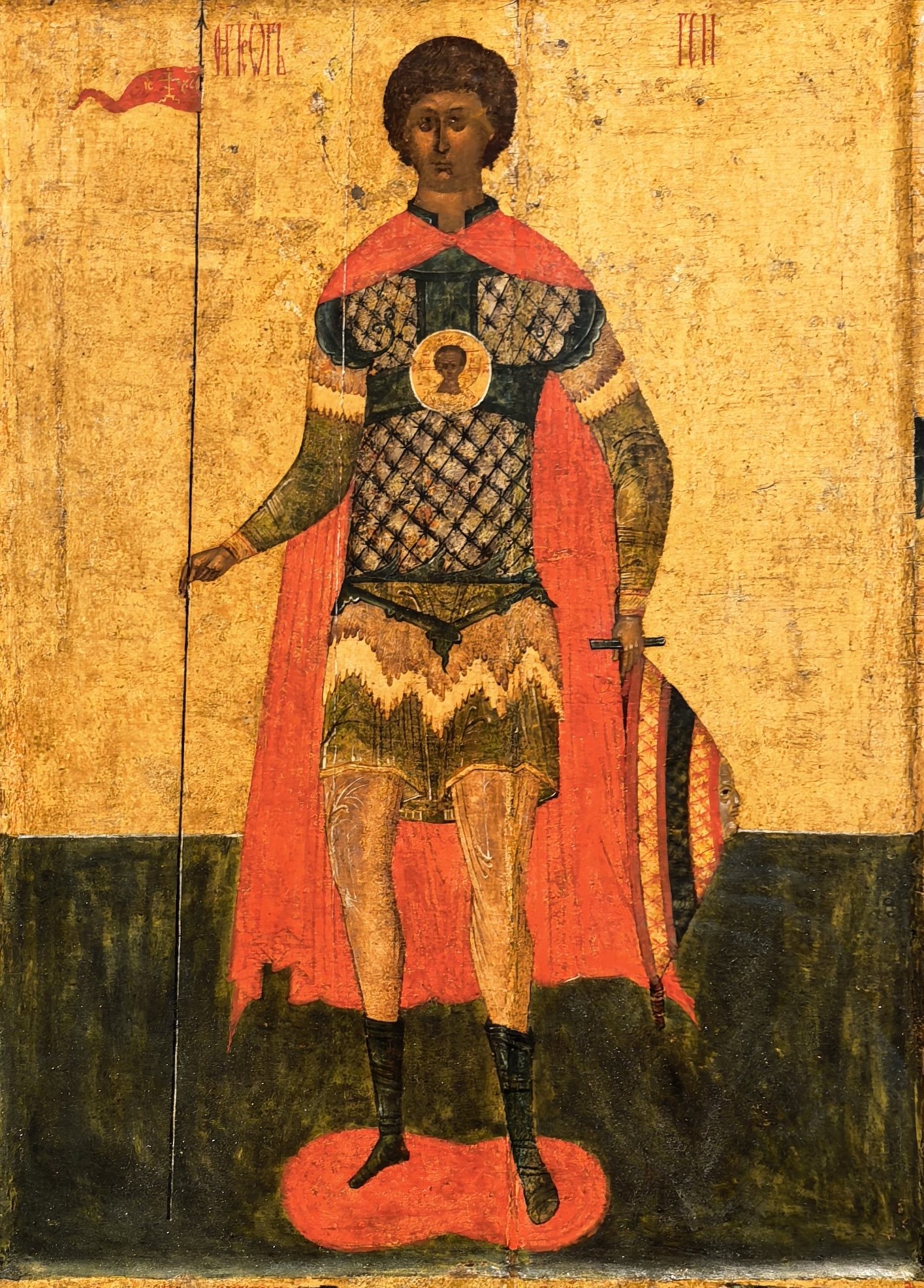
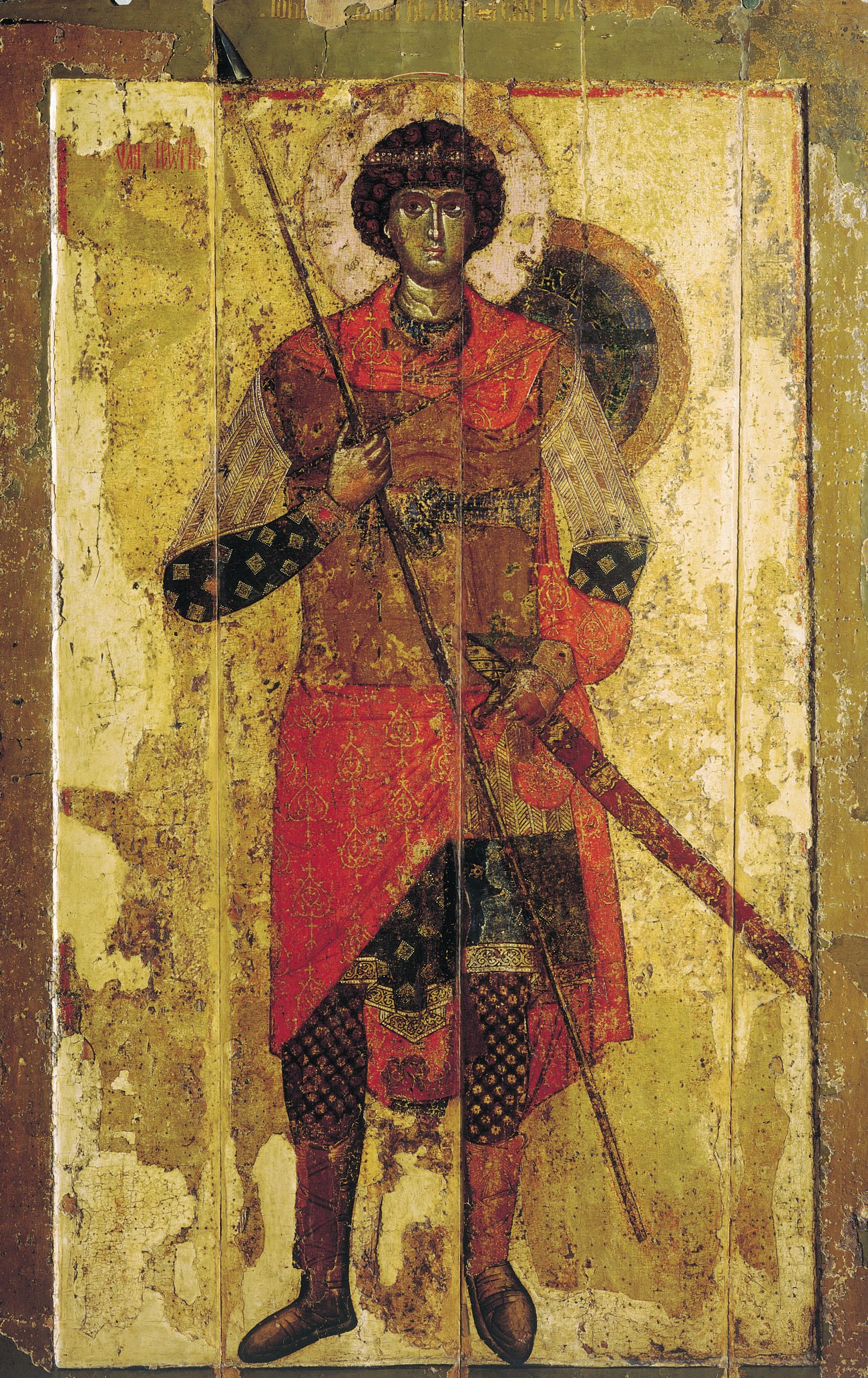
St George. Novgorod, c. 1130, the church icon of the Yuriev Monastery (now in the Dormition Cathedral of the Moscow Kremlin). Public domain.
How this is made. First-person narrative — a literally close paraphrase of this Life; not a single fact that is absent from the source. Beneath each excerpt stands the text of St Dimitry himself. Source: St Dimitry of Rostov. Lives of the Saints. Month of April, day 23 — The Suffering of the Holy Great-Martyr George the Trophy-Bearer. The face is an authentic icon; the light and breathing make it a “living icon”, with no talking lips. The pictures beside the passages are the border scenes of the icon of his life. There is no voice: the reading is yours.
Great-Martyr George in military armour — the central panel of the hagiographic icon
Border scene of the icon: Great-Martyr George in military armour — the central panel of the hagiographic icon · Moscow, 16th c.
1 · Cappadocia — Palestine

Cappadocia. Son of a Martyr

I was born in Cappadocia, in a family of Christian parents, and from infancy was brought up by them in piety. Still in childhood I lost my father: he died, tortured for confessing Christ. My mother then moved with me to Palestine, since that was her homeland and she had rich estates there.

When I came of age, I was distinguished by the beauty of my face, courage and strength of body, and therefore was appointed tribune in a famous military regiment. In this rank I showed such bravery in battle that the Emperor Diocletian, who did not yet know of my Christianity, honoured me with the rank of comes and general. My mother had already reposed by that time.

Thus I, a soldier of the Roman army, found myself at the side of the Emperor himself — in the days when he devised the cruel extermination of the Christians.

Source — St Demetrius of Rostov, “Lives of the Saints”
At that time in the Roman army there was a wondrous soldier of Christ, St George, by birth from Cappadocia […] the son of Christian parents, brought up by them in piety from his youth. Still in childhood he lost his father, who died, tortured for confessing Christ. The mother of George moved with him to Palestine, since that was her homeland and she had rich estates there. […] When he came of age, St George was distinguished by the beauty of his face, courage and strength of body, and therefore was appointed tribune […] In this rank he showed such bravery in battle that the Emperor Diocletian, who did not yet know of his Christianity, honoured him with the rank of comes […] The mother of George had already reposed by that time. […] When Diocletian devised the cruel extermination of the Christians, St George was at the side of the Emperor.
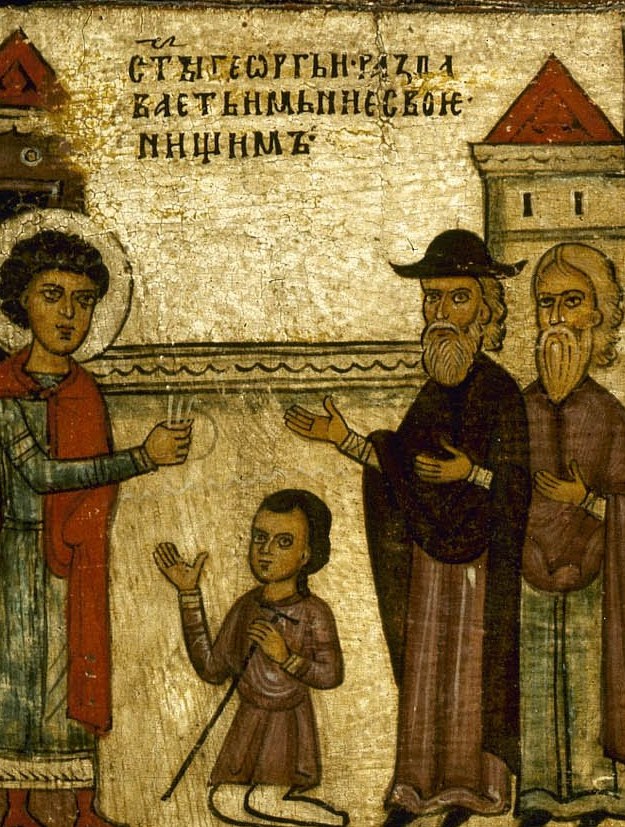
St George distributes his possessions to the poor
Border scene of the icon: St George distributes his possessions to the poor · Novgorod, 14th c.
2 · Nicomedia

Diocletian and the council in Nicomedia

The ruler of the Roman Empire, the impious Diocletian, was a fervent follower and patron of idolatry. Above all the gods he honoured Apollo, who was reputed to be a foreteller of the future: the demon dwelling in his soulless idol would prophesy, yet those predictions never came true. Once Diocletian asked Apollo about a certain matter, and the demon answered that he could not truly foretell the future, for he was hindered by righteous people. The priests told the Emperor that the righteous ones upon the earth were the Christians.

Hearing this, Diocletian was filled with wrath and fury and renewed the persecution that had ceased. The prisons, instead of adulterers, robbers and worthless men, were filled with those confessing the true God; the usual tortures were abolished as insufficient, and the most savage ones were invented. The Emperor summoned from everywhere his proconsuls and governors to a council in Nicomedia, gathered the princes, boyars and all his senate and commanded that by every means the Christian faith be exterminated throughout the Empire. All received this imperial word with approval.

I was at that time at the side of the Emperor. From the first day, as soon as I became convinced that this unrighteous design could in no way be revoked, and learned of the ferocity of the impious against the Christians, I decided that the time had come which would serve for the salvation of my soul. Immediately I distributed all my wealth — gold, silver and costly garments — to the poor; to the slaves who were with me I granted freedom, and concerning the slaves in my Palestinian estates I gave orders that some should be freed and others given to the destitute.

Source — St Demetrius of Rostov, “Lives of the Saints”
The unworthy ruler of the Roman Empire, the impious Diocletian […] was a fervent follower and patron of idolatry. Above all the gods he honoured Apollo […] For the demon dwelling in his soulless idol would prophesy of the future, yet those predictions never came true. […] I cannot truly foretell the future, for I am hindered by righteous people […] The priests answered that the righteous ones upon the earth were the Christians. Hearing this, Diocletian was filled with wrath and fury against the Christians and renewed the persecution against them that had ceased. […] the prisons, instead of adulterers, robbers and worthless men, were filled with those confessing the true God. The usual ways of torture were abolished as insufficient and the most savage tortures were invented […] Then the Emperor summoned from everywhere his proconsuls and governors to a council in Nicomedia […] gathered the princes, boyars and all his senate […] strive by every means to exterminate throughout our Empire the Christian faith […] All received this imperial word with approval. […] From the first day, as soon as St George became convinced that this unrighteous design could in no way be revoked, and learned of the ferocity of the impious against the Christians, he decided that the time had come which would serve for the salvation of his soul. Immediately St George distributed all his wealth — gold, silver and costly garments — to the poor; to the slaves who were with him he granted freedom, and concerning those slaves who were in his Palestinian estates he gave orders that some of them should be freed and others given to the destitute.
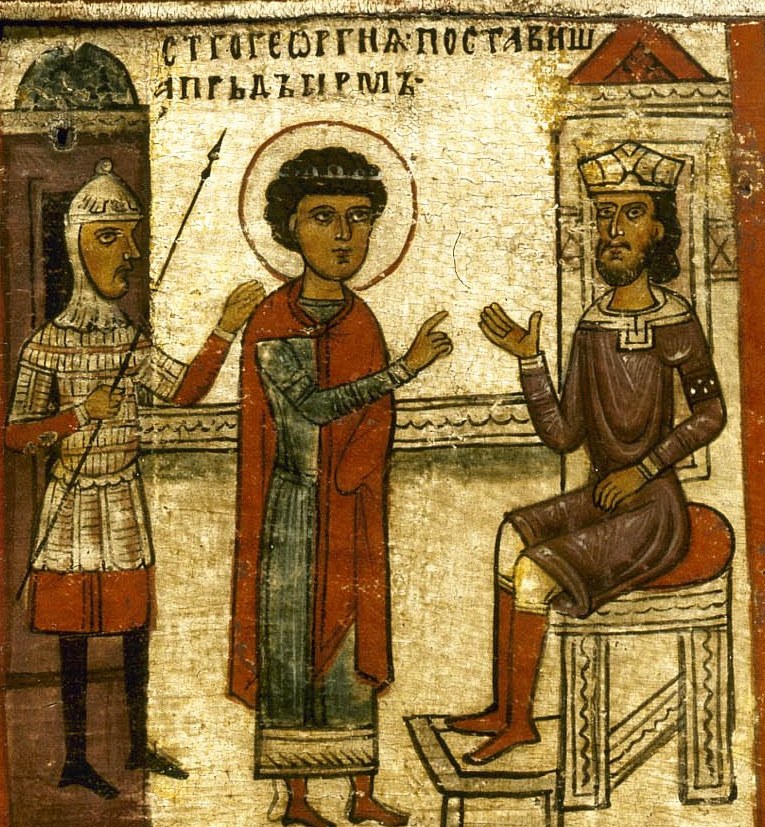
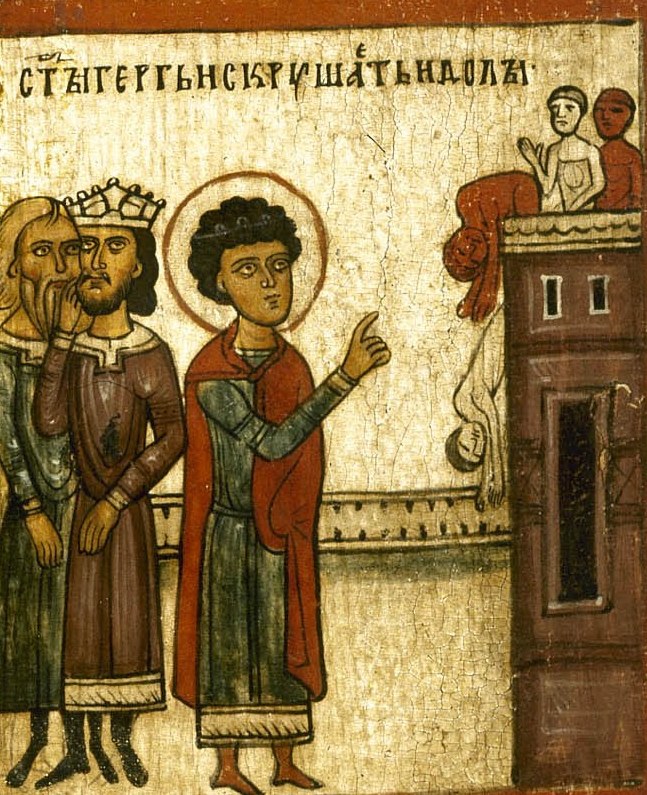
St George is brought before the Emperor
Border scene of the icon: St George is brought before the Emperor · Novgorod, 14th c.
3 · Nicomedia, the Emperor’s council

«Truth is Christ Himself». Speech at the assembly

On the third day, when the final council of the king and his princes was to be held concerning the lawless slaying of the innocent Christians, I, casting aside all human fear and having in myself only the fear of God, with a radiant face appeared at that impious and lawless assembly. I said: «O king, and you, princes and counsellors! You are established to uphold good laws and righteous judgments, yet you furiously direct your wrath against Christians». And I added: «But no, your idols are not gods! Be not deceived by this falsehood. Jesus Christ is the only God, the only Lord in the glory of God the Father, by Whom all things were created and by Whose Holy Spirit all things exist».

Astonished at such words, all turned their eyes upon the king. The king, as though thunderstruck, sat in silence and at last signalled to his friend Magnentius, who held the rank of anthypatos, that he should answer me. Magnentius asked who had moved me to such boldness. «The truth», I replied. «And what is this truth?» «The truth is Christ Himself, Whom you persecute». «Then are you also a Christian?» «I am the servant of Christ my God, and trusting in Him I have of my own will appeared among you to bear witness to the truth».

The whole assembly was thrown into confusion and an unruly clamour arose. Diocletian commanded silence to be restored, recognised me and said that he had previously marvelled at my nobility and had honoured me with no small rank, but now, like a father, he urged me not to forfeit my military glory and not to deliver the bloom of my youth to torments: «Offer sacrifice to the gods, and you will receive yet greater honour from us». I answered: «O that you yourself, O king, might through me come to know the true God and offer to Him the sacrifice of praise that He loves!»

Source — St Demetrius of Rostov, “Lives of the Saints”
On the third day, when the final council of the king and his princes was to be held concerning the lawless slaying of the innocent Christians, the valiant warrior of Christ, the holy Great-martyr George, casting aside all human fear and having in himself only the fear of God, with a radiant face and a courageous mind appeared at that impious and lawless assembly […] O king, and you, princes and counsellors! You are established to uphold good laws and righteous judgments, yet you furiously direct your wrath against Christians […] But no, your idols are not gods! Be not deceived by this falsehood. Jesus Christ is the only God, the only Lord in the glory of God the Father, by Whom all things were created and by Whose Holy Spirit all things exist. […] The king, from astonishment, could not come to himself and, as though thunderstruck, sat in silence, restraining the anger within him. At last the king signalled to Magnentius, who was present at the council, his friend, who held the rank of anthypatos, that he should answer George. […] Who has moved you to such boldness and grand speech? […] The truth is Christ Himself, Whom you persecute. […] I am the servant of Christ my God, and trusting in Him I have of my own will appeared among you to bear witness to the truth. […] I too have previously marvelled at your nobility, O George! […] Offer sacrifice to the gods, and you will receive yet greater honour from us. […] O that you yourself, O king, might through me come to know the true God and offer to Him the sacrifice of praise that He loves! […] Nothing of this can weaken my piety, and no torments will frighten my soul or shake my mind.
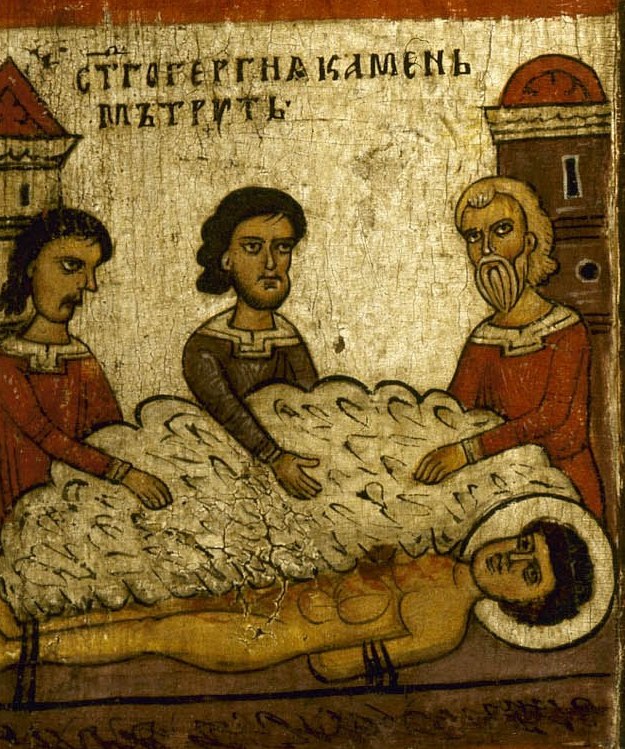
A heavy stone is laid upon the martyr’s breast
Border scene of the icon: A heavy stone is laid upon the martyr’s breast · Novgorod, 14th century
4 · Nicomedia, the prison

The spear that bent like lead

These words brought the king to a frenzy. Not allowing me to finish my speech, he commanded his armour-bearers to drive me from the assembly with spears and to cast me into prison. When the soldiers began to carry out the order and one spear already touched my body, immediately its iron became soft as lead and bent. My mouth, however, was filled with the praise of God.

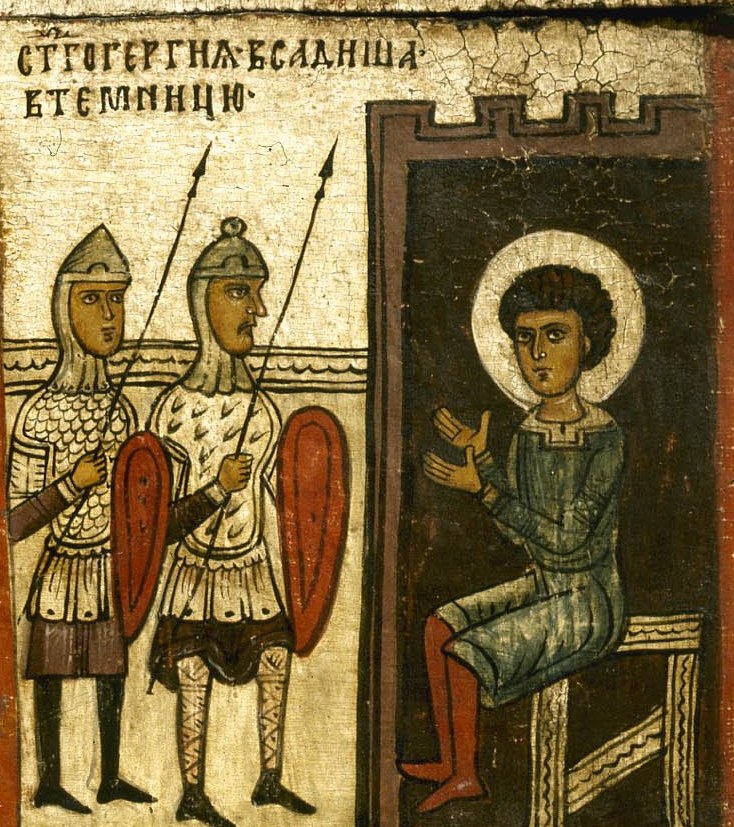
Having brought me into the prison, the soldiers stretched me out upon the ground, face upward, fastened my feet in stocks and laid a heavy stone upon my breast. Thus the tormentor commanded. I endured all this and unceasingly gave thanks to God until the following day.

When the day came, the king again summoned me to trial and, seeing me oppressed by the weight of the stone, asked: «Have you repented, George, or do you still abide in your disobedience?» Oppressed by the heavy stone that lay upon my breast, I could scarcely utter: «O king, do you truly think that I have come to such exhaustion that after so little torment I would renounce my faith? Sooner shall you grow weary tormenting me than I, being tormented by you».

Source — St Demetrius of Rostov, “Lives of the Saints”
These words of the holy Great-martyr George brought the king to a frenzy. Not allowing the saint to finish his speech, the king commanded his armour-bearers to drive George from the assembly with spears and to cast him into prison. […] When the soldiers began to carry out the king’s order and one spear already touched the body of the saint, immediately its iron became soft as lead and bent. The mouth of the martyr, however, was filled with the praise of God. […] Having brought the martyr into the prison, the soldiers stretched him out upon the ground, face upward, fastened his feet in stocks and laid a heavy stone upon his breast. Thus the tormentor commanded. The saint endured all this, unceasingly giving thanks to God until the following day. […] Have you repented, George, or do you still abide in your disobedience? […] O king, do you truly think that I have come to such exhaustion that after so little torment I would renounce my faith? Sooner shall you grow weary tormenting me than I, being tormented by you.
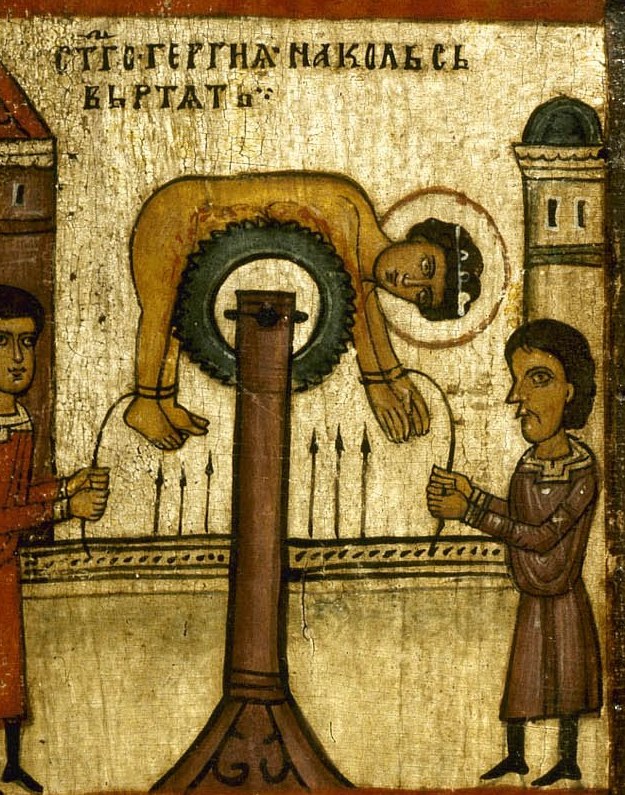
The holy Great-martyr George is spun upon the wheel
Border scene of the icon: The holy Great-martyr George is spun upon the wheel · Novgorod, 14th century
5 · Nicomedia, at the temple of Apollo

The wheel and the Angel

Then Diocletian commanded that a great wheel be brought, fitted with boards studded with iron spikes like swords, knives and awls. Upon that wheel the king commanded that I be bound naked and, by turning the wheel, that my whole body be cut by the iron spikes. Cut to pieces and crushed like a reed, I at first prayed to God with a loud voice, then quietly, to myself, thanked God, without uttering a single groan.

Considering me dead, the king in his joy offered praise to his gods: «Where then is your God, George; why has He not delivered you from such torment?» He commanded that I be unbound from the wheel as one already dead, and himself went to the temple of Apollo. Suddenly the air grew dark and a terrible thunder pealed, and many heard a voice from above: «Fear not, George, I am with you». There appeared a great radiance, and an Angel of the Lord in the form of a beautiful and bright-faced youth was seen standing by the wheel; laying his hand upon me, he said: «Rejoice!» When the Angel disappeared, I came down from the wheel, released from it by the Angel and healed by him of my wounds, and I called upon the Lord.

The soldiers in terror announced what had happened to the king, and I followed them and stood before the king in the temple. The king at first did not believe that it was I who stood before him, but I proclaimed with a loud voice: «I am George». Two men who were there, Anatolius and Protoleon, who had already earlier been instructed in the Christian faith, were completely confirmed in the confession of Christ and cried out: «There is one great and true God, the God of the Christians!» The king immediately commanded that they be led outside the city and beheaded with the sword. Queen Alexandra, who was also in the temple, came to know the truth; but when she wished to confess Christ, the eparch restrained her and commanded that she be taken to the palace.

Source — St Demetrius of Rostov, “Lives of the Saints”
Then Diocletian ordered a great wheel to be brought, beneath which were placed boards studded with iron points like swords, knives and spikes. […] On that wheel the king ordered the naked martyr to be bound and, turning the wheel, to cut all his body with the iron points fixed on the boards. Saint George, being cut in pieces and crushed like a reed, valiantly endured his torments. At first he prayed to God with a loud voice, then quietly, to himself, he thanked God, without uttering a single groan. […] Where is thy God, George; why hath He not delivered thee from such torment? […] Suddenly the air grew dark and a terrible thunder pealed, and many heard a voice from above: […] Fear not, George, I am with thee. […] There appeared a radiance, great and extraordinary, and an Angel of the Lord in the form of a beautiful and bright-faced youth, illumined with light, appeared standing by the wheel and, laying his hand on the martyr, said: […] When the Angel disappeared, the martyr himself came down from the wheel, released from the wheel by the Angel and healed by him of his wounds. […] Two men who were there, Anatolius and Protoleon, honoured with the praetorian […] One is the great and true God, the God of the Christians! […] The king immediately ordered them to be seized, without interrogation to be led outside the city and beheaded with the sword. […] Empress Alexandra, who was also present in the temple, seeing the wondrous healing of the martyr and hearing of the appearance of the Angel, recognised the truth. But when she wished to confess Christ with boldness, her eparch restrained her and, before the king learned of it, ordered her to be taken to the palace.
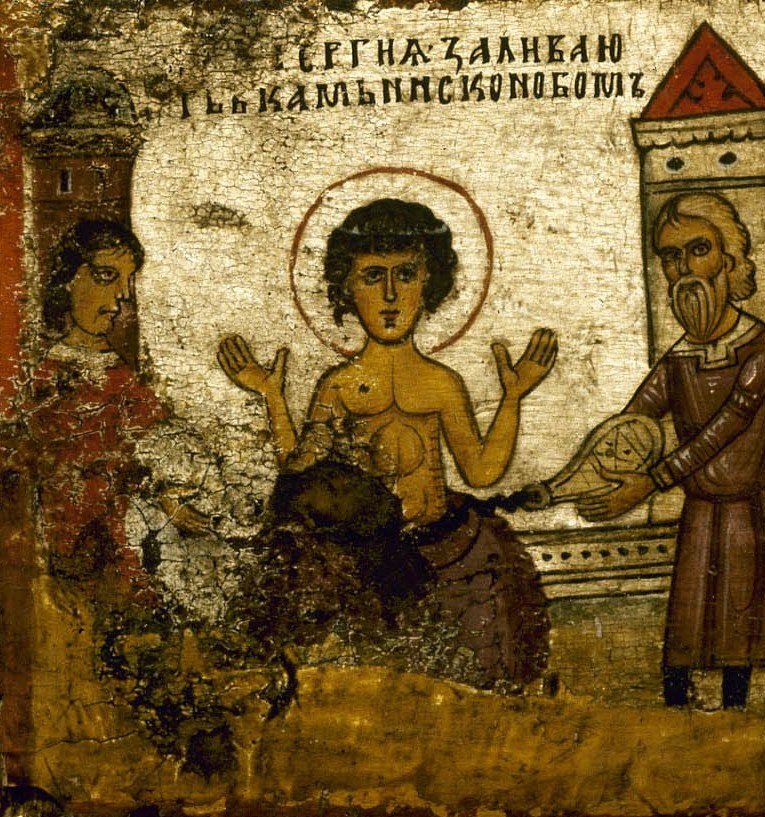
Saint George is covered with lime in the pit
Border scene of the icon: Saint George is covered with lime in the pit · Novgorod, 14th century
6 · Nicomedia, pit outside the city

Pit with unslaked lime

The evil-doing Diocletian, incapable of doing good, ordered that I be cast into a stone-lined pit with unslaked lime and be covered over with it for three days. Being led to the pit, I prayed aloud to the Lord — the Saviour of the sorrowful, the refuge of the persecuted, the hope of the hopeless: that He would hear the prayer of His servant, deliver me from the wiles of the adversary and grant me to keep until the end of my life the confession of His Holy Name; that my enemies might not say: «Where is his God?» — and that He would send me a guardian Angel, as once He turned the Babylonian furnace into dew and preserved His youths unharmed.

Having thus prayed and signed my whole body with the sign of the Cross, I entered the pit, rejoicing and glorifying God. Binding me and, according to the command, covering me with unslaked lime, the king’s servants departed.

On the third day the king ordered my bones to be cast out of the pit, for he thought that I had been burned there. When the servants came and raked away the lime, they found me, contrary to expectation, unharmed, alive, healthy and freed from bonds. I stood with a radiant face, stretching out my hands to heaven and thanking God for all His benefits. The servants and the people present at this were seized with horror and amazement and, as with one mouth, glorified my God, calling Him Great.

Source — St Demetrius of Rostov, “Lives of the Saints”
The evil-doing Diocletian, incapable of doing good, ordered that George be cast into a stone-lined pit with unslaked lime and be covered with it for three days. […] Being led to the pit, the saint prayed aloud to the Lord thus: […] Saviour of the sorrowful, refuge of the persecuted, hope of the hopeless, O Lord my God! Hear the prayer of Thy servant […] Deliver me from the wiles of the adversary and grant me to keep until the end of my life the confession of Thy Holy Name. […] Send me an Angel, the guardian of me the unworthy — Thou Who didst turn the Babylonian furnace into dew and preserve Thy youths unharmed […] Having thus prayed and signed his whole body with the sign of the Cross, George entered the pit, rejoicing and glorifying God. Binding the martyr and, according to the command, covering him in the pit with unslaked lime, the king’s servants departed. […] On the third day the king ordered the martyr’s bones to be cast out of the pit with lime, for he thought that George had been burned there. When the servants came and raked away the lime, they found the saint, contrary to expectation, unharmed, alive, healthy and freed from bonds. He stood with a radiant face, stretching out his hands to heaven and thanking God for all His benefits. […] The servants and the people present at this were seized with horror and amazement and, as with one mouth, glorified the God of George, calling Him Great.
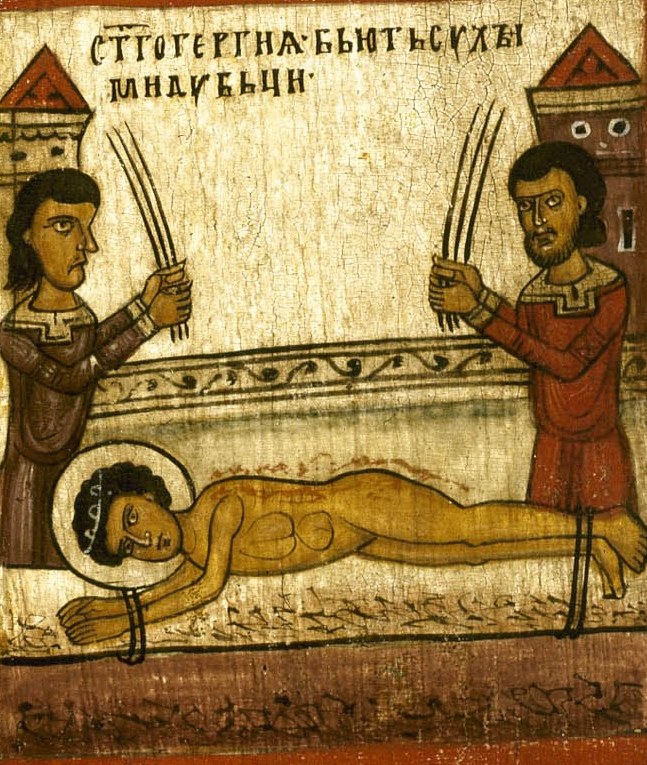
Saint George is beaten with dry cudgels
Border scene of the icon: Saint George is beaten with dry cudgels · Novgorod, 14th century
7 · Nicomedia, from the judgment hall to the prison

Iron boots

Learning what had happened, Diocletian ordered me to be brought to him and with astonishment asked whence I had such power and by what sorceries I made use. I answered that I wept for their blindness: deceived by the devil, they called the miracles of my God, seen by their own eyes, sorcery and charms.

Then Diocletian ordered iron boots to be brought, long nails fixed in their soles to be heated, me to be shod in these boots and thus driven with blows to the prison. The tormentor, mocking, said: «What a swift runner thou art, George, how quickly thou goest!» I, inhumanly dragged along, said to myself: go, George, that thou mayest attain, for thou goest «not as uncertainly» (1 Cor. 9:26) — to eternal salvation. And I called upon God that He Himself would heal me and grant me patience to the end.

Shut up in the prison, I was exhausted in body, my feet being torn to pieces, but not exhausted in spirit. And that night, by God’s help, I was healed of my wounds: my feet and all my body again became unharmed. In the morning I was brought before the king in the place of public spectacle. Seeing that I walked properly and did not limp, the king asked with astonishment: «What then, George, — dost thou like thy boots?» — «Very much», I answered. The king again urged me to renounce the magical art and to offer sacrifice to the gods.

I answered: «How senseless ye are, calling the power of God sorcery and shamelessly boasting of demonic delusion!» Then Diocletian ordered me to be struck on the mouth, that I might learn not to offend kings, and then to be beaten with ox sinews until my flesh with the blood should cleave to the ground. Fiercely tormented, I did not change the brightness of my face.

Source — St Demetrius of Rostov, “Lives of the Saints”
Having learned what had happened, Diocletian immediately ordered the saint to be brought to him and said with astonishment: […] Whence comes such power in you, George, and what sorceries do you employ […] I think that you have deliberately pretended to believe in Christ in order to display magical cunning […] you call the miracles of my God, visible to your own eyes, sorcery and enchantments. I weep for your blindness […] Then Diocletian ordered iron boots to be brought, long nails driven into their soles to be heated red-hot, the martyr to be shod in these boots and driven with blows to the prison. […] What a swift runner you are, George, how quickly you go! […] Go, George, that you may attain, for you run «not to something unknown» […] Look down from heaven, O Lord, behold my labour and hear the groaning of Thy bound servant […] Shut up there, he was exhausted in body, his feet torn to pieces, yet not exhausted in spirit. […] And that night, by God’s help, he was healed of his wounds; his feet and all his body became sound again. […] Seeing that the martyr walked properly and did not limp on his feet, as though no wounds had been inflicted on him, the emperor said to him with astonishment: […] Well, George, do your boots please you? […] How senseless you are, calling the power of God sorcery and shamelessly boasting of demonic delusion! […] he ordered those standing by to strike him on the mouth; let the tormentor learn, he said, not to vex kings. Then he commanded that George be beaten with ox sinews until his flesh with the blood clung to the ground. […] Fiercely tormented, holy George did not change the brightness of his face.
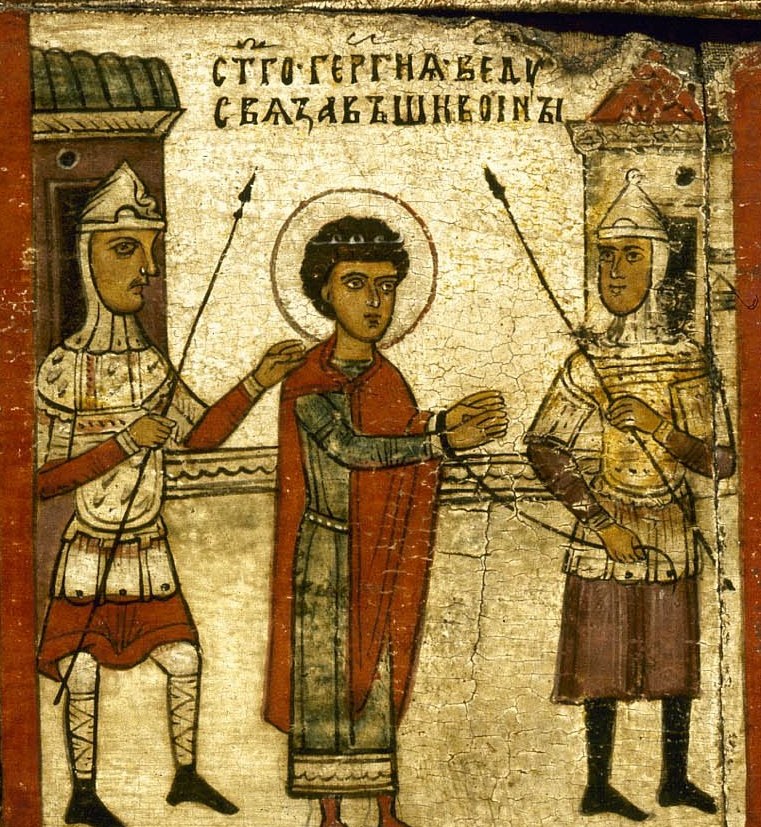
Soldiers lead bound Saint George
Border scene of the icon: Soldiers lead bound Saint George · Novgorod, 14th century
8 · Nicomedia, the judgment seat

Magician Athanasius and the cup of poison

The emperor told those around him that this was not from my courage and strength, but from magical cunning. Then Magnentius said to the emperor that there was here a certain man skilled in sorcery. The magician, named Athanasius, was summoned before the emperor; Diocletian ordered him either to destroy my sorcery or to deprive me of life with enchanted herbs, and Athanasius promised to fulfil everything the next day.

In the morning the emperor again sat at the judgment seat. Athanasius also came, boasting of his wisdom and carrying enchanted drinks in various vessels. Taking one vessel, he said to the emperor: “If you wish the madman to obey you in everything, let him drink this potion”; in another vessel was bitter death. At the emperor’s command I was brought to trial. They forced me to drink the enchanted potion; having drunk it without hesitation, I remained unharmed. Boiling with rage, the emperor ordered me to be given the other potion as well, filled with deadly poison. I did not wait for violence, but voluntarily took the vessel and drank the death-bearing poison, yet remained unharmed, preserved from death by the help of God’s grace.

The emperor and all his senate marvelled; Athanasius was perplexed. To the emperor’s question by what tricks I remained unharmed, I answered: “No, I am saved by calling on Christ and by His power.” Christ taught His servants not to fear those who kill the body, for they cannot kill the soul. His promises are not false: “But there shall not an hair of your head perish” (Lk. 21:18) — “They shall take up serpents; and if they drink any deadly thing, it shall not hurt them” (Mk. 16:18) — “He that believeth on Me, the works that I do shall he do also” (Jn. 14:12). His works are to enlighten the blind, to cleanse lepers, to cast out unclean spirits, to raise the dead.

Source — St Demetrius of Rostov, “Lives of the Saints”
Truly this is not from the courage and strength of George, but from magical cunning. […] There is here a certain man skilled in sorcery. If you order him to be brought, George will soon be vanquished and will come into obedience to you. […] Either overcome and destroy his sorcery and make him obedient to us, or immediately deprive him of life with enchanted herbs […] The magician, named Athanasius, promised to fulfil all that was commanded the next day. […] Direct my steps to the confession of Thee and preserve my path in Thy faith […] The magician Athanasius also came, boasting of his wisdom, carrying enchanted drinks in various vessels to show the emperor and all those present. […] If you wish the madman to obey you in everything, let him drink this potion. […] But if it please your judgment to see his bitter death, let him drink this. […] And he ordered the holy one to be forcibly given the enchanted potion. Having drunk it without hesitation, George remained unharmed, rejoicing and mocking demonic delusion. Boiling with rage, the emperor ordered him to be forcibly given the other potion as well, filled with deadly poison. The saint, however, did not wait for violence, but voluntarily took the vessel and drank the death-bearing poison, yet remained unharmed, being preserved from death by the help of God’s grace. […] The emperor and all his senate marvelled; the magician Athanasius also was perplexed. […] No, I am saved by calling on Christ and by His power. […] taught His servants not to fear those who kill the body, for they cannot kill the soul. […] To enlighten the blind, to cleanse lepers, to give walking to the lame, hearing to the deaf, to cast out unclean spirits, to raise the dead
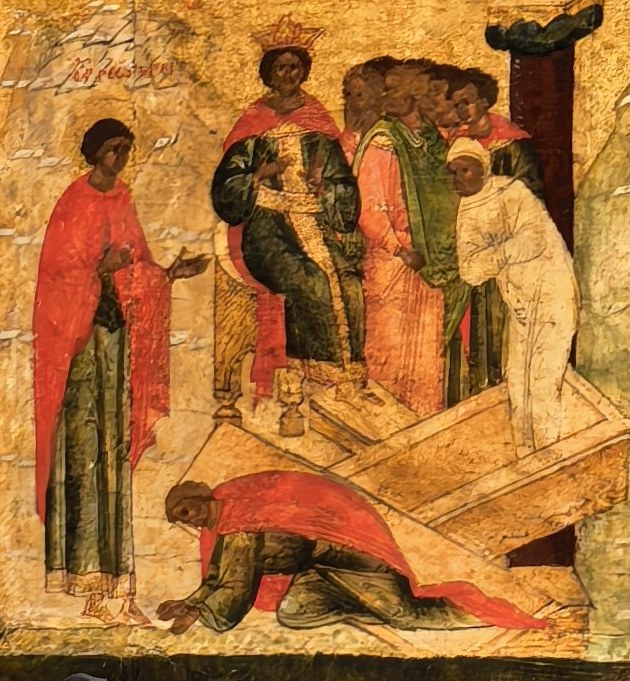
Saint George raises a dead man before the emperor
Border scene of the icon: Saint George raises a dead man before the emperor · Moscow, 16th century
9 · Nicomedia, the tomb by the city gates

The raising of the dead man

Athanasius said to the emperor that their gods had never yet raised a dead man; but if I should raise a dead man before the emperor and before all, then they too would submit to my God as the Almighty: “From here, even at a distance, the tomb is visible in which a dead man was recently laid, whom I knew while he was alive.” That tomb stood half a stadium from the judgment seat, beyond the city gates. The emperor commanded me, to demonstrate the power of my God, to raise the dead man, and Magnentius begged that I be freed from my bonds and said: “Show, George, the wondrous works of your God, and you will bring all of us to faith in Him.”

I said: “My God, Who created all things out of nothing, has power to raise that dead man through me.” Bending my knees, I prayed to God for a long time with tears; then, rising, I cried out to the Lord with a loud voice that He not put to shame those who hope in Him and grant this wicked generation the sign it asked — that He raise the dead man lying in the tomb, to His own glory.

When I said “amen,” suddenly thunder roared and the earth shook. The roof of the tomb fell to the ground, the coffin was opened, and the dead man rose alive and came out of the grave. All were struck dead with horror; many wept and glorified Christ as the great God. The emperor and those with him, convinced that before them was no apparition but a man truly raised from the dead and calling on the name of Christ, silently surrounded me. Athanasius fell at my feet, confessing that Christ is the Almighty God. But the emperor declared that Athanasius had given me not poison but some enchanted drink, and without trial ordered the heads of Athanasius and the man raised from the dead to be cut off; as for me, he commanded that I be kept in prison and in chains.

Source — St Demetrius of Rostov, “Lives of the Saints”
they had never yet seen anyone raise the dead […] let George raise the dead before you, O king, and before all of us. Then we too shall submit to his God as to the Almighty. From here, in the distance, can be seen the tomb in which a dead man was recently laid, whom I knew while he was alive. […] The tomb indicated by him stood half a stadium from the place of judgment […] For the trial was taking place at the site of the former theatre, by the city gates. That tomb was outside the city, since according to the custom of the Hellenes their dead were buried outside the city. And the king commanded the martyr to raise the dead man in order to demonstrate the power of his God. The proconsul Magnentius then entreated the king to release George from his bonds. […] Show, George, the wondrous works of your God, and you will bring all of us to faith in Him. […] My God, Who created all things out of nothing, has the power to raise that dead man through me […] But my Lord, for the sake of the people present, will do what you, tempting me, ask – so that you may not attribute this to sorcery. […] George knelt and prayed to God for a long time with tears; then, rising, George cried out to the Lord in a loud voice: […] do not put to shame those who hope in You, O Lord […] Give this wicked generation the sign it seeks and raise the dead man lying in the tomb […] When he said «amen», suddenly thunder roared and the earth shook, so that all were terrified. Then the roof of the tomb fell to the ground, the coffin was opened, and the dead man rose alive and came out of the grave. All who saw this were struck dead with horror. […] many wept and glorified Christ as the great God […] convinced that before them was not an apparition but truly a man raised from the dead and calling on the name of Christ […] Athanasius then fell at the feet of the saint, confessing that Christ is the Almighty God […] gave George to drink not poison but a certain enchanted potion […] They gave a living man the appearance of one who seemed dead […] the king commanded that without interrogation or preliminary tortures the heads of Athanasius and the one raised from the dead be cut off; as for the holy martyr of Christ George, he ordered him to be kept in prison and in chains.
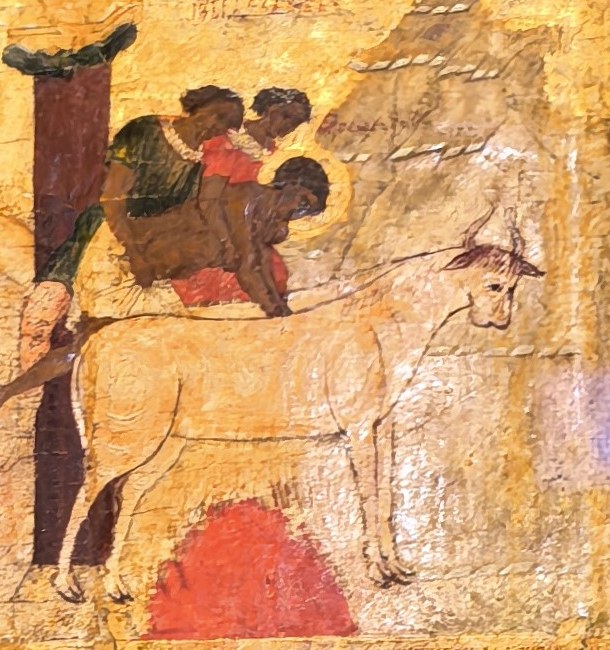
Saint George Raises the Ox of the Farmer Glycerius
Border scene of the icon: Saint George Raises the Ox of the Farmer Glycerius · Moscow, 16th century
10 · Nicomedia, the prison

The Prison. Glycerius and His Ox

I was led away to prison, where I rejoiced and thanked God the Master, Who does not put to shame those who hope in Him, and I asked Him to grant that I might soon behold His glory, having put the devil to shame to the end.

While I remained in prison, people came to me who through my miracles had come to believe in Christ; they gave gold to the guards, fell at my feet and were instructed by me in the holy faith. By invoking the name of Christ and the sign of the Cross I healed the sick as well, who came to me in great numbers in the prison. Among those who came was a certain man named Glycerius, a simple farmer, whose ox had fallen from a mountain into the forest and been smashed to death. Hearing of the miracles, Glycerius came to me, grieving over the dead ox. I smiled and said to him: «Go, brother, and do not sorrow. Christ, my God, will restore your ox to life».

The farmer went away with firm faith in my words and indeed saw his ox alive. At once he returned to me and, walking through the midst of the city, cried aloud: «Truly great is the God of the Christians!» For this the soldiers seized him and reported him to the king. Diocletian was filled with anger, did not wish to see him and ordered that his head be cut off at once outside the city. Glycerius went to death for Christ with joy, as to a feast, walking before the soldiers, loudly calling on Christ God and praying that He would accept the shedding of his blood as baptism. Thus Glycerius departed this life.

Source — St Demetrius of Rostov, “Lives of the Saints”
Saint George was led away to prison, where he rejoiced and thanked God: […] Glory to Thee, O Master, Who dost not put to shame those who hope in Thee. […] Grant me, O God, my God, soon to behold Thy glory, having put the devil to shame to the end. […] While the Great-Martyr George remained in prison, people came to him who through his miracles had come to believe in Christ, gave gold to the guards, fell at the feet of the saint and were instructed by him in the holy faith. By invoking the name of Christ and the sign of the Cross the saint healed the sick as well, who came to him in great numbers in the prison. Among those who came was a certain man named Glycerius, a simple farmer, whose ox had fallen from a mountain into the forest and been smashed to death. Hearing of the miracles of the saint, Glycerius came to him, grieving over the dead ox. The saint smiled and said to him: […] Go, brother, and do not sorrow. Christ, my God, will restore your ox to life. […] The farmer went away with firm faith in the words of the martyr and indeed saw his ox alive. At once he returned to George and, walking through the midst of the city, cried aloud: […] Truly great is the God of the Christians! […] For this the soldiers seized him and reported him to the king. Diocletian was filled with anger, did not wish to see him, and ordered that his head be cut off at once outside the city. Glycerius went to death for Christ with joy, as to a feast, walking before the soldiers, loudly calling on Christ God and praying that He would accept the shedding of his blood as baptism. Thus Glycerius departed this life.
Saint George Is Cast into Prison
Border scene of the icon: Saint George Is Cast into Prison · Novgorod, 14th century
11 · Nicomedia, the prison, night

Vision of the Lord. Instruction to the Servant

Certain men of the senate reported to the king that I, while in prison, was stirring up the people, turning many away from the gods to the Crucified One and working such wonders that all were coming to me; they advised that I be subjected to torture again and, if I did not repent, condemned to death. Summoning the proconsul Magnentius, the king commanded that a tribunal be prepared the next morning at the temple of Apollo, so that in the sight of the people he might put me to the test.

That night, while I was praying in prison, I dozed off and in a dream beheld the Lord appearing to me. Taking me by the hand, He embraced me, kissed me and placed a crown upon my head, saying: «Fear not, but be of good courage, and you shall be counted worthy to reign with Me. Do not grow faint; you will soon come to Me and receive what is prepared for you».

Awakening from sleep, I joyfully thanked the Lord and asked the prison guard for one kindness – to allow my servant to enter. The guard called the servant, who constantly stood by the prison and carefully recorded my deeds and words. When he came in, the servant bowed to the ground before me as I sat in chains, fell at my feet and burst into tears.

I raised him from the ground, bade him strengthen himself in spirit and announced to him my vision: «Child! Soon the Lord will call me to Himself; after my departure from this life, take my humble body and, according to the testament which I wrote before my contest, carry it with God’s help to our home in Palestine and fulfil everything according to my testament, having the fear of God and firm faith in Christ». The servant with tears promised to fulfil what was commanded. I lovingly embraced him, gave him the last kiss and dismissed him in peace.

Source — St Demetrius of Rostov, “Lives of the Saints”
Then certain men belonging to the synclite announced to the emperor that George, while in prison, was stirring up the people, turning many away from the gods to the Crucified One, and working wonders by sorcery, so that all were going to him. They advised that George should again be subjected to tortures and, if he did not repent and turn to the gods, that he should immediately be condemned to death. Summoning the anthypatos Magnentius, the emperor commanded that a tribunal be prepared the next morning at the temple of Apollo, so that the martyr might be tested before the eyes of the people. That night, while the holy George was praying in prison, he dozed and beheld in a dream the Lord appearing to him. The Lord raised him with His hand, embraced him, kissed him, and placed a crown upon his head, saying: […] Fear not, but be of good courage, and thou shalt be counted worthy to reign with Me. Be not faint-hearted, for thou shalt soon come to Me and receive what is prepared for thee. […] Awaking from sleep, the saint joyfully gave thanks to the Lord and, calling the prison guard, said to him: […] I ask of thee, brother, one kindness: bid my servant come in here. […] The guard called the servant, who constantly stood by the prison and carefully recorded the deeds and words of the saint. Entering, the servant bowed to the ground before his master, who sat in chains, fell at his feet, and burst into tears. The saint raised him from the ground, bade him be strong in spirit, and revealed to him his vision, saying: […] My child, the Lord will soon call me to Himself. After my departure from this life, take my humble body and, according to the testament which I wrote before my contest, carry it with God’s help to our house in Palestine and fulfil all according to my testament, having the fear of God and firm faith in Christ. […] The servant promised with tears to fulfil what was commanded. The saint lovingly embraced him, gave him the last kiss, and dismissed him in peace.
Saint George shatters the idols
Border scene of the icon: Saint George shatters the idols · Novgorod, 14th century
12 · Nicomedia, Temple of Apollo

Temple of Apollo. Empress Alexandra

In the morning the emperor sat upon the tribunal and, restraining his anger, began to converse gently with me: he spared my youth and would have had me as co-ruler, second in honour in the kingdom, if only I would consent to turn to the gods. I said: “O emperor, thou shouldst first have shown me such mercy, and not tormented me with such fierce tortures.” And I added: “If it please thee, O emperor, let us go inside the temple to see the gods whom you worship.”

The emperor gladly went with all the synclite and the people into the temple of Apollo. In the temple all gazed at me in silence, expecting that I would offer sacrifice to the gods. But I approached the idol of Apollo, stretched out my hand toward it, and asked it as though it were alive: “Dost thou wish to accept sacrifice from me as a god?” — and I made the sign of the Cross. The demon dwelling in the idol cried out: “I am not a god, neither a god nor any like me. There is but one God — He Whom thou dost confess.”

At these words there arose a noise and wailing from the idols; then they fell to the ground and were shattered. The priests and many of the people rushed at me in fury, beat me, bound me, and cried to the emperor: “Slay this sorcerer, O emperor, slay him before he destroys us.”

The report of the disturbance reached Empress Alexandra; until then she had kept hidden within herself faith in Christ, but now she no longer had strength to conceal her confession and went to where I was, crying aloud: “O God of George, help me, for Thou alone art Almighty.” At last the empress came to the midst, boldly confessing before all that Christ is the true God, fell at my feet, and denounced the gods. When the astonished emperor questioned her, she turned away and gave no answer.

Source — St Demetrius of Rostov, “Lives of the Saints”
In the morning, as soon as the sun had risen, the emperor sat upon the tribunal and, restraining his anger, began to converse gently with George: […] I spare thy youth, for the sake of thy blooming beauty, thy reason and courage. And I would have thee as co-ruler, second in honour in my kingdom, if only thou wouldst consent to turn to the gods. […] O emperor, thou shouldst first have shown me such mercy, and not tormented me with such fierce tortures. […] If it please thee, O emperor, let us go inside the temple to see the gods whom you worship. […] The emperor gladly arose and went with all the synclite and the people into the temple of Apollo, honourably leading with him the holy George. […] Entering the temple, where a sacrifice had been prepared, all gazed at the martyr in silence, undoubtedly expecting that he would offer sacrifice to the gods. But the saint approached the idol of Apollo, stretched out his hand toward it, and asked the senseless one as though it were alive: […] Dost thou wish to accept sacrifice from me as a god? […] I am not a god, neither a god nor any like me. There is but one God — He Whom thou dost confess. […] How then do you dare to dwell here when I, a servant of the true God, have come? […] At these words of the saint there arose a noise and wailing from the idols. Then they fell to the ground and were shattered. Immediately the priests and many of the people, as if frenzied, rushed furiously at the saint, beat him, bound him, and cried to the emperor: […] Slay this sorcerer, O emperor, slay him before he destroys us. […] The report of this disturbance and outcry spread throughout the city and reached the ears of Empress Alexandra. Until then she had kept hidden within herself faith in Christ; the empress no longer had strength to conceal her confession and immediately went to where the holy Great-martyr George was. […] O God of George, help me, for Thou alone art Almighty. […] The empress at last made her way through the crowd to the midst, boldly confessing before all that Christ is the true God. She fell at the feet of the martyr and, mocking the madness of the tormentor, denounced the gods. […] She turned away and gave no answer to the emperor.
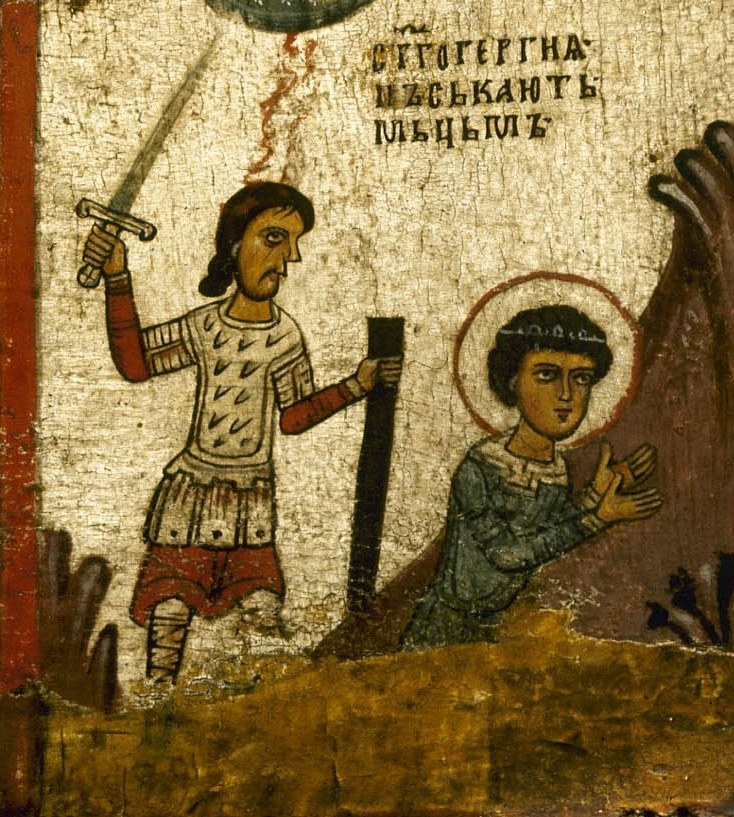
Saint George is beheaded with the sword
Border scene of the icon: Saint George is beheaded with the sword · Novgorod, 14th century
13 · Outside the city, the twenty-third day of April

Beheading with the sword

Diocletian was filled with even greater rage and, without further torturing either me or the empress, pronounced the death sentence upon both: the most evil George, who had declared himself a follower of the Galilean and had greatly blasphemed both Him and the gods, together with Empress Alexandra, who had been corrupted by his sorcery, he commanded to be beheaded with the sword.

The soldiers seized me, bound with chains, and led me outside the city. They also dragged the most noble empress, who followed me without resistance, praying within herself and often looking up to heaven. On the way the empress grew faint and asked permission to sit down. Having sat, she leaned her head against a wall and gave up her spirit to the Lord. Seeing this, I glorified God and went on, praying to the Lord that my own path might also end worthily.

Approaching the place appointed for the execution, I prayed in a loud voice: I blessed the Lord, Who had not given me as a prey to those who sought me and had delivered my soul like a bird from the snare; I asked Him to stand by me, His servant, in this last hour and to deliver my soul from the snares of the prince of the air; I asked that He not reckon as sin those who had sinned against me in ignorance, but grant them forgiveness and love, so that they too, having come to know Him, might receive a portion in His Kingdom; I asked that He receive my soul together with those who from of old had been well-pleasing to Him and remember those who call upon His glorious name.

Having prayed thus, I joyfully bowed my head beneath the sword and so departed this life on the twenty-third day of the month of April, having worthily accomplished my confession and kept the faith undefiled.

Source — St Demetrius of Rostov, “Lives of the Saints”
Diocletian was filled with even greater fury and no longer tortured either George or the empress, but immediately pronounced this death sentence upon both: […] The most wicked George, who declared himself a follower of the Galilean […] and greatly blasphemed against me and the gods, together with the empress Alexandra, who has been corrupted by his sorcery and, like him, has madly reproached the gods, I order to be beheaded by the sword. […] The soldiers seized the martyr, bound with chains, and led him outside the city. They also dragged the most noble empress, who followed George without resistance, praying within herself and often gazing toward heaven. On the way the empress grew faint and asked permission to sit down. Having sat, she leaned her head against the wall and gave up her spirit to the Lord. Seeing this, Christ’s martyr George glorified God and went on, praying to the Lord that his own path might also end worthily. When George drew near to the place appointed for his execution, he uttered a prayer in a loud voice: […] Blessed art Thou, O Lord my God, for Thou hast not given me as a prey to those who sought me, hast not made my enemies rejoice over me, and hast delivered my soul like a bird from the snare. Hear me even now, O Master, stand by me, Thy servant, in this last hour, and deliver my soul from the snares of the prince of the air and from his unclean spirits. Do not count as sin those who have sinned against me in ignorance, but grant them forgiveness and love, that they also, having come to know Thee, may receive a portion in Thy Kingdom with Thine elect. Receive also my soul with those who have pleased Thee from all ages […] Remember, O Master, those who call upon Thy glorious name […] Having prayed thus, Saint George joyfully bowed his head beneath the sword and so departed this life on the twenty-third day of the month of April, having worthily completed his confession and kept the faith undefiled.
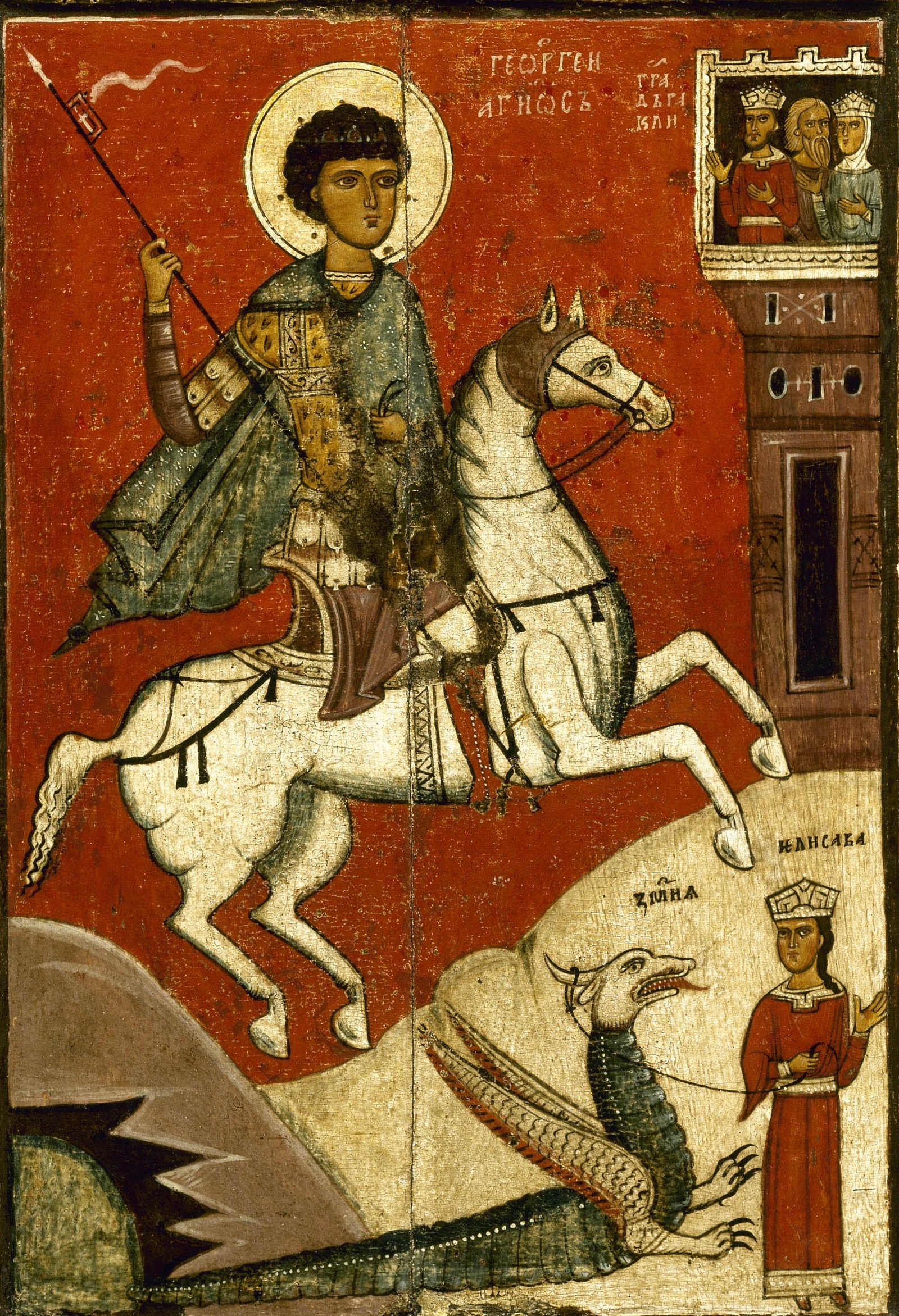
The Miracle of George and the Serpent – the central panel of the icon
Border scene of the icon: The Miracle of George and the Serpent – the central panel of the icon · Novgorod, 14th century
14 · Beirut, near the Lebanese Mountains

The Miracle of the Serpent

My body was buried in Lydda, in my Palestinian homeland. Not far away, in the city of Beirut on the shore of the Mediterranean Sea, a glorious miracle of the slaying of the serpent was wrought after my death.

Near the Lebanese Mountains there was a large lake, in which dwelt a serpent – a destroyer, great and terrible: coming out of the lake, it would seize people and devour them, and it would drive the people away with its deadly breath. The city was inhabited by idolaters, and their king, instructed by the demons dwelling in the idols, decreed: let them give their children to the serpent as food each day by lot; and when the turn comes to him, he too will give his only daughter. When the lot had gone round to all, the king with tears gave up his own daughter as well; the maiden stood on the shore of the lake and wept bitterly.

By the providence of God, who desires the salvation of all, I, a soldier of the Heavenly King, rode up to that place on horseback, holding a spear in my hand. I said to the maiden: “Fear not, maiden, for in the name of my Lord, the true God, I will save you from the serpent.” Suddenly the terrible serpent appeared from the lake. Signing myself with the sign of the Cross and calling upon the Lord, I rushed on horseback at the serpent, struck it with force in the throat with my spear and pinned it to the ground; my horse trampled the serpent with its hooves. Then I commanded the maiden to bind the serpent with her belt and lead it into the city, and I said to the people: “Fear not, but trust in the Lord Jesus Christ; it is He who has sent me to save you from the serpent.”

I slew the serpent with a sword in the midst of the city, and the inhabitants burned its carcass outside the city. After this the king and the people believed in the Lord Jesus Christ and received holy baptism; on that spot a church was built in the name of the Most Pure Virgin Mary and in my honour, and from its altar there flowed a spring of living water, healing every disease.

Source — St Demetrius of Rostov, “Lives of the Saints”
One cannot fail to mention also the glorious miracle of the slaying of the serpent, wrought by the holy Great-martyr George near his Palestinian homeland, in the Syro-Phoenician land, in the city of Beirut […] standing on the shore of the Mediterranean Sea, not far from the city of Lydda, where the body of the holy Great-martyr was also buried. The place where this miracle was wrought is shown to travellers in Palestine. […] Near the aforesaid city of Beirut, close to the Lebanese Mountains, there was a large lake, in which dwelt a serpent – a destroyer, great and terrible. Coming out of this lake, that serpent would seize many people, drag them into the lake and there devour them. Many times the people, armed, went out against it, but each time the serpent drove the people back, for, approaching the city walls, it would fill the air with its deadly breath, so that from this alone many fell ill and died. […] In this city lived unbelieving people – idolaters; their king also lived there. […] Then the king, instructed by the demons dwelling in the idols, the destroyers of human souls, announced to them this decision: if they did not wish to perish altogether, let them give their children as food to that serpent each day by lot, sons or daughters. […] Those given to be eaten by the serpent were placed on the shore of the lake, dressed in their finest clothes […] Calling his daughter to him, the king ordered her to adorn herself as beautifully as possible […] the king watched her from the height of his palace and with tears in his eyes followed her with his gaze. […] By the providence of God, who desires the salvation of all, who was pleased to save that city also from destruction both of soul and body, at that time the holy Great-martyr George, a soldier of the Heavenly King, rode up to that place on horseback, holding a spear in his hand. […] Why are you standing here and why are you weeping? […] Fear not, maiden, for in the name of my Lord, the true God, I will save you from the serpent. […] suddenly the terrible serpent appeared from the lake and made for its accustomed food. […] he rushed on his horse at the serpent, brandishing his spear, and, striking the serpent with force in the throat, he wounded it and pinned it to the ground; the horse of the saint trampled the serpent with its hooves. Then Saint George commanded the maiden to bind the serpent with her belt and lead it into the city, humbled like a dog […] Fear not, only trust in the Lord Jesus Christ and believe in Him, for it is He who has sent me to you to save you from the serpent. […] Then Saint George slew that serpent with a sword in the midst of the city. The inhabitants of that city, having dragged the carcass of the serpent outside the city, burned it. […] After this the king and the people who lived in that city believed in the Lord Jesus Christ and received holy baptism […] in the name of the Most Pure Virgin Mary […] from the altar of this church there flowed a spring of living water, healing every disease of all who with faith come to it.
The Church sings

Another Troparion, Tone 4 (to the Great-martyr George)

As the liberator of the captives and the defender of the poor, the physician of the infirm, the champion of kings, the victorious Great Martyr George, pray to Christ God to save our souls.

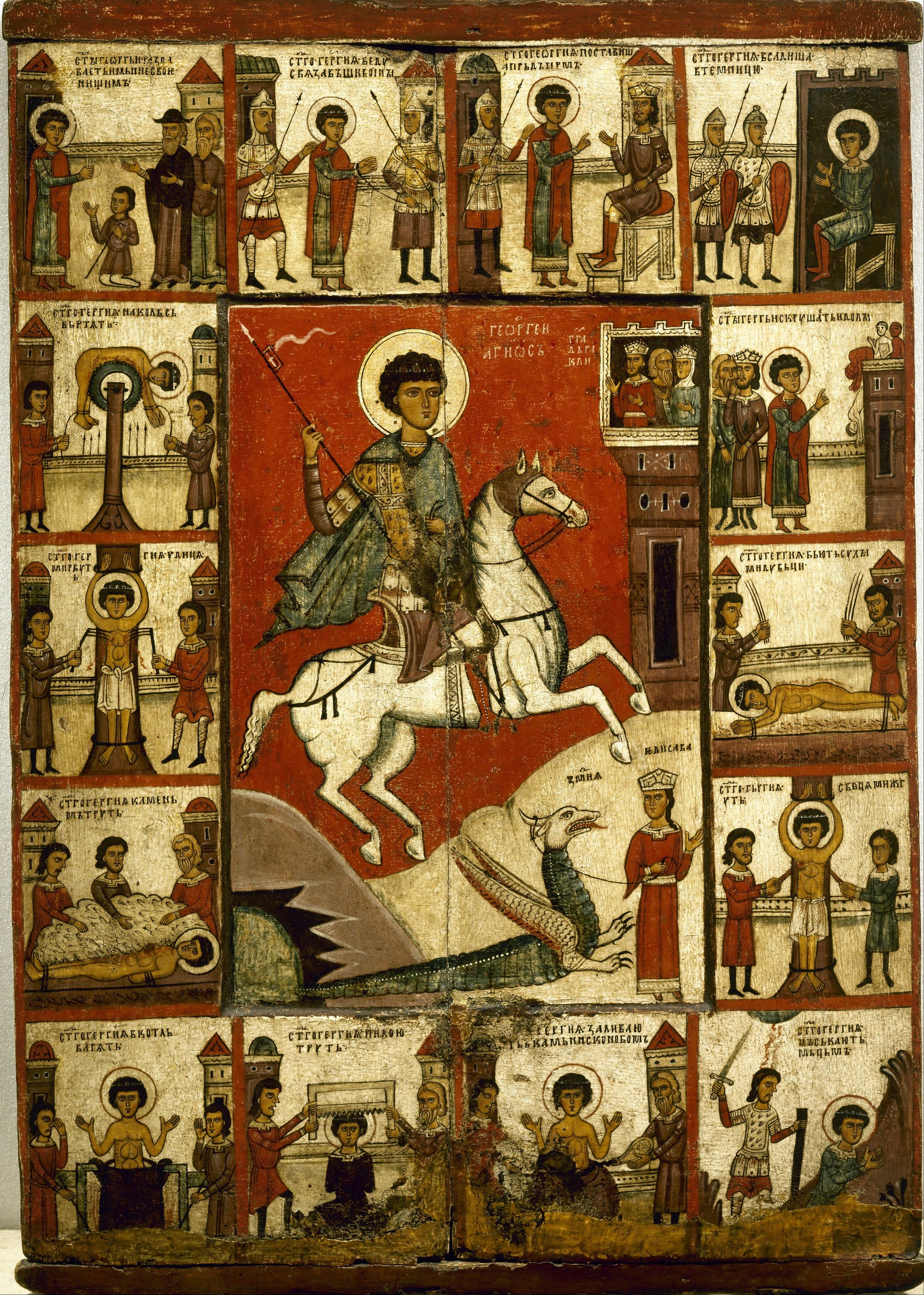
The life in the border scenes of the icon
Great-Martyr George с клеймами жития
The Miracle of George and the Dragon, with his Life in fourteen border scenes. Novgorod, first half of the 14th century. State Russian Museum (St Petersburg). Public domain. The border scenes for excerpts 1, 9 and 10 are from the icon “Great-Martyr George with his Life in 14 border scenes”, Moscow, first third of the 16th century, State Hermitage Museum. Public domain.
Prayers to the Great-martyr GeorgeSt Dimitry of Rostov, “Lives of the Saints”, in our libraryAll lives